REVERSAL OF FORTUNE: For E.S.G. Investors?

Environmental, Social and Governance Investing

SPONSOR: http://www.MarcinkoAssociates.com

***
***

An Informed Op-Ed Piece

By Dr. David Edward Marcinko; MBA MEd

As many medical, dental and podiatric colleagues are aware, Environmental, Social and Governance (ESG) investing refers to a set of standards for a company’s behavior used by socially conscious investors to screen potential investments. Over the last decade, or so, I have seen many investors pursing this laudable aim.

Yet, more than 80% of private equity fund managers have now stepped away from at least one deal due to ESG concerns, according to the 2023 BDO Private Capital Survey. The reasons are complex, and point towards fund managers’ sentiment towards risk-reward in the current economic environment.

This retreat from ESG is due to backlash from conservatives who are critical of the idea that mutual fund managers should be considering any other factor but a company’s share holders in their investment decisions. Accusations of “Greenwashing” have also plagued many ESG funds, which is when an asset management firm charging higher fees or a specific thematic fund without actually delivering a unique investment strategic competitive advantage.

Greenwashing is the process of conveying a false impression or misleading information about how a company’s products are environmentally sound. Greenwashing involves making an unsubstantiated claim to deceive consumers and / or investors into believing that a company’s products are environmentally friendly or have a greater positive environmental impact than they actually do. Greenwashing may also occur when a company attempts to emphasize sustainable aspects of a product to overshadow the company’s involvement in environmentally damaging practices.

ESG: https://medicalexecutivepost.com/2023/09/23/mas-and-esg-profit/

***

***

According to internationally known linguistics and cognitive science Professor, Mackenzie Hope Marcinko PhD of the University of Delaware, greenwashing is performed through the use of environmental imagery, misleading labels, cognitive biases and tendencies hiding tradeoffs. Greenwashing is also a play on the term “Whitewashing,” which means using false information to intentionally hide wrongdoing, errors or an unpleasant situation in an attempt to make it seem less bad than it really is.

To be sure, uncertainty around ESG regulations in the USA is leading financial deal makers to tread carefully. For example, Jim Clayton MBA, a private equity advisor also from the University of Delaware recently stated:

  • We’re a year past when the SEC said they were going to issue ESG reporting standards for public filers which has created more noise in the system.”
  • “People are nervous about what I would call ESG-intense exposed industries, in other words, those with “heavy carbon footprints”.

MORE ESG: https://medicalexecutivepost.com/2023/03/27/on-socially-responsible-investing-2/

And, a federal judge in Texas said that American Airlines violated federal law by basing investment decisions for its employee retirement plan on environmental, social, and other non-financial factors. The ruling in January 2025 by US District Judge Reed O’Connor appeared to be the first of its kind amid growing backlash by conservatives to an uptick in socially-conscious investing. O’Connor said American had breached its legal duty to make investment decisions based solely on the financial interests of 401(k) plan beneficiaries by allowing BlackRock, its asset manager and a major shareholder, to focus on environmental, social and corporate governance (ESG) factors.

Even the State of Florida pulled $2 billion from the investment management firm BlackRock in the largest divestment ever made. Florida Governor Ron DeSantis claimed that by taking ESG standards into account when making investment decisions, the firm isn’t prioritizing the financial bottom line for Floridians.

Assessment

But, for a few years at least, things were indeed good. In 2020 and 2021, ESG funds outperformed the market by ~4.3%.

Conclusion

So, always remember [caveat emptor]: let the buyer beware!

References and Readings:

1. 2023 BDO Private Capital Survey: https://insights.bdo.com/2023-BDO-Private-Capital-Survey.html

2. Marcinko, DE; Comprehensive Financial Planning Strategies for Doctors and Advisors [Best Practices from Leading Consultants and Certified Medical Planners™] Productivity Press, New York, 2017 

3. Marcinko, DE: Dictionary of Health Economics and Finance. Springer Publishing Company, NY 2006.

4. Zymeri, Jeff: ‘Not Going to Fly Here’ [DeSantis Signs Far-Reaching Anti-ESG Bill into Law]. 2023: https://www.yahoo.com/news/not-going-fly-desantis-signs-121648679.html

COMMENTS APPRECIATED

Refer and Like

***

EDUCATION: Books

SPEAKING: Dr. Marcinko will be speaking and lecturing, signing and opining, teaching and preaching, storming and performing at many locations throughout the USA this year! His tour of witty and serious pontifications may be scheduled on a planned or ad-hoc basis; for public or private meetings and gatherings; formally, informally, or over lunch or dinner. All medical societies, financial advisory firms or Broker-Dealers are encouraged to submit a RFP for speaking engagements: MarcinkoAdvisors@outlook.com 

***

***

TRADITIONAL INVESTMENT PORTFOLIO DIVERSIFICATION MODEL: Routed by Larry Fink CEO of BlackRock?

BREAKING NEWS – MARKET VOLATILITY

By Staff Reporters

***

***

US stocks nosedived on Thursday, with the Dow tumbling more than 1,200 points as President Trump’s surprisingly steep “Liberation Day” tariffs sent shock waves through markets worldwide. The tech-heavy NASDAQ Composite (IXIC) led the sell-off, plummeting over 4%. The S&P 500 (GSPC) dove 3.7%, while the Dow Jones Industrial Average (^DJI) tumbled roughly 3%. [ongoing story].

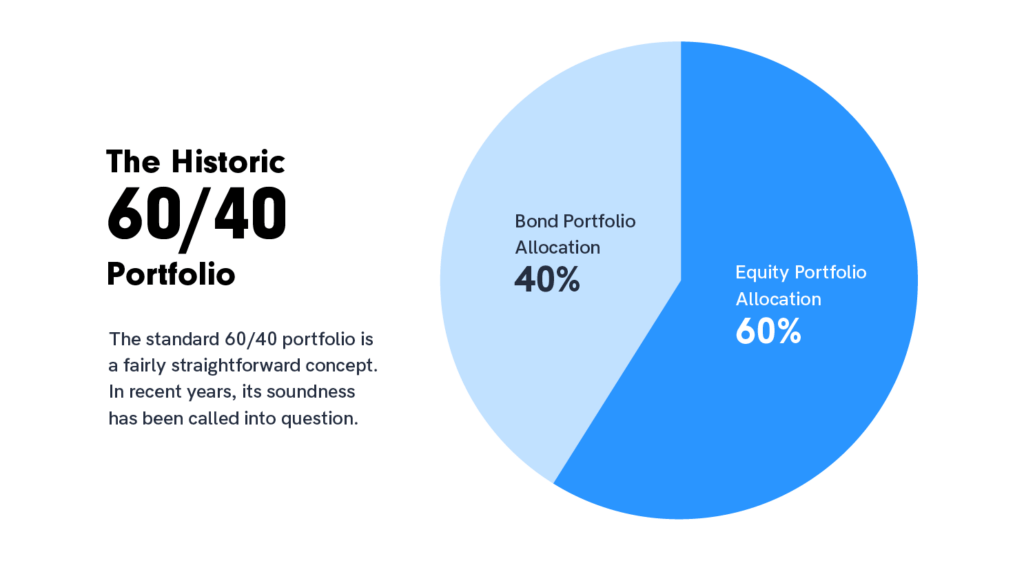
So, does the traditional 60 stock / 40 bond strategy still work or do we need another portfolio model?

***

The 60/40 strategy evolved out of American economist Harry Markowitz’s groundbreaking 1950s work on modern portfolio theory, which holds that investors should diversify their holdings with a mix of high-risk, high-return assets and low-risk, low-return assets based on their individual circumstances.

While a portfolio with a mix of 40% bonds and 60% equities may bring lower returns than all-stock holdings, the diversification generally brings lower variance in the returns—meaning more reliability—as long as there isn’t a strong correlation between stock and bond returns (ideally the correlation is negative, with bond returns rising while stock returns fall).

CORRELATION: https://medicalexecutivepost.com/2024/10/27/correlation-diversification-in-finance-and-investments/

For 60/40 to work, bonds must be less volatile than stocks and economic growth and inflation have to move up and down in tandem. Typically, the same economic growth that powers rallies in equities also pushes up inflation—and bond returns down. Conversely, in a recession stocks drop and inflation is low, pushing up bond prices.

***

  • But, the traditional 60/40 portfolio may “no longer fully represent true diversification,” BlackRock CEO Larry Fink writes in a new letter to investors.
  • Instead, the “future standard portfolio” may move toward 50/30/20 with stocks, bonds and private assets like real estate, infrastructure and private credit, Fink writes.
  • Here’s what experts say individual investors may want to consider before dabbling in private investments.

It may be time to rethink the traditional 60/40 investment portfolio, according to BlackRock CEO Larry Fink. In a new letter to investors, Fink writes the traditional allocation comprised of 60% stocks and 40% bonds that dates back to the 1950s “may no longer fully represent true diversification.

DI-WORSIFICATION: https://medicalexecutivepost.com/2024/04/09/what-is-financial-portfolio-di-worsification-2/

EDUCATION: Books

SPEAKING: Dr. Marcinko will be speaking and lecturing, signing and opining, teaching and preaching, storming and performing at many locations throughout the USA this year! His tour of witty and serious pontifications may be scheduled on a planned or ad-hoc basis; for public or private meetings and gatherings; formally, informally, or over lunch or dinner. All medical societies, financial advisory firms or Broker-Dealers are encouraged to submit a RFP for speaking engagements: MarcinkoAdvisors@outlook.com 

COMMENTS APPRECIATED

Read, Like, Subscribe and Refer

***

***

DAILY UPDATE: Superior HealthPlan, Larry Fink and the Mixed Stock Markets

MEDICAL EXECUTIVE-POST TODAY’S NEWSLETTER BRIEFING

***

Essays, Opinions and Curated News in Health Economics, Investing, Business, Management and Financial Planning for Physician Entrepreneurs and their Savvy Advisors and Consultants

Serving Almost One Million Doctors, Financial Advisors and Medical Management Consultants Daily

A Partner of the Institute of Medical Business Advisors , Inc.

http://www.MedicalBusinessAdvisors.com

SPONSORED BY: Marcinko & Associates, Inc.

***

http://www.MarcinkoAssociates.com

Daily Update Provided By Staff Reporters Since 2007.
How May We Serve You?
© Copyright Institute of Medical Business Advisors, Inc. All rights reserved. 2025

REFER A COLLEAGUE: MarcinkoAdvisors@outlook.com

SPONSORSHIPS AVAILABLE: https://medicalexecutivepost.com/sponsors/

ADVERTISE ON THE ME-P: https://tinyurl.com/ytb5955z

Your Referral Count -0-

CITE: https://www.r2library.com/Resource

The CEO of a Texas health insurance company was fired after admitting before a DOGE panel of state lawmakers that he hired private investigators to spy on customers and obtain sensitive details about their lives. Mark Sanders was dismissed from his duties as chief executive of Austin-based Superior HealthPlan after he testified before the Texas House Delivery of Government Efficiency Committee in a hearing on Medicaid procurement last week.

CITE: https://tinyurl.com/2h47urt5

US stocks closed mixed on Tuesday as investors cautiously counted down to President Trump’s highly anticipated “Liberation Day” rollout of sweeping new reciprocal tariffs. The S&P 500 (^GSPC) rose about 0.4%, extending the gains the benchmark index secured on Monday, while the Dow Jones Industrial Average (^DJI) fell just below the flatline. The tech-heavy NASDAQ Composite (^IXIC) rebounded to close up around 0.9%.

CITE: https://tinyurl.com/tj8smmes

BlackRock CEO Larry Fink said private markets should be open to all investors, not just the wealthy few in his annual letter to investors (here.)

Visualize: How private equity tangled banks in a web of debt, from the Financial Times.

COMMENTS APPRECIATED

PLEASE SUBSCRIBE: MarcinkoAdvisors@outlook.com

Thank You

***

***

***

***

EDUCATIONAL TEXTBOOKS: https://tinyurl.com/4zdxuuwf

***

“We Can Never Know About The Days [FINANCIAL MARKETS] To Come”

Join Our Mailing List

AS CARLY SIMON USED TO SING …

ArtBy Arthur Chalekian GEPC

[Financial Consultant]

However, that doesn’t stop anyone from making educated guesses about the future of companies, financial markets, and economies.

So, as we enter the second quarter, investment and business professionals have been offering their insights:

  • McKinsey & Company’s March Economic Conditions Snapshot indicated 80 percent of surveyed executives “… expect demand for their companies’ products and services will grow or stay the same in the coming months, and a majority believe (as they have in every survey since 2011) their companies’ profits will increase.” However, they are not as optimistic about the global economy as they were in December. About one-half of executives in developed and emerging markets said economic conditions globally are worse than they were six months ago
  • The Wall Street Journal’s April 2016 Economic Forecasting Survey, which queries 60 economists, reported three-of-four survey participants expect a Fed rate hike in June. Few expect a recession during the next 12 months, putting the odds at 19 percent. Almost one-half stated global risks were the greatest threat to the U.S. economy, followed by financial conditions, a slowdown in consumer spending, falling corporate profits, and U.S. politics.
  • PIMCO’s Cyclical Outlook predicts China’s gross domestic product (GDP) growth may be in the 5.5 to 6.5 percent range. The target is 6.5 percent. In addition, a gradual devaluation of the yuan is possible, although China’s currency policy often produces unexpected twists and turns.
  • BlackRock Investment Institute’s second quarter outlook centered on three themes. First, returns are likely to remain muted in the future. Second, monetary policies appear to be less divergent, which could be a positive for some markets. Third, volatility may persist as the Federal Reserve normalizes monetary policy. Diversity and careful asset selection are likely to be critical in this environment.

***

Photo of hands of businesspeople during discussing

***

Conclusion

Your thoughts and comments on this ME-P are appreciated. Feel free to review our top-left column, and top-right sidebar materials, links, URLs and related websites, too. Then, subscribe to the ME-P. It is fast, free and secure.

While it’s interesting to read experts’ predictions and expectations for coming months and years, it’s important to remember forecasts are not always accurate. An organization that tracked forecasting results through 2012 found forecasts were correct about 47 percent of the time.

Speaker: If you need a moderator or speaker for an upcoming event, Dr. David E. Marcinko; MBA – Publisher-in-Chief of the Medical Executive-Post – is available for seminar or speaking engagements. Contact: MarcinkoAdvisors@msn.com

OUR OTHER PRINT BOOKS AND RELATED INFORMATION SOURCES:

Comprehensive Financial Planning Strategies for Doctors and Advisors: Best Practices from Leading Consultants and Certified Medical Planners™

***

The “Collective Trust” – A New Financial Product?

Join Our Mailing List 

Much Like a Mutal Fund – But Less Transparent

By Staff Reporters

Recently, we received this query from a physician-investor. So, we went right to the innovator of this financial product for the answer.

A collective trust is similar to a mutual fund that only sells to institutional investors like 401-k and 403-b plans. Because a collective trust doesn’t take on retail investors, it’s exempt from some regulatory requirements, so beware!

But, not having to deal with retail investors also makes the costs lower.

Link: http://thefinancebuff.com/collective-trust-vs-mutual-fund-whats-the-difference.html

Assessment

The BlackRock EAFE Equity Index Collective Trust invests in stocks in developed countries, tracking the MSCI EAFE index.

Conclusion

And so, your thoughts and comments on this ME-P are appreciated. Please review our top-left column, and top-right sidebar materials, links, URLs and related websites, too. Then, subscribe to the ME-P. It is fast, free and secure.

Link: http://feeds.feedburner.com/HealthcareFinancialsthePostForcxos

Speaker: If you need a moderator or speaker for an upcoming event, Dr. David E. Marcinko; MBA – Publisher-in-Chief of the Medical Executive-Post – is available for seminar or speaking engagements. Contact: MarcinkoAdvisors@msn.com

Our Other Print Books and Related Information Sources:

Health Dictionary Series: http://www.springerpub.com/Search/marcinko

Practice Management: http://www.springerpub.com/product/9780826105752

Physician Financial Planning: http://www.jbpub.com/catalog/0763745790

Medical Risk Management: http://www.jbpub.com/catalog/9780763733421

Healthcare Organizations: www.HealthcareFinancials.com

Physician Advisors: www.CertifiedMedicalPlanner.com

Subscribe Now: Did you like this Medical Executive-Post, or find it helpful, interesting and informative? Want to get the latest ME-Ps delivered to your email box each morning? Just subscribe using the link below. You can unsubscribe at any time. Security is assured.

Link: http://feeds.feedburner.com/HealthcareFinancialsthePostForcxos

Sponsors Welcomed: And, credible sponsors and like-minded advertisers are always welcomed.

Link: https://healthcarefinancials.wordpress.com/2007/11/11/advertise

Product Details