ACCOUNTABLE CARE ORGANIZATION: A Financially Toxic Contract Example for Physicians

SPONSOR: http://www.MarcinkoAssociates.com

By. Dr. David Edward Marcinko; MBA MEd CMP®

***

SPONSOR: http://www.CertifiedMedicalPlanner.org

***

WARNING – DISASTROUS ACO EXAMPLE – WARNING

GIVEN CASH FLOW MODEL

Suppose that in a new Accountable Care Organization [ACO] contract, a certain medical practice was awarded a new global payment or capitation styled contract that increased revenues by $100,000 for the next fiscal year. The practice had a gross margin of 35% that was not expected to change because of the new business. However, $10,000 was added to medical overhead expenses for another assistant and all Account’s Receivable (AR) are paid at the end of the year, upon completion of the contract.

Cost of Medical Services Provided (COMSP):

The Costs of Medical Services Provided (COMSP) for the ACO business contract represents the amount of money needed to service the patients provided by the contract.  Since gross margin is 35% of revenues, the COMSP is 65% or $65,000.  Adding the extra overhead results in $75,000 of new spending money (cash flow) needed to treat the patients. Therefore, divide the $75,000 total by the number of days the contract extends (one year) and realize the new contract requires about $ 205.50 per day of free cash flows.

Assumptions

Financial cash flow forecasting from operating activities allows a reasonable projection of future cash needs and enables the doctor to err on the side of fiscal prudence. It is an inexact science, by definition, and entails the following assumptions:

  • All income tax, salaries and Accounts Payable (AP) are paid at once.
  • Durable medical equipment inventory and pre-paid advertising remain constant.
  • Gains/losses on sale of equipment and depreciation expenses remain stable.
  • Gross margins remain constant.
  • The office is efficient so major new marginal costs will not be incurred.

***

***

Physician Reactions:

Since many physicians are still not entirely comfortable with global reimbursement, fixed payments, capitation or ACO reimbursement contracts; practices may be loath to turn away short-term business in the ACA era.  Physician-executives must then determine other methods to generate the additional cash, which include the following general suggestions:

1. Extend Account’s Payable

Discuss your cash flow difficulties with vendors and emphasize their short-term nature. A doctor and her practice still has considerable cache’ value, especially in local communities, and many vendors are willing to work them to retain their business

2. Reduce Accounts Receivable

According to most cost surveys, about 30% of multi-specialty group’s accounts receivable (ARs) are unpaid at 120 days. In addition, multi-specialty groups are able to collect on only about 69% of charges. The rest was written off as bad debt expenses or as a result of discounted payments from Medicare and other managed care companies. In a study by Wisconsin based Zimmerman and Associates, the percentages of ARs unpaid at more than 90 days is now at an all time high of more than 40%. Therefore, multi-specialty groups should aim to keep the percentage of ARs unpaid for more than 120 days, down to less than 20% of the total practice. The safest place to be for a single specialty physician is probably in the 30-35% range as anything over that is just not affordable.

The slowest paid specialties (ARs greater than 120 days) are: multi-specialty group practices; family practices; cardiology groups; anesthesiology groups; and gastroenterologists, respectively. So work hard to get your money, faster. Factoring, or selling the ARs to a third party for an immediate discounted amount is not usually recommended.

3. Borrow with Short-Term Bridge Loans

Obtain a line of credit from your local bank, credit union or other private sources, if possible in an economically constrained environment. Beware the time value of money, personal loan guarantees, and onerous usury rates. Also, beware that lenders can reduce or eliminate credit lines to a medical practice, often at the most inopportune time.

4. Cut Expenses

While this is often possible, it has to be done without demoralizing the practice’s staff.

5.  Reduce Supply Inventories

If prudently possible; remember things like minimal shipping fees, loss of revenue if you run short, etc.

6. Taxes

Do not stop paying withholding taxes in favor of cash flow because it is illegal.

Hyper-Growth Model:

Now, let us again suppose that the practice has attracted nine more similar medical contracts. If we multiple the above example tenfold, the serious nature of potential cash flow problem becomes apparent. In other words, the practice has increased revenues to one million dollars, with the same 35% margin, 65% COMSP and $100,000 increase in operating overhead expenses. 

Using identical mathematical calculations, we determine that $750,000 / 365days equals $2,055.00 per day of needed new free cash flows!  Hence, indiscriminate growth without careful contract evaluation and cash flow analysis is a prescription for potential financial disaster.

COMMENTS APPRECIATED

Subscribe, Read, Refer and Like

EDUCATION: Books

SPEAKING: Dr. Marcinko will be speaking and lecturing, signing and opining, teaching and preaching, storming and performing at many locations throughout the USA this year! His tour of witty and serious pontifications may be scheduled on a planned or ad-hoc basis; for public or private meetings and gatherings; formally, informally, or over lunch or dinner. All medical societies, financial advisory firms or Broker-Dealers are encouraged to submit a RFP for speaking engagements: CONTACT: MarcinkoAdvisors@outlook.com 

***

***

Update on Health Insurance Claims Processing Costs

Join Our Mailing List

Paper versus Electronic

[By Matias Klein]

[Senior VP Technology Portico Systems Integrated Provider Management Solutions]

The average cost of processing a single, clean, paper-based or electronic claim can range from 85 cents to $1.58.

However, according to AHIP, nearly half of all claims (48 percent) were pended due to the submission of duplicate claims (35 percent), lack of complete information or other information needed to justify the claim (12 percent), or invalid codes (1 percent).

The manual adjudication of these duplicate or incorrect claim submissions increases the cost of administration to $2.05. The $2.05 scenario is a best case calculation. In our actual field experience the cost can be as high as $10.00 per claim.

Payment Delays

In addition to the increased administrative cost, one must not forget about the delayed payment to the provider. As stated by AHIP, a duplicate claim can take 9 days to remediate and missing information on a claim can take up to 11 days. This kind of delay damages the relationship between the provider and the health plan, which in terms of costs is priceless.

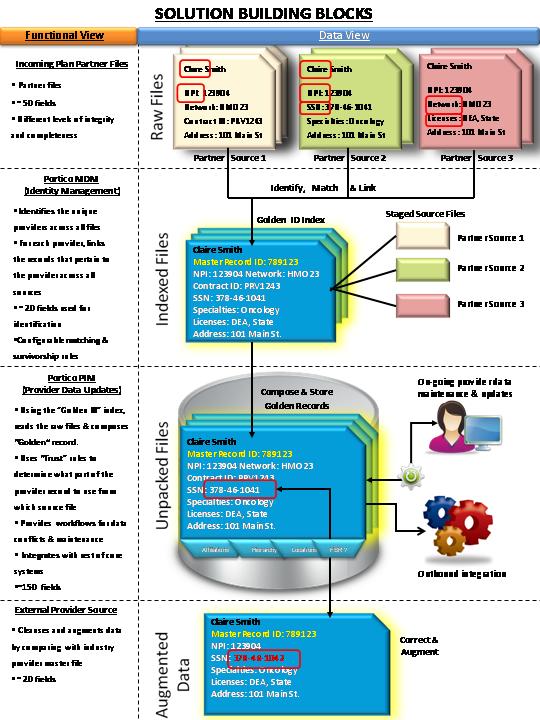
Enter ID Management

To solve this problem, some healthcare organizations are implementing Master Identity Management (IDM)—a valuable approach to creating an enterprise “source of truth” for provider identity information. But when it comes to payment integrity and claims processing, IDM without a Provider Information Management (PIM) system doesn’t work. Provider relationship and contract data are far too complex, and both types of data are needed to supplement provider identity data in support of claims administration.

Provider Information Management

When IDM is fully integrated with PIM, payers can successfully establish a single, accurate and effective source of truth. An integrated approach also:

  • Ensures quality – by standardizing, cleansing, cross-referencing and consolidating relevant data, while removing duplicate entries.
  • Mitigates risk – reducing the downstream impact of inaccurate data on all claims processing, contracting, credentialing, provider directory and connected systems.
  • Saves millions of dollars – by reducing duplicate entries by even a fraction of a percent, thus ensuring that claims are being processed in an efficient and effective manner.

Assessment

IDM plays a pivotal role in the future of healthcare. As new, collaborative and accountable care delivery models evolve, reliable provider identity management is absolutely critical. Combining IDM with PIM gives payers the most powerful solution for assuring payment integrity while improving provider identity and duplication management.

Conclusion

Your thoughts and comments on this ME-P are appreciated. Feel free to review our top-left column, and top-right sidebar materials, links, URLs and related websites, too. Then, subscribe to the ME-P. It is fast, free and secure.

Conclusion

Your thoughts and comments on this ME-P are appreciated. Feel free to review our top-left column, and top-right sidebar materials, links, URLs and related websites, too. Then, subscribe to the ME-P. It is fast, free and secure.

Speaker: If you need a moderator or speaker for an upcoming event, Dr. David E. Marcinko; MBA – Publisher-in-Chief of the Medical Executive-Post – is available for seminar or speaking engagements. Contact: MarcinkoAdvisors@msn.com

OUR OTHER PRINT BOOKS AND RELATED INFORMATION SOURCES:

Our Newest Textbook Release

Buy from Amazon

Learn How to Profit and Thrive in the PP-ACA Era

BOOK FOREWORD / TESTIMONIAL

On Hospital Revenue Cycle Opportunities

Do They Still Exist in Today’s Healthcare Milieu?

Staff Reporters

Join Our Mailing List 

For a decade now, healthcare providers have been challenged to deliver quality patient care in an environment of shrinking profit margins. Total margins and operating margins have followed the same trend. Analysts report that an operating margin of less than 5% leaves an organization without the resources to invest in new technology and capital projects, and will eventually force the facility to close or merge. With rising labor costs, a poorly performing economy, and an aging population, these numbers are not likely to improve soon.

Bar code use in hospitals may save lives

Industry Status

Although the industry has seen an overall improvement in accounts receivable days and bad debt for an extended period, it appears that many facilities have reached their peak in addressing these areas, particularly given current demands to reduce staff and other operational costs. So, where is the next major opportunity for reducing costs or maximizing revenue opportunities?

The Experts Opine

According to private consultants Ross J. Fidler and Karen White PhD, revenue cycle improvement still seems to be a promising and popular area today. And, PriceWaterhouseCoopers recently listed five areas to reinvent the revenue cycle:

1) organizational / accountability;

2) process/workflow improvements;

3) information systems/management reporting enhancements;

4) quality assurance mechanisms; and

5) department and staff productivity measurements.

Assessment

A thorough re-examination of the revenue cycle process will typically uncover cost drains and revenue opportunities.

Conclusion

To succeed in enhancing hospital revenue streams, for example, we commence with patient access through HIM to PFS, by applying optimal organizational structures, benchmarking, and technology adoption. Only then will outcomes trend toward higher performing revenue cycles.

And so, your thoughts and comments on this ME-P are appreciated. Feel free to review our top-left column, and top-right sidebar materials, links, URLs and related websites, too. Then, subscribe to the ME-P. It is fast, free and secure.

Speaker: If you need a moderator or speaker for an upcoming event, Dr. David E. Marcinko; MBA – Publisher-in-Chief of the Medical Executive-Post – is available for seminar or speaking engagements. Contact: MarcinkoAdvisors@msn.com

Get our Widget: Get this widget!

Our Other Print Books and Related Information Sources:

Practice Management: http://www.springerpub.com/prod.aspx?prod_id=23759

Physician Financial Planning: http://www.jbpub.com/catalog/0763745790

Medical Risk Management: http://www.jbpub.com/catalog/9780763733421

Health Administration Terms: www.HealthDictionarySeries.com

Subscribe Now: Did you like this Medical Executive-Post, or find it helpful, interesting and informative? Want to get the latest ME-Ps delivered to your email box each morning? Just subscribe using the link below. You can unsubscribe at any time. Security is assured.

Link: http://feeds.feedburner.com/HealthcareFinancialsthePostForcxos

Sponsors Welcomed: And, credible sponsors and like-minded advertisers are always welcomed.

Link: https://healthcarefinancials.wordpress.com/2007/11/11/advertise

Product DetailsProduct Details

Are Hospitals Auctioning Debt?

Understanding Modern Cash Flow Strategies

By Ross Filder

By Karen White PhD

www.HealthcareFinancials.com

As a sign of the contracting economic times, some struggling hospitals are using a new method to collect revenue: the Internet. It has become a channel to cut write-offs and bad debt ratios, which lower stock prices if publicly held.

Rather than simply hiring agencies to collect patient bills, hospitals have begun to put their accounts receivable (ARs) up for auction online. Bidders on the debt include the same agencies that serve the hospitals, some of which provide guaranteed payments to hospitals in exchange for access to the debt. 

Strategy Attractive to Buyer and Sellers

The auctions are also attracting other companies that buy the debt outright. For example, one method that a facility based medical practice used to auction debt was for the hospital to determine the criteria it would use for selecting the debt to be auctioned. The criteria generally focus on ARs that are a certain age, but demographic regions, legal accounts, and monthly payment accounts were also be considered.

[picapp align=”none” wrap=”false” link=”term=accounting&iid=289186″ src=”http://view4.picapp.com/pictures.photo/image/289186/corporate-details/corporate-details.jpg?size=500&imageId=289186″ width=”335″ height=”480″ /]

Request for Proposal

Once the criteria are determined, a listing of accounts is generated and supplied to potential buyers along with a Request for Proposal that asks each potential buyer to provide information on their experience in servicing hospital-type ARs, as well as details of their expertise, collection techniques, references, and price. 

Usually the winning bidder will pay a flat price for the entire AR.  It is important for the hospital to understand that when auctioning ARs the winning bidder owns the accounts and their collection tactics will not necessarily comply with the hospital’s standards for collections.

Automation

Automation can lead to decreased paperwork, process standardization, increased productivity, and cleaner claims. In 2004, Hospital & Health Network’s “Most Wired Survey” [1] found that the 100 most wired hospitals — including three out of the four AA+ hospitals in the country — had better control of expenses, higher productivity, and efficient utilization management. These numerics are much higher today. Additionally, these top hospitals tend to be larger and have better access to capital.

Assessment

The positive return on investment in technology increases allocation of funding to technology. This correlation is important because it begins to link the investment in information technology with positive financial returns in all areas of a hospital’s business, including the revenue cycle.

Conclusion

Please comment and opine on this ME-P? Feel free to review our top-left column, and top-right sidebar materials, links, URLs and related websites, too. Then, be sure to subscribe. It is fast, free and secure.

Speaker: If you need a moderator or speaker for an upcoming event, Dr. David E. Marcinko; MBA – Publisher-in-Chief of the Medical Executive-Post – is available for seminar or speaking engagements. Contact: MarcinkoAdvisors@msn.com 

Get our Widget: Get this widget!

Our Other Print Books and Related Information Sources:

Practice Management: http://www.springerpub.com/prod.aspx?prod_id=23759

Physician Financial Planning: http://www.jbpub.com/catalog/0763745790

Medical Risk Management: http://www.jbpub.com/catalog/9780763733421

Healthcare Organizations: www.HealthcareFinancials.com

Health Administration Terms: www.HealthDictionarySeries.com

Physician Advisors: www.CertifiedMedicalPlanner.com

Subscribe Now: Did you like this Medical Executive-Post, or find it helpful, interesting and informative? Want to get the latest ME-Ps delivered to your email box each morning? Just subscribe using the link below. You can unsubscribe at any time. Security is assured.

Link: http://feeds.feedburner.com/HealthcareFinancialsthePostForcxos

Sponsors Welcomed: And, credible sponsors and like-minded advertisers are always welcomed.

Link: https://healthcarefinancials.wordpress.com/2007/11/11/advertise

References:


[1]   See http://www.hhnmostwiredsurvey.com. The Most Wired Survey is conducted annually between January and March to “promote the effective use of information technology in achieving clinical and operating excellence.”

Risk Assessment of Medical Practice Billing Companies

Join Our Mailing List

Office of Inspector General

trites

[By Pati Trites MPA, CHBC with Staff Reporters]

The Office of Inspector General [OIG] believes a medical billing company’s written policies and procedures, its educational program and its audit and investigation plans should take into consideration the particular statutes, rules and program instructions that apply to each function or department of the billing company.

Co-ordination Needed

Consequently, coordination between these functions is needed, with an emphasis on areas of special concern that have been identified by the OIG through its investigative and audit functions.

Furthermore, the OIG recommends that billing companies conduct a comprehensive self-administered risk analysis or contract for an independent risk analysis by experienced health care consulting professionals. This risk analysis should identify and rank the various compliance and business risks the company may experience in its daily operations.

Risk Analysis

Once completed, the risk analysis should serve as the basis for the written policies the billing company should develop. The OIG provides the following specific list of particular risk areas that should be addressed by billing companies. It should be noted that this list is not all-encompassing and the risk analysis completed as a result of the company’s audit may provide a more individualized roadmap. Nonetheless, this list is a compilation of several years of OIG audits, investigations and evaluations and should provide a solid starting point for a company’s initial effort.

Problem List

Among the risk areas the OIG has identified as particularly problematic are:

  • Billing for items or services not actually documented;
  • Unbundling;
  • Upcoding, such as, for example, “DRG creep;
  • Inappropriate balance billing;
  • Inadequate resolution of overpayments;
  • Lack of integrity in computer systems;
  • Computer software programs that encourage billing personnel to enter data in fields indicating services were rendered though not actually performed or documented;
  • Failure to maintain the confidentiality of information/records;
  • Knowing misuse of provider identification numbers, which results in improper billing;
  • Outpatient services rendered in connection with inpatient stays;
  • Duplicate billing in an attempt to gain duplicate payment;
  • Billing for discharge in lieu of transfer;
  • Failure to properly use modifiers;
  • Billing company incentives that violate the anti-kickback statute or other similar Federal or State statute or regulation;
  • Joint ventures;
  • Routine waiver of copayments and billing third-party insurance only; and
  • Discounts and professional courtesy.

Additional Risk Areas

The physician-executive should understand that a billing company’s prior history of noncompliance with applicable statutes, regulations and Federal health care program requirements may indicate additional types of risk areas where the billing company may be vulnerable and may require necessary policy measures to prevent avoidable recurrence.

Additional risk areas should be assessed by billing companies as well as incorporated into the written policies and procedures and training elements developed as part of their compliance programs.

Assessment 

Join Our Mailing List 

Billing companies that do not code bills should implement policies that require notification to the provider who is coding to implement and follow compliance safeguards with respect to documentation of services rendered.

Moreover, the OIG recommends that billing companies who do not code for their provider clients incorporate in their contractual agreements the provider’s acknowledgment and agreement to address the above coding compliance safeguards.

Conclusion

Your thoughts and comments on this ME-P are appreciated. Feel free to review our top-left column, and top-right sidebar materials, links, URLs and related websites, too. Then, subscribe to the ME-P. It is fast, free and secure.

Link: http://feeds.feedburner.com/HealthcareFinancialsthePostForcxos

Speaker: If you need a moderator or speaker for an upcoming event, Dr. David E. Marcinko; MBA – Publisher-in-Chief of the Medical Executive-Post – is available for seminar or speaking engagements. Contact: MarcinkoAdvisors@msn.com

OUR OTHER PRINT BOOKS AND RELATED INFORMATION SOURCES:

DICTIONARIES: http://www.springerpub.com/Search/marcinko
PHYSICIANS: www.MedicalBusinessAdvisors.com
PRACTICES: www.BusinessofMedicalPractice.com
HOSPITALS: http://www.crcpress.com/product/isbn/9781466558731
CLINICS: http://www.crcpress.com/product/isbn/9781439879900
BLOG: www.MedicalExecutivePost.com
FINANCE: Financial Planning for Physicians and Advisors
INSURANCE: Risk Management and Insurance Strategies for Physicians and Advisors

Product DetailsProduct DetailsProduct Details

Medical Accounts Receivable and Related Formulae

Join Our Mailing List

Understanding Rationale and Formulae

[By Dr. David Edward Marcinko; MBA, CMP™]

[By Dr. Gary L. Bode; CPA, MSA, CMP™]

HO-JFMS-CD-ROMMedical practices, clinics and hospitals generate a patient account or an account receivable (AR) at the same time as they send the patient a bill or the insurance company a claim. ARs are treated as current assets (cash equivalents) on the healthcare entity balance sheet, and usually with a percentage mark-down to reflect historic collection rates.

The Balance Sheet

The balance sheet is a snapshot of a medical practice or healthcare entity at a specific point in time. This contrasts with the income statement (profit and loss), which shows accounting data across a period of time. The balance sheet uses the accounting formula:

Assets (what the entity owns) = Liabilities (what the entity owes) + Entity Equity (left over).

AR Aging Schedules

HDSAccording to the Dictionary of Health Economics and Finance, an AR aging schedule is a periodic report (30, 60, 90, 180, or 360 days) showing all outstanding ARs identified by patient or payor, and month due. The average duration of an AR is equal to total claims, divided by accounts receivable. Faster is better, of course, but it is not unusual for a hospital to wait six, nine, twelve months, or more for payment. Each of these measures seeks to answer two questions:

1) How many days of revenue are tied up in ARs?

2) How long does it take to collect ARs?

More Formulae

An important measure in the analysis of accounts receivable is the AR Ratio, AR Turnover Rate, and Average Days Receivables, expressed by these formulae:

1. AR Ratio = Current AR Balance / Average Monthly Gross Production
(suggested between 1 and 3 for hospitals)

2. AR Turnover Rate = AR Balance / Average Monthly Receipts

3. Average Days Receivable = AR Balance / Daily Average Charges
(suggested < 90 days for medical practices)

And Even More Measures

Other significant measures include:

1. Collection Period = ARs / Net Patient Revenue / 365 days

2. Gross Collection Percentage = Clinic Collections / Clinic Production
(suggested > 40-80% for hospitals)

3. Net Collection Percentage = Clinic Collections / Clinic Production – (minus) Contractual Adjustments (suggested > 80-90% for medical practices)

4. Contractual Percentage = Contractual adjustments / Gross production
(suggested < 40-50% for hospitals).

Assessment

Often, older ARs are often written off, or charged back as bad debt expenses and never collected at all.

Conclusion

Your thoughts and comments on this ME-P are appreciated. Feel free to review our top-left column, and top-right sidebar materials, links, URLs and related websites, too. Then, subscribe to the ME-P. It is fast, free and secure.

Speaker: If you need a moderator or speaker for an upcoming event, Dr. David E. Marcinko; MBA – Publisher-in-Chief of the Medical Executive-Post – is available for seminar or speaking engagements. Contact: MarcinkoAdvisors@msn.com

OUR OTHER PRINT BOOKS AND RELATED INFORMATION SOURCES:

Product Details

[HEALTH INSURANCE, MANAGED CARE, ECONOMICS, FINANCE AND HEALTH INFORMATION TECHNOLOGY COMPANION DICTIONARY SET]

      Product DetailsProduct DetailsProduct Details

***

More about Healthcare Organizations [Financial Management Strategies]

Our Print-Journal Preface

By Hope Rachel Hetico; RN, MHA, CMP™hetico1

As Managing Editor of a two volume – 1,200 pages – premium quarterly print journal, I am often asked about our Preface.

A Two-Volume Guide

As so, our hope is that Healthcare Organizations: [Financial Management Strategies] will shape the hospital management landscape by following three important principles.

What it is – How it works

1. First, we have assembled a world-class editorial advisory board and independent team of contributors and asked them to draw on their experience in economic thought leadership and managerial decision making in the healthcare industrial complex. Like many readers, each struggles mightily with the decreasing revenues, increasing costs, and high consumer expectations in today’s competitive healthcare marketplace. Yet, their practical experience and applied operating vision is a source of objective information, informed opinion, and crucial information for this manual and its quarterly updates.

2. Second, our writing style allows us to condense a great deal of information into each quarterly issue.  We integrate prose, applications and regulatory perspectives with real-world case models, as well as charts, tables, diagrams, sample contracts, and checklists.  The result is a comprehensive oeuvre of financial management and operation strategies, vital to all healthcare facility administrators, comptrollers, physician-executives, and consulting business advisors.

3. Third, as editors, we prefer engaged readers who demand compelling content. According to conventional wisdom, printed manuals like this one should be a relic of the past, from an era before instant messaging and high-speed connectivity. Our experience shows just the opposite.  Applied healthcare economics and management literature has grown exponentially in the past decade and the plethora of Internet information makes updates that sort through the clutter and provide strategic analysis all the more valuable. Oh, it should provide some personality and wit, too! Don’t forget, beneath the spreadsheets, profit and loss statements, and financial models are patients, colleagues and investors who depend on you.ho-journal9

www.HealthcareFinancials.com

Assessment

Rest assured, Healthcare Organizations: [Financial Management Strategies] will become an important peer-reviewed vehicle for the advancement of working knowledge and the dissemination of research information and best practices in our field. In the years ahead, we trust these principles will enhance utility and add value to your subscription. Most importantly, we hope to increase your return on investment [ROI] in some small increment.

Visit and Order Now

Specialty Technical Publishers

8 – 14th Street

Blaine, WA 98230

1-800-251-0381

orders@stpub.com

http://www.stpub.com/pubs/ho.htm

TOC: http://www.stpub.com/pdfs/toc_ho.pdf

Conclusion

And so, your thoughts and comments on this Medical Executive-Post, complimentary e-companion are appreciated. If you would like to contribute material or suggest topics for a future update, please contact me. Subscribers, have we attained our goals and objectives, as a work-in-progress in this preface statement?

Link: http://feeds.feedburner.com/HealthcareFinancialsthePostForcxos

Speaker: If you need a moderator or speaker for an upcoming event, Dr. David E. Marcinko; MBA – Publisher-in-Chief of the Executive-Post – is available for seminar or speaking engagements. Contact: MarcinkoAdvisors@msn.com  or Bio: www.stpub.com/pubs/authors/MARCINKO.htm

Get our Widget: Get this widget!

Our Other Print Books and Related Information Sources:

Practice Management: http://www.springerpub.com/prod.aspx?prod_id=23759

Physician Financial Planning: http://www.jbpub.com/catalog/0763745790

Medical Risk Management: http://www.jbpub.com/catalog/9780763733421

Healthcare Organizations: www.HealthcareFinancials.com

Health Administration Terms: www.HealthDictionarySeries.com

Physician Advisors: www.CertifiedMedicalPlanner.com

Subscribe Now: Did you like this Medical Executive-Post, or find it helpful, interesting and informative? Want to get the latest E-Ps delivered to your email box each morning? Just subscribe using the link below. You can unsubscribe at any time. Security is assured.

Link: http://feeds.feedburner.com/HealthcareFinancialsthePostForcxos

The No Insurance Club

Emerging Pre-Paid Cash-Based Medicine

By Bob Grove

no-insurance-clubHealthcare in America is in Turmoil. The No Insurance Club [NIC] feels private contracts may be the solution. More and more Americans are going without healthcare especially preventative healthcare. The reasons – costs are too high, patients can’t get accepted due to a pre-existing condition, companies are cutting back on benefits, people have been laid off from work; and the list goes on.

Governmental Solutions 

What’s being done to improve healthcare? Barack Obama and the Government want more control and regulation and the system seems to be leaning toward socialized care. Private insurance companies continue to increase premiums, which prices healthcare out of reach for the average American. Employers can no longer float the cost of insurance so they pass it on to their employees. Patients aren’t the only ones being affected by the current state of healthcare. More and more doctors are going out of business and hospitals are cutting back due to escalating costs and payment defaults.

Private Solutions 

The current remedy; Americans are taking out private major medical policies for catastrophic events with high-deductibles [MSA/HSAs] to keep monthly premiums down, or are turning to Medicaid, mini retail-clinics at grocery stores/pharmacies, and emergency room visits for common illnesses.

Innovative Solutions 

What about prevention and maintenance? More than 90 percent of health related issues can be taken care of with preventative care and maintenance but only a small percentage of Americans currently enjoy the benefit of preventative healthcare.

The No Insurance Club

The NIC has come up with a fresh look at healthcare by offering an affordable alternative to traditional insurance options.

NIC Benefits and Features 

The No Insurance Club connects patients with participating board certified physicians that will treat and care for preventative healthcare needs for a one-time prepaid annual membership fee:


  • NIC patients make a one-time annual payment that is typically less than a one-month premium with traditional insurance.
  • Patients receive up to 12 office visits per year that also include immunizations, $4 or less in-office prescriptions, and additional services including blood tests.
  • No deductible, no co-pays, no premiums.
  • No surprise bills to patients.
  • Viable alternative to COBRA for employees laid off from work.
  • Low cost option for the self-employed.

Assessment

What’s in it for the doctors? How about no insurance clerks, no need to snail mail medical insurance claims or use expensive electronic claims submission clearinghouse services, no bad debts or bad expense write-offs, no ARs; and fast cash! 

Link: http://www.noinsuranceclub.com/

I would be happy to speak with and connect ME-P readers, participating doctors and even patients for interviews to learn more about the NIC network and its benefits.

Bob Grove

Wild West PR

(801) 651-0290

bob@wildwestpr.com

Conclusion

And so, your thoughts and comments on this Medical Executive-Post are appreciated.

Speaker: If you need a moderator or speaker for an upcoming event, Dr. David E. Marcinko; MBA – Publisher-in-Chief of the Executive-Post – is available for seminar or speaking engagements. Contact: MarcinkoAdvisors@msn.com  or Bio: www.stpub.com/pubs/authors/MARCINKO.htm

Get our Widget: Get this widget!

Our Other Print Books and Related Information Sources:

Practice Management: http://www.springerpub.com/prod.aspx?prod_id=23759

Physician Financial Planning: http://www.jbpub.com/catalog/0763745790

Medical Risk Management: http://www.jbpub.com/catalog/9780763733421

Healthcare Organizations: www.HealthcareFinancials.com

Health Administration Terms: www.HealthDictionarySeries.com

Physician Advisors: www.CertifiedMedicalPlanner.com

Subscribe Now: Did you like this Medical Executive-Post, or find it helpful, interesting and informative? Want to get the latest E-Ps delivered to your email box each morning? Just subscribe using the link below. You can unsubscribe at any time. Security is assured.

Link: http://feeds.feedburner.com/HealthcareFinancialsthePostForcxos

Hospitals Auctioning Patient Debt

Online Sale of Patient ARs

Staff Reporters

In another sign of the contracting economic times, FierceHealthFinance is reporting that some struggling hospitals are using the internet as a new channel to cut their write-offs, and bad debt ratios which lower stock prices, if publicly-held.

Exit the Debt Collectors – Enter the Auctioneers

Rather than simply hiring agencies to collect patient bills, some hospitals have begun to put ARs up for auction online. Bidders on the debt include the same agencies that serve the hospitals, some of which provide guaranteed payments to hospitals in exchange for access to the debt. The auctions are also attracting other companies that buy the debt outright.  

Intermediary Channels

Many of these auctions are run through intermediary channels like www.ARxChange.com, a TriCap Technology Group site; while others use www.medipent.com Medipent LLC. The companies vet collectors to see that they will use the right tactics before participating in auctions, and also, try to make sure they comply with the hospital standards for collections. Also, hospitals have the final say over who bids on their accounts.

Critics

Despite safeguards, some critics argue that auctions change the dynamics of hospital collections, unfavorably. Usually, collectors are paid a percentage of what they collect, sometimes more when they collect more. But, in many of these cases, winning bidders get to keep all of the money they collect. This gives them a greater incentive to be aggressive in their tactics, according to the Wall Street Journal.

Assessment

When will debt-auctioning filter down to the individual clinic and medical practice level? “It is only a matter of time”, according to industry expert Hope Rachel Hetico; RN, MHA, CMP™ of Atlanta, Georgia

Conclusion

Your thoughts, opinions and comments are appreciated?

Related Information Sources:

Practice Management: http://www.springerpub.com/prod.aspx?prod_id=23759

Physician Financial Planning: http://www.jbpub.com/catalog/0763745790

Medical Risk Management: http://www.jbpub.com/catalog/9780763733421

Healthcare Organizations: www.HealthcareFinancials.com

Health Administration Terms: www.HealthDictionarySeries.com

Physician Advisors: www.CertifiedMedicalPlanner.com

Subscribe Now: Did you like this Executive-Post, or find it helpful, interesting and informative? Want to get the latest E-Ps delivered to your email box each morning? Just subscribe using the link below. You can unsubscribe at any time. Security is assured.

Link: http://feeds.feedburner.com/HealthcareFinancialsthePostForcxos

Referrals: Thank you in advance for your electronic referrals to the Executive-Post.