Assessment of Workplace Violence in Healthcare

ON MEDICAL WORKPLACE VIOLENCE

By Eugene Schmuckler PhD, MBA CTA

By Dr. David E. Marcinko MBA

1. What Is Workplace Violence?

Workplace violence is more than physical assault — it is any act in which a person is abused, threatened, intimidated, harassed, or assaulted in his or her employment. Swearing, verbal abuse, playing “pranks,” spreading rumors, arguments, property damage, vandalism, sabotage, pushing, theft, physical assaults, psychological trauma, anger-related incidents, rape, arson, and murder are all examples of workplace violence. The Registered Nurses Association of Nova Scotia defines violence as “any behavior that results in injury whether real or perceived by an individual, including, but not limited to, verbal abuse, threats of physical harm, and sexual harassment.” As such, workplace violence includes:

  • threatening behavior — such as shaking fists, destroying property, or throwing objects;
  • verbal or written threats — any expression of intent to inflict harm;
  • harassment — any behavior that demeans, embarrasses, humiliates, annoys, alarms, or verbally abuses a person and that is known or would be expected to be unwelcome. This includes words, gestures, intimidation, bullying, or other inappropriate activities;
  • verbal abuse — swearing, insults, or condescending language;
  • muggings — aggravated assaults, usually conducted by surprise with intent to rob; or
  • physical attacks — hitting, shoving, pushing, or kicking.

Workplace violence can be brought about by a number of different actions in the workplace. It may also be the result of non-work related situations such as domestic violence or “road rage.” Workplace violence can be inflicted by an abusive employee, a manager, supervisor, co-worker, customer, family member, or even a stranger.  The University of Iowa Injury Prevention Research Center classifies most workplace violence into one of four categories.

  • Type I Criminal Intent — Results while a criminal activity (e.g., robbery) is being committed and the perpetrator had no legitimate relationship to the workplace.
  • Type II Customer/Client — The perpetrator is a customer or client at the workplace (e.g., healthcare patient) and becomes violent while being assisted by the worker.
  • Type III Worker on Worker — Employees or past employees of the workplace are the perpetrators.
  • Type IV Personal Relationship — The perpetrator usually has a personal relationship with an employee (e.g., domestic violence in the workplace).

2. Effects of Workplace Violence

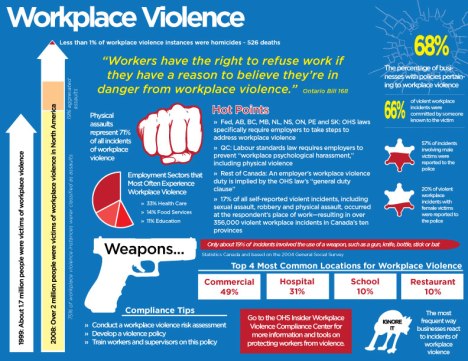
The healthcare sector continues to lead all other industry sectors in incidents of non-fatal workplace assaults. In 2000, 48% of all non-fatal injuries from violent acts against workers occurred in the healthcare sector. Nurses, nurses’ aides, and orderlies suffer the highest proportion of these injuries. Non-fatal assaults on healthcare workers include assaults, bruises, lacerations, broken bones, and concussions. These reported incidents include only injuries severe enough to result in lost time from work. Of significance is that the median time away from work as a result of an assault or other violent act is 5 days. Almost 25% of these injuries result in longer than 20 days away from work. Obviously, this is quite costly to the facility as well as to the victim.

A study undertaken in Canada found that 46% of 8,780 staff nurses experienced one or more types of violence in the last five shifts worked. Physical assault was defined as being spit on, bitten, hit, or pushed.

Both Canadian and U.S. researchers have described the prevalence of verbal threats and physical assaults in intensive care, emergency departments, and general wards. A study in Florida reported that 100% of emergency department nurses experience verbal threats and 82% reported being physically assaulted. Similar results were found in a study undertaken in a Canadian hospital. Possible reasons for the high incidence of violence in emergency departments include presence of weapons, frustration with long waits for medical care, dissatisfaction with hospital policies, and the levels of violence in the community served by the emergency department.

Similar findings have been reported in studies of mental health professionals, nursing home and long-term care employees, as well as providers of service in home and community health.

Violence in hospitals usually results from patients, and occasionally family members, who feel frustrated, vulnerable, and out of control. Transporting patients, long waits for service, inadequate security, poor environmental design, and unrestricted movement of the public are associated with increased risk of assault in hospitals and may be significant factors in social services workplaces as well. Finally, lack of staff training and the absence of violence prevention programming are associated with elevated risk of assault in hospitals. Although anyone working in a hospital may become a victim of violence, nurses and aides who have the most direct contact with patients are at higher risk. Other hospital personnel at increased risk of violence include emergency response personnel, hospital safety officers, and all healthcare providers. Personnel working in large medical practices fall into this category as well. Although no area is totally immune from acts of violence it most frequently occurs in psychiatric wards, emergency rooms, waiting rooms, and geriatric settings.

Many medical facilities mistakenly focus on systems, operations, infrastructure, and public relations when planning for crisis management and emergency response: they tend to overlook the people. Obviously, no medical facility can operate without employees who are healthy enough to return to work and to be productive. Individuals who have been exposed to a violent incident need to be assured of their safety.

The costs associated with workplace violence crises are not limited to healthcare dollars, absenteeism rates, legal battles, or increased insurance rates. If mishandled, traumatic events can severely impair trust between patients, employees, their peers, and their managers. Without proper planning, an act of violence can disrupt normal group processes, interfere with the delivery of crucial information, and temporarily impair management effectiveness. It may also lead to other negative outcomes such as low employee morale, increased job stress, increased work turnover, reduced trust of management and co-workers, and a hostile working environment.

Data collected by the U.S. Department of Justice shows workplace violence to be the fastest growing category of murder in the country. Homicide, including domestic homicides, is the leading cause of on-the-job death for women, and is the second leading cause for men. The National Institute of Occupational Safety and Health (NIOSH) found that an average of 20 workers is murdered each week in the U.S. In addition, an estimated 1 million workers — 28,000 per week — are victims of non-fatal workplace assaults each year. Workplace attacks, threats, or harassment can include the following monetary costs:

  • $13.5 billion in medical costs per year;
  • 500,000 employees missing 1,750,000 days of work per year; with a 41% increase in stress levels with the concomitant related costs!
workplace-violence

More links: 

Racism in Medicine:

MORE: Work Violence

racist

About the Author

Dr. Eugene Schmuckler was Coordinator of Behavioral Sciences at a Public Training Center before accepting his current position as Academic Dean for iMBA, Inc. He is an international expert on personal re-engineering and coaching whose publications have been translated into Dutch and Russian. He now focuses on career development, change management, coaching and stress reduction for physicians and financial professionals. Behavioral finance, life planning and economic risk tolerance assessments are additional areas of focus. Formerly, Dr. Schmuckler was a senior adjunct faculty member at the Keller Graduate School of Management, Atlanta. He taught courses in Organizational Behavior and Leadership, Strategic Staffing, Training and Development, and the capstone course in human resources management. He is a member of a number of professional organizations including the American Psychological Association, the Academy of Management, and the Society for Human Resource Management. A native of Brooklyn New York, he received his BS degree in Psychology from Brooklyn College. He earned his MBA and PhD degrees in Industrial and Organizational Psychology from Louisiana State University. Currently, he serves on the executive BOD for:  www.MedicalBusinessAdvisors.com  and is the Dean of Admissions for www.CertifiedMedicalPlanner.org

Conclusion

Your thoughts and comments on this ME-P are appreciated. Feel free to review our top-left column, and top-right sidebar materials, links, URLs and related websites, too. Then, subscribe to the ME-P. It is fast, free and secure.

Speaker: If you need a moderator or speaker for an upcoming event, Dr. David E. Marcinko; MBA – Publisher-in-Chief of the Medical Executive-Post – is available for seminar or speaking engagements. Contact: MarcinkoAdvisors@msn.com

OUR OTHER PRINT BOOKS AND RELATED INFORMATION SOURCES:

Product Details

Product Details

Seeking Peer Reviewers for New Medical Risk Management Text Book

Join Our Mailing List 

Our Newest Text Book-in-Production

http://www.CertifiedMedicalPlanner.org

[By Ann Miller RN MHA]

CMP logo

***

RISK MANAGEMENT, LIABILITY INSURANCE, AND ASSET PROTECTION STRATEGIES FOR DOCTOR AND ADVISORS

[Best Practices from Leading Consultants and Certified Medical Planners™]

***

***

Skills Needed

If you are a physician, nurse, accountant, attorney, medical risk manager or healthcare executive, we need you.

Form below or contact us for details to peer-review, etc. MarcinkoAdvisors@msn.com

Assessment

Channel Surfing the ME-P

Have you visited our other topic channels? Established to facilitate idea exchange and link our community together, the value of these topics is dependent upon your input. Please take a minute to visit. And, to prevent that annoying spam, we ask that you register. It is fast, free and secure.

Conclusion

Your thoughts and comments on this ME-P are appreciated. Feel free to review our top-left column, and top-right sidebar materials, links, URLs and related websites, too. Then, subscribe to the ME-P. It is fast, free and secure.

Speaker: If you need a moderator or speaker for an upcoming event, Dr. David E. Marcinko; MBA – Publisher-in-Chief of the Medical Executive-Post – is available for seminar or speaking engagements. Contact: MarcinkoAdvisors@msn.com

OUR OTHER PRINT BOOKS AND RELATED INFORMATION SOURCES:

Comprehensive Financial Planning Strategies for Doctors and Advisors: Best Practices from Leading Consultants and Certified Medical Planners(TM)

[Companion Text Book]


Go back

Your message has been sent

Warning
Warning
Warning
Warning

Warning.

Two Healthcare Sectors the Stock Market Got Wrong on Election Day 2012

Join Our Mailing List

How various sectors in the Health Care Industry fared under the PP-ACA legislation?

[A SPECIAL R&D REPORT FOR THE ME-P]

By David K. Luke MIM, MS-PFP, CMP™ [Certified Medical Planner™]

Website: http://www.networthadvice.com

David K. LukeThere has been a lot of speculation since the words “Affordable Care Act” were first whispered years ago on how the various sectors in the Health Care Industry would fare under such legislation. I proposed that a good indicator would be to look at the performance of the individual health care sector stocks on the first trading day after the election.

(See With Obama Election Win, “Mr. Market” Weighs in on the ACA Equity Winners and Losers by David K. Luke on November 16, 2012).

Link: With Obama Election Win “Mr. Market” Weighs in on the ACA Equity Winners and Losers

The day after Pres. Obama’s reelection on Wednesday, November 7, 2012 the stock market was down over 2% as measured by the S&P 500 and the Dow Jones Industrial Average (DJIA). The common reason given was increased doubt that the impending “fiscal cliff” issue, which was splitting the House and the Senate, would be resolved. There was however, another big concern on investor’s mind: the future of the Affordable Care Act. While the election was close when measured by the popular vote with President Obama earning 51.06% versus Mitt Romney with 47.20%, the electoral vote showed a hands-down Obama victory with 332 versus 206 votes. Investors voted with their pocketbooks with that first trading session following the election showing certain healthcare sectors up in price, other healthcare sectors with moderate returns, and certain healthcare sectors down in price.

Disparate Health Care Sector Returns

It is interesting to look back now over a year and a half later and see how accurate those investor votes were on that first day of realization that health care reform was continuing forward at a much faster pace now that President Obama would be serving a second term. Keeping in mind that the day was a very negative day as a whole in the stock market, a number of healthcare sectors were up in price. This group includes Hospital Stocks and Medicaid HMOs. Note the phenomenal one-day returns (in a down 2% market!) on the sample stocks in these two groups:

Hospital Stocks

  • Health Management Associates (HMA) +7.3%
  • HCA Holdings Inc. (HCA) +9.4%
  • Community Health Systems Inc. (CYH) +6.0%
  • Tenet Healthcare Corp. (THC) +9.6%

Medicaid HMOs

  • Molina Healthcare Inc. (MOH) +4.6%
  • Centene Corp. (CNC) +10.1%
  • WellCare Health Plans Inc. (WCG) +4.4%

Such positive returns on a big down day in the market indicates investors assessing these healthcare sectors being good investments under an Obama presidency and a positive outlook for the implementation of the Affordable Care Act. The other up sector on that day was the Drug Wholesalers, up almost 1% on that negative day. (See “Selected Health Care Performance” Chart – below).

The market had a tepid response to the Pharmacy Benefit sector, as well as the Generic Pharmacy, Testing Labs, and Big Pharma. In my sample group, these sectors were down -.4%, -7%, -1.7%, and -1.4% respectively. It is important to note however that these sectors while slightly positive or barely negative still performed better than the general market that day.

Two Sectors

But, the two healthcare sectors that the stock market severely punished with the voting of substantially more sellers than buyers by investors on that first post-election day were the Medical Device Companies (down 2.5% in the sample group) and the Medicare Part D Companies (down 4.7% in the sample group). The thought at the time was that Medical Device Companies, facing an impending medical device excise tax of 2.3% on the sale of most medical devices in the United States, would be devastated, and that Medicare Part D Companies would face severe profit constraints with tighter-fisted government regulations imposed by the ACA.

***

Stock_Market

***

The Retro-Specto-Scope

In hindsight, investors were correct on two out of the three predictions based on stock market prices on the various healthcare sectors. Hospital Stocks, Medicaid HMOs, and Drug Wholesalers, the leading sectors indicated to be winners with the impending implementation of the ACA, are up 69.8%, 63.6% and 76.5% respectively in the sample groups since November 7, 2012. This remarkable and closely parallel return for these three sectors seemed to prove that the stock market on November 7, 2012 correctly picked the three winning health care sectors! The S&P 500 index for the same time is up 32.02%, a nice return for 1 ½ years but about half the return of these apparently huge benefactors of the ACA. The healthcare sectors that investors felt less positive about (but more positive than the general stock market) on that first postelection day were Pharmacy Benefit Companies, Generic Pharmacy Companies, Testing Labs, and Big Pharma. These four health care sectors are up 43.8%, 40.5%, 6.4%, and 20.5% respectively. Again, in terms of ranking the sectors, these four sectors performed in line based on the comparative returns of the other healthcare sectors.

Wisdom of Crowds

Amazingly, it appears that the emotional Mr. Market predicated quite accurately on Wednesday, November 7, 2012, in one day of trading, not just which health sectors would be good investments for the near future, but the actually ranking of the future performance of the sectors! It seems as though the stock market, as one large voting machine, precisely dissected the over 20,000 pages + of resulting legislation created from the original 906 pages (pdf here) of the PPACA law and distilled it down to profits and losses with the resulting winners and losers in the health care industry in one trading session.

Two [2] Big Misses

Investors however were way off on their concerns about Medical Device Companies and Medicare Part D Companies. The two sample groups were up 71.3% and 66.4% in the time of November 7, 2012 to May 19, 2014 respectively, more than double the S&P 500 for the same period, and in line with the best performing sectors! This is spite of the fact that stock sample of these two groups were the two worst performers on post-election day trading. What happened?

***

Bear + A Falling Stock Chart

***

The “Medical Device Excise Tax” Fable and the “Private Insurers Will Control Costs” Fairy Tale

Wall Street has sharpened their pencils in the last year and a half and realized they have gravely underestimated the profit potential of the Medical Device makers and the Managed Care Health Insurers, in spite of the ACA. Based on stock price performance of the sample group of major players in the past 18 months, fewer sectors look as profitable as the Medical Device Industry and the Medicare Part D Industry. What happened?

The Medical Device industry states that the tax will cost the US “tens of thousands of jobs” and that those jobs will be shipped overseas. A number of issues that are involved here however refute these claims (http://www.factcheck.org/2013/10/boehner-and-the-medical-device-tax/. It appears that any targeted reductions were not related to the implementation of the tax, which became effective January 1, 2013, in spite of heavy protest by the industry. Medical technology continues to have a bright future regardless of the tax.

The notion that the “Affordable” Care Act will help reign in the rampant cost increases of Medicare’s “Part D” program seem to be elusive. Private insurers have done a poor job of keeping drug prices down, especially when compared to the discounts the government gets for Medicaid. Medicare Part D companies wield significant influence on Capitol Hill, and impending steeper discounts look unlikely.

Everybody Wins, Except …

Before the ACA implementation, about 85% of Americans had health insurance. Currently with an additional 7 million Americans with health insurance thanks to Obamacare, an additional 2.2% of Americans now have coverage, or about 87% of all Americans. How can such a slight increase in new health care consumers be responsible for such large anticipated profits in the health care sector? It cannot. Wall Street is telling us that the new health law is not about new customers, but about increased profit margins for the health care industry. I can draw three conclusions:

  1. The Affordable Care Act may not be so affordable for health consumers
  2. Most companies in the Health Care Industry stand to gain financially with ACA. There is one sure loser with ACA: The physician, who can only look forward to increased workloads and mpending Medicare SGR pay cuts.

THE CHART [Research and Development]

Selected Health Care Sector Stock Performance Random Sampling of Publically Traded Companies From President Obama Re-election Date to Present

Chart

Conclusion

Your thoughts and comments on this ME-P are appreciated. Feel free to review our top-left column, and top-right sidebar materials, links, URLs and related websites, too. Then, subscribe to the ME-P. It is fast, free and secure.

Link: http://feeds.feedburner.com/HealthcareFinancialsthePostForcxos

Speaker: If you need a moderator or speaker for an upcoming event, Dr. David E. Marcinko; MBA – Publisher-in-Chief of the Medical Executive-Post – is available for seminar or speaking engagements. Contact: MarcinkoAdvisors@msn.com

OUR OTHER PRINT BOOKS AND RELATED INFORMATION SOURCES:

Product DetailsProduct DetailsProduct Details

Product DetailsProduct Details

Product Details  Product Details

Product Details

PP-ACA Physician Ownership Provisions

Join Our Mailing List

Understanding the “whole hospital exception” to the Stark laws

By Dr. David Edward Marcinko MBA CMP®

www.CertifiedMedicalPlanner.org

Dr. David E. Marcinko MBAThis was a big week for healthcare reform, wasn’t it? Some provisions of the PP-ACA requiring the employer mandates were delayed another year; until January 1, 2015.

But, before passage of the ACA in 2010, the “whole hospital exception” to the Stark law allowed physicians to have an ownership interest in a hospital to which those physicians refer patients, provided the physician is invested in the whole hospital and not a subdivision of the hospital, with no limitations as to the amount or extent of physician ownership, on either an aggregate or individual basis.

Prohibitions

Now, according to colleague Robert James Cimasi MHA, AVA, ASA, MCBA, CMP®, of www.HealthCapital.com, The ACA completely prohibits physician-owned hospitals which were not Medicare-certified by December 31, 2010.

[1] The ACA allows hospitals with a provider agreement prior to December 31, 2010 to continue Medicare participation if they meet the following four criteria: (1) located in a county with a population growth rate of at least150% the state’s population growth over the last 5 years; (2) have Medicaid inpatient admission percentage of at least the average of all hospitals in the county; (3) located in a state with below-national-average bed capacity; and, (4) have bed occupancy rate greater than state average. [2]

Grandfathered

A very limited number of physician-owned hospital existing in 2010 met or were close to meeting all 4 of criteria.[3] The Reconciliation Act provided a limited exception to the ACA growth restrictions for grandfathered physician owned hospitals that treat the highest percentage of Medicaid patients in their county (and are not the sole hospital in a county).[4]

###

Financial Management Strategies for Hospitals and Healthcare Organizations: Tools, Techniques, Checklists and…

### 

Assessment

Based on these provisions, the 2010 healthcare reform legislation will likely have a considerable negative impact on physician-owned hospitals, in terms of impeding development of new hospitals and expansion of existing hospitals.

Conclusion

Your thoughts and comments on this ME-P are appreciated. Feel free to review our top-left column, and top-right sidebar materials, links, URLs and related websites, too. Then, subscribe to the ME-P. It is fast, free and secure.

Link: http://feeds.feedburner.com/HealthcareFinancialsthePostForcxos

Speaker: If you need a moderator or speaker for an upcoming event, Dr. David E. Marcinko; MBA – Publisher-in-Chief of the Medical Executive-Post – is available for seminar or speaking engagements. Contact: MarcinkoAdvisors@msn.com

OUR OTHER PRINT BOOKS AND RELATED INFORMATION SOURCES:

Health Dictionary Series: http://www.springerpub.com/Search/marcinko

Practice Management: http://www.springerpub.com/product/9780826105752

Physician Financial Planning: http://www.jbpub.com/catalog/0763745790

Medical Risk Management: http://www.jbpub.com/catalog/9780763733421

Hospitals: http://www.crcpress.com/product/isbn/9781439879900

Physician Advisors: www.CertifiedMedicalPlanner.org


[1]       “Section-by-Section Analysis with Changes Made by Title X and Reconciliation included within Titles I-IX,” Democratic Policy Committee, http://dpc.senate.gov/healthreformbill/healthbill96.pdf (Accessed 5/24/2010).

[2]       “Section-by-Section Analysis with Changes Made by Title X and Reconciliation included within Titles I-IX,” Democratic Policy Committee, http://dpc.senate.gov/healthreformbill/healthbill96.pdf (Accessed 5/24/2010).

[3]       “Healthcare Reform: A Brief Analysis on How it Impacts ASCs and Physician-OwnedHospitals – 10 Observations”, By Scott Becker, Leigh Page, and Rob Kurtz, Becker’s Hospital Review, http://www.beckersorthopedicandspine.com/news-a-analysis/legal-a-regulatory/1193-healthcare-reform-abrief- analysis-on-how-it-impacts-ascs-and-physician-owned-hospitals-10-observations (Accessed 5/20/10).

[4]       “Section-by-Section Analysis with Changes Made by Title X and Reconciliation included within Titles I-IX,” Democratic Policy Committee, http://dpc.senate.gov/healthreformbill/healthbill96.pdf (Accessed 5/24/2010).

Product DetailsProduct Details

Hear Dr. Marcinko on Audio-Educator [Do you Need Money to Start or Grow Your Medical Practice?]

Join Our Mailing List

Crafting a Business Plan and Starting a Medical Practice [A “Live” Audio-Conference]

Conference Registration: http://www.audioeducator.com/hospitals-and-health-systems/business-plan-for-medical-practice-013012.html

Wednesday, Jan 30th, 2013 at 1 PM, EST for 60 minutes

Order

By Staf Reporters www.CertifiedMedicalPlanner.org

Dr David E Marcinko MBAThe “Business Plan” is a key tool for raising start-up capital for a new medical practice, or financing a medical / surgical service line extension for a mature one. It is also used for acquiring loans to finance growth of an existing practice.
Although long recognized as a quintessential business tool, its’ formal structure and mental rigor are only now being recognized in the medical community as competition increases in the healthcare industrial complex.

Reasons for the Plan

There are many reasons to write a medical practice business plan. The process of gathering, compiling and analyzing information is an invaluable experience to the beginning practitioner, or experienced veteran physician. Our expert Dr. David E. Marcinko MBA CMPwill discuss all these, step by step in this 1-hour enlightening event.

See the steps below:

  • Determine the feasibility of a new practice start-up.
  • Raise money from investment bankers for a new practice.
  • Obtain financing to expand an existing office or turn-around a declining satellite.
  • Develop an operational strategic plan and conduct due diligence.
  • Create a budget, time frame or business direction for a practice.
  • Unmask potential problems, risks or benefits of a medical practice.
  • Focus on market opportunities by determining revenue centers or cost drivers.
  • Persuade third party payers, networks and insurance carriers that your practice has a future and represents a viable synergistic partner for their organization.

Medical Office Business Plan

As an attendee you will get:

  • Power Point slide presentation.
  • Time-line checklist to new medical office launch.
  • Topical comprehensive white paper.
  • Electronic blog forum for further information.

Dr. Marcinko in this 60-minute conference will present to you:

  • Executive Summary: Where you concisely state the purpose of the loan, the exact amount of money required, an explanation of what the loan will be used for and why it’s needed.
  • Pro-forma Cash Budgets and Financial Statements: You’ll learn to how effectively use your data and underlying assumptions to prepare information that your banker can easily read and buy into.
  • Doctor’s Personal Financial Statements: Learn how to use copies of the last 3 years of personal tax returns for the bank as well as identify the collateral being pledged as security for the loan.
  • Representation: Here is where this presentation is invaluable.

Ask a question at the Q&A session following the live event and get advice unique to your situation, directly from our expert speaker.

Who should attend? Medical students, interns, residents and fellows, New, mid-career and mature medical practitioners, Office managers, clinic administrators, healthcare CXOs and physician / nurse executives, All doctors who wish to be employers; not employees.

http://businessofmedicalpractice.com/chapter-3-2/

Why use AudioEducator?

  • Save money on travel. Our conferences are available from the comfort and convenience of your own office or meeting room.
  • Meet your specific training needs. Whether you attend a live event, load up one of our encore broadcasts, or purchase a CD or PDF transcript — you’ll get the information you need on your schedule.
  • Keep learning after the event. Every conference purchase includes the speaker’s materials so you can keep learning long after the conference is over.
  • Save time training your whole staff. Gather around a speaker phone or computer and enlighten your entire team for one low price.
  • Do you work with a virtual team or multiple locations? Ask our customer specialists about discounts for your whole staff.

REGISTER HERE

http://www.audioeducator.com/speakers/index/speaker/600

###

 Product Details

www.BusinessofMedicalPractice.com

Order


The Marcinko Method of Improving Quality while Reducing Medical Errors and Healthcare Costs

Join Our Mailing List

Dr. David Edward Marcinko FACFAS MBA CMP

[Former – Certified Physician in Healthcare Quality]

[Former – Certified Financial Planner]

www.CertifiedMedicalPlanner.org

[Publisher-in-Chief]

THINK TWICE!

Doctor’s Orders

Life Corollaries:

Marcinko’s Rx for Obesity: Eat less – Exercise more – Avoid noxious lifestyles.

Marcinko’s Rx for Practice Success: Treat sick patients – Be humble – Keep faith.

Marcinko’s Rx for Financial Success: Spend less – Earn more – Be a fiduciary. 

Marcinko’s Rx for Wealth & Happiness: Don’t divorce – Love kids – Practice philanthropy.

Professional Medical Corollary:

The Choosing Wisely® list, which is aimed at cutting down on unnecessary testing by doctors and patients.

Assessment  

I am not an oracle. What else can you ad to the list?

Conclusion

Your thoughts and comments on this ME-P are appreciated. Feel free to review our top-left column, and top-right sidebar materials, links, URLs and related websites, too. Then, subscribe to the ME-P. It is fast, free and secure.

Link: http://feeds.feedburner.com/HealthcareFinancialsthePostForcxos

Speaker: If you need a moderator or speaker for an upcoming event, Dr. David E. Marcinko; MBA – Publisher-in-Chief of the Medical Executive-Post – is available for seminar or speaking engagements. Contact: MarcinkoAdvisors@msn.com

OUR OTHER PRINT BOOKS AND RELATED INFORMATION SOURCES:

DICTIONARIES: http://www.springerpub.com/Search/marcinko
PHYSICIANS: www.MedicalBusinessAdvisors.com
PRACTICES: www.BusinessofMedicalPractice.com
HOSPITALS: http://www.crcpress.com/product/isbn/9781466558731
CLINICS: http://www.crcpress.com/product/isbn/9781439879900
BLOG: www.MedicalExecutivePost.com
FINANCE: Financial Planning for Physicians and Advisors
INSURANCE: Risk Management and Insurance Strategies for Physicians and Advisors

Certified Medical Planner

A Resource For Financial Planners Who Advise Doctors and Medical Professionals

Emerging Education Network with Professional CMPDesignation

Certified Medical Planner

Wealth managers, CPAs, JDs, MBAs, MDs, RNs, CFPs, RIAs and financial advisors etc., with an interest in physician clients, the healthcare space, ecoonomics, practice management and medical social media, can now indulge their tastes in all with a new venture by the Institute of Medical Business Advisors, Inc.

Education and Certification: www.CertifiedMedicalPlanner.org

Professional Network: www.MedicalExecutivePost.com

Invitation to Matriculate: Letterhead CMP

Assessment

CERTIFIED MEDICAL PLANNER™ – Entering a niche market, with focused advice from educated advisors and consultants, is the ‘win-win’ business model of the future.

Conclusion

Your thoughts and comments on this ME-P are appreciated. Feel free to review our top-left column, and top-right sidebar materials, links, URLs and related websites, too. Then, subscribe to the ME-P. It is fast, free and secure.

Link: http://feeds.feedburner.com/HealthcareFinancialsthePostForcxos

Speaker: If you need a moderator or speaker for an upcoming event, Dr. David E. Marcinko; MBA – Publisher-in-Chief of the Medical Executive-Post – is available for seminar or speaking engagements. Contact: MarcinkoAdvisors@msn.com

Our Other Print Books and Related Information Sources:

Health Dictionary Series: http://www.springerpub.com/Search/marcinko

Practice Management: http://www.springerpub.com/product/9780826105752

Physician Financial Planning: http://www.jbpub.com/catalog/0763745790

Medical Risk Management: http://www.jbpub.com/catalog/9780763733421

Hospitals: http://www.crcpress.com/product/isbn/9781439879900

Physician Advisors: www.CertifiedMedicalPlanner.org

Product DetailsProduct DetailsProduct Details

Product Details  Product Details

Product Details

EHRs – Still Not Ready For Prime Time

Join Our Mailing List 

At Least … Not Yet!

By David K. Luke MIM, Certified Medical Planner™ candidate

www.CertifiedMedicalPlanner.org

Since Feb 17, 2009 when President Obama signed into legislation the Health Information Technology for Economic and Clinical Health Act (HITECH) as a part of the 2009 stimulus package, the incentives were promised for the adoption in health care practices of Electronic Health Records (EHRs).

The Carrot and the Stick

The incentives payments for “meaningful use” range from $63,750 over 6 years by Medicaid to maximum payments of $44,000 over 5 years for Medicare. The penalty for not adopting by Medicare will be 1% of Medicare payments in 2015, increasing to 3% over 3 years. Stimulus money is granted based on meaningful use of an EHR system.

The Reality

Stories are rolling in by early adopters now that give cause for a prudent physician to rethink implementation anytime soon of an EHR for his/her practice. Here is a sampling:

  • EHRs can be hacked and doctors will be held accountable. A total of 385 breaches of protected health information affecting over 19 million records have been reported since August 2009 (Redspin Breach Report 2011). Redspin also reports that industry estimates have put the value of a stolen health record on the black market at about $50 per record. For me, this is the biggest red flag for implementing an EHR now. Vendors are offering solutions in the form of data “masking”, but this could increase the cost of the systems.
  • EHRs have stringent audit requirements under the HITECH Act. Health care organizations are expected to monitor for breaches of PHI. Audit logs must be kept. Audit strategy, process, and implementation tools must be used to meet stage 1 meaningful use criteria. Sanctions to employees for not following protocol. Healthcare facilities leave themselves vulnerable to individual and class action lawsuits when they do not have a strong enforcement and audit program in place for their EHR.
  • EHRs are expensive to implement, both in terms of money and in terms of time. Dollar costs range from free (Practicefusion) to $50,000+ for such EHR vendors as Allscripts or eClinicalWorks + ongoing maintenance costs. But don’t’ forget the time investment. Even small EHR systems can take 2 years to implement. I have just witnessed a client’s large pediatric practice literally crippled with the initial time investment required for staff and physicians to learn the system. Half staffing the front desk and other areas so employees can go to training has caused a drain on both patient and employee morale.
  • Legal concerns are still unanswered regarding EHRs. Currently the debate is still on about who owns the electronic data. The EHR vendor will tell you that you do. HIPPA gives the patient the right to see their record or chart, and the right to have a physical copy of their record based on a reasonably cost for copying and postage. Typically doctors share medical records with other health care providers as a professional courtesy. Empowered patients think they own their records. According to a reference regarding an HIMSS white paper, a patient owns the data in a Continuity of Care Document and has the ability to input and access that information.
  • Obtaining meaningful use stimulus payments is not a given. I met with a physician owner client a few months ago in Arizona that has implemented an EHR for their pediatric practice and was hoping to receive the stimulus payment for stage one by completing the 20 criteria needed. After plowing through the 31-page “Arizona Medicaid EHR Incentive Program” guide provided by The Arizona Health Care Cost Containment System Administration or AHCCCS, which is the Arizona arm of Medicaid he turned in his application, which was denied. His initial reaction was that the program did not have the funding in Arizona, but that seems not to be the case as a number of large payments have been made now in the state. Banner Healthcare, which operates the largest hospital system in the state with thirteen inpatient facilities, reported a total of $12.4 million in Medicaid booty for implementation of its NextGen Healthcare EMR systems in 2011. It appears that there is a learning curve involved here and the smaller practices will catch up while the hospitals currently seem to have better systems in place to capture the stimulus money. An entire MU industry has emerged to help physicians such as my client perfect their stimulus applications.

Risk vs. Reward

In the investment world I am always comparing risk vs. return when managing my client’s portfolios. At times in the marketplace, for various reasons, it just does not make economic sense to make certain investments as the possible risks far outweigh the potential return. An easy example now is the investment in “safe” longer-term treasury bonds. With a near 40-year low in interest rates, the 30-year treasury today yields 3.18 %. Yet if interest rates rise 1% in the marketplace, that 30-year treasury can drop 12%. A 2% rise can result in a fall of 22% in value. It would take 7 years accumulating 3.18% to offset the loss in value caused by a 2% rise in rates. I do not think rates are going up 2% tomorrow, but I just do not like the risk/reward spectrum here. Likewise, the biggest concern currently I have with EHRs is data breeches, as mentioned above, and the stiff penalties involved currently. Paper systems look a whole lot cheaper and safer when considering the ease at which a data breech can occur with electronic data. Fines, criminal sentencing, and disciplinary action by licensing boards are risks not worth taking considering current history on data breeches. Losing your license or your business or personal freedom because of an employee’s careless actions is not worth it. Lest you think I exaggerate, consider the following examples from the past few years enforced by the Office for Civil Rights (OCR), the enforcement side of the US Department of Health and Human Services that enforces HIPAA, and by employers and licensing boards:

Incident: A terminated researcher at UCLA School of Medicine retaliated by accessing UCLA patient records (many celebrities) 323 total times over the next four weeks.

Penalty: 4 years in prison for the terminated researcher for violating HIPAA Privacy Rules

Incident: Thirteen staff members at UCLA hospital accessed Britney Spears’ medical records without authorization.

Penalty: UCLA fired the 13 individuals, suspended another six.

Incident: A doctor and two hospital employees accessed the medical records of a slain Arkansas TV reporter. Details were leaked to the press of her attack.

Penalty: All pled guilty to misdemeanors for violating HIPAA privacy rules and were sentenced to one-year probation. The three all were curious about the case and “peeked” at the patient’s record as employees of the hospital, even though she was not their patient. The doctor’s privileges were suspended by the hospital for two weeks; he was fined $5,000 and ordered to perform 50 hours of community service by speaking to medical workers about the importance of patient privacy. The two other employees were terminated.

Incident: Cignet denied 41 patients, on separate occasions, access to their medical records when requested.

Penalty: Initial violation was $1.3 million. OCR concluded that Cignet committed willful neglect to comply with the Privacy Rule and fined an additional $3 million.

Incident: 57 unencrypted computer hard discs containing PHI of more than one million people was stolen from a storage locker leased by Blue Cross Blue Shield of Tennessee (BCBST).

Penalty: OCR fined BCBST $1.5 million in settlement. The fact that BCBST secured the information in a leased data closet that was secured by biometric and keycard scan in a building with additional security was not enough. BCBST also spent $17 million in investigation, notification and protection efforts and had increased future compliance costs.

Incident: Health Net discovered that nine portable hard drives that contained PHI and personal financial information of approximately 1.5 million people were missing. The hard drives in question went missing from an IBM-operated datacenter in Rancho Cordova, California.

Penalty: The complaint alleged violations of HIPAA. Connecticut Insurance Commissioner wins a $375,000 fine for failing to protect member information and not reporting in a timely manner just months after the Connecticut AG won a $250,000 settlement for the breach. Vermont’s AG jumps in and gets a settlement of $55,000 to the State because 525 Vermonters were on the lost drive.

Incident: WellPoint / Anthem Blue Cross became aware that its customers’ health applications and information website, which contained up to 470,000 applicant’s information, was potentially publicly accessible when an applicant alerted the company that altered URLS after an upgraded authentication code could allow access to other people’s information.

Penalty: WellPoint / Anthem agreed to the terms of a class action lawsuit filed in California that will provide $1.5 million in general settlement, with an additional donation of $250,000 to two non-profit organizations aimed at protecting consumer’s rights, $150,000 donated to Consumer Action and $100,000 donated to the Public Law Center in Orange County. WellPoint / Anthem also agree to pay $100,000 to the state of Indiana for the data breach that exposed 32,000 state residents. A 2009 Indiana law requires companies to notify the state of certain data breaches within a certain period that was not met.

An Investment?

I bring up these examples to make a point. The EHR vendor will talk about your EHR being an “investment”. You cannot have an ROI if you lose money. Notice that most cases were due to careless, innocent lapses of judgment. Also in many cases actual damages either did not occur or were hard to prove. The new HITECH act extends HIPAA to allow the states’ attorney general to also bring actions, which adds more salt to the wound. Some of these cases do not appear to be done yet either as far as the lawyers are concerned. Also, notice that even when the health care provider regarding storing the data exercised extreme care (BCBST with biometric, keyscan leased lockers and Health Net employing IBM’s “secure” datacenter), the health provider was sued and fined. Smaller medical practices I believe are even more susceptible to EHR data breaches, where bad password management practices and website maintenance problems are more common and often protocols and training are not firmly in place.

Assessment

The widespread use and integrated implementation of EHRs are going to happen, no doubt. Your practice will eventually have one. 2015 is still a few years off before the first 1% Medicare penalties hit. Tell the EHR vendor to call back in 2014 once the kinks are worked out. Waiting two more years may not prevent a costly incident due to the vengeful fired employee or due to a careless slip in protocol. Those landmines will always be there.

But, two more years will allow the EHR stakeholders more time to improve their product, namely the security and encryption of the data in case of a breach, and two more years will allow the OCR and the state AG’s to fill up on the low hanging fruit and make their point.

Conclusion

Your thoughts and comments on this ME-P are appreciated. Feel free to review our top-left column, and top-right sidebar materials, links, URLs and related websites, too. Then, subscribe to the ME-P. It is fast, free and secure.

Speaker: If you need a moderator or speaker for an upcoming event, Dr. David E. Marcinko; MBA – Publisher-in-Chief of the Medical Executive-Post – is available for seminar or speaking engagements. Contact: MarcinkoAdvisors@msn.com

OUR OTHER PRINT BOOKS AND RELATED INFORMATION SOURCES:

Product DetailsProduct DetailsProduct Details

Product Details Product Details

Product Details

Variations in Medical Practice Patterns for Financial Advisors

Join Our Mailing List

Lessons Learned for both Physicians and Financial Advisors

By David K Luke MIM, Certified Medical Planner® candidate

[Physician Financial Advisor – Fee-Only]

http://www.NetWorthAdvice.com

http://www.DocFP.com

www.CertifiedMedicalPlanner.org

Physicians are constantly being trained in new techniques and methodologies, learning about new treatments and new drugs as they become available. For example, Elaine Zablocki (Zalocki, Elaine, Changing Physician Practice Patterns: Strategies for Success in a Capitated Health Care System, New York: Aspen Publishers, 1995 Print) gives examples from a physician profiling study done by Blue Cross Blue Shield of Nebraska (p 13-14).

BCBSN circa 1993

In 1993 BCBSN began to analyze data on Nebraska patients and discovered striking variations in practice patterns in different parts of the state.  One observation was that in two small rural areas there was a particularly high hospital surgical admission rates for nonmalignant gynecological conditions. Another observation was of wide variations in physician practice patterns for ENT surgical procedures such as tympanostomy tubes and surgery for nose and sinus problems. Some ENT physicians were performing three times as many procedures per patient as the average. According to medical director David Bouda, MD “our overall approach has been to take this information to the local physician group or area that seems to be different compared to others, present the data, and then have some kind of dialogue with the physicians. We say, ‘Here’s a group of physicians who seem to be exceptional in these ways – – what do you think about this?’”. The effort seems to pay off.  In the case of the high admission rates for hysterectomy cases, BDBSN saw a steady decline over 3 years. In the ENT example, questionable claims dropped markedly. The general approach to changing physician practices patterns was to take an educational approach getting physicians to pay attention to established parameters modified or created by his or her peers which would have a greater impact on health care costs than harassing the physicians over the phone regarding hospital length of stay or procedure questioning.

Defensive Doctors?

Not surprisingly, physicians often became defensive the first time they see this type of data. There is no point challenging an individual at this point. What I found interesting about the study, in spite of it being dated, was the comment that “…after all, educating physicians about practice patterns to promote better health care is a long-term process”. Are you a better doctor today then you were X years ago? Of course! Change is good even though it can be painful. Are you disingenuous because you practice medicine in a better fashion than you did years ago? Of course not! The concern would be if a practitioner doesn’t change (or worse refuses to change) in spite of being enlightened by a different method or approach.

Of the Financial Advisory Business

Enlightenment occurs in the financial advisory business as well. I started in the financial world in May of 1986  as a new recruit with my new graduate business degree working for GM of Canada in the Treasury Department. I spent time managing the foreign currency exposure, assisting the chief investment officer in the daily cash management (taking over for him while he was on vacation) and supervising the Borrowings Department at GMAC of Canada. All of these responsibilities involved making daily multiple transactions with brokers in the million dollars plus territory. In 1989 we moved our small family to Arizona so I could ply my trade as a stockbroker and help people retire successfully. Over the years the business has evolved greatly. When I got started in the trade, pretty much everything was sales commission driven. While “fee-only” existed, it was still very much in the pioneering phase with very fee practitioners. Over the years, especially beginning around 5 years ago, like the physician that observes the data in the above examples, I began to perceive that perhaps there was a better way to give advice to my clients. In the beginning I was defensive and even suspicious that these “fee-only” folks were just a little too bit self-righteous. Changing a few words from the observation of physicians above we could say:

“after all, educating financial advisors about practice patterns to promote better financial advice is a long-term process”

My Own Journey as a Financial Advisor

In 2010 I joined Net Worth Advisory Group as a fee-only advisor and have not looked back.  Am I a hypocrite because now I espouse a view and business model that is in some respects totally different then the views and business model I used 5, 10 or 20 years ago? I don’t think so.  In fact, to NOT have changed would have been the easier thing to do. I believe that following my conscience (yes, I used that self-righteous word “conscience” in this discussion) and changing to a much more client centric model, dropping thousands of dollars in retainer fees, dropping licenses that I had worked so hard to obtain, and really learning how to be a better financial planner was certainly initially a big sacrifice.

The point is … I knew I had to do it … and that was that. I believe the business model I have now is absolutely in the best interest of our clients. I wish I had this model available 23 years ago.

And today, in the medical industry, a better model is patient centered care. What an exciting opportunity, for all physicians, to reduce practice variation and pursue the grail of evidence based medicine [EBM].

NOTES: It should be noted that the “father” of medical variations may be Jack Wennberg MD, who studied prostatectomy, hysterectomy and appendectomy rates in the 1970’s and continues his work today at http://www.dartmouthatlas.org/

Conclusion

Your thoughts and comments on this ME-P are appreciated. Feel free to review our top-left column, and top-right sidebar materials, links, URLs and related websites, too. Then, subscribe to the ME-P. It is fast, free and secure.

Link: http://feeds.feedburner.com/HealthcareFinancialsthePostForcxos

Speaker: If you need a moderator or speaker for an upcoming event, Dr. David E. Marcinko; MBA – Publisher-in-Chief of the Medical Executive-Post – is available for seminar or speaking engagements. Contact: MarcinkoAdvisors@msn.com

Our Other Print Books and Related Information Sources:

Health Dictionary Series: http://www.springerpub.com/Search/marcinko

Practice Management: http://www.springerpub.com/product/9780826105752

Physician Financial Planning: http://www.jbpub.com/catalog/0763745790

Medical Risk Management: http://www.jbpub.com/catalog/9780763733421

Hospitals: http://www.crcpress.com/product/isbn/9781439879900

Physician Advisors: www.CertifiedMedicalPlanner.org

Product DetailsProduct DetailsProduct Details

Product Details  Product Details

Product Details


Welfare Benefit Trust Plans for Physicians?

 Join Our Mailing List

A SPECIAL REPORT FOR THE ME-P

“Hall of Fame” for Egregious Investment Advice

By David K. Luke MIM, Certified Medical Planner™ – candidate

[Physician Financial Advisor – Fee Only]

www.NetWorthAdvice.com

www.CertifiedMedicalPlanner.org

Physicians unfortunately often become unwitting targets of some very egregious investment advice. Usually it involves an investment product with an imbedded fat commission just waiting to be deposited in a “financial advisor’s” bank account.

In the “Hall of Fame” of egregious investment advice is the Welfare Benefit Trust. About 10 years ago, while I was working for a top five national brokerage firm (this was before my fee-only days when I was still on the “dark side”) our internal Insurance Products Department at the brokerage firm’s head office presented an amazing investment product. This “Welfare Benefit Trust” we were told should be shown to our profitable small business owners as a cure for their every ill caused by paying too much taxes. A Welfare Benefit Trust essentially works like this:

  • The business provides a fringe benefit for their employees, such as health insurance and life insurance.
  • The benefit is established in the name of a trust and funded with a cash value life insurance policy
  • Here is the gravy: the entire amount deposited into the trust (insurance policy) is tax deductible to the company, and
  • The owners of the company can withdraw the cash value from the policy in later years tax-free.

Yes, the holy grail of tax avoidance has been achieved: tax deductible up front and tax-free when you withdraw. By the way, if you are not familiar with such investments there is a reason. They are not legal by the tax code. Physician practices, as well as other small and mid-sized businesses, became buyers into these welfare benefit trusts as they were sold as a way for the practice to “protect” a large profit in a certain year from being taxed. We were told it was not uncommon for a single transaction into a welfare benefit trust to be $200,000 to $300,000 dollars or more in a single premium payment, yielding typically a six-figure commission check.

A few years later the gig was up as it became obvious these could not be tax legal. My understanding is that most medical practices that bought these “unrolled” them when the major brokerage firms realized that avarice got the best of them and stopped selling them. In 2007, the IRS and the Treasury Department issued a formal warning cautioning “about certain Trust Arrangements Sold as Welfare Benefit Funds”. The IRS called these “abusive schemes” and made such a transaction what the IRS lovingly calls a “listed transaction”. Essentially, a listed transaction is a transaction that the IRS has determined to be a tax avoidance transaction. The IRS even keeps these Listed Transactions on their website, listed in chronological order from 1 to 34. Welfare Benefit Trusts is #33.

Good Welfare Benefit Trusts

First of all, it is important to mention that “there are many legitimate welfare benefit funds that provide benefits” according to the IRS. Internal Revenue Code Sections 419 and 419A spell out the rules allowing employers to make tax-deductible contributions to Welfare Benefit Plans. There is nothing wrong with these plans and no mystery to them. After all, a medical practice or any business for that matter is allowed to deduct the costs of doing business as an expense. This includes employee salary and benefits.

VEBAs (Voluntary Employee Benefits Association) have been around since 1928 and are used by employers to provide health, life, disability, education and other benefits for their employees and are the original Welfare Benefit Trusts. When properly established and executed, a VEBA can be a legitimate employee benefit structure. In 2007 the United Auto Workers, in order to relieve the Big 3 Automakers from carrying the liability for their health plans on their accounting books, formed the world’s largest VEBA with over $45 billion in assets.

Bad Welfare Benefit Trusts

However, the IRS does have a problem with Welfare Benefit Plans that are promoted to small business owners as a scheme to avoid taxes and provide medical and life insurance benefits to key employees that in substance primarily serve the owner(s) of the business. These 419 Welfare Benefit Plan schemes claim that the employer’s contributions are deductible under IRC section 419 as ordinary and necessary business expenses, allowing the business owner to provide a life insurance policy for his favorite employee, himself, and accumulate cash value in a life insurance policy.

Lest there be any confusion or debate, IRC 264(a)(1) states:

(a) General rule

No deduction shall be allowed for –

(1) Premiums on any life insurance policy, or endowment or

annuity contract, if the taxpayer is directly or indirectly a

beneficiary under the policy or contract.

While VEBAs have been used properly, as in the UAW example above, unfortunately they are often a front for an abusive tax shelter. In the 1970’s VEBAs were being used by the wealthy as a popular tool for tax reduction and asset protection. In 1984 Congress passed the Deficit Reduction Act, which limited the use of VEBAs. In the 1990’s however VEBAs were structured to give business owners tax benefits not allowed and got back on the IRS radar. Two state medical societies along with a neonatology group practice became test cases by the IRS that helped close those VEBAs with abusive tax structures and purporting to be employee welfare benefit plans: Southern California Medical Professionals Association VEBA, New Jersey Medical Profession Association VEBA and Neonatology Associates, PA. Although the VEBAs claimed to have favorable determination letters, the actual execution of the plan did not comply with the law, mainly by allowing the employees to hold term policies in the plan that could be converted into universal life policies at the same insurer and use the conversion credit account to spring cash value in the policy. This then allowed policyholders to borrow against the UL policy as a supposedly nontaxable source of retirement income, with the repayment of the loan paid out of the policy’s death benefits. (“Making Welfare Plans Work”, Advisor Today, September 2000 P 110). This of course is not allowed under the tax code.

Those that think that they may be in the clear with their abusive tax shelter because:

  1. A large passage of time has occurred since they have owned it
  2. They have a favorable determination letter
  3. Other honorable businesses/ Medical Societies also have the same tax shelter
  4. My insurance agent said it was legal

may want to read the 98-page ruling by the United States Tax Court filed on July 31, 2000 in the case of the above-mentioned Neonatology and related cases. The long arm of the IRS reached back 9 years to 1991, 1992, 1993 disallowing hundreds of thousands of dollars and assessing deficiencies and huge “accuracy-related” tax penalties. Even the doctors that had died since then were not given a break either; their estates and surviving widows were assessed the deficiencies and penalties.

In 2002 the IRS talked Congress into passing new laws basically killing the use of multiple employer 419 plans. Some TPAs (third party administrators) that had set up the multiple employer plans discovered that they could use single employer 419 welfare benefit trusts and VEBAs because Congress forgot to include them when they passed the negative laws shutting done the multiple employer plans. This forced the IRS to issue notices 2007-83 and 2007-84, Rev. Ruling 2007-65 and make welfare benefit trusts listed tax transactions now on the listed tax transactions list. (“Negative IRS Notices On 419 and VEBA Plans” Roccy M. Defrancesco Nov 1, 2007)

Ugly Welfare Benefit Trusts

I call these “Ugly” because these Welfare Benefit Trusts were sold to small business owners after the 2007 IRS listed transaction warning, and after the multiple IRS notices and revenue rulings. The major brokerage firms by 2004 had stopped selling Welfare Benefit Trusts to protect their own financial interests, realizing these were compliance and lawsuit time bombs. The 2007 IRS listed transaction notice along with multiple other notices however did not seem to stop some smaller broker dealer firms and life insurance agents from promoting these.

I have become aware of the fact that Welfare Benefit Trusts that are in violation of the basics of the tax code (unlimited full deduction of premium,  100% tax free distribution to owner of cash value) are still being sold even today and even affecting existing clients. These Welfare Benefit Trusts go by many different names and the insurance agents selling them are using a number of different insurance companies to fund the plan. These plans involve the sale of an insurance policy usually with a six-digit premium that often pays the insurance agent a six-digit commission, so perhaps I should not be surprised that individuals (physicians?) are still being victimized

Conversation with IRS Attorney on Welfare Benefit Trusts

On January 20, 2012 I discussed with Betty Clary, an IRS attorney that helped draft the listed transaction #33 on the IRS website, on what exactly the IRS considers an abusive Welfare Benefit Plan. She stated that, once you take out the fact that the trust cannot be offering a collective bargaining element which is covered by another IRS code, there were three elements they look for:

  1. There has to be a Trust that claims to be providing welfare benefits
  2. There is either a cash value policy involved that offers accumulation or a policy in which money is set aside for a future policy in which accumulation occurs, such as a term policy that can then offer a higher accumulated value.
  3. The plan cannot deduct in any year more than the benefit provided. For example if the plan just provides a death benefit, the most that can be deducted in a year is only the term cost of that benefit, not the entire premium. If the plan offers medical benefits, then only the cost (what was paid out to the employee) for that benefit can be deducted in that year.

I found it interesting that the IRS is pursuing this broader definition as an abusive plan. Betty explained that in the case of a discovered abusive Welfare Benefit Plan, the IRS would disallow the deductions, assert income back to the owner as a distribution of profits, and assess penalties. The courts are clear that you cannot get out of penalties by claiming you are relying on the person that sold you the Welfare Benefit Plan.

What if you currently have a Welfare Benefit Trust for your Practice?

Realizing that someone you trusted has financially devastated you, carelessly misguided you and sold you a bogus tax program in order to pay cash for his new 7 series BMW can be a difficult and rude awakening. After accepting the fact that your Welfare Benefit Plan you have for your practice meets the basic criteria as mentioned in this article as an abusive transaction, I would recommend that you consult an attorney that specializes in pursuing promoters of abusive Welfare Benefit Plans and discuss your options. I have had discussions with Lance Wallach, an accountant and expert witness used in a number of Welfare Benefit Trust cases, which has confirmed to me that you must be proactive. You may be advised to file an IRS form 8886, which is a disclosure form related to prohibited tax shelter transactions. The penalties for failure to file a form 8886 can be stiff. Of course, filing this form will open the Pandora’s Box on your Welfare Benefit Trust to the IRS. Lance has told me that many of these 8886 filings are done incorrectly. An incorrectly filed IRS form is an unfiled IRS form, so please consult a CPA who is experienced in this area. Your attorney that has expertise with Welfare Benefit Trusts will be able to guide you with this. Regarding recourse, according to Lance, most all cases are settled out of court, as the insurance company, the agent, and the agency prefer to avoid the publicity.

Conclusion

Your thoughts and comments on this ME-P are appreciated. Feel free to review our top-left column, and top-right sidebar materials, links, URLs and related websites, too. Then, subscribe to the ME-P. It is fast, free and secure.

Speaker: If you need a moderator or speaker for an upcoming event, Dr. David E. Marcinko; MBA – Publisher-in-Chief of the Medical Executive-Post – is available for seminar or speaking engagements. Contact: MarcinkoAdvisors@msn.com

OUR OTHER PRINT BOOKS AND RELATED INFORMATION SOURCES:

Product DetailsProduct DetailsProduct Details

Product Details  Product Details

Product Details