Real Estate Agent VERSUS Realtor?

By AI

***

***

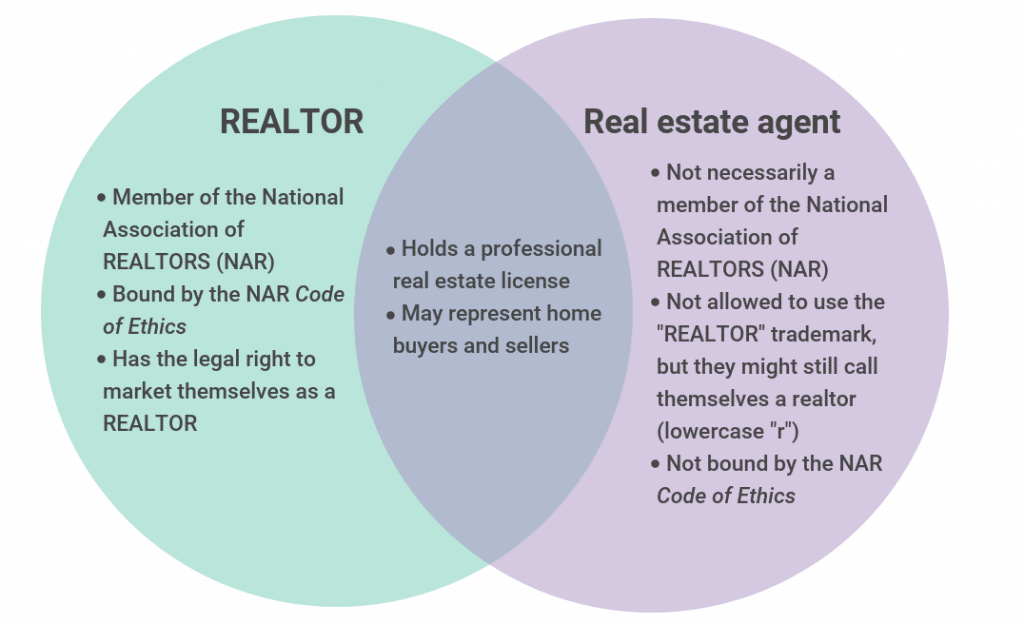
The terms “real estate agent” and “realtor” are often used interchangeably to describe a licensed professional who can help you buy or sell a home. But the terms have different meanings. 

Real Estate Investing: https://medicalexecutivepost.com/2025/04/14/physicians-on-real-estate-investing/

  • A realtor is a licensed salesperson who belongs to the National Association of Realtors (NAR), and must comply with NAR’s code of ethics. The term is capitalized when describing a NAR member, and NAR owns the trademark.
  • A real estate agent is simply a licensed salesperson who does not belong to NAR, and refers to any individual who holds a real estate salesperson’s license.

REITS: https://medicalexecutivepost.com/2024/08/13/on-non-traded-real-estate-investment-trusts-reits/

Should you hire a real estate agent or a realtor? Agents who belong to NAR aren’t necessarily better than non-member agents. NAR is just a trade association — not a licensing body — so membership is optional. 

Commercial RE: https://medicalexecutivepost.com/2013/09/10/financial-freedom-through-commercial-real-estate-education-and-investing/

COMMENTS APPRECIATED

Like and Refer

***

***

REAL ESTATE Investing for Physicians

SOME GUIDELINES FOR COLLEAGUES

Touring with Marcinko | The Leading Business Education ...

By Dr. David Edward Marcinko MBA CMP®

SPONSOR: http://www.CertifiedMedicalPlanner.org

CMP logo

According to Rick Kahler MS CFP® ChFC CCIM [www.KahlerFinancial.com] real estate is one of the largest asset classes in the world. The family home is the largest asset many middle-class Americans own. And, real estate makes up a significant portion of the net worth of many wealth accumulators. Directly owning real estate is not an investment for the faint of heart, the armchair investor, or the uneducated. Most wealth accumulators would do well to leave direct ownership of real estate to the pros and invest in real estate investment trusts (REITs) instead [personal communication].

Still, as we have seen, the lure of investing in a tangible asset like real estate is enticing for high risk tolerant physician-investors who need a sense of control and interaction with their investments. If you are among them, here are a few guidelines that may keep you on a profitable path.

1. Don’t attempt to purchase investment real estate without the help of a commercial real estate specialist who is a fiduciary bound to look out for your best interest. Engage a Certified Commercial Investment Member (CCIM) with years of training and experience in analyzing and acquiring investment real estate. To find a CCIM near you, go to http://www.ccim.com.

2. You will sign a disclosure agreement that will tell you who the Realtor represents. Be sure the Realtor you engage represents you and not the seller, both parties, or neither party.

3. Never trust the income and expense data provided by the seller’s Realtor. While a seller represented by a CCIM will have a greater chance of supplying you with accurate data, most will significantly understate expenses and overstate the capitalization rate. Selling Realtors often understate the average annual cost of repairs and maintenance. I estimate this annual expense at 10%.

4. Another often understated expense is management. Many owners manage their own properties, so the selling broker doesn’t include an estimate for management expenses. They should. Real estate doesn’t manage itself, ever. You will either need to hire professional management or do your own management (always a scary proposition). Even if you do it yourself, you have an opportunity cost of your time, so you must include a management fee in the expenses. Most small residential apartments and single-family homes will pay 10% of their rents to a manager.

5. You must verify all the costs presented to you by the seller’s Realtor. Demand copies of at least the last three and preferably five years of tax returns. Research items like utility bills, property taxes, legal fees, insurance costs and repairs, maintenance costs, replacement reserves, tax preparation and all management fees. As a rule of thumb, expenses will average 40% of rental income on average-aged properties where the tenants pay all utilities except water. Newer properties may have expenses as low as 35%, while older properties can be as high as 50%.

6. By subtracting the vacancy rate and stabilized expenses from the rent, you will find the net operating income. This is the income you will put in your pocket—assuming the property is paid for. By dividing the net operating income by the purchase price, you will find the return you will receive on your investment, called the capitalization or “cap” rate. In Rapid City SD, for example, the cap rate tends to be 4% for single-family homes, 5% to 8% for duplexes to eight-plexes, and 8% to 12% for larger residential and commercial properties.

Citation: https://www.r2library.com/Resource/Title/0826102549

ASSESSMENT: Yes, physician-investors and all of us can build wealth with real estate. You just need to educate yourself, work hard, start conservatively, think long-term, and be prepared for lean years. This is not a quick or easy path to riches. Your comments are appreciated. Thank You.

INVESTING: https://www.amazon.com/Comprehensive-Financial-Planning-Strategies-Advisors/dp/1482240289/ref=sr_1_1?ie=UTF8&qid=1418580820&sr=8-1&keywords=david+marcinko

***

INVITE DR. MARCINKO: https://medicalexecutivepost.com/dr-david-marcinkos-bookings/

THANK YOU

***

Why I Hate Non-Publicly Traded REITS

On Product Frustration

Lon JefferiesBy Lon Jefferies MBA CFP® CMP®

As my experience in the financial planning and investment advisory industries has grown over the years, there is one investment that I’ve seen no logical reason to own — non-publicly traded real estate investment trusts.

Josh Brown, one of my favorite analysts and author of TheReformedBroker.com nailed each of my frustrations with these products. Here is a significant excerpt from his post:

 ***

I consider non-traded REITs or nREITS to be part of the group of investments that are just absolute murderholes for clients – they pay the brokers so much that they cannot possibly work out (and they rarely do without all kinds of aggravation and additional costs). Further, I have yet to hear a single credible explanation as to why a broker would recommend a non-traded REIT over a public REIT other than compensation. The only explanation that makes sense to me is that 7% is a lot more than the 1% commission you get doing an agency trade on a NYSE-traded REIT. A reader with experience in the industry sent this to me and I found it hilarious. Below, a fictional, transparent conversation between an indie broker and his “client” that would never occur…

If Brokers Were Transparent:

Rep:

Before we wrap up our quarterly portfolio review I would like to talk to you about a new investment I think you might be interested in.  You have been looking for more income and this is an investment vehicle that pays a 7% dividend.

Client:

Sounds great, give me the details.

Rep:

With your portfolio size and risk tolerance I would recommend a $100,000 investment.  Given that amount let’s first go over the fees. If you invest $100,000 I will be paid a commission of $7,000. My firm is going to get $1,500 – $2,000 in revenue share. My wholesaler, the salesman that works for the investment’s sponsor company, will get $1,000. He is a great guy, buys me dinner and takes me golfing. The sponsor company is going to get around $3,000 to pay for some of the costs they incurred in setting up the investment. So after Day 1 there will be around $87,000 left over to actually invest.  I bet you are getting excited.

Client:

Are you on drugs? Why would I pay 13% in fees on anything?

Rep:

Don’t worry, it won’t feel like you are paying $13,000 in fees. The rules allow my firm to report your investment at $100,000 on your statement. You never really know what its worth but you will think you never lost money. Pretty sweet huh?

Client:

You have to be kidding.

Rep:

No, this is a really good investment. Let me tell you about the income component before you jump to any conclusions. Like I said this investment pays a 7% dividend and the dividend won’t change.

Client:

That sounds high and how do you know it won’t change?

Rep:

You see, the sponsor just picks the 7% dividend number out of thin air. Here’s how it works. You see the vehicle you are going to invest in is new and it’s going to take the firm a while before your net $87,000 is actually invested. Later on, maybe 2-4 years from now they will have the money fully invested and it will generate actual cash flow. So they just pay a quarterly dividend of 7% by giving you your money back. This is great from a tax perspective because return of capital isn’t taxed as income.

Client:

Are we on hidden camera or something?

Rep:

Ha, you are funny. I bet this next benefit will change your mind.

Client:

I hope so or I should start looking for another financial advisor.

Rep:

This is the best feature. You can’t sell your investment until the sponsor has the opportunity to create liquidity. You might be locked up in this investment for 7-10 years.

Client:

This feels like the Twilight Zone. Your firm allows you to sell this crap?

Rep:

Oh yeah, our firm sells a ton of it. In fact independent broker dealer firms like mine sold over $20 billion of these investments in 2013. Think about that. Reps like me made over $140 million dollars and our firms pocketed $20-$30 million.

Client:

This is crazy, what is this investment?

Rep:

Non-traded REITs. $100,000 sound about right?

***

Currency

***

Josh touched on every part of these investments that I despise — excessive commission paid to the so-called “financial advisor” (salesman), a supposed “dividend” that is really just paying the investor his own money back (essentially providing an interest-free loan), and a complete lack of liquidity and transparency.

When I begin working with a new client who owns one of these products, it is impossible to obtain accurate, current information on the investment (not even a true value is apparent). Even worse, if the client wants to sell the investment he would need to do so at pennies on the dollar. For the most part, once an investor purchases one of these products he just needs to forget about it and hope that one day he can get his money back.

Assessment

The bottom line is that if your advisor ever recommends a non-publicly traded REIT, I’d strongly recommend you walk out the door and start searching for a true financial advisor with a fiduciary responsibility to act in your best interest.

Conclusion

Your thoughts and comments on this ME-P are appreciated. Feel free to review our top-left column, and top-right sidebar materials, links, URLs and related websites, too. Then, subscribe to the ME-P. It is fast, free and secure.

Speaker: If you need a moderator or speaker for an upcoming event, Dr. David E. Marcinko; MBA – Publisher-in-Chief of the Medical Executive-Post – is available for seminar or speaking engagements. Contact: MarcinkoAdvisors@msn.com

OUR OTHER PRINT BOOKS AND RELATED INFORMATION SOURCES:

Product Details  Product Details

***

On non-traded real estate investment trusts (REITS)

Private real estate investment trusts (REITS)

By Rick Kahler CFP®

In February 2016, I published an article that was not kind to non-traded or private real estate investment trusts (REITS). Unlike the traded variety that can be sold immediately on a public exchange, non-traded REITS have no public market if you want to liquidate the shares, making them much more illiquid. I contended that even though non-traded REITS had some theoretical benefits, the high fees and commissions, illiquidity, lack of transparency, and lack of a track record associated with them negate any advantage. My longstanding recommendation has been to stay with traded public REITS for your portfolio.

That article was picked up by Barron’s, where it was read by Tom Lonergan of JLL Income Property Trust. He agreed with me that most non-traded REITS did have all the negatives I listed, but pointed out that others did not. While I was skeptical, I decided to investigate further.

A Sleuth

My investigation over the past year did turn up a handful of non-traded REITS that don’t pay a commission, have reasonable fees, have limited liquidity, offer transparency, and do have an existing portfolio of properties that offers an easily discernable track record. This article is my acknowledgement that not all non-traded REITS are equal.

First, why should you even care if real estate is in your portfolio? The biggest reason is that it’s the third largest asset class, behind bonds and stocks. Of all that real estate, about 7% is owned by public REITS. The remaining 93% is owned by publicly traded corporations, private partnerships and REITS, and individuals.

One of the strongest arguments for including a non-traded REIT in your portfolio is that it acts much more like directly owning real estate than a traded REIT. The big difference between non-traded and traded REITS is volatility. Traded REITS are more volatile than stocks. Traded REITS have a potential annual volatility (referred to as standard deviation) of 22%, while the stocks of large companies are 16%. A non-traded REIT has a volatility of around 2%, which is almost that of bonds at 3%.

Why the huge difference in non-traded and traded REITS when they are the same asset class? The answer is liquidity. With traded REITS, liquidity is both a major strength and an Achilles heel. Traded REITS are subject to public sentiment, just like stocks. Their price is driven by behavior. Since they are liquid and can be bought and sold in a nanosecond, their price can swing wildly. In this regard, traded REITS act more like a stock investment than a real estate investment.

Non-traded REITS, just like rental houses or office buildings owned directly by an investor, can’t be traded or liquidated quickly. The price of a non-traded REIT is set by the value of the properties that are owned, not public sentiment. That is why the share value of traded REITS dropped around 75% in 2009, while non-traded REITS dropped around 25%. The properties owned by the traded REITS didn’t decrease any more than the non-traded REITS, but the wholesale panic in the public exchanges dropped their share value three times more than the decline in the actual value of the real estate.

***

***

Assessment

As with many things in life, when it comes to real estate we can’t have our cake and eat it too. One factor that makes real estate such a stable investment is that it is inherently illiquid. You can’t have both liquidity and low volatility. But you can have a non-traded REIT that has limited liquidity, a track record, with reasonable fees and no commission. However, you do have to look hard to find them.

Conclusion

Your thoughts and comments on this ME-P are appreciated. Feel free to review our top-left column, and top-right sidebar materials, links, urls and related websites, too. Then, subscribe to the ME-P. It is fast, free and secure.

Speaker: If you need a moderator or speaker for an upcoming event, Dr. David E. Marcinko; MBA – Publisher-in-Chief of the Medical Executive-Post – is available for seminar or speaking engagements.

Contact: MarcinkoAdvisors@msn.com

Subscribe: MEDICAL EXECUTIVE POST for curated news, essays, opinions and analysis from the public health, economics, finance, marketing, I.T, business and policy management ecosystem.

***

***

https://www.routledge.com/Comprehensive-Financial-Planning-Strategies-for-Doctors-and-Advisors-Best-Practices-from-Leading-Consultants-and-Certified-Medical-PlannersTM/Marcinko-Hetico/p/book/9781482240283

Select and Check Your Stock Broker and Financial Advisor?

Shopping Suggestions

Rick Kahler MS CFP

By Rick Kahler MS CFP®

Shopping for a financial adviser you can trust has never been easy. The Department of Labor [DOL] rule requiring brokers to act in a fiduciary capacity when dealing with retirement plan assets has not made it any easier. The government’s intent was to help consumers clearly distinguish when financial professionals can be relied upon to give unbiased financial advice or when they are acting in their own interests to sell a financial product. Unfortunately, the rule has only exacerbated the confusion.

When shopping for financial advisers, you need to investigate their education, niche, process, compensation structure, and experience to see whether they are a good fit for your needs. Equally important, it’s up to you to do a background check and determine whose interest the adviser is looking out for. No one else will do it for you.

Two-Steps

Here are two important steps you can take to greatly increase your chances of getting someone who will truly be looking out for you.

First, ask any adviser you deal with to sign a statement affirming they will act in the capacity of a fiduciary to you, meaning you will be a client, not a customer. A copy of this form can be found at www.advisorperspectives.com. Advisers unwilling to sign the Form Adv are not likely to be fiduciaries who will put your interests first.

Second, check the adviser’s background. If advisers receive any type of fee, they are held to a fiduciary standard automatically by the SEC. Still, it’s wise to check their background for any misconduct, which you can do at www.adviserinfo.sec.gov. If advisers sell securities, mutual funds, private REITs, or limited partnerships and receive any type of commission, they will be regulated by FINRA. You can go to BrokerCheck.finra.org to view their records for misconduct.

It’s important to check an adviser’s background because being found guilty of misconduct doesn’t mean they can’t actively be selling financial products.

For example, in a March 7 article at kitces.com, financial planner and writer Michael Kitces points out that over 73% of FINRA-registered brokers who FINRA lists as having a misconduct “are still employed a year later, despite the fact that such brokers are a whopping 5x more likely to engage in misconduct again in the future.”

Kitces explains that while just 7.3% of all FINRA brokers have some type of misconduct on their records, only about half of them actually lose their jobs and about half of those find employment with another firm. Additionally, it seems some firms have more of a culture of employing brokers with misconduct.

***

Wall Street

***

The top five brokerage firms with the highest (15% or more) concentration of brokers with misconduct are Oppenhiemer & Co, First Allied Securities, Wells Fargo Advisers Financial Network, UBS Financial Services, and Cetera Advisers. This is according to a working paper, “The Market for Financial Adviser Misconduct,” by Mark Egan, Gregor Matvos, and Amit Seru, business school professors at the University of Chicago and University of Minnesota. Geographic location also makes a big difference with the states of California, Florida, and New York having counties with much higher concentrations of brokers guilty of misconduct (15 – 30%) than states like Pennsylvania, Kansas, Iowa, Kentucky, and Vermont with the counties having the lowest concentration (2 – 3%).

Kitces reminds us that the “single greatest predictor of whether a broker will engage in misconduct is whether he/she has engaged in any prior misconduct.”

Assessment

For this reason, it’s crucial to make FINRA’s Broker Check part of your research before hiring a financial adviser. Before trusting any adviser to put your interests first, look out for your own interests by investigating the adviser’s history.

Conclusion

Your thoughts and comments on this ME-P are appreciated. Feel free to review our top-left column, and top-right sidebar materials, links, URLs and related websites, too. Then, subscribe to the ME-P. It is fast, free and secure.

Speaker: If you need a moderator or speaker for an upcoming event, Dr. David E. Marcinko; MBA – Publisher-in-Chief of the Medical Executive-Post – is available for seminar or speaking engagements. Contact: MarcinkoAdvisors@msn.com

OUR OTHER PRINT BOOKS AND RELATED INFORMATION SOURCES:

Comprehensive Financial Planning Strategies for Doctors and Advisors: Best Practices from Leading Consultants and Certified Medical Planners™

***

FINANCIAL ASSET CLASSES: Like a Box of Valentine Chocolates?

On Valentine’s Day Diversification

                                         By Rick Kahler MS CFP® ChFC CCIM 

                                                   www.KahlerFinancial.com

Rick Kahler CFPThe stock markets crashed yesterday after the new CPI report and update.

Nevertheless, with displays of Valentine candy in every store, February is the perfect time to talk about chocolate. A creative financial planner might even steal Forrest Gump’s analogy and say, “Diversification is like a box of chocolates.”

Except that it isn’t.

True, a box of chocolates might have a lot of variety. Cream centers. Caramels. Nougats. Nuts. Dark chocolate. Milk chocolate. Truffles. Yet it’s all still chocolate.

Retirement Savings

Buying that box would be like investing your retirement savings in a variety of US stocks. Even if you had a dozen different companies, they would all be the same basic category of investment, or asset class.

For example, suppose you gave your true love a slightly more diversified Valentine gift made up of chocolates, Girl Scout cookies, baklava, and apple pie. That would compare to investing in different types of stocks like US, international, or emerging markets. But, everything would still be dessert.

Wiser Physician-Investors

You would be a wiser doctor-investor if you took your true love out for dinner and had a meat course, a salad, vegetables, bread, dessert, and wine. Now you’d start to see real diversification.

In addition to US, international, and emerging market stocks (all dessert), you might have some other asset classes like US and international bonds (meat), real estate (bread), cash (salad), commodities (veggies), and absolute return strategies (wine).

***

box

***

Long Term Growth Generator

This kind of asset class diversification is the best investment strategy for long-term growth. My preference is eight or nine different classes. For many clients, I recommend a mix of US and international stocks and bonds, real estate investment trusts, a commodities index fund, market neutral funds like merger arbitrage and managed futures, junk bonds, and Treasury Inflation Protected Securities (TIPS).

Market Fluctuations

Fluctuations in the market will tend to affect the various securities within a given asset class in the same way. Most US stocks, for example, would generally move up or down at the same times. So, owning shares of several different stocks wouldn’t protect you against changes in the market. When a portfolio is well-diversified, the volatility is reduced even during times when the markets are moving strongly up or down.

When I talk about investing in a variety of asset classes, I don’t mean owning stocks, real estate, gold, or other assets directly. For individual investors, mutual funds are a much better choice. Occasionally, someone will ask me, “But why should I have everything in mutual funds? That isn’t diversified, is it?”

Mutual Funds

Mutual funds are not an asset class. A mutual fund isn’t like a type of food; it’s like the plate you put the food on. A single plate might hold one food item or servings from several different food groups. More specifically, mutual funds are pools of money invested by managers. One fund might invest in real estate investment trusts (REITS). Another might have international stocks chosen for their high returns. Still others invest in a diversified mix of asset classes. The mutual fund is just the container that holds the investments.

heart[Courtesy GE Healthcare]

Annuities

Annuities and IRAs aren’t asset classes, either, but are also examples of different types of containers that hold investments. If you use your IRA to purchase an annuity, all you’re doing is stacking one plate on top of another. It doesn’t give you another asset class, it just costs you more for the second plate.

Assessment

Having a box of chocolates for dinner might seem more appealing in the short term than eating a balanced meal. Investing in the “get-rich-now” flavor of the month might seem tempting, too. Yet in the long run, asset class diversification is the best way to make sure you have a healthy investment diet.

***

February 14th, 2024

***

Conclusion

Your thoughts and comments on this ME-P are appreciated. Feel free to review our top-left column, and top-right sidebar materials, links, URLs and related websites, too. Then, subscribe to the ME-P. It is fast, free and secure.

Speaker: If you need a moderator or speaker for an upcoming event, Dr. David E. Marcinko; MBA – Publisher-in-Chief of the Medical Executive-Post – is available for seminar or speaking engagements. Contact: MarcinkoAdvisors@msn.com

OUR OTHER PRINT BOOKS AND RELATED INFORMATION SOURCES:

***

  Comprehensive Financial Planning Strategies for Doctors and Advisors: Best Practices from Leading Consultants and Certified Medical Planners(TM)* 8

What is a REIT, Really?

REITs – The Margarine of Real Estate Investing

See the source image

By Dr. Dennis Bethel MD

By Dr. David E. Marcinko MBA CMP®

CMP logo

SPONSOR: http://www.CertifiedMedicalPlanner.org

Just like real estate, butter has been around for thousands of years.  Sometime in the 1800’s someone decided that there was a need for something that looked like butter, tasted similar to butter, but wasn’t butter.  Along came margarine.  Real estate investment trusts (REITs) are the margarine of the real estate investing world.

NAREIT, the National Association of Real Estate Investment Trusts, answers the question

What is a REIT?” in the following way:

“A REIT, or Real Estate Investment Trust, is a type of real estate company modeled after mutual funds.  REITs were created by Congress in 1960 to give all Americans – not just the affluent – the opportunity to invest in income producing real estate in a manner similar to how many Americans invest in stocks and bonds through mutual funds.  Income-producing real estate refers to land and the improvements on it – such as apartments, offices or hotels.  REITs may invest in the properties themselves, generating income through the collection of rent or they may invest in mortgages or mortgage securities tied to the properties, helping to finance the properties and generating interest income.”

While REITs typically own real estate, investors in REITs do not.  REITs are paper assets that represent interest in a company that owns and operates income producing properties.  In essence they are real estate flavored stock.  As such, REITs are generally highly correlated with the stock market.

***

https://www.sgobserver.com/wp-content/uploads/2018/08/Screen-Shot-2018-08-26-at-8.41.54-pm.png

***

TERMINOLOGY

When discussing REITs, you encounter the following terminology – public, private, traded, and non-traded.  Public REITs can be designated as non-traded or traded depending on whether or not they are traded on a stock exchange.

Since traded REITs are traded on the stock exchange, they enjoy a high degree of liquidity just like any other stock.  Unfortunately, traded REITs tend to follow the economic cycles and can closely correlate with the stock market.  This can lead to a higher degree of volatility than what is usually seen with physical real estate.  Additionally, they do not afford the investor the tax-advantages that come with investments in physical real estate.

MORE: https://medicalexecutivepost.com/2017/11/15/on-non-traded-real-estate-investment-trusts-reits/

Private REITs and non-traded public REITs are not traded on an exchange.  These are usually offered to accredited investors through broker-dealer networks.  These REITs are illiquid and generally have high fees.  They have been plagued with transparency issues as well as conflicts of interest.  Valuation of this stock is difficult and can be misleading to the investor.  Due diligence is very important as the quality of non-traded REITs can vary widely.

MORE: https://medicalexecutivepost.com/2014/06/13/why-i-hate-non-publicly-traded-reits/

ASSESSMENT: Your thoughts and comments are appreciated.

Risk Management, Liability Insurance, and Asset Protection Strategies for Doctors and Advisors : Best Practices from Leading Consultants and Certified Medical Planners™ book cover

ORDER TEXTBOOK: https://www.routledge.com/Risk-Management-Liability-Insurance-and-Asset-Protection-Strategies-for/Marcinko-Hetico/p/book/9781498725989

Comprehensive Financial Planning Strategies for Doctors and Advisors: Best Practices from Leading Consultants and Certified Medical Planners™

ORDER TEXTBOOK: https://www.routledge.com/Comprehensive-Financial-Planning-Strategies-for-Doctors-and-Advisors-Best/Marcinko-Hetico/p/book/9781482240283

INVITE DR. MARCINKO: https://medicalexecutivepost.com/dr-david-marcinkos-

THANK YOU

***

Physician Retirement Portfolio Real Estate?

Join Our Mailing List 

Inefficient and Illiquid … But?

By Rick Kahler MS CFP® http://www.KahlerFinancial.com

Rick Kahler MS CFPWhat’s the best way to hold real estate in a retirement portfolio? For many investors, the answer seems to be “not at all.” That’s not the right answer. This asset class, appropriately owned, can help support you well in retirement.

Not like Stocks

Unlike stocks, which trade on a highly efficient and liquid exchange, trading real estate is inefficient and illiquid. The ease of buying and selling stocks is one of the major reasons the asset class is over-represented in most portfolios.

Based on the fascination of the financial press with the stock market, it’s easy to get the impression that stocks comprise the largest financial asset class. According to Matthew Yglesias, author of The Rent Is Too Damn High, the total value of commercial real estate in the US as of December 2013 was $20 trillion. This equals the value of publicly traded stock. (The largest asset class is bonds with $37 trillion.)

While one could make a strong argument for owning equal amounts of real estate and stocks in most retirement portfolios, very few hold any real estate at all.

Direct Ownership

Probably the worst way to hold real estate is to own it directly. The only popular retirement plan that allows direct ownership of real estate is the self-directed IRA. Unfortunately, the government discourages holding real estate this way by taxing it unfavorably. As I’ve described in a previous column, it’s not a good idea.

RLPs

Registered Limited Partnerships [RLPs] were a popular way to own real estate in the 1980’s. While someone must have made money on these investments, I don’t think it was the investors. I don’t know an investor who made a dime, but I do know some distributors and promoters who got very rich with them. The problem wasn’t the real estate but the lack of transparency inherent in a limited partnership. This allowed promoters and distributors to hide high fees and commissions that didn’t give the investors a chance of profiting.

REITs

Gradually, the real estate investment trust gained popularity as another investment vehicle for owning real estate. A publicly traded REIT is similar to an ETF (a form of a mutual fund) that trades on the major exchanges and invests directly in real estate. REITs receive beneficial tax breaks, must pass through 90% of their cash flow to investors, have a high degree of transparency, and are highly liquid. They also tend to specialize in certain types of real estate, so rather than hold REITs individually; I prefer to own a mutual fund that owns a diversified assortment.

The fees and commissions associated with REITs are very low, which helps make them a good choice for investment portfolios. It is also another reason they don’t often show up there, since most financial vehicles are sold, not bought. Mutual funds, annuities, and cash value insurance pay much higher commissions than exchange traded REITs.

Wall Street solved that problem by creating the non-traded REIT, which does not trade on a securities exchange and therefore is highly illiquid. The benefits touted by salespeople are the potential for higher dividends, plus lower volatility than publicly traded REITs. Here’s the downside: Their lower volatility is an illusion created by their high illiquidity. They also lack transparency, which gives cover to charging high fees and commissions. The non-traded REIT is scarily like its older cousin of the 1980’s, the registered limited partnership.

USA

Assessment

Including real estate in a retirement portfolio can be a good idea as long as the ownership is properly structured. A mutual fund that holds a broad diversification of publicly traded REITS is one way to help you build a strong foundation for retirement.

Channel Surfing the ME-P

Have you visited our other topic channels? Established to facilitate idea exchange and link our community together, the value of these topics is dependent upon your input. Please take a minute to visit. And, to prevent that annoying spam, we ask that you register. It is fast, free and secure.

Conclusion

Your thoughts and comments on this ME-P are appreciated. Feel free to review our top-left column, and top-right sidebar materials, links, URLs and related websites, too. Then, subscribe to the ME-P. It is fast, free and secure.

Speaker: If you need a moderator or speaker for an upcoming event, Dr. David E. Marcinko; MBA – Publisher-in-Chief of the Medical Executive-Post – is available for seminar or speaking engagements. Contact: MarcinkoAdvisors@msn.com

OUR OTHER PRINT BOOKS AND RELATED INFORMATION SOURCES:

Comprehensive Financial Planning Strategies for Doctors and Advisors: Best Practices from Leading Consultants and Certified Medical Planners(TM)

Leader Of The Healthcare REIT Industry?

Join Our Mailing List

About Ventas, Inc

tim

By Timothy McIntosh MBA MPH CFP® CMP™ [Hon]

Ventas, Inc. is a real estate investment trust (REIT). The Company has a portfolio of seniors housing and healthcare properties located throughout the United States, Canada and the United Kingdom.

The Company operates through three segments: triple-net leased properties, senior living operations and MOB operations. The triple-net leased properties segment invests in seniors housing and healthcare properties throughout the United States and the United Kingdom and lease those properties to healthcare operating companies under triple-net or absolute-net leases that obligate the tenants to pay all property-related expenses.

The senior living operations segment invests in seniors housing communities throughout the United States and Canada and engages independent operators, such as Atria and Sunrise, to manage those communities. The MOB operations segment, acquires, owns, develops, leases, and manages MOBs throughout the United States. It invests in seniors housing and healthcare properties.

Ventas: Leader Of The Healthcare REIT Industry

house

Conclusion

Your thoughts and comments on this ME-P are appreciated. Feel free to review our top-left column, and top-right sidebar materials, links, URLs and related websites, too. Then, subscribe to the ME-P. It is fast, free and secure.

Speaker: If you need a moderator or speaker for an upcoming event, Dr. David E. Marcinko; MBA – Publisher-in-Chief of the Medical Executive-Post – is available for seminar or speaking engagements. Contact: MarcinkoAdvisors@msn.com

OUR OTHER PRINT BOOKS AND RELATED INFORMATION SOURCES:

Risk Management, Liability Insurance, and Asset Protection Strategies for Doctors and Advisors: Best Practices from Leading Consultants and Certified Medical Planners™8Comprehensive Financial Planning Strategies for Doctors and Advisors: Best Practices from Leading Consultants and Certified Medical Planners™

***

Physician’s Acquiring Real-Estate

Join Our Mailing List

Innovative Funding in Difficult Times

[Staff Reporters]mortgaged-house

Real estate can be acquired by physician-investors, even in these difficult times, in many different ways. For example, through direct purchase, participation in a real estate partnership vehicle with other investors [such as general partnerships, limited partnerships, various corporate entities, and, in most states, limited liability companies (LLCs), and investments in real estate securities such as Real Estate Investment Trusts (REITs).

Section 1031

Real estate also can be acquired through tax-deferred exchanges under Section 1031 of the IRS Code, in which a client “trades” one investment property for another, deferring the taxes due on the sale of the exchanged property. This allows the doctor to reinvest “pre-tax” dollars in another real estate investment, potentially benefiting from appreciation on the larger investment. The physician may also exchange one larger property into two or several smaller properties and pay tax consequences on each one as those properties are sold as cash is needed.

Tax and Risk Management

The way a physician takes ownership of real estate will affect the tax treatment of income and profit. For example, having an LLC-owned investment property will provide him/her with the same protection from individual liability as a corporation, while allowing him/her to have much more favorable tax treatment. Real estate can be bought directly by purchasing it in the following manners:

1. Paying cash,

2. Paying a cash down payment and acquiring a loan,

3. Paying cash to the seller who is financing, or

4. Financing the purchase by using either new real estate financing, seller financing, or credit borrowing when a lender is willing to loan solely on the strength of, and the financial statement of, the borrower, or a combination of these.

Trading and Secured Loans

Real estate also can be acquired by trading other valuable assets, sometimes in combination with financing. A client can obtain interests in real estate by making loans on real estate assets that are secured by a deed of trust or a mortgage. Another method is to invest as a participating lender. In such an instance the borrower needs to agree to provide equity kickers or participation in cash flow whereby the lender (doctor) can benefit directly from the real estate performance.fp-book21

Equity Participation Plans

With an equity participation, the physician-investor can profit or gain from the sale of the property, sometimes in a preferential manner (i.e., the money the doctor loaned is returned, with interest, and a predetermined percentage or portion of the gain is given to the owner/borrower before distribution of the sales proceeds). Similarly, the doctor can participate in annual cash flow, giving a fixed or a fluctuating amount depending on the performance of the investment. As a lender, many of the benefits of ownership of real estate are not available to the MD, but the doctor should have a security interest in the property and no direct responsibility for operation of the real estate investment. Also, if possible, the borrower should provide additional guarantees of performance. The borrower could do this by providing additional security, such as the deeds of trust on the borrower’s house, other real-estate, and the acquired property; bank letters of credit; or guarantees of performance from people other than the party to whom the money is originally loaned.archway

Assessment

If a physician-investor is considering acquiring or lending on real estate, s/he should check with his professional advisors, including accountants and attorneys, before proceeding. The doctor’s attorney should review any contracts or agreements before the client signs anything. The physician also will need a due diligence review to ascertain both the relative values of the real estate on which money is being loaned and the borrower’s track record and background.

Conclusion

Your thoughts and comments on this ME-P are appreciated. Feel free to review our top-left column, and top-right sidebar materials, links, URLs and related websites, too. Then, subscribe to the ME-P. It is fast, free and secure.

Link: http://feeds.feedburner.com/HealthcareFinancialsthePostForcxos

Speaker: If you need a moderator or speaker for an upcoming event, Dr. David E. Marcinko; MBA – Publisher-in-Chief of the Medical Executive-Post – is available for seminar or speaking engagements. Contact: MarcinkoAdvisors@msn.com

OUR OTHER PRINT BOOKS AND RELATED INFORMATION SOURCES:

DICTIONARIES: http://www.springerpub.com/Search/marcinko

Product DetailsProduct DetailsProduct Details

Fractional Interests in Real-Estate

What is it Really Worth?

Staff Writers

If real-estate constitutes a large portion of your estate, as a mature physician, you should be familiar with how fractional interests are valued. This may be especially true during the current sub-prime mortgage debacle in this country.

It’s all About Control and Marketability

Fractional interests are generally subject to two general categories of valuation adjustments: [1] lack of control and [2] lack of marketability.

Lack of Control Discounts

Typically, appraisers first determine the value of the underlying real-estate asset as a single interest, applying one or a combination of approaches, including (1) the income approach, (2) the replacement cost approach, or (3) the comparable sales approach.

Determining Factors

In analyzing a fractional ownership interest, the appraiser needs to understand what investment risk and return factors change as the physician investor moves from fee-simple ownership to a fractional interest.

And, when the fractional interest is in the form of a partnership or other unincorporated business format, additional analysis will be necessary since these organizational forms are based upon contractual agreements among the investing parties, and upon state statutes that apply to each type.

It is usually somewhat difficult to obtain meaningful valuation data for fractional interests, and the total discounts realized are usually not separable into lack of control and lack of marketability factors. Numerous studies have been conducted by reputable valuation firms; with often ambiguous results.

Probably the most reliable data in determining lack of control discounts are those derived from the sale of minority blocks of stock of a real-estate corporation and those for publicly traded REITs.

Lack of Marketability Discounts

With respect to lack of marketability discounts, the best source appears to be sales of restricted stock, which show larger discounts for OTC stocks versus NYSE or ASE securities. These restricted stock studies cover a span from the late 1960s through today and traditionally indicated an average price discount of 35% until a few years ago. Today of course, this discount has increased with recent events.

Additional evidence comes from studies of IPOs by comparing the IPO stock price with the price at which the company’s stock traded in private transactions prior to the IPO. These studies indicate lack of marketability discounts of 40% to 50%, or more, in some cases today.

Assessment

Data from past studies provided appraisers, and physician-investors, with a solid arsenal of analytical weapons and data to draw from when a fractional ownership interest was to be appraised. Again, the situation has drastically changed in 2008, and into the near-future, at least.

Conclusion

Do you own any other fractional investments; like plans or boats? In today’s environment, how do you value fractional interests in real estate? Please comment and opine; the more experiential the better.

Related Information Sources:

Practice Management: http://www.springerpub.com/prod.aspx?prod_id=23759

Physician Financial Planning: http://www.jbpub.com/catalog/0763745790

Medical Risk Management: http://www.jbpub.com/catalog/9780763733421

Healthcare Organizations: www.HealthcareFinancials.com

Health Administration Terms: www.HealthDictionarySeries.com

Physician Advisors: www.CertifiedMedicalPlanner.com

Speaker: If you need a moderator or speaker for an upcoming event, Dr. David E. Marcinko; MBA – Publisher-in-Chief of the Executive-Post – is available for seminar or speaking engagements. Contact: MarcinkoAdvisors@msn.com  or Bio: www.stpub.com/pubs/authors/MARCINKO.htm

Subscribe Now: Did you like this Executive-Post, or find it helpful, interesting and informative? Want to get the latest E-Ps delivered to your email box each morning? Just subscribe using the link below. You can unsubscribe at any time. Security is assured.

Link: http://feeds.feedburner.com/HealthcareFinancialsthePostForcxos

Copyright 2008 iMBA Inc: All rights reserved, USA, unless otherwise noted. Use is restricted to Executive-Post subscribers only. No redistribution is allowed. To avoid violation of iMBA Inc copyright restrictions and redistribution policy, please register for your own free Executive-Post membership. Detailed information and registration links are available at:

Link: http://feeds.feedburner.com/HealthcareFinancialsthePostForcxos

Referrals: Thank you in advance for your electronic referrals to the Executive-Post.