


SAVANTS: Investing

By Dr. David Edward Marcinko; MBA MEd

http://www.DavidEdwardMarcinko.com

SPONSOR: http://www.MarcinkoAssociates.com

***

***

The Architecture of Genius

In the complex ecosystem of global financial markets, most participants are content to match the average returns of broad market indices. However, a rare subset of individuals consistently achieves extraordinary, market-beating performance over decades. Often referred to as investing savants, these figures possess an uncommon blend of analytical rigor, emotional detachment, and pattern recognition. Far from relying on luck or secret insider tips, true investing savants operate through disciplined frameworks that exploit the behavioral flaws of the broader market.

At the core of an investing savant’s skillset is a profound mastery of temperament over intellect. While Wall Street is saturated with individuals possessing high IQs and advanced degrees, superior intelligence often becomes a liability in finance. Overly clever investors frequently construct complicated models that fail during periods of market stress, or they succumb to overconfidence, trading too frequently and eroding their returns through taxes and fees. In contrast, investing savants exhibit extreme emotional regulation. They remain unmoved by the euphoria of bull markets and the panic of sudden crashes. When asset prices plummet, an ordinary investor sees danger and sells to prevent further loss; a savant views the exact same event as a temporary mispricing and calmly deploys capital to acquire valuable assets at a discount.

This emotional discipline is paired with an exceptional capacity for independent, contrarian thinking. Financial markets are inherently driven by herd mentality, as evolutionary psychology conditions humans to seek safety in numbers. Yet in investing, consensus thinking rarely yields outsized profits because popular ideas are already reflected in an asset’s price. Savants possess the psychological fortitude to stand entirely alone, often enduring years of underperformance and public skepticism while waiting for their thesis to materialize. They do not seek validation from financial media or peers. Instead, they rely on primary research, historical data, and first-principles reasoning to form convictions that diverge sharply from conventional wisdom.

Furthermore, investing savants demonstrate an extraordinary understanding of probability and risk management. Rather than viewing the future as a single predictable outcome, they think in terms of expected value and asymmetric payoffs. They constantly ask how much they stand to lose if they are wrong versus how much they stand to gain if they are right. By structuring investments with strictly limited downside and vast upside potential, they ensure that a string of inevitable mistakes will never lead to financial ruin. To a savant, preservation of capital is always the primary objective; generating high returns is merely the secondary result of avoiding catastrophic errors.

***

***

Another defining trait of these financial prodigies is their ability to synthesize vast amounts of seemingly unrelated information into a coherent worldview. Great investors are notoriously voracious readers who study history, psychology, physics, and biology alongside accounting and economics. By borrowing mental models from diverse disciplines, they recognize recurring patterns in human behavior and economic cycles that narrow specialists miss. They understand that while specific technologies and industries constantly evolve, the underlying drivers of market cycles—greed, fear, leverage, and innovation—remain remarkably constant across centuries.

Finally, patience serves as the ultimate multiplier for the investing savant. Modern financial culture is obsessed with short-term metrics, quarterly earnings, and instant gratification. Savants deliberately opt out of this frantic race, extending their time horizons to years or even decades. They recognize that true wealth is built through the uninterrupted power of compounding, which requires sitting quietly on great investments while resisting the urge to tinker. As the saying goes in value investing circles, the big money is not in the buying or the selling, but in the waiting.

Ultimately, the label of “savant” can be misleading if it implies that great investing is a mystical gift bestowed upon a chosen few. While the top echelon of investors undoubtedly possesses rare natural aptitude, their success is rooted in habits that anyone can study. By cultivating emotional resilience, thinking independently, managing downside risk, and exercising profound patience, ordinary investors can adopt the mindset of the masters, turning the chaotic noise of the market into a symphony of long-term wealth creation.

EDUCATION: Books

SPEAKING: Dr. Marcinko will be speaking and lecturing, signing and opining, teaching and preaching, storming and performing at many locations throughout the USA this year! His tour of witty and serious pontifications may be scheduled on a planned or ad-hoc basis; for public or private meetings and gatherings; formally, informally, or over lunch or dinner. All medical societies, financial advisory firms or Broker-Dealers are encouraged to submit an RFP for speaking engagements: CONTACT: Ann Miller RN MHA at MarcinkoAdvisors1738@outlook.com -OR- http://www.MarcinkoAssociates.com

Like, Refer and Subscribe

(©) Copyright USA. All rights reserved.

SEND IN YOUR ME-Ps & TOPIC IDEAS, TODAY!

HOSPITALS: http://www.crcpress.com/product/isbn/9781466558731

CLINICS: http://www.crcpress.com/product/isbn/9781439879900

ADVISORS: www.CertifiedMedicalPlanner.org

FINANCE: Financial Planning for Physicians and Advisors

INSURANCE: Risk Management and Insurance Strategies for Physicians and Advisors

Dictionary of Health Economics and Finance

Dictionary of Health Information Technology and Security

Dictionary of Health Insurance and Managed Care

***

WEALTH: The Reverse Effect?

By Dr. David Edward Marcinko; MBA MEd

http://www.DavidEdwardMarcinko.com

SPONSOR: http://www.MarcinkoAssociates.com

****

***

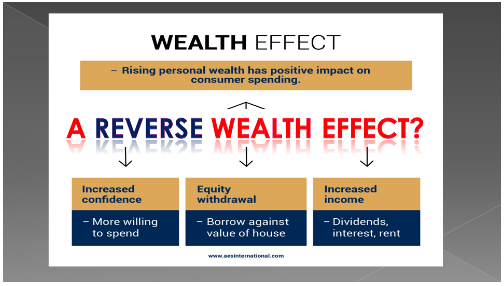
The reverse wealth effect is a psychological and economic phenomenon where consumers reduce their spending because the value of their financial assets decreases. Unlike a direct income shock, such as losing a job or receiving a pay cut, this shift in consumer behavior occurs even if an individual’s current cash flow remains completely unchanged. When stock portfolios plunge, home values drop, or cryptocurrency markets crash, people feel poorer on paper. This perceived loss of security triggers a powerful instinct to save rather than spend, creating a ripple effect that can drag down an entire economy.

To fully understand this concept, it helps to look at its opposite: the standard wealth effect. In a booming economy, rising asset prices make individuals feel financially secure and optimistic about the future. A homeowner who sees their property value appreciate by a hundred thousand dollars feels a sense of newfound affluence. Even though they cannot easily spend that home equity to buy groceries, that paper wealth gives them the confidence to dine out more often, buy a new car, or take an expensive vacation. They feel cushioned by their assets, which lowers their incentive to save out of their regular paycheck and increases their marginal propensity to consume.

The reverse wealth effect flips this dynamic with devastating efficiency. When asset markets experience a prolonged downturn, the psychological safety net vanishes. A worker with a steady salary might look at their retirement account and see that it has lost twenty percent of its value over a few months. Objectively, their biweekly paycheck is identical to what it was before the crash, and their ability to cover immediate expenses is uncompromised. However, the realization that their long-term financial security has eroded induces anxiety. The future suddenly feels uncertain and risky.

This anxiety manifests as immediate defensive economic behavior. Consumers begin to scale back on discretionary expenses to compensate for the perceived loss in total net worth. Plans for home renovations are shelved, luxury purchases are postponed, and high-end brands are swapped for budget alternatives. Because consumer spending drives the vast majority of economic activity in modern developed nations, this collective belt-tightening has immediate macroeconomic consequences.

***

***

As millions of households simultaneously reduce their spending, businesses begin to feel the squeeze. Retailers, entertainment venues, and service providers see their revenues decline. In response to dropping demand, corporations slow down production, trim operational costs, and halt expansion plans. This reduction in corporate activity eventually leads to hiring freezes or layoffs, converting a psychological “paper loss” into a tangible income shock for workers who lose their jobs. Thus, the reverse wealth effect can act as a catalyst that accelerates an economic slowdown, turning a simple market correction into a full-scale recession.

Central banks and monetary policymakers watch asset markets closely for this exact reason. When interest rates are raised rapidly to combat inflation, asset prices usually fall as borrowing becomes more expensive and future corporate earnings are discounted heavily. While policymakers may intend to cool down an overheating economy, a sharp drop in housing and stock markets can trigger a reverse wealth effect that is far more severe than intended. If consumer confidence shatters too quickly, the drop in spending can cause a hard landing for the economy.

Ultimately, the reverse wealth effect highlights the deep connection between human psychology and macroeconomic stability. It serves as a reminder that economic decisions are not made purely on the basis of cold, hard cash flow or current income. Perceptions, expectations, and the fluid value of accumulated wealth heavily dictate how confident people feel about participating in the economy. When the illusion of rising wealth disappears, the reality of economic contraction quickly follows.

EDUCATION: Books

SPEAKING: Dr. Marcinko will be speaking and lecturing, signing and opining, teaching and preaching, storming and performing at many locations throughout the USA this year! His tour of witty and serious pontifications may be scheduled on a planned or ad-hoc basis; for public or private meetings and gatherings; formally, informally, or over lunch or dinner. All medical societies, financial advisory firms or Broker-Dealers are encouraged to submit an RFP for speaking engagements: CONTACT: Ann Miller RN MHA at MarcinkoAdvisors1738@outlook.com -OR- http://www.MarcinkoAssociates.com

Like, Refer and Subscribe

(©) Copyright USA. All rights reserved.

SEND IN YOUR ME-Ps & TOPIC IDEAS, TODAY!

HOSPITALS: http://www.crcpress.com/product/isbn/9781466558731

CLINICS: http://www.crcpress.com/product/isbn/9781439879900

ADVISORS: www.CertifiedMedicalPlanner.org

FINANCE: Financial Planning for Physicians and Advisors

INSURANCE: Risk Management and Insurance Strategies for Physicians and Advisors

Dictionary of Health Economics and Finance

Dictionary of Health Information Technology and Security

Dictionary of Health Insurance and Managed Care

***

PLUMMETING & PLUNGING: Global Stock Markets

By Dr. David Edward Marcinko; MBA MEd

http://www.DavidEdwardMarcinko.com

SPONSOR: http://www.MarcinkoAssociates.com

****

***

The Mechanics of Momentum: Political Shift and the Tech Realignment

The dramatic plunge in global financial markets today stands as a stark reminder of how rapidly optimism can transform into panic when political realignment collides with systemic valuation anxieties. Just twenty-four hours after celebrating a historic post-midterm election rally, Wall Street experienced a severe reversal, wiping out trillions of dollars in market value. The absolute epicenter of this rout was the technology sector, specifically the high-flying semiconductor and artificial intelligence trades that have propelled equity benchmarks to record heights over the past year. Analyzing why the market suffered such a swift breakdown requires looking at a volatile confluence of political shockwaves, immediate regulatory fears, and underlying skepticism regarding corporate capital expenditures.

The fundamental catalyst for the panic stems directly from the shifting balance of power following the midterm congressional elections. Financial markets inherently dislike uncertainty, yet they often overreact to changes in governance. When early post-election headlines initially brought a wave of certainty, equity futures soared on the assumption that a stable political environment would preserve corporate momentum. However, as the finality of a decisive Democratic legislative sweep crystallized, institutional investors abruptly shifted their focus toward the policy implications of the incoming Congress.

For the past several quarters, the market has operated under the assumption of an uninhibited buildout of artificial intelligence data centers, buoyed by promises of continuous federal deregulation. The incoming legislative majority campaigned heavily on platforms critical of massive data center expansion, citing mounting concerns over rising electricity prices and strain on the domestic power grid. Consequently, traders rapidly priced in a reality where the expansion of AI hardware would face strict oversight, potential moratoriums on data center construction, and heightened environmental mandates. This sudden policy threat fundamentally disrupted the growth models used to justify premium stock valuations, prompting a mass exodus of capital from the year’s most crowded trades.

The ensuing correction in technology indices exposes a deeper, pre-existing vulnerability: growing skepticism over the artificial intelligence revenue model. For months, hyperscale technology companies and major cloud providers have deployed hundreds of billions of dollars globally to construct computing infrastructure. Institutional investors were already quietly questioning the timeline required for these massive capital deployments to generate substantial financial returns. The threat of regulatory restrictions served as the ultimate trigger, converting structural skepticism into an active panic. Investors concluded that if data center construction becomes slower and more expensive due to legislative oversight, the return on investment will stretch even further into the future. This realization triggered a wave of profit-taking, which rapidly escalated into a full-scale liquidation across prominent chip manufacturers and software developers.

Crucially, the sheer speed of the downturn was exacerbated by technical market factors and herd behavior. In modern financial markets, automated algorithms and quantitative trading strategies react instantaneously to specific policy shifts and volatility spikes. As major indices broke below key moving averages, automated sell programs activated, placing downward pressure on prices. Wall Street’s prominent volatility gauge spiked significantly, reflecting a dramatic premium on downside protection. Seeing institutional entities aggressively derisking, retail traders panicked, executing their largest single-day equity liquidation in years. This cascading effect meant that selling was no longer restricted to technology firms; all primary market sectors closed lower as asset managers sold liquid positions across financial, manufacturing, and consumer industries to balance portfolio risk.

***

***

The broader macroeconomic environment provided the dry tinder for this sell-off. Elevated borrowing costs had already left corporations sensitive to structural friction. When geopolitical risks flared alongside localized energy infrastructure disruptions, commodity markets reacted defensively, immediately reigniting fears of inflation. Higher energy input costs complicate the expansion of any power-dependent industry, intensifying the pressure on tech corporations facing regulatory scrutiny. Faced with the prospect of sticky inflation, rising capital costs, and a decelerating infrastructure buildout, investors chose to flee toward safe-haven assets, prompting a flight to quality in the government bond market.

Ultimately, the market collapse is a classic narrative of a technical correction colliding with systemic repricing. The midterm election did not change corporate earnings overnight, but it decisively shifted future growth expectations. The speculative premium that had built up around technology infrastructure dissolved the moment investors realized that political and environmental realities could slow the pace of commercial expansion. Wall Street proved once again that when long-term assumptions are challenged by immediate structural hurdles, capital prioritizes safety over speculation, prompting a swift revaluation of global equity values.

EDUCATION: Books

SPEAKING: Dr. Marcinko will be speaking and lecturing, signing and opining, teaching and preaching, storming and performing at many locations throughout the USA this year! His tour of witty and serious pontifications may be scheduled on a planned or ad-hoc basis; for public or private meetings and gatherings; formally, informally, or over lunch or dinner. All medical societies, financial advisory firms or Broker-Dealers are encouraged to submit an RFP for speaking engagements: CONTACT: Ann Miller RN MHA at MarcinkoAdvisors1738@outlook.com -OR- http://www.MarcinkoAssociates.com

Like, Refer and Subscribe

(©) Copyright USA. All rights reserved.

SEND IN YOUR ME-Ps & TOPIC IDEAS, TODAY!

HOSPITALS: http://www.crcpress.com/product/isbn/9781466558731

CLINICS: http://www.crcpress.com/product/isbn/9781439879900

ADVISORS: www.CertifiedMedicalPlanner.org

FINANCE: Financial Planning for Physicians and Advisors

INSURANCE: Risk Management and Insurance Strategies for Physicians and Advisors

Dictionary of Health Economics and Finance

Dictionary of Health Information Technology and Security

Dictionary of Health Insurance and Managed Care

***