


 Support our online development, and advance our onground research initiatives in free market economics, as we seek to showcase the brightest Next-Gen minds.
THE ME-P DISCLAIMER: Posts, comments and opinions do not necessarily represent iMBA, Inc., but become our property after submission. Copyright © 2006 to-date. iMBA, Inc allows colleges, universities, medical and financial professionals and related clinics, hospitals and non-profit healthcare organizations to distribute our proprietary essays, photos, videos, audios and other documents; etc. However, please review copyright and usage information for each individual asset before submission to us, and/or placement on your publication or web site. Attestation references, citations and/or back-links are required. All other assets are property of the individual copyright holder.


By Dr. David Edward Marcinko; MBA MEd
http://www.DavidEdwardMarcinko.com
SPONSOR: http://www.MarcinkoAssociates.com
****

***
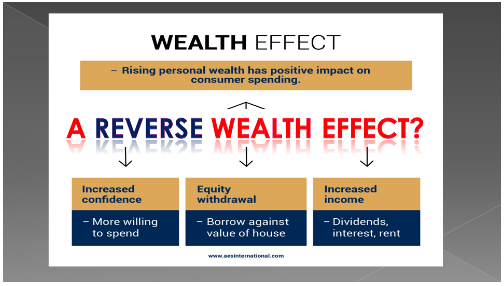
The reverse wealth effect is a psychological and economic phenomenon where consumers reduce their spending because the value of their financial assets decreases. Unlike a direct income shock, such as losing a job or receiving a pay cut, this shift in consumer behavior occurs even if an individual’s current cash flow remains completely unchanged. When stock portfolios plunge, home values drop, or cryptocurrency markets crash, people feel poorer on paper. This perceived loss of security triggers a powerful instinct to save rather than spend, creating a ripple effect that can drag down an entire economy.
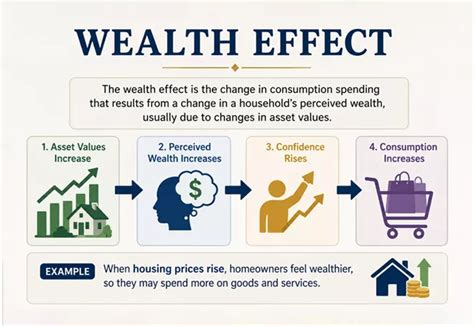
To fully understand this concept, it helps to look at its opposite: the standard wealth effect. In a booming economy, rising asset prices make individuals feel financially secure and optimistic about the future. A homeowner who sees their property value appreciate by a hundred thousand dollars feels a sense of newfound affluence. Even though they cannot easily spend that home equity to buy groceries, that paper wealth gives them the confidence to dine out more often, buy a new car, or take an expensive vacation. They feel cushioned by their assets, which lowers their incentive to save out of their regular paycheck and increases their marginal propensity to consume.
The reverse wealth effect flips this dynamic with devastating efficiency. When asset markets experience a prolonged downturn, the psychological safety net vanishes. A worker with a steady salary might look at their retirement account and see that it has lost twenty percent of its value over a few months. Objectively, their biweekly paycheck is identical to what it was before the crash, and their ability to cover immediate expenses is uncompromised. However, the realization that their long-term financial security has eroded induces anxiety. The future suddenly feels uncertain and risky.
This anxiety manifests as immediate defensive economic behavior. Consumers begin to scale back on discretionary expenses to compensate for the perceived loss in total net worth. Plans for home renovations are shelved, luxury purchases are postponed, and high-end brands are swapped for budget alternatives. Because consumer spending drives the vast majority of economic activity in modern developed nations, this collective belt-tightening has immediate macroeconomic consequences.
***
***
As millions of households simultaneously reduce their spending, businesses begin to feel the squeeze. Retailers, entertainment venues, and service providers see their revenues decline. In response to dropping demand, corporations slow down production, trim operational costs, and halt expansion plans. This reduction in corporate activity eventually leads to hiring freezes or layoffs, converting a psychological “paper loss” into a tangible income shock for workers who lose their jobs. Thus, the reverse wealth effect can act as a catalyst that accelerates an economic slowdown, turning a simple market correction into a full-scale recession.
Central banks and monetary policymakers watch asset markets closely for this exact reason. When interest rates are raised rapidly to combat inflation, asset prices usually fall as borrowing becomes more expensive and future corporate earnings are discounted heavily. While policymakers may intend to cool down an overheating economy, a sharp drop in housing and stock markets can trigger a reverse wealth effect that is far more severe than intended. If consumer confidence shatters too quickly, the drop in spending can cause a hard landing for the economy.
Ultimately, the reverse wealth effect highlights the deep connection between human psychology and macroeconomic stability. It serves as a reminder that economic decisions are not made purely on the basis of cold, hard cash flow or current income. Perceptions, expectations, and the fluid value of accumulated wealth heavily dictate how confident people feel about participating in the economy. When the illusion of rising wealth disappears, the reality of economic contraction quickly follows.
SPEAKING: Dr. Marcinko will be speaking and lecturing, signing and opining, teaching and preaching, storming and performing at many locations throughout the USA this year! His tour of witty and serious pontifications may be scheduled on a planned or ad-hoc basis; for public or private meetings and gatherings; formally, informally, or over lunch or dinner. All medical societies, financial advisory firms or Broker-Dealers are encouraged to submit an RFP for speaking engagements: CONTACT: Ann Miller RN MHA at MarcinkoAdvisors1738@outlook.com -OR- http://www.MarcinkoAssociates.com
Like, Refer and Subscribe
(©) Copyright USA. All rights reserved.
SEND IN YOUR ME-Ps & TOPIC IDEAS, TODAY!
HOSPITALS: http://www.crcpress.com/product/isbn/9781466558731
CLINICS: http://www.crcpress.com/product/isbn/9781439879900
ADVISORS: www.CertifiedMedicalPlanner.org
FINANCE: Financial Planning for Physicians and Advisors
INSURANCE: Risk Management and Insurance Strategies for Physicians and Advisors
Dictionary of Health Economics and Finance
Dictionary of Health Information Technology and Security
Dictionary of Health Insurance and Managed Care
***

Share this:

Filed under: iMBA, Inc. | Tagged: dollars, economics, finance, history, Marcinko, money, news, philosophy, politics, Wealth, wealth-effect | Leave a comment »