Effective Marketing: Using Loss Leaders in Financial Services

By Dr. David Edward Marcinko MBA MEd CMP

***

***

SPONSOR: http://www.CertifiedMedicalPlanner.org

***

In the competitive world of financial services, attracting and retaining clients is a constant challenge. To stand out, many financial advisors employ strategic marketing tactics known as “loss leaders”—free or discounted services designed to showcase value and build trust. These offerings serve as entry points for potential clients, allowing advisors to demonstrate expertise and initiate long-term relationships.

One of the most common loss leaders is the free initial consultation. This no-obligation meeting gives prospective clients a chance to discuss their financial goals, ask questions, and get a feel for the advisor’s approach. For the advisor, it’s an opportunity to assess the client’s needs and present tailored solutions. While no revenue is generated from this meeting, it often leads to paid engagements once the client feels confident in the advisor’s capabilities.

Another popular tactic is offering a complimentary financial plan or portfolio review. These services provide tangible insights into a client’s current financial situation and suggest improvements. By delivering real value upfront, advisors build credibility and demonstrate their analytical skills. Clients who receive actionable advice are more likely to continue working with the advisor on a paid basis.

Educational content also plays a key role in loss leader strategy. Advisors frequently host free webinars, workshops, or seminars on topics like retirement planning, tax strategies, or investment basics. These events not only educate attendees but also position the advisor as a thought leader. Attendees often leave with a better understanding of their financial needs and a desire to seek personalized guidance.

In the digital realm, advisors may offer free tools and assessments on their websites. These include retirement readiness calculators, risk tolerance quizzes, and budgeting templates. Such tools engage users and provide personalized feedback, creating a natural segue into one-on-one consultations. Additionally, offering free newsletters or eBooks helps advisors stay top-of-mind while delivering ongoing value.

Some advisors go further by waiving fees for introductory services, such as account setup or the first few months of investment management. This lowers the barrier to entry and encourages hesitant clients to try the service. Once clients experience the benefits, they’re more likely to commit long-term.

Loss leaders are not limited to high-net-worth individuals. Advisors targeting younger or less affluent clients may offer free debt management plans or budgeting assistance. These services address immediate concerns and build loyalty among clients who may become more profitable as their financial situations improve.

Ultimately, loss leaders are about building relationships. By offering something of value without immediate compensation, financial advisors demonstrate their commitment to helping clients succeed. This fosters trust, encourages engagement, and often leads to lasting partnerships. In a field where reputation and reliability are paramount, loss leaders serve as powerful tools for growth and differentiation.

COMMENTS APPRECIATED

EDUCATION: Books

SPEAKING: Dr. Marcinko will be speaking and lecturing, signing and opining, teaching and preaching, storming and performing at many locations throughout the USA this year! His tour of witty and serious pontifications may be scheduled on a planned or ad-hoc basis; for public or private meetings and gatherings; formally, informally, or over lunch or dinner. All medical societies, financial advisory firms or Broker-Dealers are encouraged to submit an RFP for speaking engagements: CONTACT: Ann Miller RN MHA at MarcinkoAdvisors@outlook.com -OR- http://www.MarcinkoAssociates.com

Like, Refer and Subscribe

***

***

TENDENCY: Consistency and Commitment

By Staff Reporters and AI

***

***

Consistency and Commitment Tendency: Human beings have evolved – probably both genetically and socially – to be consistent.  It is easier and safer to deal with others if they honor their commitments and if they behave in a consistent and predictable manner over time. This allows people to work together and build trust that is needed for repeat dealings and to accomplish complex tasks. 

In the jungle, this trust was necessary to for humans to successfully work as a team to catch animals for dinner, or fight common threats.  In business and life it is preferable to work with others who exhibit these tendencies.  Unfortunately, the downside of these traits is that people make errors in judgment because of the strong desire not to change, or be different (“lemming effect” or “group-think”).  So the result is that most people will seek out data that supports a prior stated belief or decision and ignore negative data, by not “thinking outside the box”. 

Additionally, future decisions will be unduly influenced by the desire to appear consistent with prior decisions, thus decreasing the ability to be rational and objective.  The more people state their beliefs or decisions, the less likely they are to change even in the face of strong evidence that they should do so.  This bias results in a strong force in most people causing them to avoid or quickly resolve the cognitive dissonance that occurs when a person who thinks of themselves as being consistent and committed to prior statements and actions encounters evidence that indicates that prior actions may have been a mistake. 

According to colleague Dan Ariely PhD, it is particularly important therefore for advisors to be aware that their communications with clients and the press clouds the advisor’s ability to seek out and process information that may prove current beliefs incorrect.  Since this is obviously irrational, one must actively seek out negative information, and be very careful about what is said and written, being aware that the more you shout it out, the more you pound it in.

COMMENTS APPRECIATED

Subscribe and Like!

***

***

MONEY SCRIPTS: Fundamental Subconscious Beliefs and Economic Behavioral Patterns Defined

SALES PSYCHOLOGY FOR INVESTMENT ADVISORS, FINANCIAL ADVISORS, INSURANCE AGENTS, WEALTH MANAGERS AND FINANCIAL PLANNERS

By Dr. David Edward Marcinko; MBA MEd CMP®

http://www.MarcinkoAssociates.com

***

***

SPONSOR: http://www.CertifiedMedicalPlanner.org

***

***

Stocks were decimated yesterday in the first full trading day following President Trump’s tariff announcement. It was the biggest single-day decline since the start of the Covid-19 pandemic in March 2020. Every Magnificent Seven stock was battered—Apple worst of all. And so perhaps it is a good time to discuss the concept of “Money Scripts”.

***

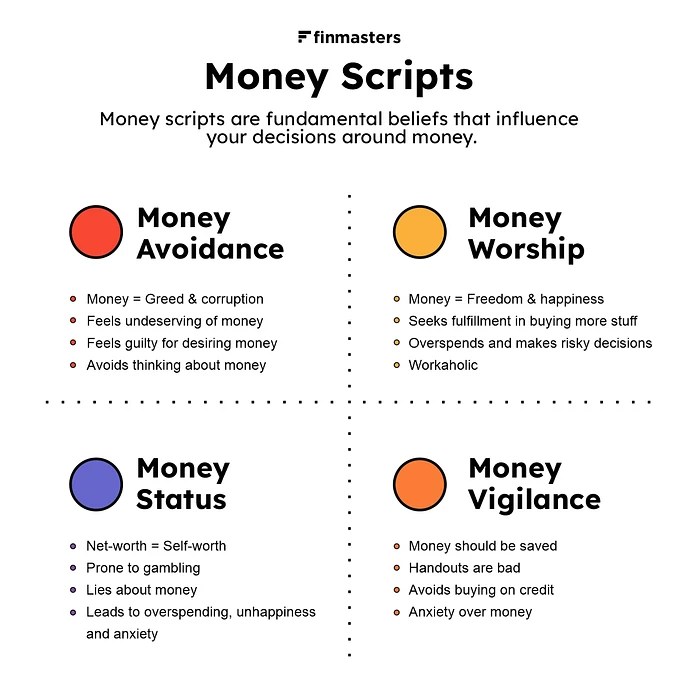
Money Scripts are unconscious beliefs about money that are typically only partially true, are developed in childhood, and drive adult financial behaviors. Money scripts may be the result of “financial flashpoints,” which are salient early experiences around money that have a lasting impact in adulthood. Money scripts are often passed down through the generations and social groups often share similar money scripts. And so, we argue that Money scripts are at the root of all illogical, ill-advised, self-destructive, or self-limiting financial behaviors.

In research at Kansas State University [KSU], researchers identified four distinct Money script patterns, which are associated with financial health and predict financial behaviors. These include: (a) money avoidance, (b) money worship, (c) money status, and (d) money vigilance [personal communication Brad Klontz, PsyD, CFP®, Kenneth Shubin-Stein, MD, MPH, MS, CFA and Sonya Britt, PhD, CFP®].

And so, we all like to think our financial decisions are fully rational, but the truth is that our subconscious beliefs have a dramatic impact on our money and financial decisions. These money scripts are important to know and understand. A summary is below:

            Money Avoidance

Money avoidance scripts are illustrated by beliefs such as “Rich people are greedy,” “It is not okay to have more than you need,” and “I do not deserve a lot of money when others have less than me.” Money avoiders believe that money is bad or that they do not deserve money. They believe that wealthy people are corrupt and there is virtue in living with less money. They may sabotage their financial success or give money away even though they cannot afford to do so. Money avoidance scripts may be associated with lower income and lower net worth and predict financial behaviors including ignoring bank statements, overspending, financial dependence on others, financial enabling of others, and having trouble sticking to a budget.

            Money Worship 

Money worship is typified by beliefs such as “More money will make you happier,” “You can never have enough money,” and “Money would solve all my problems.” Money worshipers are convinced that money is the key to happiness. At the same time, they believe that one can never have enough. Money worships have lower income, lower net worth, and higher credit card debt. They are more likely to be hoarders, spend compulsively, and put work ahead of family.

            Money Status

Money status scripts include “I will not buy something unless it is new,” “Your self-worth equals you net worth,” and “If something isn’t considered the ‘best’ it is not worth buying.” Money status seekers see net worth and self-worth as being synonymous. They pretend to have more money than they do and tend to overspend as a result. They often grew up in poorer families and believe that the universe should take care of their financial needs if they live a virtuous life. Money status scripts are associated with compulsive gambling, overspending, being financially dependent on others, and lying to one’s spouse about spending.

            Money Vigilance

Money vigilant beliefs include “It is important to save for a rainy day,” “You should always look for the best deal, even if it takes more time,” and “I would be a nervous wreck if I did not have an emergency fund.” The money vigilants are alert, watchful and concerned about their financial welfare. They are more likely to save and less likely to buy on credit. As a result, they tend to have higher income and higher net worth. They also have a tendency to be anxious about money and are secretive about their financial status outside of their household. While money vigilance is associated with frugality and saving, excessive anxiety can keep someone from enjoying the benefits that money can provide.

Identification

When money scripts are identified, it is helpful to examine where they came from. A simple behavioral finance technique involves reflecting on the following questions:

  • What three lessons did you learn about money from your mother?
  • What three lessons did you learn about money from your father?
  • What is your first memory around money?
  • What is your most painful money memory?
  • What is your most joyful money memory?
  • What money scripts emerged for you from this experience?
  • How have they helped you?
  • How have they hurt you?
  • What money scripts do you need to change?

Conclusion

Ideally, from a balanced middle ground, we can see past the limitations of money scripts, our self and others who are polarized. Those who believe “Money is meant to be spent” or “Money is meant to be saved” have a world view that results in extreme positions. Labeling them as “correct” or “wrong” is not a useful way to try to shift anyone’s polarized money script beliefs.

EDUCATION: Books

SPEAKING: Dr. Marcinko will be speaking and lecturing, signing and opining, teaching and preaching, storming and performing at many locations throughout the USA this year! His tour of witty and serious pontifications may be scheduled on a planned or ad-hoc basis; for public or private meetings and gatherings; formally, informally, or over lunch or dinner. All medical societies, financial advisory firms or Broker-Dealers are encouraged to submit a RFP for speaking engagements: CONTACT: MarcinkoAdvisors@outlook.com 

COMMENTS APPRECIATED

Read, Refer, Like and Subscribe

***

***

PYGMALION: Rosenthal Effect

By Staff Reporters

***

***

The Pygmalion Effect, also known as the Rosenthal Effect, is a fascinating psychological phenomenon where higher expectations lead to an increase in performance. This concept originated from a study conducted by Robert Rosenthal and Lenore Jacobson in the 1960s. They discovered that when teachers were led to believe that certain students were expected to perform better academically, those students indeed showed significant improvement.

Here’s a brief overview of how the Pygmalion Effect works:

  1. Expectation Setting: When someone in a position of authority (like a teacher or manager) has high expectations for an individual, they often communicate these expectations through subtle cues.
  2. Behavioral Changes: The individual receiving these cues tends to internalize the expectations and changes their behavior accordingly. They might become more motivated, put in more effort, and show greater persistence.
  3. Performance Improvement: As a result of these behavioral changes, the individual’s performance improves, thereby fulfilling the initial high expectations.

This effect highlights the power of positive reinforcement and belief in someone’s potential. It underscores the importance of fostering a supportive and encouraging environment, whether in educational settings, workplaces, or personal relationships.

If you’re interested in applying the Pygmalion Effect in your life, consider these tips:

  • Set High, Yet Realistic Expectations: Believe in the potential of those around you and communicate your confidence in their abilities.
  • Provide Support and Resources: Ensure that individuals have the tools and support they need to meet these expectations.
  • Offer Positive Feedback: Regularly acknowledge and celebrate progress and achievements to reinforce positive behavior.

Remember, the Pygmalion Effect is a powerful reminder that our beliefs and expectations can significantly influence the outcomes we see in others.

COMMENTS APPRECIATED

Refer and Subscribe

***

***

EMBRACING Stock Market Stoicism

By Vitaliy Katsenelson CFA

***

***

Embracing Stock Market Stoicism 

2024 brought me back to a core Stoic principle that I hold close to my heart: the dichotomy of control. Here’s the gist: Some things are within our power—our values, our character, our decisions—and some aren’t—like your brother-in-law’s random (and possibly dumb) comment, your spouse’s mood, or the fact that every traffic light turns red right as you pull up.

In investing, it’s the same. We can control:

  • The quality of our research—being logical and thorough in our research
  • Our decisions and discipline—systematically following our research
  • Our reactions—how we react to the news and external environmental pressure (I will discuss this at the end of the letter)

The market can price our stocks however it pleases on a month-to-month—or even year-to-year—basis. That’s the part we can’t control. We have to remember that these market prices are merely opinions, not final verdicts. The Stoics teach us to focus our energy on what we can influence (our process) and accept what we can’t (the market’s whims).

This probably sounds straightforward, but there’s a twist that makes it harder for you, the client, to see how this all plays out in real time. You can easily check the portfolio’s value—my decisions, not so much. In theory, I could make subpar investments and hide behind fancy Stoic talk.

That’s exactly the why of these very detailed letters: to show you our thinking, walk you through our individual decisions. I write, you read—that’s our agreement. You’re the judge of whether my process makes sense. But I can’t do that part for you.

CONTINUE READING: https://investor.fm/embracing-stock-market-stoicism/?mc_cid=25f3bd9eb4&mc_eid=7a63a03234

COMMENTS APPRECIATED

Like, Refer and Subscribe

***

***