DONOR ADVISED FUND: Defined

WHAT IS A DONOR ADVISED FUND?

Sponsor: http://www.CertifiedMedicalPlanner.org

***

***

A donor-advised fund is a private account created to manage and distribute charitable donations on behalf of an organization, family, or individual. Donor-advised funds can democratize philanthropy by aggregating the contributions of multiple donors, thus multiplying their impact on worthy causes. Donor-advised funds also have abundant tax advantages.

DONOR DEPENDENCY: https://medicalexecutivepost.com/2025/01/02/culture-donation-dependency/

Donor-advised funds have become increasingly popular, as they offer the donor greater ease of administration while still allowing them to maintain significant control over the placement and distribution of charitable gifts. But, unlike private foundations, donor-advised fund holders enjoy a federal income tax deduction of up to 60% of adjusted gross income (AGI) for cash contributions and up to 30% of AGI for the appreciated securities they donate. Donors to these funds can contribute cash, stock shares, and other assets. When they transfer assets such as limited-partnership interests, they can avoid capital gains taxes and receive immediate fair market value tax deductions.

MEDICAL ETHICS: https://medicalexecutivepost.com/2024/06/20/medical-ethics-physician-and-financial-organizations/

According to the National Philanthropic Trust’s 2023 Donor-Advised Fund Report, these funds have continued to grow in recent years, despite some headwinds including the Covid-19 pandemic and occasional stock market setbacks. Total grants awarded by donor-advised funds in 2022 increased by 9% to $52.16 billion, while total contributions rose by 9% to $85.5 billion.

Many donor-advised funds accept non-cash assets—such as checks, wire transfers, and cash positions from a brokerage account—in addition to cash and cash equivalents.

Donating non-cash assets may be more beneficial for individuals and businesses, leading to bigger tax bigger write-offs.

PHILANTHROPY: https://medicalexecutivepost.com/2021/11/15/national-philanthropy-day-2021/

COMMENTS APPRECIATED

Like and Refer

***

***

HEALTHCARE VALUATION: Terms and Definitions

By Health Capital Consultants, LLC

***

***

The term “value” has many different meanings and definitions to different parties. Therefore, at the outset of each valuation engagement, it is critical to define appropriately (and have all parties agree to) the standard of value to be employed in developing the valuation opinion.

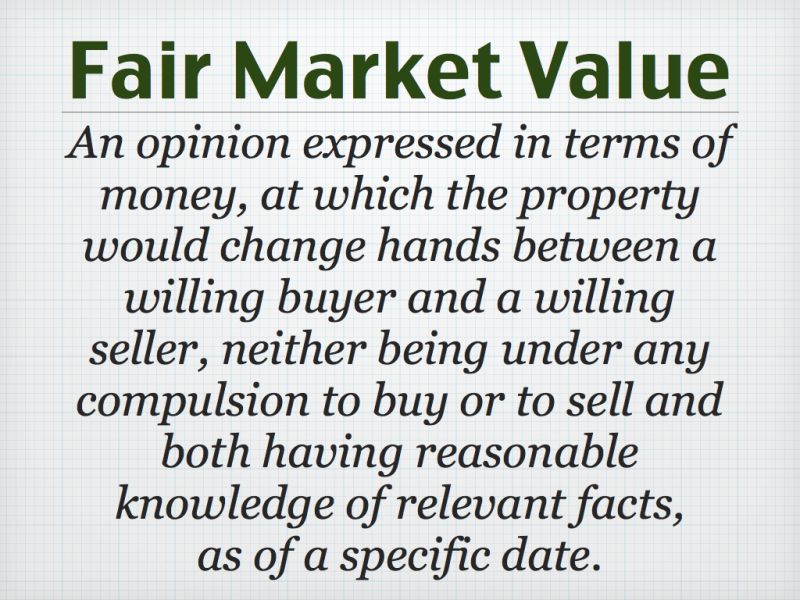
The standard of value defines the type of value to be determined and answers the question “value to whom?” There are several standards of value that may be sought, including: Fair Market Value (FMV), Fair Value, Investment Value, and Liquidation Value. (Read more...) 

COMMENTS APPRECIATED

Refer, Subscribe and Like

***

***

Multi-Specialty Surveys for Physician Compensation – Released

By Health Capital Consultants, LLC

***

***

It’s the most wonderful time of the year – Survey Season! Beginning in late May each year, numerous industry normative benchmark physician production and compensation surveys begin publishing the most recent year’s reports. These healthcare and specialty specific surveys annually report specific types of physician compensation and productivity metrics across the country for various specialties and are widely used by hospitals, physician practices, and healthcare compensation and valuation experts, are often used for the determination of Fair Market Value (FMV) physician compensation for regulatory compliance purposes.

CITE: https://www.r2library.com/Resource

Additionally, the government has referenced and utilized industry normative benchmark compensation surveys (including those listed below) in reviewing and litigating physician compensation arrangements, indicating their reliance on this data as well. (Read more…)

COMMENTS APPRECIATED

Thank You

***

***

PHYSICIAN ACQUISITION: The Art of Acquiring Your Medical Practice

Part Two: Medical Practice Valuation

By Dr. David Edward Marcinko, MBA, MED, CMP

www.CertifiedMedicalPlanner.org

In Part 1, we discussed how to establish fair market value (FMV) for a medical practice in the article, “Establish Your Practice’s Fair Market Value.” This time, we’ll review important terms and conditions for the sale acquisition and transaction.

LINK: https://medicalexecutivepost.com/2023/02/02/establish-your-practices-fair-market-value/

Valuation Types

Unfortunately, as a general rule, medical practice worth is presently deteriorating. A good medical practice is no longer a good business necessarily, and selling doctors can no longer automatically expect to extract a premium sale price. Nevertheless, appraising your medical practice on a periodic basis can play a key role in obtaining maximum value for it.

Competent practice valuation specialists typically charge a retainer to cover out-of-pocket expenses. Fees should not be based on a percentage of practice value, and may take 30-45 days to complete. Flat fees should be the norm because a sliding scale or percentage fee may be biased toward over-valuation in a declining marketplace. Fees range from $7,500-$50,000 for the small to large medical practice or clinic.

Expect to pay a retainer and sign a formal, professional engagement letter. Seek an unbiased and independent viewpoint. Buyer and sellers should each have their own independent appraisal done, using similar statistics, accounting measures, and economic assumptions.

At the Institute of Medical Business Advisors, Inc www.MedicalBusinessAdvisors.com we use three engagement levels that vary in intensity, purpose, and cost:

1. A comprehensive valuation provides an unambiguous value range. It is supported by most all procedures that valuators deem relevant, with mandatory onsite review. This gold standard is suitable for contentious situations. A written “opinion of value” is applicable for litigation support activities like depositions and trial. It is also useful for external reporting to bankers, investors, the public, Internal Revenue Service (IRS), etc.

2. A limited valuation lacks additional suggested Uniform Standards of Professional Appraisal Practice (USPAP) procedures. It is considered to be an “agreed upon engagement,” when the client is the only user. For example, it may be used when updating a buy/sell agreement, or when putting together a practice buy-in for a valued associate. This limited valuation would not be for external purposes, so no onsite visit is necessary and a formal opinion of value is not rendered.

3. An ad-hoc valuation is a low level engagement that provides a gross non-specific approximation of value based on limited parameters or concerns involved parties. Neither a written report nor an opinion of value is rendered. It is often used periodically as an internal organic growth/decline gauge.

Structure Sales Transactions and Acquisitions

When the practice price has been determined and agreed on, the actual sales deal can be structured in a couple of ways:

(1) Stock Purchase v. Asset Purchase

In an asset transaction, the buyer will receive a tax amortization benefit associated with the intangible value of the business. This tax amortization represents a non-cash expense benefiting the buyer. In this case, the present value of those future tax benefits is added to the business enterprise value.

(2) Corporate Transactions

Typical private deals in the past involved some multiple (ratio) of earning before income taxes (EBIT)—usually a combination of cash, restricted stock, notes receivable, and possibly assumption of liabilities. For some physician hospital organizations, and public deals, the receipt of common stock can increase the practice price by as much as 40-50 percent (to accept the corresponding business risk, in lieu of cash).

Complete the Deal

The deal structure will vary depending on whether the likely buyer is a private practitioner, health system or a corporate partner. Some key issues to consider in the “art of the deal” include:

  • Working capital (in or out?): Including working capital in the transaction will increase the sale price.
  • Stock vs. asset transaction: Structuring the deal as an asset purchase will increase practice value due to the tax amortization benefits received by the buyer for intangible assets of the practice.
  • Common stock premium: The total sale price can be significantly higher than a cash equivalent price for accepting the risk and relative illiquidity of common stock as part of the payment.
  • Physician compensation: If your goal is to maximize practice value, take home a lower salary to increase practice sale price. The reverse is also true.

Understand Private Deal Structure

Assuming a practice sale is a private transaction, deal negotiations are based on the following pricing methodologies:

Seller financing: Many transactions involve an earn-out arrangement where the buyer puts money down and pays the balance under a formula based on future revenues, or gives the seller a promissory note under similar terms. Seller financing decreases a buyer’s risks (the longer the terms, the lower the risk). Longer terms demand premiums, while shorter terms demand discounts. Premiums that buyers pay for a typical seller-financed practice are usually more than what you would expect from a simple time value of money calculation, as a result of buyer risk reduction from paying over time, rather than up front with a bank loan or all cash. Remember to obtain a life insurance policy on the buyer.

Down payment: The greater the down payment for acquisition of a medical practice, the greater the risk is to the buyer. Consequently, sellers who will take less money up front can command a higher than average price for their practice, while sellers who want more down usually receive less in the end.

Taxation: Tax consequences can have a major impact on the price of a medical practice. For instance, a seller who obtains the majority of the sales price as capital gains can often afford to sell for a much lower price and still pocket as much or more than if the sales price were paid as ordinary income. Value attributed to the seller’s patient list, medical records, name brand, good will, and files qualifies for capital gains treatment. Value paid for the selling doctor’s continuing assistance after the sale and value attributed to a non-compete agreement are taxed at ordinary income. A buyer willing to allocate more for items with capital gains treatment, or a seller willing to take more in ordinary income, can frequently negotiate a better price. This is the essence of economically prudent practice transition planning.

Sidestep Common Buyer Blunders

Here are 10 blunders to avoid, as a buyer:

1. Believing the selling doctor’s attestations. Always verify data through an independent appraisal.

2. Wanting to change the culture of the practice. Be careful: Patients may not adjust quickly to change.

3. Using all available cash without keeping a reserve for potential contingencies.

4. Creating a conflict with the seller by recognizing a weakness and continually focusing on it for a bargain price.

5. Failing to realize that managed care plan contracts can be lost quickly or may not be always transferable.

6. Suffering from analysis paralysis. Money cannot be made by continually checking out a medical practice, only by actually running one.

7. Not appreciating the uniqueness of each practice, and using inaccurate “rules of thumb” from the golden age of medicine.

8. Not realizing that practice worth and goodwill value have plummeted lately and continue to decline in most parts of the country.

9. Not understanding that practice brokers may play both sides of the buy/sell equation for profit. Brokers usually are not obligated to disclose conflicts of interest, are not fiduciaries, and do not provide testimony as a court-approved expert witness.

10. Not hiring an appraisal professional who will testify in court, if need be, using the IRS-approved USPAP methods of valuation. Always assume that the appraisal will be contested (many times, it is).

After pricing and contracting due diligence has been performed, the next step in the medical practice sale process—as Donald Trump might say—is just good, old-fashioned negotiation.

Electronic Downloads

Part I: Part I

Part II: Part II

Additional Reading:

Cimasi, R.J., A.P. Sharamitaro, T.A. Zigrang, L.A.Haynes. Valuation of Hospitals in a Changing Reimbursement and Regulatory Environment. Edited by David E. Marcinko. Healthcare Organizations: Financial Management Strategies. Specialty Technical Publishers, 2008.

Marcinko, D.E. “Getting it Right: How much is a plastic surgery practice really worth?” Plastic Surgery Practice, August 2006.

Marcinko, D.E., H.R. Hetico. The Business of Medical Practice (3rd ed). Springer Publishing,New York,N.Y., 2011.

Marcinko, D.E. and H.R. Hetico. Risk Management and Insurance Planning for Physicians and Advisors. Jones and Bartlett Publishers, Sudbury, Mass., 2007.

Marcinko, D.E. and H.R. Hetico. Financial Planning for Physicians and Advisors. Jones and Bartlett Publishers, Sudbury, Mass., 2007.

Marcinko, D.E. and H.R. Hetico. Dictionary of Health Insurance and Managed Care. Springer Publishers, New York, N.Y., 2007.

Marcinko, D.E. and H.R. Hetico. Dictionary of Health Economics and Finance. Springer Publishers,New York,N.Y., 2007.

Product Details  Product Details

   Product Details 

FAIR MARKET VALUATION DETERMINATION: Medical Practices or Clinics

MEDICAL PRACTICE OR AMBULATORY SURGERY CENTER

MARCINKO ASSOCIATES, Inc.

http://www.MARCINKOASSOCIATES.com

***

FAIR MARKET VALUATION DETERMINATION

There are a Myriad of Reasons for Obtaining a Medical Practice Valuation and Appraisal Engagement:

  • Outright selling-buying
  • Partnership and Associate buy-in / buy-out
  • Mergers and Acquisitions
  • Organic growth tracking
  • Hospital integrations
  • Private and public reporting
  • Financing and Venture Capital
  • Estate and tax planning

Our Capability

We have the ability to provide extensive analysis of value components in healthcare practices and provide appraisals based on business, economic, and market conditions. This involves detailed examination of financials and clinical data in the context of numerous factors including medical specialty, physician supply and demand, payer mix, regulatory environment, regional dynamics, and risk premium.

CITE: https://www.r2library.com/Resource

***

READ MORE: https://marcinkoassociates.com/welcome-medical-colleagues/

THANK YOU

***

***

***

ACCOUNTING: Mark to Market [MTM] Fair Value

***

***

By Staff Reporters

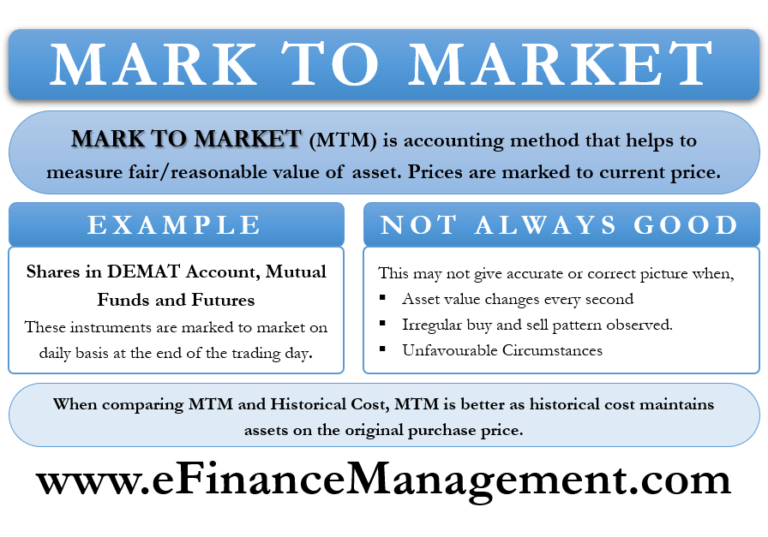
According to Wikipeida, Mark-to-market (MTM or M2M) or fair value accounting is accounting for the “fair value” of an asset or liability based on the current market price, or the price for similar assets and liabilities, or based on another objectively assessed “fair” value.[1] Fair value accounting has been a part of Generally Accepted Accounting Principles (GAAP) in the United States since the early 1990s. Failure to use it is viewed as the cause of the Orange County Bankruptcy,[2][3] even though its use is considered to be one of the reasons for the Enron scandal and the eventual bankruptcy of the company, as well as the closure of the accounting firm Arthur Andersen.[4]

Mark-to-market accounting can change values on the balance sheet as market conditions change. In contrast, historical cost accounting, based on the past transactions, is simpler, more stable, and easier to perform, but does not represent current market value. It summarizes past transactions instead. Mark-to-market accounting can become volatile if market prices fluctuate greatly or change unpredictably. Buyers and sellers may claim a number of specific instances when this is the case, including inability to value the future income and expenses both accurately and collectively, often due to unreliable information, or over-optimistic or over-pessimistic expectations of cash flow and earnings.[5]

Stock brokers allow their clients to access credit via margin accounts. These accounts allow clients to borrow funds to buy securities. Therefore, the amount of funds available is more than the value of cash (or equivalents). The credit is provided by charging a rate of interest and requiring a certain amount of collateral, in a similar way that banks provide loans. Even though the value of securities (stocks or other financial instruments such as options) fluctuates in the market, the value of accounts is not computed in real time. Marking-to-market is performed typically at the end of the trading day, and if the account value decreases below a given threshold (typically a ratio predefined by the broker), the broker issues a margin call that requires the client to deposit more funds or liquidate the account.

COMMENTS APPRECIATE

Thank You

***

***

PHYSICIAN APPRAISAL ENGAGEMENTS: Investment Banking, FMV and Venture Capital

By Staff Reporters

SPONSOR: http://www.MARCINKOASSOCIATES.com

***

***

There are a myriad of reasons for obtaining a Fair Market Value [FMV], Venture Capital [VC} and/or Investment Banking [IB] funding appraisal engagement:

  • Outright Selling-Buying
  • Partnership and Associate buy-in / buy-out
  • Mergers and Acquisitions
  • Organic growth tracking
  • Hospital integrations
  • Private and public reporting
  • Financing and Venture Capital
  • Estate and Tax Planning

And, there are many cautions, too. On July 19, 2023, the Federal Trade Commission (FTC) and the Department of Justice (DOJ) released a draft update of its Merger Guidelines, which guides the regulatory agencies in their review of both mergers and acquisitions in evaluating compliance with federal antitrust laws.

The new Guidelines replace, amend, and consolidate the Vertical Merger Guidelines and Horizontal Merger Guidelines, which were published in 2020 and 2010, respectively.

Our Value Analysis: https://marcinkoassociates.com/fmv-appraisals/

COMMENTS APPRECIATED

Thank You

***

***

***

FAIR MARKET VALUATION DETERMINATION [FMV]

MEDICAL PRACTICE OR AMBULATORY SURGERY CENTER

D.E. MARCINKO ASSOCIATES, Inc.

http://www.MARCINKOASSOCIATES.com

***

FAIR MARKET VALUATION DETERMINATION

There are a Myriad of Reasons for Obtaining a Medical Practice Valuation and Appraisal Engagement:

  • Outright selling-buying
  • Partnership and Associate buy-in / buy-out
  • Mergers and Acquisitions
  • Organic growth tracking
  • Hospital integrations
  • Private and public reporting
  • Financing and Venture Capital
  • Estate and tax planning

MORE: https://marcinkoassociates.com/fmv-appraisals/

Our Capability

We have the ability to provide extensive analysis of value components in healthcare practices and provide appraisals based on business, economic, and market conditions. This involves detailed examination of financials and clinical data in the context of numerous factors including medical specialty, physician supply and demand, payer mix, regulatory environment, regional dynamics, and risk premium.

CITE: https://www.r2library.com/Resource

***

READ MORE: https://marcinkoassociates.com/welcome-medical-colleagues/

THANK YOU

***

FAIR MARKET VALUATION DETERMINATION [FMV]

MEDICAL PRACTICE OR AMBULATORY SURGERY CENTER

D.E. MARCINKO ASSOCIATES, Inc.

http://www.MARCINKOASSOCIATES.com

***

FAIR MARKET VALUATION DETERMINATION

There are a Myriad of Reasons for Obtaining a Medical Practice Valuation and Appraisal Engagement:

  • Outright selling-buying
  • Partnership and Associate buy-in / buy-out
  • Mergers and Acquisitions
  • Organic growth tracking
  • Hospital integrations
  • Private and public reporting
  • Financing and Venture Capital
  • Estate and tax planning

MORE: https://marcinkoassociates.com/fmv-appraisals/

Our Capability

We have the ability to provide extensive analysis of value components in healthcare practices and provide appraisals based on business, economic, and market conditions. This involves detailed examination of financials and clinical data in the context of numerous factors including medical specialty, physician supply and demand, payer mix, regulatory environment, regional dynamics, and risk premium.

CITE: https://www.r2library.com/Resource

***

READ MORE: https://marcinkoassociates.com/welcome-medical-colleagues/

THANK YOU

***

HOME VALUES: Appraised vs. Assessed vs. Fair Market Value

KNOW THE THE DIFFERENCE

By Staff Reporters

***

As doctors, nurses and medical professionals try to get an idea of what their home is worth, please go into the process with the knowledge that the concept of “value” can carry a different definition depending on who’s assigning it.

***

Home Value Estimator | What Is Your House Worth?

For example:

  • Appraised value – The appraised value of your home is the number assigned to it by a professional appraiser. This value is especially important when a home buyer is getting a mortgage. The lender will typically require a professional appraisal to verify that the borrower hasn’t agreed to an unrealistic valuation.
  • Assessed value – The assessed value of your home is the figure assigned to it by the county where it’s located for property tax purposes. While an appraisal involves someone inspecting the interior and exterior of your home, assessments are often conducted in a mass approach by using pricing trends.
  • Fair market value – The fair market value of your home doesn’t involve a professional. Instead, it involves other people just like you who might be willing to pay more because they love a home or a certain neighborhood. So, for example, an appraised value might be $300,000, but a recent surge in buying activity and limited supply might motivate a buyer to go above that price. On the flip side, keep in mind that those buyers might be willing to pay less than what you believe it’s worth, too.
  • CITE: https://www.r2library.com/Resource/Title/082610254

***

MORTGAGES: https://medicalexecutivepost.com/2022/01/23/manual-mortgage-underwriting-what-is-it-really/

RENT v. BUY: https://medicalexecutivepost.com/2017/03/14/the-apartment-rent-vs-home-buy-decision/

MORTGAGE CALCULATOR: https://www.msn.com/en-us/money/personalfinance/use-this-calculator-to-find-out-how-much-house-you-really-can-afford/ar-AATkoSK?li=BBnb7Kz

***

COMMENTS APPRECIATED

Thank You

Subscribe to the Medical Executive-Post

MORE: https://www.amazon.com/Comprehensive-Financial-Planning-Strategies-Advisors/dp/1482240289/ref=sr_1_1?ie=UTF8&qid=1418580820&sr=8-1&keywords=david+marcinko

***

#6: The Six Commandments of Value Investing

***

6. In the long run, stocks revert to their fair value

***

***

EDITOR’S NOTE: Although it has been some time since speaking live with busy colleague Vitaliy Katsenelson CFA, I review his internet material frequently and appreciate this ME-P series contribution. I encourage all ME-P readers to do the same and consider his value investing insights carefully.

By Vitaliy Katsenelson, CFA

***

6. In the long run, stocks revert to their fair value

Reversion to fair value is not a pie-in-the-sky concept. If a stock is significantly undervalued for a long time, then this undervaluation gets cured, eventually. That can happen through share buybacks – the company can basically buy all of its shares and take itself private.

Or it can happen by the company’s paying out its earnings in dividends, thus creating yields that the market will not be able to ignore. Or the company’s competitors will realize that it is cheaper for them to buy the company than to replicate its assets on their own. Either way, undervaluation gets cured.

This faith that undervaluation will not last forever is paramount to value investing. But this is not your regular faith, which requires belief without proof. This is evidence-supported faith with hundreds of years of data to back it. Just look at the US stock market: it has gone through cycles when it was incredibly cheap and others when it was incredibly expensive. At some points in its journey from one extreme to the other, it touched its fair value, even if it was transitory.

Historically, value investing (owning undervalued companies) has done significantly better than other strategies. Paradoxically, the reason it has done well in the long run is because it did not work consistently in the short run. If something works consistently (keyword), everybody piles into it and it stops working.

These aforementioned cycles of temporary brilliance and dumbness are not just common to us mere mortals. Even Warren Buffett’s Berkshire Hathaway goes through them. As just one example, in 1999, when the stock market went up 21%, Berkshire Hathaway stock declined 19%. In 1999, the financial press was writing obituaries for Buffett’s investment prowess.

Suddenly, in 1999, Buffett’s IQ was lagging the market by 40%. At the time, investors were infatuated with internet stocks that were not making money but that were supposed to have a bright future. Investors were selling unsexy “old economy” stocks that Buffett owned in order to buy the “new economy” ones.

If at the end of 1999, you were to sell Berkshire Hathaway and buy the S&P 500 instead, you would have done the easy thing, but it would have been a large (though very common) mistake. Over the next three years Berkshire Hathaway gained over 30% while the S&P declined over 40%. During the year 1999, Buffett’s IQ did not change much; in fact, the (book) value of businesses Berkshire Hathaway owned went up by 0.5% that year. But in 1999, the market’s attention was somewhere else and it chose to price Berkshire Hathaway 19% lower. 

As a value investor, if you do a reasonable job estimating what the business is worth, then at some point the stock market will price it accordingly. You need to have faith. I am acutely aware how wishful this statement sounds. But this faith, the belief in mean reversion, has to be deeply ingrained in our psyche. It will allow us to remain rational when people around us are not. 

***

CITE: https://www.r2library.com/Resource/Title/0826102549

COMMENTS APPRECIATED

Editor’s Final Note; Many thanks to VK for this timely series on value investing. Our ME-P readers appreciate you.

Thank You

Subscribe to the Medical Executive-Post

***

***

FMV of the Medical Practice?

FINANCIAL OPINIONS OF MEDICAL PRACTICE FAIR MARKET VALUE [FMV]
Courtesy: https://lnkd.in/eBf-4vY
Plastic Surgery-Medical Practice Worth, Valuation, Sales & Succession Planning

For doctor-colleagues, buying or selling a practice may be the biggest financial transaction of their lives. Reasons for appraising practice worth include: sales, merger, succession, retirement and estate planning; partnership disputes and divorce; or as an important tool for organic growth and strategic planning.

DHEF: https://lnkd.in/dqdbWM9
FOREWORD: https://lnkd.in/ecwZWxu

However, the transaction is fraught with many pitfalls to avoid and no medical specialty seems immune; especially when it comes to contentious fair market value [FMV] appraisals.

ESSAY: https://lnkd.in/eujJySP
MAXIMIZATION: https://lnkd.in/dG8UYaa
BLUNDERS: https://lnkd.in/etgDpqr
Your comments are appreciate.

BUSINESS, FINANCE, INVESTING & INSURANCE TEXTS:
1 – https://lnkd.in/ebWtzGg
2 – https://lnkd.in/ezkQMfR
3 – https://lnkd.in/ewJPTJs
THANK YOU
***

Transitioning and Appraising a Podiatry [Medical] Practice

Join Our Mailing List

A Round Table Fair Market Valuation Discussion of One

By Dr. David Edward Marcinko MBA CMP™

[Former – American Society of Health Economists (ASHE) member]

[Editor-in-Chief]

www.CertifiedMedicalPlanner.org

Recently, I was asked to participate in a roundtable of expert’s discussion on the worth or fair market value [FMV] of a typical podiatric [medical] practice on an “ongoing concern” basis.

Of course, this is the type of engagement we often perform at the www.MedicalBusinessAdvisors.com And, I have written about this topic informally on this blog, and more formally in our white-papers and books: www.BusinessofMedicalPractice.com

So, I was pleased to add my experienced opinion to the discussion sponsored by a trade industry magazine upon the invitation of Editor Dr. Barry H. Block JD.

LINK: Podiatry Mgmt Round Table

Assessment

Due to copyright issues, I posted only my comments to the questions posed to all participants. Nevertheless, they are very representative of most medical practices with the exception of the noted podiatric-specific differences.

Invitation: Letterhead.iMBA_Inc.

Product Details

Conclusion

Your thoughts and comments on this ME-P are appreciated. Feel free to review our top-left column, and top-right sidebar materials, links, URLs and related websites, too. Then, subscribe to the ME-P. It is fast, free and secure.

Link: http://feeds.feedburner.com/HealthcareFinancialsthePostForcxos

Speaker: If you need a moderator or speaker for an upcoming event, Dr. David E. Marcinko; MBA – Publisher-in-Chief of the Medical Executive-Post – is available for seminar or speaking engagements. Contact: MarcinkoAdvisors@msn.com

Our Other Print Books and Related Information Sources:

Health Dictionary Series: http://www.springerpub.com/Search/marcinko

Practice Management: http://www.springerpub.com/product/9780826105752

Physician Financial Planning: http://www.jbpub.com/catalog/0763745790

Medical Risk Management: http://www.jbpub.com/catalog/9780763733421

Hospitals: http://www.crcpress.com/product/isbn/9781439879900

Physician Advisors: www.CertifiedMedicalPlanner.org

Product DetailsProduct DetailsProduct Details

Thinking About Selling or Transitioning Your Medical Practice?

We Can Help with a FMV Practice Appraisal

ADVERTISEMENT

The www.MedicalBusinessAdvisors.com practice valuation and transition team can help you appraise your medical practice, develop a new associate/partner transition plan, and even help transition your patients.

A Profitable Transition

You can also choose how to “wind-down” or transition out of practice gracefully and economically, as you work with only select patients, on-board a new associate/partner, or sell your practice outright.


Your Practice Business Equity

Either way, we can help you unlock the hard-earned equity in your medical practice and ensure that your patients – and life’s work – are taken care of with a fair market valuation. Purchasing and reviewing our books and white-papers is a great way to start. Otherwise – call us today?

Let’s Talk

770.448.0769

MarcinkoAdvisors@msn.com

Speaker: If you need a moderator or speaker for an upcoming event, Dr. David E. Marcinko; MBA – Publisher-in-Chief of the Medical Executive-Post – is available for seminar or speaking engagements. Contact: MarcinkoAdvisors@msn.com

Our Other Print Books and Related Information Sources:

Health Dictionary Series: http://www.springerpub.com/Search/marcinko

Practice Management: http://www.springerpub.com/product/9780826105752

Physician Financial Planning: http://www.jbpub.com/catalog/0763745790

Medical Risk Management: http://www.jbpub.com/catalog/9780763733421

Healthcare Organizations: www.HealthcareFinancials.com

Physician Advisors: www.CertifiedMedicalPlanner.com

Product Details 

The Ins and Outs of Selling Your Business

Cost-Benefit Analysis and FMV for Entrepreneurs

Join Our Mailing List 

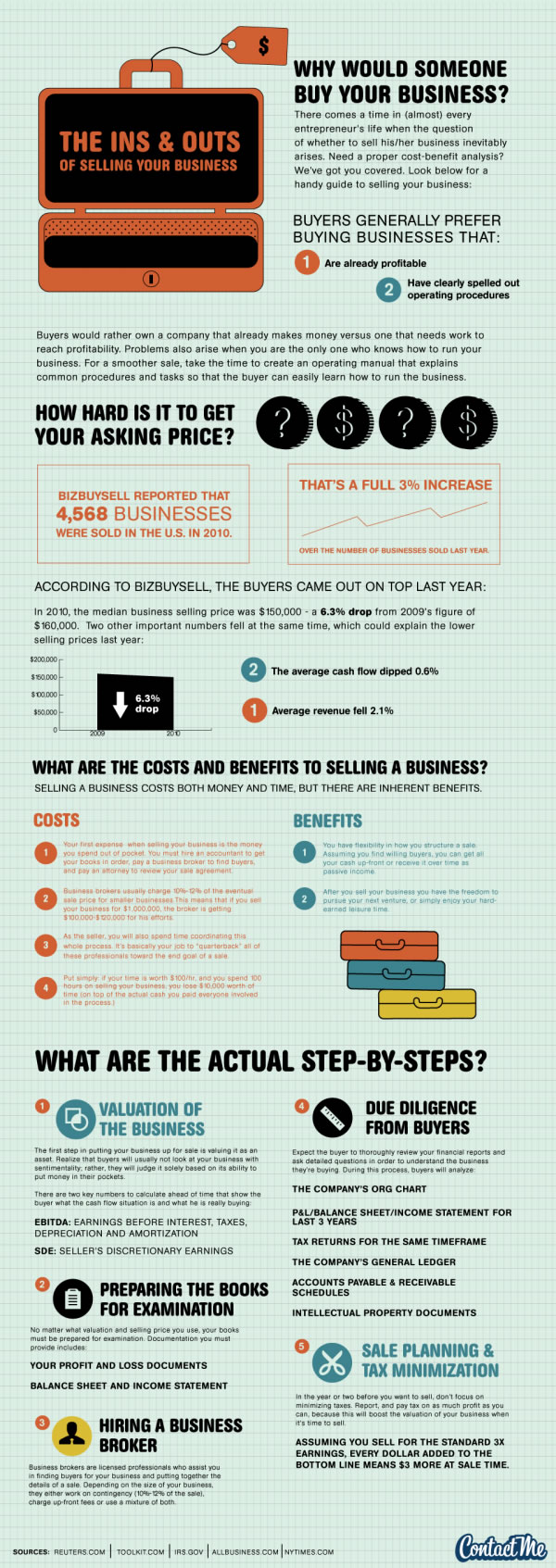
There comes a time in (almost) every entrepreneur’s life when the question of whether to sell his/her business inevitably arises.

So, if you need a proper cost-benefit analysis, take a look at the info-graphic below.

Assessment

Brought to you by contactme.com in collaboration with Column Five

Conclusion

And so, your thoughts and comments on this ME-P are appreciated. Feel free to review our top-left column, and top-right sidebar materials, links, URLs and related websites, too. Then, subscribe to the ME-P. It is fast, free and secure.

Link: http://feeds.feedburner.com/HealthcareFinancialsthePostForcxos

Speaker: If you need a moderator or speaker for an upcoming event, Dr. David E. Marcinko; MBA – Publisher-in-Chief of the Medical Executive-Post – is available for seminar or speaking engagements. Contact: MarcinkoAdvisors@msn.com

Our Other Print Books and Related Information Sources:

Health Dictionary Series: http://www.springerpub.com/Search/marcinko

Practice Management: http://www.springerpub.com/product/9780826105752

Physician Financial Planning: http://www.jbpub.com/catalog/0763745790

Medical Risk Management: http://www.jbpub.com/catalog/9780763733421

Healthcare Organizations: www.HealthcareFinancials.com

Physician Advisors: www.CertifiedMedicalPlanner.com

Subscribe Now: Did you like this Medical Executive-Post, or find it helpful, interesting and informative? Want to get the latest ME-Ps delivered to your email box each morning? Just subscribe using the link below. You can unsubscribe at any time. Security is assured.

Link: http://feeds.feedburner.com/HealthcareFinancialsthePostForcxos

Sponsors Welcomed: And, credible sponsors and like-minded advertisers are always welcomed.

Link: https://healthcarefinancials.wordpress.com/2007/11/11/advertise

Product DetailsProduct DetailsProduct Details       

Product Details  Product Details

   Product Details

On Selling or Transitioning Out of Medical Practice?

We Can Help with a FMV Practice Appraisal – Get a FREE White-Paper

By Ann Miller RN MHA

[Executive-Director]

The www.MedicalBusinessAdvisors.com practice valuation and transition team can help you appraise your medical practice, develop a new associate/partner transition plan, and even help transition your patients.

A Profitable Transition

You can also choose how to “wind-down” or transition out of practice gracefully and economically, as you work with only select patients, on-board a new associate/partner, or sell your practice outright.

Your Practice Business Equity

Either way, we can help you unlock the hard-earned equity in your medical practice and ensure that your patients, and life’s work – are taken care of professionally.

Purchasing and reviewing our books and white-papers is a great way to start. Otherwise – call, or email us, today?

Let’s Talk or e-mail:

770.448.0769

MarcinkoAdvisors@msn.com for a free white paper!

Speaker: If you need a moderator or speaker for an upcoming event, Dr. David E. Marcinko; MBA – Publisher-in-Chief of the Medical Executive-Post – is available for seminar or speaking engagements. Contact: MarcinkoAdvisors@msn.com

Our Other Print Books and Related Information Sources:

Health Dictionary Series: http://www.springerpub.com/Search/marcinko

Practice Management: http://www.springerpub.com/product/9780826105752

Physician Financial Planning: http://www.jbpub.com/catalog/0763745790

Medical Risk Management: http://www.jbpub.com/catalog/9780763733421

Healthcare Organizations: www.HealthcareFinancials.com

Physician Advisors: www.CertifiedMedicalPlanner.com

Product Details


Understanding the Premise of Appraisal Value and Investment Time Horizon

Join Our Mailing List

Key Issues in Healthcare Entity Valuation and Appraisal

By Robert James Cimasi; MHA, ASA, AVA, CBA, CMP™

cimasiwww.HealthCapital.com

The Premise of Value under which any healthcare entity fair market valuation is conducted is an assumption further defining the Standard of Value to be used.

The Premise of Value defines the hypothetical terms of the sale and answers the question, “Value under what further defining circumstances?”  Two general concepts relate to the consideration and selection of the Premise of Value, i.e., “value in use” and “value in exchange.”

Value in Use

Value in use is that premise of value that assumes that the assets will continue to be used as part of an ongoing business enterprise, producing profits as a benefit of ownership.

For example, in valuing the assets of a surgical hospital, the valuator must determine whether it is appropriate to value simply the tangible assets, or if it is appropriate to consider the enterprise as a going concern and incorporate the potential value of intangible assets. Orderly liquidation value involves assuming that the equipment is sold, perhaps separately, over a reasonable period of time. Forced liquidation assumes that the equipment is sold as quickly as possible to the first bidder.

Value in Exchange

Value in exchange is often referred to as “liquidation value.”  Liquidation value describes a sale of the assets of a business enterprise under conditions other than its continued operation as a going concern.

The liquidation can be on the basis of an orderly disposition of the assets where more extensive marketing efforts are made and sufficient time is permitted to achieve the best price for all assets, or on the basis of forced liquidation where assets are sold immediately and without concern for obtaining the best price.

hospital

Liquidation

Of course, costs of liquidation should be considered in the value estimate when using this premise of value.  Shortening the investment time horizon may have a deleterious effect on the valuation of the subject entity as it presents a restriction on the available pool of buyers and investors and the level of physician ownership, as required under the standard of Fair Market Value.

Assessment

Do the dual issues of value premise and time horizon still seem logical in modernity; why or why not? How comfortable are you that a reasonable FMV can be determined for any healthcare entity after passage of  The Patient Protection and Affordable Care Act in March of 2010? Please comment and opine. 

Channel Surfing the ME-P

Have you visited our other topic channels? Established to facilitate idea exchange and link our community together, the value of these topics is dependent upon your input. Please take a minute to visit. And, to prevent that annoying spam, we ask that you register. It is fast, free and secure.

Conclusion

Your thoughts and comments on this ME-P are appreciated. Feel free to review our top-left column, and top-right sidebar materials, links, URLs and related websites, too. Then, subscribe to the ME-P. It is fast, free and secure.

Speaker: If you need a moderator or speaker for an upcoming event, Dr. David E. Marcinko; MBA – Publisher-in-Chief of the Medical Executive-Post – is available for seminar or speaking engagements. Contact: MarcinkoAdvisors@msn.com

OUR OTHER PRINT BOOKS AND RELATED INFORMATION SOURCES:

Product DetailsProduct DetailsProduct Details

Proposed Disallowance of Fair Market Value for FLPs

On the HR 436 Proposal for FLPs

By Linda Trugman; CPAtrugman, MBA, ABV, ASA, MCBA

On January 9, 2009 the US House of Representatives introduced HR 436. The Bill would establish the federal estate tax exemption at $3,500,000, and set the tax rate for estates exceeding that amount at 45 percent, eliminating the currently scheduled 2010 phase-out and subsequent reversion to pre-Bush tax cut levels with the $1 million exclusion and a 55 percent tax rate.

Estate Planning Technique Elimination

Importantly, the Bill, if enacted as proposed, would remove a popular estate planning technique by eliminating most discounts associated with what is referred to generically as family limited partnerships [FLPs, a general term applied to closely held asset holding companies often holding non-business assets].

FLP Non-Controlling Interests

Currently, when a physician-investor or any other individual transfers a non-controlling interest in a FLP, whether by gift or at death, the interest is valued at the price that a willing buyer would pay for the partnership interest, or fair market value. Since such FLP interests are not publicly traded, and do not represent a controlling interest in the partnership, business appraisers often assign substantial discounts in valuing these interests.

Case Model:

For example, a 10 percent limited partnership interest in a partnership that holds $1 million worth of securities would not be valued at $100,000 under current law. Rather, because a buyer of the partnership interest cannot sell the interest on the open market, nor exert control prerogatives on the partnership, he or she would pay materially less for the interest [perhaps 30 percent to 50 percent less]. 

Elimination of FMV Standards

The Bill as drafted would be effective for transfers occurring after the date of enactment. However, there is always the possibility that any final statute might be applied retroactively. While the fate of this piece of legislation is uncertain, it may reflect the attitude of the new administration towards keeping and strengthening the estate tax. 

If HR 436 becomes law, appraisers would no longer be allowed to apply Fair Market Value standards to valuing these non-control FLP interests; they would not be able to apply any discounts to “non-business” assets held by partnerships or other entities. Instead, those assets would be valued as though they were transferred directly to the recipient. 

Assessment

The Bill as drafted would be effective for transfers occurring after the date of enactment. However, there is always the possibility that any final statute might be applied retroactively. While the fate of this piece of legislation is uncertain, it may reflect the attitude of the new administration towards keeping and strengthening the estate tax. I have attached the proposed legislation to this post.

File:  hr-436 

Conclusion

And so, your thoughts and comments on this Medical Executive-Post are appreciated.

Speaker: If you need a moderator or speaker for an upcoming event, Dr. David E. Marcinko; MBA – Publisher-in-Chief of the Executive-Post – is available for seminar or speaking engagements. Contact: MarcinkoAdvisors@msn.com  or Bio: www.stpub.com/pubs/authors/MARCINKO.htm

Our Other Print Books and Related Information Sources:

Practice Management: http://www.springerpub.com/prod.aspx?prod_id=23759

Physician Financial Planning: http://www.jbpub.com/catalog/0763745790

Medical Risk Management: http://www.jbpub.com/catalog/9780763733421

Healthcare Organizations: www.HealthcareFinancials.com

Health Administration Terms: www.HealthDictionarySeries.com

Physician Advisors: www.CertifiedMedicalPlanner.com

Subscribe Now: Did you like this Medical Executive-Post, or find it helpful, interesting and informative? Want to get the latest E-Ps delivered to your email box each morning? Just subscribe using the link below. You can unsubscribe at any time. Security is assured.

Link: http://feeds.feedburner.com/HealthcareFinancialsthePostForcxos