The Stock Market Doesn’t Care About Clinton or Trump

Join Our Mailing List

By

Yep! 

We have only a month to go before voters settle on either Hillary Clinton or Donald Trump.

Guess what?

The stock market doesn’t care a whit.

***

stock-exchange

***

The Stock Market Doesn’t Care About Clinton or Trump | Rebalance-IRA.com

Conclusion

Your thoughts and comments on this ME-P are appreciated. Feel free to review our top-left column, and top-right sidebar materials, links, URLs and related websites, too. Then, subscribe to the ME-P. It is fast, free and secure.

Speaker: If you need a moderator or speaker for an upcoming event, Dr. David E. Marcinko; MBA – Publisher-in-Chief of the Medical Executive-Post – is available for seminar or speaking engagements. Contact: MarcinkoAdvisors@msn.com

OUR OTHER PRINT BOOKS AND RELATED INFORMATION SOURCES:

Comprehensive Financial Planning Strategies for Doctors and Advisors: Best Practices from Leading Consultants and Certified Medical Planners™

***

On The Unpredictability of The Market

Join Our Mailing List

On Brexit

Michael Zhuang

By Michael Zhuang,

[Principal of MZ Capital Management]

At the end of June this year, UK citizens voted in a referendum for the nation to withdraw from the European Union. The result, which defied the expectations of many, led to market volatility as participants weighed possible consequences.

Journalists

Journalists responded by using the results to craft dramatic headlines and stories. The Washington Post said the vote had “escalated the risk of global recession, plunged financial markets into free fall, and tested the strength of safeguards since the last downturn seven years ago.” The Financial Times said “Brexit” had the makings of a global crisis. “[This] represents a wider threat to the global economy and the broader international political system,” the paper said. “The consequences will be felt across the world.”

What about those self-proclaimed financial gurus? Motley Fool wrote: “Sell Everything! How Brexit Can Shatter Share Market” and Jim Cramer wrote: “Don’t Buy! Why the Mass Brexit Sell Off is Worth Riding Out.”

It turned out there was no “mass brexit sell off”

It’s true UK got a new Prime Minister, and the Pound Sterling fell to 35 years low. But within a few weeks of the UK vote, Britain’s top share index, the FTSE 100, hit 11-month highs. By mid-July, the US S&P 500 and Dow Jones Industrial Average had risen to record highs. Shares in Europe and Asia also strengthened after dipping initially following the vote.

***

thumb

***

Assessment

Before Brexit faded away in our memory, what can we learn from this experience? I don’t know about you, here is what I learn. We don’t know what gonna happen in the future, and we don’t know how the market gonna react. And those pundits on TV and newsletter don’t know either. Prudent investing aka wealth preservation should never be based on their (or our) speculation.

Conclusion

Your thoughts and comments on this ME-P are appreciated. Feel free to review our top-left column, and top-right sidebar materials, links, URLs and related websites, too. Then, subscribe to the ME-P. It is fast, free and secure.

Speaker: If you need a moderator or speaker for an upcoming event, Dr. David E. Marcinko; MBA – Publisher-in-Chief of the Medical Executive-Post – is available for seminar or speaking engagements. Contact: MarcinkoAdvisors@msn.com

OUR OTHER PRINT BOOKS AND RELATED INFORMATION SOURCES:

Risk Management, Liability Insurance, and Asset Protection Strategies for Doctors and Advisors: Best Practices from Leading Consultants and Certified Medical Planners™8Comprehensive Financial Planning Strategies for Doctors and Advisors: Best Practices from Leading Consultants and Certified Medical Planners™

***

What is the right relationship to money?

Join Our Mailing List

Money often costs too much.

-Ralph Waldo Emerson

By Gus: https://www.wisedrugged.com

Presented By J. Krishnamurti

As the Dow Jones soars to new peaks, it seems many of us feel a sense of security within the realm of money.

Less preoccupation maybe? Is th…

***

Money

***

What is the right relationship to money? presented by J. Krishnamurti

Conclusion

Your thoughts and comments on this ME-P are appreciated. Feel free to review our top-left column, and top-right sidebar materials, links, URLs and related websites, too. Then, subscribe to the ME-P. It is fast, free and secure.

Speaker: If you need a moderator or speaker for an upcoming event, Dr. David E. Marcinko; MBA – Publisher-in-Chief of the Medical Executive-Post – is available for seminar or speaking engagements. Contact: MarcinkoAdvisors@msn.com

OUR OTHER PRINT BOOKS AND RELATED INFORMATION SOURCES:

Product Details

***

Retirement Investing with Vanguard Founder John Bogle [video]

Join Our Mailing List

Campaigning for Safer Retirement Investing with Vanguard Founder John Bogle

***

***

When it comes to making retirement investing safer, Rebalance IRA strives to be on the right side of history. Our latest efforts saw Managing Director Scott Puritz joining legendary investing innovator John Bogle, and other industry leaders, in a landmark pro-consumer initiative.

Watch Rebalance IRA Join John Bogle In The ‘Campaign for Investors’

Conclusion

Your thoughts and comments on this ME-P are appreciated. Feel free to review our top-left column, and top-right sidebar materials, links, URLs and related websites, too. Then, subscribe to the ME-P. It is fast, free and secure.

Speaker: If you need a moderator or speaker for an upcoming event, Dr. David E. Marcinko; MBA – Publisher-in-Chief of the Medical Executive-Post – is available for seminar or speaking engagements. Contact: MarcinkoAdvisors@msn.com

OUR OTHER PRINT BOOKS AND RELATED INFORMATION SOURCES:

Comprehensive Financial Planning Strategies for Doctors and Advisors: Best Practices from Leading Consultants and Certified Medical Planners™

***

Are You a One Percenter?

Join Our Mailing List

Well … Are you Doctor?

Rick Kahler MS CFP

By Rick Kahler MSFS CFP

What would it take for you to become a one percenter? How much net worth would put you in the wealthiest one percent in the United States?

In a recent discussion with a colleague, I suggested this number was $1.2 million. He said $9 million. Turns out the real answer, which is surprisingly hard to find, probably falls somewhere in between $1.2 million and $9 million. I have read several articles that put it in the range of $3 to $5 million.

Joshua Kennon, author of The Complete Idiot’s Guide to Investing, 3rd Edition, discusses this topic in more detail in an article posted to his blog in September 2011. He cites several sources and points out the differing methods used by the Federal Reserve Board (which uses the $9 million figure) and the IRS (which favors $1.2 million) to arrive at their numbers.

Regardless of the net worth needed to enter the top 1%, the media usually focuses on the amount of a household’s annual income as what really determines what makes someone rich. We know the income of the rich is growing faster than the income of the poor and middle class. What isn’t reported as often is that the percentage of Americans considered “rich” is also increasing by leaps and bounds. This is different from the rich getting richer. This means an increasing number of Americans are joining the ranks of the rich and the upper middle class.

***

untitled

***

In June 2016, Stephen J. Rose, a nationally recognized labor economist affiliated with the Income and Benefits Policy Center at the Urban Institute, published a report titled “The Growing Size and Incomes of the Upper Middle Class.” His research covered a 36-year period from 1979 through 2014. He found that the number of households earning $350,000 or more a year (adjusted for inflation) increased eighteen times, from 0.1% of the population in 1979 to 1.8% in 2014. The upper middle class, those households earning between $100,000 to $350,000, increased two and one-half times, from 12.9% to 29.4%.

With more people earning more money and moving into the rich and upper middle class categories, it would stand to reason that fewer people would be left in the categories of middle class, lower middle class, and poor. The middle class, households earning $50,000 to $100,000, shrank from 38.8% to 32.0%. The lower middle class, households earning from $30,000 to $50,000, declined from 23.9% to 17.1%. The poor, households earning under $30,000, contracted from 24.3% to 19.8%.

Good News?

That is really good news. It means that today, the average American is earning more money than was the case 36 years ago. Perhaps our economic system isn’t as broken as some would have us believe.

With so many political candidates and activists focused on issues like income inequality, it’s easy to assume that more and more Americans are sinking to the bottom economically. Before making such assumptions, it’s important to factor in real data like that cited in Rose’s report.

The plight of those who unfortunately remain on the bottom is a real concern that deserves attention. Yet it is only one part of the whole picture. Many others are able to move upward, an individual and societal accomplishment that is worth celebrating.

Assessment

Instead of taking more from those who do succeed, it would be more useful to focus on what we can do to help others emulate them. The middle and upper middle classes tend to receive less attention than either the poor or the rich, yet these categories make up the majority of Americans. There is always room for others to join them. 

Conclusion

Your thoughts and comments on this ME-P are appreciated. Feel free to review our top-left column, and top-right sidebar materials, links, URLs and related websites, too. Then, subscribe to the ME-P. It is fast, free and secure.

Speaker: If you need a moderator or speaker for an upcoming event, Dr. David E. Marcinko; MBA – Publisher-in-Chief of the Medical Executive-Post – is available for seminar or speaking engagements. Contact: MarcinkoAdvisors@msn.com

OUR OTHER PRINT BOOKS AND RELATED INFORMATION SOURCES:

Comprehensive Financial Planning Strategies for Doctors and Advisors: Best Practices from Leading Consultants and Certified Medical Planners™

***

Forcing Investment

Join Our Mailing List

Erik Hare

[By Erik Hare]

After the Dust Storm

The dust is settling. After the various panics that rocked the early part of the year, mainly due to a slow-down in China and the developing world as a whole, Brexit put another shock to the system…

***

investing

***

Forcing Investment

Conclusion

Your thoughts and comments on this ME-P are appreciated. Feel free to review our top-left column, and top-right sidebar materials, links, URLs and related websites, too. Then, subscribe to the ME-P. It is fast, free and secure.

Speaker: If you need a moderator or speaker for an upcoming event, Dr. David E. Marcinko; MBA – Publisher-in-Chief of the Medical Executive-Post – is available for seminar or speaking engagements. Contact: MarcinkoAdvisors@msn.com

OUR OTHER PRINT BOOKS AND RELATED INFORMATION SOURCES:

Comprehensive Financial Planning Strategies for Doctors and Advisors: Best Practices from Leading Consultants and Certified Medical Planners™

***

The Next Economy 2.0

Join Our Mailing List

Erik Hare

[By Erik Hare]

An Eight Point Plan

The beauty of election season is that every citizen has an opinion and they get to voice it. Because we are a Democratic Republic, it’s usually up to the candidates running to propose very specific…

***

economic freedom

***

The Next Economy – An 8 Point Plan

Conclusion

Your thoughts and comments on this ME-P are appreciated. Feel free to review our top-left column, and top-right sidebar materials, links, URLs and related websites, too. Then, subscribe to the ME-P. It is fast, free and secure.

Speaker: If you need a moderator or speaker for an upcoming event, Dr. David E. Marcinko; MBA – Publisher-in-Chief of the Medical Executive-Post – is available for seminar or speaking engagements. Contact: MarcinkoAdvisors@msn.com

OUR OTHER PRINT BOOKS AND RELATED INFORMATION SOURCES:

Comprehensive Financial Planning Strategies for Doctors and Advisors: Best Practices from Leading Consultants and Certified Medical Planners™

***

Japan – Down the Rabbit Hole

Join Our Mailing List

Erik Hare

[By Erik Hare]

On Japan

For all we complain about low growth and dimming prospects here in the US, it’s a problem that has plagued the developed world. If anything, we’re doing quite well, thank you. Europe is still strug…

***

rabbit

***

 Japan – Down the Rabbit Hole

Conclusion

Your thoughts and comments on this ME-P are appreciated. Feel free to review our top-left column, and top-right sidebar materials, links, URLs and related websites, too. Then, subscribe to the ME-P. It is fast, free and secure.

Speaker: If you need a moderator or speaker for an upcoming event, Dr. David E. Marcinko; MBA – Publisher-in-Chief of the Medical Executive-Post – is available for seminar or speaking engagements. Contact: MarcinkoAdvisors@msn.com

OUR OTHER PRINT BOOKS AND RELATED INFORMATION SOURCES:

Comprehensive Financial Planning Strategies for Doctors and Advisors: Best Practices from Leading Consultants and Certified Medical Planners™

***

The Dragon Bleeds

Join Our Mailing List

Erik Hare

[By Erik Hare]

SNAPSHOT – Money is fleeing China

That’s hardly news, since it’s been happening for well over a year now. More accurately, money is now seriously fleeing China – at a rate which shows how little confid…

***

camera

***

The Dragon Bleeds

Conclusion

Your thoughts and comments on this ME-P are appreciated. Feel free to review our top-left column, and top-right sidebar materials, links, URLs and related websites, too. Then, subscribe to the ME-P. It is fast, free and secure.

Speaker: If you need a moderator or speaker for an upcoming event, Dr. David E. Marcinko; MBA – Publisher-in-Chief of the Medical Executive-Post – is available for seminar or speaking engagements. Contact: MarcinkoAdvisors@msn.com

OUR OTHER PRINT BOOKS AND RELATED INFORMATION SOURCES:

Comprehensive Financial Planning Strategies for Doctors and Advisors: Best Practices from Leading Consultants and Certified Medical Planners™

***

More on Risk Aversion

Join Our Mailing List

Erik Hare

[By Erik Hare]

The Global Economic Slowdown

The economic news out of most of the world points to a continued, if not new, slowdown. Japan is going nowhere, Europe may be shrinking, China is bleeding capital, and the rest of the world is hang…

***

coffee

***

Risk Aversion

Conclusion

Your thoughts and comments on this ME-P are appreciated. Feel free to review our top-left column, and top-right sidebar materials, links, URLs and related websites, too. Then, subscribe to the ME-P. It is fast, free and secure.

Speaker: If you need a moderator or speaker for an upcoming event, Dr. David E. Marcinko; MBA – Publisher-in-Chief of the Medical Executive-Post – is available for seminar or speaking engagements. Contact: MarcinkoAdvisors@msn.com

OUR OTHER PRINT BOOKS AND RELATED INFORMATION SOURCES:

 Risk Management, Liability Insurance, and Asset Protection Strategies for Doctors and Advisors: Best Practices from Leading Consultants and Certified Medical Planners™

***

On Warren Buffett’s Letters-to-Partners

Join Our Mailing List

Investment Theory #1:

b696a884043ecbafbdeedcb29d9ee5bb

By David Shahrestani

Warren Buffett’s 1957 Letter to Partners In 1956, Warren Buffett concluded his work for Benjamin Graham and returned to Omaha, where he started an investment partnership. This partnership was…

Investment Theory #1: Buffett’s Letters

Conclusion

Your thoughts and comments on this ME-P are appreciated. Feel free to review our top-left column, and top-right sidebar materials, links, URLs and related websites, too. Then, subscribe to the ME-P. It is fast, free and secure.

Speaker: If you need a moderator or speaker for an upcoming event, Dr. David E. Marcinko; MBA – Publisher-in-Chief of the Medical Executive-Post – is available for seminar or speaking engagements. Contact: MarcinkoAdvisors@msn.com

OUR OTHER PRINT BOOKS AND RELATED INFORMATION SOURCES:

Comprehensive Financial Planning Strategies for Doctors and Advisors: Best Practices from Leading Consultants and Certified Medical Planners™

***

Brexit Re-Deux?

Join Our Mailing List

Rick Kahler MS CFP[By Rick Kahler MSFS CFP®]

British voters shocked the world last week with their 52% to 48% decision to leave the European Union. The uncertainty of how this complex divorce will play out over the coming decade sent global markets reeling.

In fact, London’s Financial Times Stock Exchange 100 lost 4.4% of its value in one day, and the British pound sterling was down 14% against the yen and 10% against the dollar. The financial news media went berserk.

Britain has two years after notifying the EU of its intention to leave to negotiate its exit with policy makers, so we can expect the markets to remain volatile for some time.

Why all the fuss?

The thinking is that British companies will lose access to the European market for duty-free trade and financial services. Some think London will no longer be able to function as Europe’s financial center as it has done, since companies have long seen Britain as the gateway to free trade with the 28 nations in the EU. Eventually, Britain could lose American investment and manufacturing jobs that would move across the channel to mainland Europe. However, this is all speculation. Nobody knows exactly how the Brexit will play out long-term.

One reason it’s unwise to assume the worst is because the Brexit vote is not legally binding on the government. Since British Prime Minister David Cameron resigned his post and called for a new election by October, it’s possible the new government might decide to delay withdrawing from the EU. Or Parliament could instruct the new prime minister not to notify the EU that Britain is withdrawing until the government has had a chance to study further the implications. There could even be a second referendum to undo the first.

Given all these uncertainties, what was and continues to be my advice to investors?

It’s Quite Simple – Do nothing!

The current market disruptions represent an emotional roller coaster, a short-term panic reaction to what is likely to be a very long-term, well-constructed exit from the EU. British companies were certainly not 4% less valuable the day after the vote than the day before, and the pound sterling is not suddenly a second-rate currency. The US, China, and Japan are not part of the EU. Global economies function fine and they will continue to function without Britain in the EU, just as they functioned well before the EU was created in 1989.

The emotions of traders and speculators are driving the short-term market responses to a long-term event that will be worked out by reasonable people who will have their nation’s economic best interests at heart. Long-term investors who sold because of the Brexit will undoubtedly realize they were suckered and manipulated once again by panic masquerading as an assessment of real damage to the companies they’ve invested in.

***

british_pound_sign_black

***

Good News

The good news is that long-term investors who are diversified have only a minority of their portfolios in equities. While the Brexit was not good in the short run for Britain’s currency and global equity markets, it was a positive for investment vehicles. Gold, bonds, and managed futures all profited nicely upon the news of the Brexit. The strategy of global diversification worked—again. And, if equity markets decline sufficiently, long-term investors will be able to rebalance their portfolios by selling a portion of what has appreciated and buying equities. That is called “selling high and buying low.”

Second Thoughts?

Assessment

However much short-term disruption there may be, Britain and the EU will find a way to move through this unexpected event without too much damage. Like every other recent short-term financial calamity, Brexit will become just another blip on the long-term charts.

Conclusion

Your thoughts and comments on this ME-P are appreciated. Feel free to review our top-left column, and top-right sidebar materials, links, URLs and related websites, too. Then, subscribe to the ME-P. It is fast, free and secure.

Speaker: If you need a moderator or speaker for an upcoming event, Dr. David E. Marcinko; MBA – Publisher-in-Chief of the Medical Executive-Post – is available for seminar or speaking engagements. Contact: MarcinkoAdvisors@msn.com

OUR OTHER PRINT BOOKS AND RELATED INFORMATION SOURCES:

Risk Management, Liability Insurance, and Asset Protection Strategies for Doctors and Advisors: Best Practices from Leading Consultants and Certified Medical Planners™8Comprehensive Financial Planning Strategies for Doctors and Advisors: Best Practices from Leading Consultants and Certified Medical Planners™

***

Brexit: What to Do About It?

Join Our Mailing List

The BRITISH-EXIT 2016?

Michael Zhuang                              

By Michael Zhuang

Shortly, there will be a referendum in Great Britain to determine if the UK should stay in EU or should leave for good. A mere month ago, the stay vote still won by a comfortable margin. Just showing how political wind can shift, the odds are now 50/50 that the leave vote might win.

Here are some consequences I believe a leave vote would entail:

1. Copycat referendums in other EU states, and within a few years, EU might not exist.

2. London’s reputation as world financial capital on par with New York may be diminished.

3. Disruptions to trades and investments, since UK’s relationship with Europe and the rest of the world, will have to be renegotiated.

4. Pound Sterling, London stocks, and property prices might go south. Potential capital flights from the UK.

5. More volatility in global stock markets.

As an investor, what should you do about it?

Well, all of the above can be called informed speculations. They are not actionable intelligence. In other words, when it comes to investment, we should never base our decisions on speculation about future events.

There is a mountain of academic evidence that the more investors react to events, the less the returns they get from stock markets. If you don’t believe me, go read “Trading is Hazardous to Your Wealth”, by Berkeley professor Terry Odean, published in Journal of Finance in April 2000.

I know it’s the reverse of a popular belief, but I will follow this mantra “Don’t just do something, sit there!”

If it should come to pass that the market drops significantly following the Brexit vote, then we rebalance and pick up shares cheap! Who doesn’t like a big discount?

***

british_pound_sign_black

***

PS: As I was finishing up this article, news broke that a pro-stay MP was shot and killed by a pro-leave fanatic. The murder has the potential of shifting the political wind again!

Conclusion

Your thoughts and comments on this ME-P are appreciated. Feel free to review our top-left column, and top-right sidebar materials, links, URLs and related websites, too. Then, subscribe to the ME-P. It is fast, free and secure.

Speaker: If you need a moderator or speaker for an upcoming event, Dr. David E. Marcinko; MBA – Publisher-in-Chief of the Medical Executive-Post – is available for seminar or speaking engagements. Contact: MarcinkoAdvisors@msn.com

OUR OTHER PRINT BOOKS AND RELATED INFORMATION SOURCES:

Risk Management, Liability Insurance, and Asset Protection Strategies for Doctors and Advisors: Best Practices from Leading Consultants and Certified Medical Planners™8Comprehensive Financial Planning Strategies for Doctors and Advisors: Best Practices from Leading Consultants and Certified Medical Planners™

***

R.I.P Tom Perkins

Join Our Mailing List 

[By Staf Reporters]

A Venture Capitalist

Thomas James Perkins  died last week (January 7, 1932 – June 7, 2016). He was an American businessman, capitalist and was one of the founders of venture capital firm Kleiner Perkins Caufield & Byers.

***

TP

https://en.wikipedia.org/wiki/Thomas_Perkins_(businessman)

***

Conclusion

Your thoughts and comments on this ME-P are appreciated. Feel free to review our top-left column, and top-right sidebar materials, links, URLs and related websites, too. Then, subscribe to the ME-P. It is fast, free and secure.

Speaker: If you need a moderator or speaker for an upcoming event, Dr. David E. Marcinko; MBA – Publisher-in-Chief of the Medical Executive-Post – is available for seminar or speaking engagements. Contact: MarcinkoAdvisors@msn.com

OUR OTHER PRINT BOOKS AND RELATED INFORMATION SOURCES:


For Investors – Discovering Truth Takes Time

Join Our Mailing List

Discovering Truth Takes Time

vitaly
By Vitaliy Katsenelson, CFA Institutional Investor Magazine
The Roman philosopher, playwright, statesman and occasional satirist Lucius Annaeus Seneca wasn’t talking about the stock market when he wrote that “time discovers truth,” but he could have been.

In the long run a stock price will reflect a company’s (true) intrinsic value. In the short run the pricing is basically random.

Here are two real-life examples:

***

For Investors, Discovering Truth Takes Time

***

Conclusion

Your thoughts and comments on this ME-P are appreciated. Feel free to review our top-left column, and top-right sidebar materials, links, URLs and related websites, too. Then, subscribe to the ME-P. It is fast, free and secure.

Speaker: If you need a moderator or speaker for an upcoming event, Dr. David E. Marcinko; MBA – Publisher-in-Chief of the Medical Executive-Post – is available for seminar or speaking engagements. Contact: MarcinkoAdvisors@msn.com

OUR OTHER PRINT BOOKS AND RELATED INFORMATION SOURCES:

Risk Management, Liability Insurance, and Asset Protection Strategies for Doctors and Advisors: Best Practices from Leading Consultants and Certified Medical Planners™8Comprehensive Financial Planning Strategies for Doctors and Advisors: Best Practices from Leading Consultants and Certified Medical Planners™

***

My Interview Request from The American College of Financial Services

Join Our Mailing List 

By Gary Arnesto

RE: Interview Request from The American College of Financial Services

Dr. Marcinko,

I work for the content marketing company Media Shower, and I’m writing on behalf of The American College of Financial Services, a school that offers education in the financial planning field, specifically to help students achieve professional designations such as: Certified Financial Planner (CFP), Chartered Financial Consultant (ChFC), Chartered Life Underwriter (CLU), RICP (Retirement Income Certified Professional), and Financial Services Certified Professional (FSCP).

We’re starting a new Expert Interview series with important people in the financial professional industry, and we’d love to do an email interview with you to run on The American College blog!

We’ll send you a few interview questions, and we’ll turn your responses into a great article for our audience with a link back to The American College. All we ask for in return is a link posted on your site that promotes the interview to your audience.

You can see our website here: http://www.theamericancollege.edu/

If you’d like to discuss the program with someone at the company directly, feel free to contact Xand Griffin at: xgriffin@stratusinteractive.com.

Please let me know if you’d be interested in doing the email interview with us, and we’ll get moving on it right away!

Thank you,

Gary Arnesto

Assessment and RSVP

Many thanks for the invitation Gary, and yes I accept. My opinions may not always be correct; but I am never equivocal.

***

DEM tie

David Edward Marcinko MBBS DPM MBA CMP®

http://www.CertifiedMedicalPlanner.org

cmp-logo16

***

Conclusion

Your thoughts and comments on this ME-P are appreciated. Feel free to review our top-left column, and top-right sidebar materials, links, URLs and related websites, too. Then, subscribe to the ME-P. It is fast, free and secure.

Speaker: If you need a moderator or speaker for an upcoming event, Dr. David E. Marcinko; MBA – Publisher-in-Chief of the Medical Executive-Post – is available for seminar or speaking engagements. Contact: MarcinkoAdvisors@msn.com

OUR OTHER PRINT BOOKS AND RELATED INFORMATION SOURCES:

Risk Management, Liability Insurance, and Asset Protection Strategies for Doctors and Advisors: Best Practices from Leading Consultants and Certified Medical Planners™8Comprehensive Financial Planning Strategies for Doctors and Advisors: Best Practices from Leading Consultants and Certified Medical Planners™

***

Managing Your 401(k)

Join Our Mailing List

MANAGING YOUR 401(k)

By Dan Timotic CFA

More than 73 million Americans actively participate in employer-sponsored defined-contribution plans such as 401(k), 403(b), and 457 plans.

If you are among this group, you’ve taken a big step on the road to retirement, but as with all investing, it’s important to understand your plan and what it can do for you.

Here are a few ways to make the most of this workplace benefit.

***

 investing

READ MORE

Conclusion

Your thoughts and comments on this ME-P are appreciated. Feel free to review our top-left column, and top-right sidebar materials, links, URLs and related websites, too. Then, subscribe to the ME-P. It is fast, free and secure.

Speaker: If you need a moderator or speaker for an upcoming event, Dr. David E. Marcinko; MBA – Publisher-in-Chief of the Medical Executive-Post – is available for seminar or speaking engagements. Contact: MarcinkoAdvisors@msn.com

OUR OTHER PRINT BOOKS AND RELATED INFORMATION SOURCES:

Risk Management, Liability Insurance, and Asset Protection Strategies for Doctors and Advisors: Best Practices from Leading Consultants and Certified Medical Planners™

***

The World Experiments with Negative Interest Rates

Join Our Mailing List

Below Zero

ImageProxy

By Dan Timotic CFA

As of late April 2016, six central banks in Europe and Asia have adopted negative interest rates in an effort to stimulate their national economies. The experiment began in Denmark in 2012, but the big step came in June 2014 when the European Central Bank (ECB) dropped its benchmark rate below zero. Sweden and Switzerland soon followed, and Japan and Hungary went negative in early 2016. Taken together, these economies represent about one-fourth of global economic output.1–2

Although the Federal Reserve remains committed to raising the federal funds target rate, the Fed is watching the efforts of foreign central banks with an eye toward expanding its tools in the event of an economic downturn. On a more immediate level, the overseas experiment is affecting the dollar and helping to suppress interest rates in the United States.3–4

Reverse Economics

Central banks lower interest rates for two fundamental reasons: (1) to encourage business investing and consumer spending by making it cheaper to borrow and less lucrative to hold onto cash; and (2) to lower the value of the national currency in order to make exports more appealing and create an expectation of future inflation, which may further stimulate current spending.

The push into negative territory reflects the same goals, but it reverses traditional economic concepts by turning borrowers into creditors and creditors into borrowers. Although specifics vary, the central banks are pulling rates downward by assessing a negative interest rate on certain short-term deposits from commercial banks. These banks actually lose money on their deposits, which in theory should stimulate the banks to lend money to other banks, businesses, and consumers.

The greatest fear regarding negative rates is a mass exodus from the banking system. The experiments in Europe and Japan are still new and the rates relatively moderate, but so far banks and their customers seem to be weathering the transition, albeit with lower margins and additional fees.5 Deposits in eurozone banks grew by $327 billion from June 2014 (when negative rates were implemented) through October 2015.6 Some banks assess negative rates on large commercial customers, but they have been hesitant to do so with retail customers. One small Swiss bank instituted a charge of 0.125% on savings accounts and gained more customers than it lost.7

These early responses suggest that businesses and consumers may be willing to pay a premium to deposit cash assets safely in a bank. Keeping large amounts of cash outside of a bank can be expensive, requiring guards, safes, and other security measures. Average consumers might keep cash under a mattress, but it is difficult to pay bills — or buy merchandise over the Internet — with cash. This cost-benefit balance may change if rates continue to decline.

Bonds and Mortgage Rates

By April 2016, more than $8 trillion of government bonds in Europe and Japan were trading at negative interest rates.8 As with banking, this suggests that some investors are willing to accept a loss in return for the security of government bonds. However, negative or very low yields may put pressure on pension plans and insurance companies, which depend on low-risk, fixed-rate investments.9

Low rates have driven housing prices up in Denmark and Sweden, creating fears of a “bubble.” Some Danish homeowners have even seen the monthly interest on their adjustable-rate mortgages turn into monthly credits due to negative rates.10

***

WA_16051_Experiment_Interest_Rate

***

Currency Competition

After the ECB instituted negative rates, the euro dropped sharply against the U.S. dollar and was still down about 17% in April 2016.11 A strong dollar stimulates European exports at the expense of U.S. exports and makes it more difficult to raise U.S. interest rates, which would only make the dollar more appealing for foreign investors.

Denmark, Sweden, Switzerland, and Hungary all dropped rates in large part to keep their currencies competitive with the euro.12 Denmark’s experience, the longest-running experiment, suggests that negative rates may be effective when the primary goal is to control currency but less effective as a stimulus to growth.13 On the other hand, Japan’s initial efforts have seen the yen rise unexpectedly against the dollar, unsettling markets.14

How Low Can They Go?

Early eurozone results are tepid but encouraging. Annual GDP growth improved to 1.5% in 2015 versus 0.9% in 2014, and lending by eurozone banks (which had been decreasing) increased slightly by 0.6% in 2015.15 It’s unclear how much worse the European situation might be without negative rates.

Assessment

After a tentative beginning, central banks have become more aggressive. In March 2016, the ECB dropped its deposit rate to –0.40%, and the Swiss National Bank rate was –0.75%.16 It remains to be seen how banks and consumers will respond to even lower rates, and whether reverse economics will strengthen the global economy or create new challenges.

All investments are subject to market fluctuation, risk, and loss of principal. Investments, when sold, may be worth more or less than their original cost. Investing internationally carries additional risks, such as differences in financial reporting and currency exchange risk as well as economic and political risk unique to a specific country. This may result in greater investment price volatility.

References

1, 5, 9, 16) International Monetary Fund, 2016 2, 12) Reuters, April 10, 2016 3) The New York Times, March 5, 2016 4, 11) European Central Bank, 2016 6) The New York Times, December 3, 2015 7–8, 10, 14) The Wall Street Journal, April 14, 2016 13) Bloomberg, February 15, 2016 15) The Wall Street Journal, February 28, 2016

Conclusion

Your thoughts and comments on this ME-P are appreciated. Feel free to review our top-left column, and top-right sidebar materials, links, URLs and related websites, too. Then, subscribe to the ME-P. It is fast, free and secure.

Speaker: If you need a moderator or speaker for an upcoming event, Dr. David E. Marcinko; MBA – Publisher-in-Chief of the Medical Executive-Post – is available for seminar or speaking engagements. Contact: MarcinkoAdvisors@msn.com

OUR OTHER PRINT BOOKS AND RELATED INFORMATION SOURCES:

[PHYSICIAN FOCUSED FINANCIAL PLANNING AND RISK MANAGEMENT COMPANION TEXTBOOK SET]

          Risk Management, Liability Insurance, and Asset Protection Strategies for Doctors and Advisors: Best Practices from Leading Consultants and Certified Medical Planners™         Comprehensive Financial Planning Strategies for Doctors and Advisors: Best Practices from Leading Consultants and Certified Medical Planners™

***

On the DOL’s New Fiduciary Rule

Join Our Mailing List

By Rick Kahler MSFS CFP®

Rick Kahler MS CFPThe Department of Labor’s groundbreaking new Fiduciary Rule may change the legal responsibilities of advisors who sell financial products for consumers’ retirement accounts.

Financial services industry pundits aren’t sure whether the new rule is a giant step in the right direction or a successful dodging of a bullet by Wall Street.

Original Intent

The original intent was to require those selling financial products for retirement plans to act as fiduciaries—advisors required to put clients’ interests ahead of their own.

One proposed provision was a “restricted asset list” which would have banned the sale of high-commission products like private REITs and annuities to IRAs and other retirement plans. Wall Street brokers were “expecting a punch in the face that would force a dramatic overhaul of how they dealt with their customers,” notes Joshua Brown, CEO of Ritholtz Wealth Management, in an April 6 article at Fortune.com.

As adopted, the final rule allows financial salespeople to still sell all the controversial illiquid high-commissioned products they currently sell, as long as the brokerage firm can document the product is in the client’s best interest. Brown says this amounts to a “love tap.”

The Pundits

Bob Veres, editor of Inside Information, sees the new Fiduciary Rule as still a big win for consumers and fiduciary advisors. In an April 8 column, he writes, “professional financial planners and advisors have achieved a victory, and the Wall Street and independent broker-dealer service models have been dealt a blow.”

Veres argues that the new fiduciary duty to act in the client’s best interest will by itself preclude financial salespeople from justifying the sale of high-commissioned products in IRAs. He also points out that salespeople will no longer be allowed to receive “fat commissions” for recommending annuities and non-traded REITS, and therefore are unlikely to recommend these products.

Financial planner and writer Michael Kitces [a friend of this ME-P and advocate of iMBA’s online Certified Medical Planner® fiduciary focused professional charter education certification program] suggests the DOL’s concession allowing the current questionable financial products to still be purchased by IRAs may be “a brilliantly executed strategy of conceding to the financial services industry the exact parts that didn’t actually matter in the long run . . . yet keeping the key components that mattered the most,” the fiduciary duty to the client.

MORE: http://www.CertifiedMedicalPlanner.org

Brown believes salespeople will continue recommending higher-cost products “so long as a justification can be made for their being recommended (quality, performance, etc.).”

He adds, “Advisors will still be able to sell the proprietary products of their own firm so long as they can enunciate the reason why these products are in their customers’ “best interests” – a hurdle whose height will probably be adjusted on a case-by-case basis as no one really knows what it means yet.”

Kitces contends the new law will ultimately give the consumer the power through the courts to define what is and isn’t in their best interests. He points out:

***

PetreGloveimage-300x200

***

“In other words, while the DOL fiduciary rule didn’t outright regulate what Wall Street can and cannot do, it did change the legal standard by which those actions will be judged and ensure that eventually the courts will have the opportunity to rule on these fiduciary conflicts.”

While the new rule only applies to retirement assets, Veres and Brown see it as a step toward requiring a fiduciary standard for all investment advice. I tend to agree.

Assessment

Since so many small investors hold retirement accounts, applying a fiduciary standard to those investments may help more consumers understand the difference between fiduciary advisors and product salespeople. As the industry moves toward full compliance with the rule by the April 2017 deadline, we may see an increase in consumer demand for financial advisors who put clients’ interests first.

Conclusion

Your thoughts and comments on this ME-P are appreciated. Feel free to review our top-left column, and top-right sidebar materials, links, URLs and related websites, too. Then, subscribe to the ME-P. It is fast, free and secure.

Speaker: If you need a moderator or speaker for an upcoming event, Dr. David E. Marcinko; MBA – Publisher-in-Chief of the Medical Executive-Post – is available for seminar or speaking engagements. Contact: MarcinkoAdvisors@msn.com

OUR OTHER PRINT BOOKS AND RELATED INFORMATION SOURCES:

Risk Management, Liability Insurance, and Asset Protection Strategies for Doctors and Advisors: Best Practices from Leading Consultants and Certified Medical Planners™  Risk Management, Liability Insurance, and Asset Protection Strategies for Doctors and Advisors: Best Practices from Leading Consultants and Certified Medical Planners™

***

Does the FED REALLY Matter?

Join Our Mailing List 

Does the Fed REALLY matter?

eric

By Erik Kobayashi-Solomon

[intelligent option investor]

Does the Fed REALLY matter?

This is an update to research done in the fall of 2015.

Common wisdom holds that Federal Reserve interest rate policy changes have a large effect on equity returns. The Fed represents, many believe, the ultimate market traffic light.

****

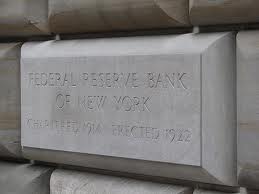
NY Fed Reserve Bank

[FEDERAL RESERVE BANK OF NEW YORK]

***

And, everyone takes this mental model for granted, but is it really true?

Read more

Was the 2008 Financial Crisis Caused by the Big Banks?

Assessment

The conclusions should be compelling to all ME-P readers, physician-executives and intelligent investors!

Conclusion

Your thoughts and comments on this ME-P are appreciated. Feel free to review our top-left column, and top-right sidebar materials, links, URLs and related websites, too. Then, subscribe to the ME-P. It is fast, free and secure.

Speaker: If you need a moderator or speaker for an upcoming event, Dr. David E. Marcinko; MBA – Publisher-in-Chief of the Medical Executive-Post – is available for seminar or speaking engagements. Contact: MarcinkoAdvisors@msn.com

OUR OTHER PRINT BOOKS AND RELATED INFORMATION SOURCES:

Risk Management, Liability Insurance, and Asset Protection Strategies for Doctors and Advisors: Best Practices from Leading Consultants and Certified Medical Planners™8Comprehensive Financial Planning Strategies for Doctors and Advisors: Best Practices from Leading Consultants and Certified Medical Planners™

***

It’s Still Harder to Become a Hairdresser than a Financial Adviser?

Join Our Mailing List

How Come and Why?

[By Jason Zweig]

****

The great journalist H.L. Mencken wrote decades ago
,

“The essence of a genuine professional man is that he cannot be bought.”

And that, in turn, can spring only from a culture of exhaustive training and the highest standards of conduct.

Professions like accounting, law and medicine took decades, often centuries, to advance to the point of requiring rigorous education and licensing for all their members.

***

vintage-beauty-salon-equipment-9

***

Assessment

The field of investment advice remains a long way from being able to call itself a profession.

More: http://blogs.wsj.com/moneybeat/2016/04/08/how-come-its-still-harder-to-become-a-hairdresser-than-a-financial-adviser/

On Wall Street’s Suitability, Prudence and Fiduciary Accountability

Conclusion

Your thoughts and comments on this ME-P are appreciated. Feel free to review our top-left column, and top-right sidebar materials, links, URLs and related websites, too. Then, subscribe to the ME-P. It is fast, free and secure.

Speaker: If you need a moderator or speaker for an upcoming event, Dr. David E. Marcinko; MBA – Publisher-in-Chief of the Medical Executive-Post – is available for seminar or speaking engagements. Contact: MarcinkoAdvisors@msn.com

OUR OTHER PRINT BOOKS AND RELATED INFORMATION SOURCES:

Risk Management, Liability Insurance, and Asset Protection Strategies for Doctors and Advisors: Best Practices from Leading Consultants and Certified Medical Planners™8Comprehensive Financial Planning Strategies for Doctors and Advisors: Best Practices from Leading Consultants and Certified Medical Planners™

***

Leader Of The Healthcare REIT Industry?

Join Our Mailing List

About Ventas, Inc

tim

By Timothy McIntosh MBA MPH CFP® CMP™ [Hon]

Ventas, Inc. is a real estate investment trust (REIT). The Company has a portfolio of seniors housing and healthcare properties located throughout the United States, Canada and the United Kingdom.

The Company operates through three segments: triple-net leased properties, senior living operations and MOB operations. The triple-net leased properties segment invests in seniors housing and healthcare properties throughout the United States and the United Kingdom and lease those properties to healthcare operating companies under triple-net or absolute-net leases that obligate the tenants to pay all property-related expenses.

The senior living operations segment invests in seniors housing communities throughout the United States and Canada and engages independent operators, such as Atria and Sunrise, to manage those communities. The MOB operations segment, acquires, owns, develops, leases, and manages MOBs throughout the United States. It invests in seniors housing and healthcare properties.

Ventas: Leader Of The Healthcare REIT Industry

house

Conclusion

Your thoughts and comments on this ME-P are appreciated. Feel free to review our top-left column, and top-right sidebar materials, links, URLs and related websites, too. Then, subscribe to the ME-P. It is fast, free and secure.

Speaker: If you need a moderator or speaker for an upcoming event, Dr. David E. Marcinko; MBA – Publisher-in-Chief of the Medical Executive-Post – is available for seminar or speaking engagements. Contact: MarcinkoAdvisors@msn.com

OUR OTHER PRINT BOOKS AND RELATED INFORMATION SOURCES:

Risk Management, Liability Insurance, and Asset Protection Strategies for Doctors and Advisors: Best Practices from Leading Consultants and Certified Medical Planners™8Comprehensive Financial Planning Strategies for Doctors and Advisors: Best Practices from Leading Consultants and Certified Medical Planners™

***

“We Can Never Know About The Days [FINANCIAL MARKETS] To Come”

Join Our Mailing List

AS CARLY SIMON USED TO SING …

ArtBy Arthur Chalekian GEPC

[Financial Consultant]

However, that doesn’t stop anyone from making educated guesses about the future of companies, financial markets, and economies.

So, as we enter the second quarter, investment and business professionals have been offering their insights:

  • McKinsey & Company’s March Economic Conditions Snapshot indicated 80 percent of surveyed executives “… expect demand for their companies’ products and services will grow or stay the same in the coming months, and a majority believe (as they have in every survey since 2011) their companies’ profits will increase.” However, they are not as optimistic about the global economy as they were in December. About one-half of executives in developed and emerging markets said economic conditions globally are worse than they were six months ago
  • The Wall Street Journal’s April 2016 Economic Forecasting Survey, which queries 60 economists, reported three-of-four survey participants expect a Fed rate hike in June. Few expect a recession during the next 12 months, putting the odds at 19 percent. Almost one-half stated global risks were the greatest threat to the U.S. economy, followed by financial conditions, a slowdown in consumer spending, falling corporate profits, and U.S. politics.
  • PIMCO’s Cyclical Outlook predicts China’s gross domestic product (GDP) growth may be in the 5.5 to 6.5 percent range. The target is 6.5 percent. In addition, a gradual devaluation of the yuan is possible, although China’s currency policy often produces unexpected twists and turns.
  • BlackRock Investment Institute’s second quarter outlook centered on three themes. First, returns are likely to remain muted in the future. Second, monetary policies appear to be less divergent, which could be a positive for some markets. Third, volatility may persist as the Federal Reserve normalizes monetary policy. Diversity and careful asset selection are likely to be critical in this environment.

***

Photo of hands of businesspeople during discussing

***

Conclusion

Your thoughts and comments on this ME-P are appreciated. Feel free to review our top-left column, and top-right sidebar materials, links, URLs and related websites, too. Then, subscribe to the ME-P. It is fast, free and secure.

While it’s interesting to read experts’ predictions and expectations for coming months and years, it’s important to remember forecasts are not always accurate. An organization that tracked forecasting results through 2012 found forecasts were correct about 47 percent of the time.

Speaker: If you need a moderator or speaker for an upcoming event, Dr. David E. Marcinko; MBA – Publisher-in-Chief of the Medical Executive-Post – is available for seminar or speaking engagements. Contact: MarcinkoAdvisors@msn.com

OUR OTHER PRINT BOOKS AND RELATED INFORMATION SOURCES:

Comprehensive Financial Planning Strategies for Doctors and Advisors: Best Practices from Leading Consultants and Certified Medical Planners™

***

DOL’s Fiduciary Rule Brings Good News

The DOL and Your Retirement Account

 
Join Our Mailing List 

By Michael Zhuang,

[Principal of MZ Capital Management]
Contributor to Morningstar and Physicians Practice
Michael Zhuang
 
Recently the Department of Labor issued a fiduciary rule that requires financial advisors who manage retirement accounts to act in clients’ best interests.
***
Here is the quote from a Wall Street Journal report … 

About $14 trillion in retirement savings could be affected by the rule, which requires stockbrokers providing retirement advice to act as “fiduciaries” who will serve their clients’ “best interest.” That is stricter than the current standard, which only says they need to offer “suitable” recommendations, a standard that critics say has encouraged some advisers to charge excessive fees or favor investments that offer hidden commissions.

Still, reflecting intense lobbying from the financial industry, which has fought the regulation since it was first proposed six years ago, the final version includes a number of modifications. 

This might come as a surprise to many physician-executives and people that financial advisors do not need to act in clients’ best interests up until this day.  

Alas, as I explained in this article, there are really two types of financial advisors: those who have a broker license (series 7) and those who have a registered investment advisor license (series 65).

Here is the kicker:

93% of all financial advisors are licensed brokers. These are advisors from major Wall Street brokerages like Merrill Lynch, Morgan Stanley and etc., as well as many independent broker-dealers. By law, they do NOT need to act in clients’ best interests. 

Those who have a registered investment advisor license have always been required by law to act in clients’ best interests, but they account for only 7% of all financial advisors. 

The financial industry benefits tremendously from not needing to act in clients’ best interests, for instance, by selling clients high hidden cost financial products. That’s why they fight the fiduciary rule tooth and nail, and with the help of many Senators and Congressmen.

It’s better late than never. I am glad that seven years after the financial crisis that nearly brought the country to its knees, something is finally done to address the rampant conflict of interests in the financial industry. 

There is a caveat though. The fiduciary rule only applies to retirement accounts. So if you have a brokerage account and an IRA account with Merrill Lynch. Your Merrill Lynch broker needs to act in your best interests with your IRA account, but needs NOT with your brokerage account! 

Assessment 

The best way to check whether your financial advisor is a broker is to ask “Do you have a series 7 license?” If the answer is “Yes.” You need a second opinion review. Chances are good that it will find many hidden costs and bad investments.

More: The DOL’s Final Fiduciary Rule: What’s in it and what does it mean for advisors?

Conclusion

Your thoughts and comments on this ME-P are appreciated. Feel free to review our top-left column, and top-right sidebar materials, links, URLs and related websites, too. Then, subscribe to the ME-P. It is fast, free and secure.

Speaker: If you need a moderator or speaker for an upcoming event, Dr. David E. Marcinko; MBA – Publisher-in-Chief of the Medical Executive-Post – is available for seminar or speaking engagements. Contact: MarcinkoAdvisors@msn.com

OUR OTHER PRINT BOOKS AND RELATED INFORMATION SOURCES:

Risk Management, Liability Insurance, and Asset Protection Strategies for Doctors and Advisors: Best Practices from Leading Consultants and Certified Medical Planners™8Comprehensive Financial Planning Strategies for Doctors and Advisors: Best Practices from Leading Consultants and Certified Medical Planners™

****

On Investor Sentiment?

Join Our Mailing List 

HOW DO INVESTORS REALLY FEEL ABOUT STOCK MARKETS?         

Art

By Arthur Chalekian GEPC

Individual Investors (AAII) surveys investors weekly about whether they are bullish, bearish, or neutral on stock markets for the next six months.

Last week, the majority of participants indicated they were neutral. There was less bullish sentiment than the previous week, but bulls maintained a slight edge over bears:

The Results

  • Bullish: 27.2 percent
  • Neutral: 47.1 percent
  • Bearish: 25.8 percent

Assessment

The AAII also asked whether participants were better off, worse off, or as well off as they had been eight years ago (early in the Great Recession). More than one-half (54 percent) said they were better off. The remainder was almost evenly split. Twenty-four percent indicated they were not better off, and 23 percent said they were as well off.

***

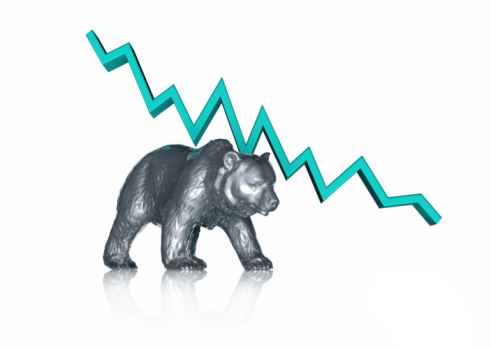
Bear + A Falling Stock Chart[A BEAR Market]

***

Conclusion

Your thoughts and comments on this ME-P are appreciated. Feel free to review our top-left column, and top-right sidebar materials, links, URLs and related websites, too. Then, subscribe to the ME-P. It is fast, free and secure.

Speaker: If you need a moderator or speaker for an upcoming event, Dr. David E. Marcinko; MBA – Publisher-in-Chief of the Medical Executive-Post – is available for seminar or speaking engagements. Contact: MarcinkoAdvisors@msn.com

OUR OTHER PRINT BOOKS AND RELATED INFORMATION SOURCES:

Comprehensive Financial Planning Strategies for Doctors and Advisors: Best Practices from Leading Consultants and Certified Medical Planners™

***

Seeking the “Perfect” Investment

Join Our Mailing List

If I only had a crystal ball

Rick Kahler MS CFP

By Rick Kahler MS CFP®  http://www.KahlerFinancial.com

“If I only had a crystal ball.” Every investor has probably made this wish from time to time; even physician-executives. We would all like a way to avoid the emotional pain and anxiety that are sure to come when our portfolios lose value due to inevitable market downturns.

The Pain – The Pain

Surely a perfect investment would spare us that pain. Suppose a mutual fund manager with a crystal ball knew which 10% of the 500 largest U. S. stocks would earn the highest returns for each upcoming five-year period. Investing only in those stocks should ensure gain with no pain.

According to an article by Bob Veres, editor of Inside Information, someone has looked back over more than 80 years to track such a hypothetical perfect fund. Alpha Architect, a research company, divided the 500 largest U.S. stocks into deciles and imagined a fund investing in only the 10% known to have the highest returns for the next five years. Beginning January 1, 1927, the hypothetical portfolio was adjusted every five years. If you could have purchased it then and held it to the end of 2009, you would have earned just under 29% a year. Lots of gain, no pain at all, right?

Enter the Bear

Except for the particularly bad bear market that started in 1929, when you would have seen your investment plummet 75.96%. Or the one-year period starting at the end of March 1937, when the fund would have fallen more than 44%.

Or, the nine more times over the years that the fund dropped by 20% or more. It lost 22% in 1974 when the S&P 500 was up 20%. In 2000-2001 you’d have watched it plummet 34% while the S&P 500 was only down 21%. Or how about the 20% drop from the end of September through the end of November 2002, at a time when the S&P 500 was sailing along with a 15% positive return.

Yes, the long-term returns in this “perfect” investment were amazing. The full ride, however, offered many opportunities for anxiety and even terror, when investors would have been strongly tempted to bail.

***

brain

***

Alpha Architect

Alpha Architect concluded that even if God—who presumably doesn’t need a crystal ball to have perfect foresight—were running this mutual fund, He would have lost a lot of investors. During the rough patches, many would have lost faith in His management skill.

Investors who are ultimately successful learn to hang on through thick and thin, knowing that markets eventually recover. Yet even if we could choose a perfect investment, staying with it for the long term is a challenge.

Speed Demons

One of the reasons market declines are so frightening is that they happen much faster than market gains.

Ben Carlson, author of A Wealth of Common Sense: Why Simplicity Trumps Complexity in Any Investment Plan, looked at all the bear markets and bull markets going back to 1928. The bull market rallies averaged 57% returns, while bear markets averaged losses of 24%. The bull markets lasted an average of 474 days. The bear market drops were more intense, compressed into an average of just 232 days before the next upturn.

Even when, by percentage, the gains far outweigh the losses, the more gradual pace of the bull markets doesn’t attract our attention in the same way as the heart-stopping downturns of bear markets.

Assessment

Veres calls the Alpha Architect research “a lesson in humility and patience.” We can’t look into the future with a real crystal ball. However, looking back at market patterns with an imaginary one can help us protect ourselves from our own tendency to bail out in the face of adversity.

Conclusion

Your thoughts and comments on this ME-P are appreciated. Feel free to review our top-left column, and top-right sidebar materials, links, URLs and related websites, too. Then, subscribe to the ME-P. It is fast, free and secure.

Speaker: If you need a moderator or speaker for an upcoming event, Dr. David E. Marcinko; MBA – Publisher-in-Chief of the Medical Executive-Post – is available for seminar or speaking engagements. Contact: MarcinkoAdvisors@msn.com

OUR OTHER PRINT BOOKS AND RELATED INFORMATION SOURCES:

[PHYSICIAN FOCUSED FINANCIAL PLANNING AND RISK MANAGEMENT COMPANION TEXTBOOK SET]

  Risk Management, Liability Insurance, and Asset Protection Strategies for Doctors and Advisors: Best Practices from Leading Consultants and Certified Medical Planners™  Comprehensive Financial Planning Strategies for Doctors and Advisors: Best Practices from Leading Consultants and Certified Medical Planners™

[Dr. Cappiello PhD MBA] *** [Foreword Dr. Krieger MD MBA]

Front Matter with Foreword by Jason Dyken MD MBA

***

Why A Global Diversified Portfolio?

Join Our Mailing List 

Investing at Home or Away?

Michael ZhuangBy Michael Zhuang

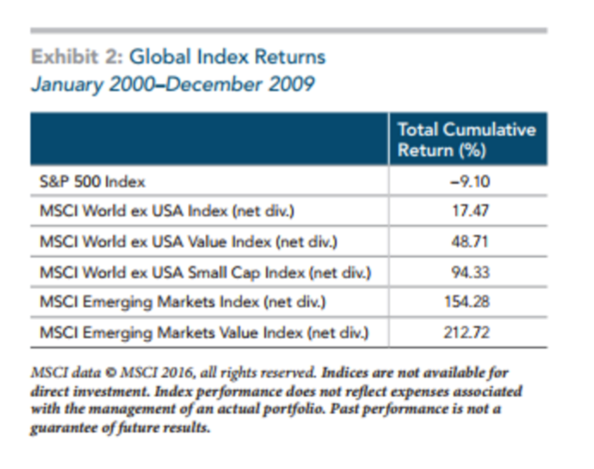
Recently a client asked me why we bother with investing in international markets.  After all, the S&P 500 has done quite well in the last year. Indeed, it has outperformed foreign markets three years in a row, and by a huge margin to boot.

Take 2014 for example-the S&P 500 was up 13%, while the international markets on aggregate were down 5%. So; why then?

Table

Well, let’s look at this table

***

untitled

***

The Lost Decade

The decade between 2000 and 2009 is what investors call “The Lost Decade,” but only if you invested solely in the S&P 500. If you had owned a globally diversified portfolio, the decade would not have been lost. In fact, after The Lost Decade, some of my clients asked me “Why bother with investing in US stocks at all?”

Assessment

My answers then and now are the same: because we don’t know what the future will bring and we don’t know which market will do best or worst, so we need a globally diversified portfolio to limit our risk of falling victim to another lost decade.

Conclusion

Your thoughts and comments on this ME-P are appreciated. Feel free to review our top-left column, and top-right sidebar materials, links, URLs and related websites, too. Then, subscribe to the ME-P. It is fast, free and secure.

Speaker: If you need a moderator or speaker for an upcoming event, Dr. David E. Marcinko; MBA – Publisher-in-Chief of the Medical Executive-Post – is available for seminar or speaking engagements. Contact: MarcinkoAdvisors@msn.com

OUR OTHER PRINT BOOKS AND RELATED INFORMATION SOURCES:

Comprehensive Financial Planning Strategies for Doctors and Advisors: Best Practices from Leading Consultants and Certified Medical Planners™

***

Gilead Sciences’ Miracle Drug Combination

Join Our Mailing List

More on Gilead Sciences

vitaly

By Vitaliy Katsenelson CFA

It is easy, exciting and uplifting to talk about how Gilead has saved millions of lives. But I have to admit I found myself to be slightly conflicted as a capitalist investor and human being when it came to analyzing the company.

So, here is my take on Gilead Sciences in essay form 

***

drugs

Gilead Sciences’ Miracle Drug Combination

Conclusion

Your thoughts and comments on this ME-P are appreciated. Feel free to review our top-left column, and top-right sidebar materials, links, URLs and related websites, too. Then, subscribe to the ME-P. It is fast, free and secure.

Speaker: If you need a moderator or speaker for an upcoming event, Dr. David E. Marcinko; MBA – Publisher-in-Chief of the Medical Executive-Post – is available for seminar or speaking engagements. Contact: MarcinkoAdvisors@msn.com

OUR OTHER PRINT BOOKS AND RELATED INFORMATION SOURCES:

***

[PHYSICIAN FOCUSED FINANCIAL PLANNING AND RISK MANAGEMENT COMPANION TEXTBOOK SET]

 Risk Management, Liability Insurance, and Asset Protection Strategies for Doctors and Advisors: Best Practices from Leading Consultants and Certified Medical Planners™ Comprehensive Financial Planning Strategies for Doctors and Advisors: Best Practices from Leading Consultants and Certified Medical Planners™

[Dr. Cappiello PhD MBA] *** [Foreword Dr. Krieger MD MBA]

Front Matter with Foreword by Jason Dyken MD MBA

***

The White Coat Investor

Join Our Mailing List

By Staff Reporters

OVERHEARD IN THE DOCTOR’S LOUNGE

[The White Coat Investor]*

Dahle

James M. Dahle MD FACEP

Although I think a physician is perfectly capable of doing his own financial planning and investment management, the majority of doctors want, and would benefit from hiring a competent, fiduciary, fee-only advisor who can give them good advice at a fair price. The more familiar an advisor is with the unique financial planning issues associated with physicians, such as properly managing hundreds of thousands of dollars in students loans and acquiring specialty-specific disability insurance, the better.

Unfortunately, it is surprisingly difficult for a doctor to hire such an advisor as the vast majority of those who bill themselves as financial advisors are little more than commissioned mutual fund or insurance salesmen. Many of these so-called advisors state that they “specialize in physicians,” but in reality, merely specialize in marketing to physicians.

To make matters worse, a doctor may assume that these advisors are trained professionals comparable to accountants, attorneys, or physicians, when in reality the advisor may only have a few days of formal training, and most of that in sales.

Assessment

Obtaining high-quality, physician-specific, financial advice offered at a fair price sometimes seems like trying to find the Holy Grail.

*NOTE: The white coat ceremony is a medical school ritual that marks the transition from the study of preclinical to clinical health sciences. WCCs typically involve a formal “robing” or “cloaking” of students in white coats, the garb doctors have traditionally worn for over a century.

About the Author

The White Coat Investor: [A Doctor’s Guide to Personal Finance and Investing] Editor: www.whitecoatinvestor.com

Conclusion

Your thoughts and comments on this ME-P are appreciated. Feel free to review our top-left column, and top-right sidebar materials, links, URLs and related websites, too. Then, subscribe to the ME-P. It is fast, free and secure.

Speaker: If you need a moderator or speaker for an upcoming event, Dr. David E. Marcinko; MBA – Publisher-in-Chief of the Medical Executive-Post – is available for seminar or speaking engagements. Contact: MarcinkoAdvisors@msn.com

OUR OTHER PRINT BOOKS AND RELATED INFORMATION SOURCES:

***

[PHYSICIAN FOCUSED FINANCIAL PLANNING AND RISK MANAGEMENT COMPANION TEXTBOOK SET]

  Risk Management, Liability Insurance, and Asset Protection Strategies for Doctors and Advisors: Best Practices from Leading Consultants and Certified Medical Planners™  Comprehensive Financial Planning Strategies for Doctors and Advisors: Best Practices from Leading Consultants and Certified Medical Planners™

[Dr. Cappiello PhD MBA] *** [Foreword Dr. Krieger MD MBA]

Front Matter with Foreword by Jason Dyken MD MBA

***

Advisor V. Adviser [The Ultimate “Terminology” Fraudster?]

Join Our Mailing List

Anonymous Doctor

[By Anonymous]

Are the US Securities Acts the Ultimate “Terminology” Fraudster?

As a doctor and investor, I have learned thru the internet that Larry Elford, an Investment Misconduct and Malpractice Consultant – and many others – believe that the ultimate terminology fraudster is the US Securities Acts (1935 & 1940) and the Investment Adviser Act. Why?

They have no such category as “advisor” in the Acts.

Industry lawyers know this well, as does FINRA, and may be using this “spelling ruse” to dupe and deceive millions of Americans into believing that their commission sales “broker” is some kind of fiduciary “adviser” professional.

Some even believe it to be an industry pandemic of “bait and switch” to deceive and then shortchange investors.

Source: http://www.investoradvocates.ca/viewtopic.php?f=1&t=193&sid=1cc2690bde2ebdfaa749be1d35395083#p3867

***

th

***

VIDEO: Here is an under 2 minute glimpse into the Three Card Monte game being played, upon investors, when your Securities Commission proudly tells you to “check your “adviser’s” registration”.

Link: https://youtu.be/zIjt0qRsJKg

Assessment

Is this a mere lexicon conundrum; or truer pathology?

And, did you know that a Certified Medical Planner® is a client fiduciary at all times? Visit: http://www.CertifiedMedicalPlanner.org

cmp-logo16

Enter the CMPs

Conclusion

Your thoughts and comments on this ME-P are appreciated. Feel free to review our top-left column, and top-right sidebar materials, links, URLs and related websites, too. Then, subscribe to the ME-P. It is fast, free and secure.

Speaker: If you need a moderator or speaker for an upcoming event, Dr. David E. Marcinko; MBA – Publisher-in-Chief of the Medical Executive-Post – is available for seminar or speaking engagements. Contact: MarcinkoAdvisors@msn.com

OUR OTHER PRINT BOOKS AND RELATED INFORMATION SOURCES:

***

[PHYSICIAN FOCUSED FINANCIAL PLANNING AND RISK MANAGEMENT COMPANION TEXTBOOK SET]

  Risk Management, Liability Insurance, and Asset Protection Strategies for Doctors and Advisors: Best Practices from Leading Consultants and Certified Medical Planners™       Comprehensive Financial Planning Strategies for Doctors and Advisors: Best Practices from Leading Consultants and Certified Medical Planners™

[Dr. Cappiello PhD MBA] *** [Foreword Dr. Krieger MD MBA]

Front Matter with Foreword by Jason Dyken MD MBA

***

The “Big Mac Index” in Russia

Join Our Mailing List

IF YOU LIKE FAST FOOD AND A GOOD DEAL, YOU CAN FIND A REALLY CHEAP BIG MAC IN RUSSIA        

ArtBy Arthur Chalekian GEPC

[Financial Consultant]

The Economist created The Big Mac Index 30 years ago as a rough-and-ready gauge of world currencies. The index is based on the idea when currencies are aligned correctly, the same product (in this case, a Big Mac®) should have the same price in different countries when that price is denominated in a single currency. This is called purchasing power parity (PPP).

For the purposes of this commentary, we looked at the price of a Big Mac in U.S. dollars. Early in 2016, a Big Mac cost a hungry American about $4.93. In Russia, it cost about a $1.53, in the Euro area $4.00, and in Switzerland, about $6.44. These prices indicate the Russian ruble is undervalued by about 69 percent, the Euro is undervalued by about 19 percent, and the Swiss franc is overvalued by almost 31 percent. Switzerland is an outlier, according to The Economist:

“Americans hunting for cut-price burgers abroad are spoilt for choice: the index shows most currencies to be cheap relative to the greenback. This is partly owing to the Federal Reserve’s decision to raise interest rates when the central banks of the euro zone and Japan are loosening monetary policy… Another force weakening many currencies, including the ruble, has been the ongoing slump in commodity prices since mid-2014. Shrinking demand from China and a glut of supply have sapped the value of exports from Australia, Brazil, and Canada, among other places, causing their currencies to wilt, too.”

In theory, when a country’s currency depreciates relative to that of its trading partners, the country’s exports should become more attractive because they are less expensive and should boost economic growth. However, depreciation hasn’t produced the results many expected.

One explanation, offered by both the World Bank and the IMF, is globalization. If a country’s exports are part of a global supply chain, then the cost of materials imported to create the exports may offset gains from currency depreciation. According to The Economist,

“The IMF thinks this accounts for much of the sluggishness of Japan’s exports; the World Bank argues that it explains about 40 percent of the diminished impact of devaluations globally.”

***

IMG_0701

[An ME-P Correspondent in Moscow]

***

Conclusion

Your thoughts and comments on this ME-P are appreciated. Feel free to review our top-left column, and top-right sidebar materials, links, URLs and related websites, too. Then, subscribe to the ME-P. It is fast, free and secure.

Speaker: If you need a moderator or speaker for an upcoming event, Dr. David E. Marcinko; MBA – Publisher-in-Chief of the Medical Executive-Post – is available for seminar or speaking engagements. Contact: MarcinkoAdvisors@msn.com

OUR OTHER PRINT BOOKS AND RELATED INFORMATION SOURCES:

[PHYSICIAN FOCUSED FINANCIAL PLANNING AND RISK MANAGEMENT COMPANION TEXTBOOK SET]

  Risk Management, Liability Insurance, and Asset Protection Strategies for Doctors and Advisors: Best Practices from Leading Consultants and Certified Medical Planners™ Comprehensive Financial Planning Strategies for Doctors and Advisors: Best Practices from Leading Consultants and Certified Medical Planners™

[Dr. Cappiello PhD MBA] *** [Foreword Dr. Krieger MD MBA]

Front Matter with Foreword by Jason Dyken MD MBA

***

2016 Charles H. Dow Award winning white-paper

  2016 DOW AWARD PAPER EARLY RELEASE ….. LEVERAGE AND MOVING AVERAGES ……

Join Our Mailing List

By Michael A. Gayed CFA

Michael-Gayed-sepia
Portfolio Manager
www.pensionpartners.com

The 2016 Charles H. Dow Award winning paper “Leverage for the Long Run” is now available for download by clicking here.

I encourage you to not only read the paper, but also forward this email to colleagues and clients who look towards moving averages as a means of outperforming markets.

Conclusion

Your thoughts and comments on this ME-P are appreciated. Feel free to review our top-left column, and top-right sidebar materials, links, URLs and related websites, too. Then, subscribe to the ME-P. It is fast, free and secure.

Speaker: If you need a moderator or speaker for an upcoming event, Dr. David E. Marcinko; MBA – Publisher-in-Chief of the Medical Executive-Post – is available for seminar or speaking engagements. Contact: MarcinkoAdvisors@msn.com

OUR OTHER PRINT BOOKS AND RELATED INFORMATION SOURCES:

 Comprehensive Financial Planning Strategies for Doctors and Advisors: Best Practices from Leading Consultants and Certified Medical Planners™

Plunging Oil Prices Bring Together Enemies in Alliance

Join Our Mailing List
What Next?
ArtBy Arthur Chalekian GEPC

[Financial Consultant]

***

And the economic data says …..
***
The United States economy is doing pretty well. So well that a March rate hike by the Federal Reserve is not entirely out of the question.
***
Barron’s described the situation like this:
***
“Squawking pessimism can’t drown out what is a very respectable start to 2016. Economic data so far this year, apart from predictions of deflation and negative interest rates, could justify what was scheduled to be, but what soon seemed impossible, a rate hike at the March FOMC.
***
Yes, global factors are a risk and are hurting the factory sector but service prices are definitely on the climb and vehicle prices and vehicle production, reflecting strength in domestic demand, are back up. Ignore the cacophony of doubt and look at the economic data for yourself!”
 ***
U.S. economic data was generally positive last week, but that wasn’t the primary driver behind the rally in U.S. stock markets, according to Reuters. Nope, that had more to do with oil prices. Despite serious political differences, Iran and Saudi Arabia appeared to reach an accord on oil production last week, when Iran endorsed a plan by Saudi Arabia to stabilize global oil prices, according to The Guardian. The agreement pushed oil prices higher mid-week.
 ***
However, late in the week, news that oil stockpiles in the U.S. were at record levels reignited worries about oversupply and oil prices fell at week’s end. U.S. stock markets followed, giving back some of the week’s gains on Friday, but all of the major indices finished more than 2 percent higher for the week.
 ***
Assessment
 ***
Economic data may dominate the news next week. We’ll get more information on housing, durable goods orders, jobless claims for February, and a revised estimate for fourth quarter’s gross domestic product growth. Barron’s suggested a strong employment report in tandem with rising prices could influence the Fed’s interest rate decision.
***

Conclusion

Your thoughts and comments on this ME-P are appreciated. Feel free to review our top-left column, and top-right sidebar materials, links, URLs and related websites, too. Then, subscribe to the ME-P. It is fast, free and secure.

Speaker: If you need a moderator or speaker for an upcoming event, Dr. David E. Marcinko; MBA – Publisher-in-Chief of the Medical Executive-Post – is available for seminar or speaking engagements. Contact: MarcinkoAdvisors@msn.com

OUR OTHER PRINT BOOKS AND RELATED INFORMATION SOURCES:

Risk Management, Liability Insurance, and Asset Protection Strategies for Doctors and Advisors: Best Practices from Leading Consultants and Certified Medical Planners™8Comprehensive Financial Planning Strategies for Doctors and Advisors: Best Practices from Leading Consultants and Certified Medical Planners™

***

WONDERING WHAT THE NEXT DECADE MAY BRING?

Join Our Mailing List

Art

By Arthur Chalekian GEPC

[Financial Consultant]

America is renowned for innovation

***

America is renowned for innovation – originating ideas that change the ways in which people live and work. From the cotton gin to the assembly line, the transcontinental railroad to the automobile, the telephone to the Internet, ideas and inventions have spurred America’s economic growth during the past two centuries.
 ***
Here are a few inventions that are on the horizon:
  • The Superman memory crystal: Imagine, a tiny piece of glass etched by a laser that has the capacity to save an enormous amount of data for more than 13 billion years, according to LiveScience.com. One tiny disc currently holds the Magna Carta, Universal Declaration of Human Rights, and King James Bible.
  • A transparent antipeep piezoelectric nanogenerator (TAPN): It may have a tongue twister of a name right now, but the TAPN could become as familiar as your phone charger in the future. All you’ll have to do is place a transparent film on the touchscreen of a smartphone or another device, and then every tap on the screen will generate electricity. Which begs the question: Could texting teenagers power the world?
  • A braille printer: A 12-year-old used Legos to build an inexpensive printer for people who are blind or suffering from macular degeneration or other conditions that affect eyesight. It used a thumbtack to punch braille dots into paper. Newer prototypes don’t rely on thumbtacks, and are expected to translate words from a computer screen into braille very quickly.
  • A fry pan that teaches cooking: Cooking will not become a lost art if a couple of hungry and cooking-challenged college students are successful. They’ve developed a smart frying pan. The pan transmits temperature data to the cook using a smartphone app that also lets the cook know when it’s time for the next step in a recipe.
 Assessment
 ***
The human brain is an engine for innovation, and innovation is a driver of economic growth. Let’s hope the outlook is good for brainstorms in the United States and across the globe.
***
Conclusion

Your thoughts and comments on this ME-P are appreciated. Feel free to review our top-left column, and top-right sidebar materials, links, URLs and related websites, too. Then, subscribe to the ME-P. It is fast, free and secure.

Speaker: If you need a moderator or speaker for an upcoming event, Dr. David E. Marcinko; MBA – Publisher-in-Chief of the Medical Executive-Post – is available for seminar or speaking engagements. Contact: MarcinkoAdvisors@msn.com

OUR OTHER PRINT BOOKS AND RELATED INFORMATION SOURCES:

Risk Management, Liability Insurance, and Asset Protection Strategies for Doctors and Advisors: Best Practices from Leading Consultants and Certified Medical Planners™8Comprehensive Financial Planning Strategies for Doctors and Advisors: Best Practices from Leading Consultants and Certified Medical Planners™

***

Understanding Your Real Rate of Return [RROR]

Join Our Mailing List

Some Modern ROR versus RORR Musings

Rick Kahler MS CFPBy Rick Kahler MS CFP®

http://www.KahlerFinancial.com

Is there anything more important than the overall rate of return you earn on your investment portfolio?

Yes, there is. It’s the real rate of return.

Past Half Decade

Over the past five years, even diversified portfolios have earned relatively low returns. Many investors are fearful that this has significantly reduced the income they can expect to receive upon retirement.

To see whether that fear is justified, let’s look at some numbers. Based on a model portfolio I follow that holds nine different asset classes, the average return for the past three years (after all fees and expenses) was 2.45%. The five-year return was a little better at 2.67%. However, the seven-year return was 5.62%.

If an expected long-term (10 years or more) overall return on the same portfolio was 5.00%, at first glance it appears the portfolio slightly exceeded its expectation for seven years, but fell considerably short the last three and five years.

Now – Take a Second Glance

But, if there is a first glance, you know there is a second glance coming. And that second glance highlights a seemingly obscure fact that changes the picture considerably. In every future return expectation, there is also another estimate that rarely is mentioned, but which is as important as the rate of return. This is the rate of inflation.

While the long-term expected overall return was 5.00%, the long-term expected rate of inflation was 3.00%. That means there was an expectation the investments would earn 2.00% above the rate of inflation.

This is known as the real rate of return (RROR) and it’s far more important than the overall rate of return.

For example, if the projected inflation rate was 4%, the expected real rate of return would have been 1%. At a projected inflation rate of 6%, the real rate of return would have actually been negative.

Most financial planners base their projections of a client’s retirement income on the real rate of return. A real rate of return of 2% is very common.

The Real Rate of Return

Taking into account the real rate of return, what has actually happened over the past three, five, and seven years? Overall expected returns have definitely been lower over the past three and five years. So has the rate of inflation. While the estimated inflation rate was 3.00%, the actual inflation rate was significantly lower, at 0.78% for the past three years and 1.03% for the past five. Subtracting these numbers from the overall rate of return (2.45% for three years and 2.67 for five years) gives us the real rates of return: 1.68% and 1.64% for the last three and five years. Compared with the estimated real return of 2.00%, this is slightly lower but still close to hitting the target.

***

stock market

***

Looking at the seven-year real rate of return, things go from “ok” to “phenomenal.” While the overall rate of return of 5.62% was higher than the expected return of 5.00%, the inflation rate was 1.03% instead of the expected 3.00%. This resulted in a real rate of return of 4.59%, more than double the expected real rate of return.

Bottom Line

The bottom line is that those investors who have been in the market for seven years will have more to spend in retirement than previously projected. In investment circles, this is called a home run.

For physician investors discouraged by recent overall return numbers, a second look might give you cause to cheer up. If you’ve invested in a diversified portfolio, rebalanced, and stayed the course during market crashes, things may be better than they seem.

Assessment

Thanks to one of the lowest inflation rates in modern history, you could be further ahead than you thought.

Conclusion

Your thoughts and comments on this ME-P are appreciated. Feel free to review our top-left column, and top-right sidebar materials, links, URLs and related websites, too. Then, subscribe to the ME-P. It is fast, free and secure.

Speaker: If you need a moderator or speaker for an upcoming event, Dr. David E. Marcinko; MBA – Publisher-in-Chief of the Medical Executive-Post – is available for seminar or speaking engagements. Contact: MarcinkoAdvisors@msn.com

OUR OTHER PRINT BOOKS AND RELATED INFORMATION SOURCES:

Risk Management, Liability Insurance, and Asset Protection Strategies for Doctors and Advisors: Best Practices from Leading Consultants and Certified Medical Planners™8Comprehensive Financial Planning Strategies for Doctors and Advisors: Best Practices from Leading Consultants and Certified Medical Planners™

***

On “Negative” Interest Rates

Join Our Mailing List

ArtBy Arthur Chalekian GEPC

[Financial Consultant]

Are markets suffering from excessive worry?

Last week, markets headed south because investors were concerned about the possibility of negative interest rates in the United States – even though the U.S. Federal Reserve has been tightening monetary policy (i.e., they’ve been raising interest rates).

The worries appear to have taken root after the House Financial Services Committee asked Fed Chair Janet Yellen whether the Federal Reserve was opposed to reducing its target rate below zero should economic conditions warrant it (e.g., if the U.S. economy deteriorated in a significant way). Barron’s reported on the confab between the House and the Fed:

“Another, equally remote scenario also gave markets the willies last week: that the Federal Reserve could potentially push its key interest-rate targets below zero, as its central-bank counterparts in Europe and Japan already have. Not that anybody imagined it was on the agenda of the U.S. central bank, which, after all, had just embarked on raising short-term interest rates in December and marching to a different drummer than virtually all other central banks, which are in rate-cutting mode.”

Worried investors may want to consider insights offered by the Financial Times, which published an article in January titled, “Why global economic disaster is an unlikely event.” It discussed global risks, including inflation shocks, financial crises, and geopolitical upheaval and conflict while pointing out:

“The innovation-driven economy that emerged in the late 18th and 19th centuries and spread across the globe in the 20th and 21st just grows. That is the most important fact about it. It does not grow across the world at all evenly – far from it. It does not share its benefits among people at all equally – again, far from it. But it grows. It grew last year. Much the most plausible assumption is that it will grow again this year. The world economy will not grow forever. But it will only stop when…resource constraints offset innovation. We are certainly not there yet.”

Assessment

Markets bounced at the end of the week when the Organization of Petroleum Exporting Countries (OPEC) indicated its members were ready to cut production. The news pushed oil prices about 12 percent higher and alleviated one worry – for now.

NY Fed Reserve Bank

Conclusion

Your thoughts and comments on this ME-P are appreciated. Feel free to review our top-left column, and top-right sidebar materials, links, URLs and related websites, too. Then, subscribe to the ME-P. It is fast, free and secure.

Speaker: If you need a moderator or speaker for an upcoming event, Dr. David E. Marcinko; MBA – Publisher-in-Chief of the Medical Executive-Post – is available for seminar or speaking engagements. Contact: MarcinkoAdvisors@msn.com

OUR OTHER PRINT BOOKS AND RELATED INFORMATION SOURCES:

***

Risk Management, Liability Insurance, and Asset Protection Strategies for Doctors and Advisors: Best Practices from Leading Consultants and Certified Medical Planners™8Comprehensive Financial Planning Strategies for Doctors and Advisors: Best Practices from Leading Consultants and Certified Medical Planners™

***

Are We Still in a Sideways Stock Market?”

Join Our Mailing List 

Are we there YET!

vitaly[By Vitaliy Katsenelson CFA]

In 1976 the Eagles came out with their most successful album, Hotel California, featuring the eponymous single. That song became their claim to fame. Over the next almost four decades the Eagles performed thousands of concerts and they wrote a lot of new songs, but you can’t see yourself going to an Eagle’s concert and not hearing “Hotel California.”  They performed “Hotel California” at every concert and maybe more than once at some. I don’t have the fame the Eagles do, nor do I entertain for a living (unless you call this entertainment).

But, I do feel a little bit like the Eagles when I talk about sideways markets. Let me explain.  I wrote Active Value Investing in 2007, and I followed up with a simplified version, The Little Book Of Sideways Markets, in 2010. Since the books came out, I have given hundreds of interviews and presentations all over the world on the subject.  And just as the Eagles grew sick of playing “Hotel California,” I am sick of sideways markets. When I do interviews now, I politely ask the interviewer to stay away from the topic of sideways markets, as it really bores me.

***

Bull markets

***

Now, recently I’ve received emails form loyal readers and reporters asking“I am attaching an article I wrote for Institutional Investor magazine in April 2013 that answers this question.  And if you want to peer deep into the entrails of sideways markets, read this very lengthy article I wrote for John Mauldin’s (must-read) Outside the Box newsletter.  IMAGE Very little has changed since I wrote this article (or the books).

Okay, the Donald and a Democratic Socialist are the lead contenders for the presidency of the US, but otherwise the framework I discussed in the article is much the same.  I could have written the article today, since the data points I used haven’t fundamentally changed – they’ve only gotten more extreme (despite the recent sell-off). The law of mean reversion (i.e., high valuations lead to lower valuations and high profit margins lead to lower profit margins) is still intact.

P.S. Lately I’ve been travelling more than usual.  I just came back from a two-day trip to San Diego, where I attended the Qualcomm analyst investor day.  I could have watched it online (I usually do), but Qualcomm is one of our largest positions and I wanted to be physically present to get a visceral feel for the management.  I’m glad I went.  I will be spending this week in Miami, attending one of my favorite investment conferences (and this time I have a hotel reservation).

Assessment

In late February a small group of my very close value investor friends is getting together in Denver.  First we’ll visit a few companies, then we’ll ski a few days in Vail and, most importantly, share and debate investment ideas until the wee hours.  We had a similar gathering in Atlanta a few months ago – it was absolutely amazing.

Conclusion

Your thoughts and comments on this ME-P are appreciated. Feel free to review our top-left column, and top-right sidebar materials, links, URLs and related websites, too. Then, subscribe to the ME-P. It is fast, free and secure.

Speaker: If you need a moderator or speaker for an upcoming event, Dr. David E. Marcinko; MBA – Publisher-in-Chief of the Medical Executive-Post – is available for seminar or speaking engagements. Contact: MarcinkoAdvisors@msn.com

OUR OTHER PRINT BOOKS AND RELATED INFORMATION SOURCES:

Risk Management, Liability Insurance, and Asset Protection Strategies for Doctors and Advisors: Best Practices from Leading Consultants and Certified Medical Planners™8Comprehensive Financial Planning Strategies for Doctors and Advisors: Best Practices from Leading Consultants and Certified Medical Planners™

***

Rationality and Emotions in Financial Decisions [Video]

Join Our Mailing List

Rationality and Emotions in Financial Decisions

By Professor Eyal Winter [SFI Seminars]

Conclusion

Your thoughts and comments on this ME-P are appreciated. Feel free to review our top-left column, and top-right sidebar materials, links, URLs and related websites, too. Then, subscribe to the ME-P. It is fast, free and secure.

Speaker: If you need a moderator or speaker for an upcoming event, Dr. David E. Marcinko; MBA – Publisher-in-Chief of the Medical Executive-Post – is available for seminar or speaking engagements. Contact: MarcinkoAdvisors@msn.com

OUR OTHER PRINT BOOKS AND RELATED INFORMATION SOURCES:

Risk Management, Liability Insurance, and Asset Protection Strategies for Doctors and Advisors: Best Practices from Leading Consultants and Certified Medical Planners™8Comprehensive Financial Planning Strategies for Doctors and Advisors: Best Practices from Leading Consultants and Certified Medical Planners™

***

How to Invest the Dale Carnegie Way

Join Our Mailing List 

How to Win Friends and Influence People

vitaly

By Vitaliy Katsenelson CFA

My History

The first time I read Dale Carnegie’s How to Win Friends and Influence People was in 1990. I was living in Russia; the Cold War had just ended. Capitalist American books suddenly became very popular. Carnegie’s was one of the first to be translated into Russian and was “the book to read.” Everyone wanted to be a capitalist, and this book was supposed to make me a better one. I decided, however, that it was stuffed with disingenuous fluff — that it taught the reader how to not be authentic; it turned you into a fake.

Thinking back, at the time I read it, that book had no chance of getting through to me. I was a product of the Soviet system. We were Seinfeld’s Soup Nazi “No soup for you” nation. Teachers who were kind and inspired students were considered weak. I remember two teachers in my school who were considered virtuosos. Neither one smiled. They rarely praised and were never afraid to insult their students for getting an answer wrong. But they were highly regarded because they knew their subjects well and thoroughly subjugated their students.

Here is how Carnegie puts it:

“When dealing with people, let us remember we are not dealing with creatures of logic. We are dealing with creatures of emotion, creatures bristling with prejudices and motivated by pride and vanity.”

If we were computers and had no emotions, then my Soviet teachers would have been right that knowledge is the only thing that matters. Then teaching (communicating) would be just data transfer from teacher to student.

But, if you have something you think is worth uploading to others, they have to be willing to download it. This is where the wisdom of Carnegie comes in. If we were computers, the way data was packaged would be irrelevant — the content would be all that mattered. However, because we are human, the way we package our content is paramount if the other side is to be willing to receive it.

Criticism is futile because it puts a person on the defensive and usually makes him strive to justify himself. Criticism is dangerous because it wounds a person’s precious pride, hurts his sense of importance and arouses resentment.

There is a person I work with (she is probably reading this, so I have to tread lightly). She has a task she does for me on a regular basis. She is a very diligent and hardworking person, but occasionally she makes a mistake. Pre–Dale Carnegie, I would criticize her. Not anymore. Now I start with praise — how she does a great job, how sometimes I wish I could match her attention to detail — and only then do I lightly mention her mistake. Everything I say about her work is absolutely true — she’d detect a lie. The data upload is the same — she made a mistake — but I package it differently. The result is that she has been making a lot fewer mistakes and the quality of our working environment has improved.

As an investor, I am constantly involved in arguing and debating with others. I debate ideas with my partner, Mike, and with my value investor friends. Mike and I often disagree — which is awesome, because if we always agreed, one of us would be extraneous. But this quote from Carnegie’s book changed how I debate: “You can’t win an argument. You can’t because if you lose it, you lose it; and if you win it, you lose it. Why? Well, suppose you triumph over the other man and shoot his argument full of holes and prove that he is non compos mentis. Then what? You will feel fine. But what about him? You have made him feel inferior. You have hurt his pride. He will resent your triumph.”

Carnegie provides this advice: “Our first natural reaction in a disagreeable situation is to be defensive. Be careful. Keep calm and watch out for your first reaction. It may be you at your worst, not your best. Control your temper. Remember, you can measure the size of a person by what makes him or her angry. Listen first. Give your opponents a chance to talk… Look for areas of agreement. When you have heard your opponents out, dwell first on the points and areas on which you agree.”

I used to feel I had to win every argument. I patted myself on the back when I did. Now I wish I hadn’t.

***

df6e2218796363_562d230ca763b

[Influence Meter]

***

Twenty-five years later I wish I could turn to my 17-year-old self and say, “Read this book slowly; pay attention; this is the most important thing you’ll ever read. It will change your life if you let it.” Unfortunately, due to the lack of a time machine, I can’t do that, but I can encourage everyone around me, including my kids, to read this very important book.

Carnegie’s book will turn anyone into a better businessperson or capitalist because it will help you to understand other people better. But more important, this book will make you a better spouse and a better parent.

P.S. I wish I’d reread Dale Carnegie’s book before my oldest child was born. I would have made fewer mistakes as a parent. I’ve been very good at trying not to criticize him and emphasizing his achievements. But I have not been careful enough in selecting his teachers. When Jonah was younger he liked to play chess, and we played together at least once a day. We got him a bona fide Russian chess teacher. He was a 70-something-year-old engineer, a brilliant chess player, Moscow champion. But he was tough. Rarely smiled. Emphasized the negatives (when Jonah made a wrong move) and underemphasized the positives (when Jonah made the right move). He was actually a genuinely good person, and he probably would be a good teacher for an adult – like me. But Jonah required a teacher that inspired, that poured water on the small seed of interest he had in chess. Instead, after a year, Jonah lost interest and quit playing chess.

Here is another example

My daughter Hannah had a Russian language teacher (the wife of Jonah’s chess teacher). The wife was not much different from the husband – emotionless and tough. Hannah studied Russian for a year and made little progress. She was scared, intimidated. Dissatisfied with her lack of progress, we changed teachers. Hannah’s new teacher is a beam of light and excitement. When she comes to our house she brings joy (and candy). After every lesson Hannah gets candy. Hannah’s Russian leaped forward. She got to the point where she started to read and memorize poems in Russian. She participated in her first “Russian poetry jam.” She looks forward to every lesson, not just because of the candy but because her new Russian teacher figured out a way to make Hannah feel good about herself when studies Russian – that is Dale Carnegie 101 

Conclusion

Your thoughts and comments on this ME-P are appreciated. Feel free to review our top-left column, and top-right sidebar materials, links, URLs and related websites, too. Then, subscribe to the ME-P. It is fast, free and secure.

Speaker: If you need a moderator or speaker for an upcoming event, Dr. David E. Marcinko; MBA – Publisher-in-Chief of the Medical Executive-Post – is available for seminar or speaking engagements. Contact: MarcinkoAdvisors@msn.com

OUR OTHER PRINT BOOKS AND RELATED INFORMATION SOURCES:

Risk Management, Liability Insurance, and Asset Protection Strategies for Doctors and Advisors: Best Practices from Leading Consultants and Certified Medical Planners™ Risk Management, Liability Insurance, and Asset Protection Strategies for Doctors and Advisors: Best Practices from Leading Consultants and Certified Medical Planners™

***

DOES THE STOCK MARKET OVER-REACT?

Join Our Mailing List 

Some say it does!

ArtBy Arthur Chalekian GEPC

[Financial Consultant]

Some experts say it does. In 1985, Werner DeBondt, currently a professor of finance at DePaul University, and Richard Thaler, currently a professor of behavioral science and economics at the University of Chicago, published an article titled, Does The Stock Market Overreact? 

Professor Speak

The professors were among the first economists to study behavioral finance, which explores the ways in which psychology explains investors’ behavior. Classic economic theory assumes all people make rational decisions all the time and always act in ways that optimize their benefits. Behavioral finance recognizes people don’t always act in rational ways, and it tries to explain how irrational behavior affects markets.

Research 

DeBondt and Thaler’s research, which has been explored and disputed over the years, supported the idea that markets tend to overreact to “unexpected and dramatic news and events.” The pair found people tend to give too much weight to new information. As a result, stock markets often are buffeted by bouts of optimism and bouts of pessimism, which push stock prices higher or lower than they deserve to be.

***

ambulance

***

In a recent memo, Oaktree Capital’s Howard Marks reiterated his long-held opinion, “…In order to be successful, an investor has to understand not just finance, accounting, and economics, but also psychology.” He makes a good point.

Assessment 

When markets become volatile, it’s a good idea to remember the words of Benjamin Graham, author of The Intelligent Investor, who wrote, “By developing your discipline and courage, you can refuse to let other people’s mood swings govern your financial destiny. In the end, how your investments behave is much less important than how you behave.”

Conclusion

Your thoughts and comments on this ME-P are appreciated. Feel free to review our top-left column, and top-right sidebar materials, links, URLs and related websites, too. Then, subscribe to the ME-P. It is fast, free and secure.

Speaker: If you need a moderator or speaker for an upcoming event, Dr. David E. Marcinko; MBA – Publisher-in-Chief of the Medical Executive-Post – is available for seminar or speaking engagements. Contact: MarcinkoAdvisors@msn.com

OUR OTHER PRINT BOOKS AND RELATED INFORMATION SOURCES:

Risk Management, Liability Insurance, and Asset Protection Strategies for Doctors and Advisors: Best Practices from Leading Consultants and Certified Medical Planners™8Comprehensive Financial Planning Strategies for Doctors and Advisors: Best Practices from Leading Consultants and Certified Medical Planners™

***

Video on The Current State Of The Stock Market

Join Our Mailing List

Earnings Crisis!

By Chapwood Investments, LLC   

          ***             

MARKETS CLOSED TODAY!   

A Message From Ed Butowsky On The Current State Of The Stock Market

[2/11/2016]

ImageProxy

Click on this link to view video message

***

Conclusion

Your thoughts and comments on this ME-P are appreciated. Feel free to review our top-left column, and top-right sidebar materials, links, URLs and related websites, too. Then, subscribe to the ME-P. It is fast, free and secure.

Speaker: If you need a moderator or speaker for an upcoming event, Dr. David E. Marcinko; MBA – Publisher-in-Chief of the Medical Executive-Post – is available for seminar or speaking engagements. Contact: MarcinkoAdvisors@msn.com

OUR OTHER PRINT BOOKS AND RELATED INFORMATION SOURCES:

Comprehensive Financial Planning Strategies for Doctors and Advisors: Best Practices from Leading Consultants and Certified Medical Planners™

***

“Sell Everything!”

 Join Our Mailing List

Rick Kahler MS CFP

[By Rick Kahler MS CFP]

“Sell Everything!”

That’s the advice to investors from RBS, a large investment bank based in Scotland, which issued the dire recommendation to its customers on January 8th, 2016.

The warning urged investors to sell everything except high-quality bonds, predicting the global economy was in for a “fairly cataclysmic year ahead …. similar to 2008.” They said this is a year to focus on the return of capital rather a return on capital.

Stunning

I was first stunned that a respectable investment bank would issue such a radical recommendation. Then I was amused at my own surprise. I had momentarily forgotten this is logical behavior for a company whose profits depend on its customers actively buying and selling. It is not legally required to look out for customers’ best interests and has no incentive to do so.

Clearly, the time-honored way of earning market returns over the long haul is to diversify among asset classes, rebalance religiously, and always stay in the markets. The research is overwhelming that shows those who attempt to time the markets have significantly lower returns over the long haul than those who don’t.

Example:

For example, according to a study by Dalbar, Inc., over the last twenty years the average underperformance of investors and advisors that timed the market was 7.12% a year.

What’s so bad about trying to minimize loses and selling out when things begin looking scary?

Nothing. Who wouldn’t want to exit markets just in time to watch them fall so low that you could sweep up bargains by buying back in? Therein lies the problem: not only do you need to get out on time (not too early and not too late), but you must then know when to get back in.

The Crystal Ball

The only way I know to do this is to own a crystal ball, which the economists at RBS apparently possess.

Here are a few of the things they say to expect:

  • Oil could fall as low as $16 a barrel.
  • The world has far too much debt to be able to grow well.
  • Advances in technology and automation will wipe out up to half of all jobs.
  • Global disinflation is turning to global deflation as China and the US sharply devalue their currencies.
  • Stocks could fall 10% to 20%.

Prediction

The last prediction was the one that grabbed my attention. Given the comparison of the coming year to 2008, I expected a forecast of a significantly greater drop in stocks, say 40% to 60%. Comparatively, their forecast of 10% to 20% seems almost rosy.

While RBS is particularly gloomy, bearish forecasts have also been issued by other investment brokerage firms, including JP Morgan, Morgan Stanley, Bank of America Merrill Lynch, Barclays, Deutsche Bank, Societe Generale, and Macquarie.

Just for perspective, here’s a look as reported by The Spectator at previous predictions from Andrew Roberts, the RBS analyst who issued the recent dire warning. In June 2010, he warned,

“We cannot stress enough how strongly we believe that a cliff-edge may be around the corner, for the global banking system (particularly in Europe) and for the global economy. Think the unthinkable.” In July 2012, he said, “People talk about recovery, but to me we are in a much worse shape than the Great Depression.”

Incidentally, one thing Roberts did not predict was the meltdown of 2008.

***

212_1

“Sell Everything?”

***

Assessment

The inaccuracy of earlier dire predictions should encourage physicians and all investors to stay the course.

As usual, chances are that those who diversify their investments among five or more asset classes and periodically rebalance their portfolios will come out on top. The odds greatly favor consumers who ignore doom-and-gloom warnings, especially from those whose companies may profit from investor panic.

Conclusion

Your thoughts and comments on this ME-P are appreciated. Feel free to review our top-left column, and top-right sidebar materials, links, URLs and related websites, too. Then, subscribe to the ME-P. It is fast, free and secure.

Speaker: If you need a moderator or speaker for an upcoming event, Dr. David E. Marcinko; MBA – Publisher-in-Chief of the Medical Executive-Post – is available for seminar or speaking engagements. Contact: MarcinkoAdvisors@msn.com

OUR OTHER PRINT BOOKS AND RELATED INFORMATION SOURCES:


Risk Management, Liability Insurance, and Asset Protection Strategies for Doctors and Advisors: Best Practices from Leading Consultants and Certified Medical Planners™         Comprehensive Financial Planning Strategies for Doctors and Advisors: Best Practices from Leading Consultants and Certified Medical Planners™

***

Investment Lessons Learned from the Poker Table

 Join Our Mailing List 

“I don’t know”

vitaly

               By Vitaliy Katsenelson CFA                   

These three words don’t inspire a lot of confidence in the messenger and probably will not get me invited onto CNBC, but that is exactly what I think about the topic I am about to discuss. I received a few e-mails from people who had a problem with a phrase in one of my blog posts this fall.

In that article I examined various risks that other investors and I are concerned about. The phrase was “the prospect of higher, maybe even much higher, interest rates.” These readers were convinced that higher interest rates and inflation are not a risk because we are not going to have them for a long, long time, that we are heading into deflation. These readers basically told me that I should worry about the things that will come next, not things that may or may not happen years and years down the road. I am pretty sure that if that phrase had addressed the risk of deflation and lower interest rates ahead, I’d have gotten as many e-mails arguing that I was wrong — that we’ll soon have inflation and skyrocketing interest rates, and deflation is not going to happen. I don’t know whether we are going to have inflation or deflation in the near future.

More important, I’d be very careful about trusting my money to anyone holding very strong convictions on this topic and positioning my portfolio on the basis of them. Any poker player knows that the worst thing that can happen is to have the second-best hand. If you have a weak hand, you are going to play defensively or fold (unless you are bluffing) and likely won’t lose much.

***

md-defeated-

***

But, if you’re pretty confident in your hand, you may bet aggressively (god forbid you go all-in) — after all, you could easily have the winning cards. Four of a kind is a great poker hand unless your opponent has a straight flush. Generally, the more confident you are in an investment, the larger portion of your portfolio will be placed in that position.

Therefore superconvinced inflationists will load up on gold, and superconvinced deflationists will be swimming in long-term bonds. If their predictions are right, they’ll make a boatload of money. If they’re wrong, however, they will have the second-best-hand problem — and lose a lot of money. The complexity of the global economy has been increased by monetary and fiscal government interventions everywhere. There is no historical example to which you can point and say, “That is what happened in the past, and this time looks just like that.” When was the last time every major global economy was this overlevered and overstimulated? I think never. (Okay almost never, but you have to go back to World War II.) What is going to happen when the Fed unwinds its $4 trillion balance sheet? I don’t know.

Also the transmission mechanism of problems in our new global economy is so much more dynamic now than it was even a decade ago. Just think about the importance of China to the global economy today versus 2004. That year U.S. imports from China stood at $196 billion. Just in the first eight months of 2014, they were $293 billion. China was single-handedly responsible for the appreciation of hard commodities (oil, iron ore, steel) over the past decade as it gobbled up the bulk of incremental demand.

Now, I don’t want to sink to the level of the one-armed economist — but conversation about inflation and deflation is just that, an “on one hand . . . but on the other hand” discussion. Just like in poker, second-best hands may be tolerable if, when you went all-in, you did not leverage your house, empty your kid’s college fund or pawn your mother-in-law’s cat. Even if you lost your money, you will live to play another hand — maybe just not today.

***

th

***

In the “I don’t know” world, second-best hands when you bet on inflation or deflation are acceptable on an individual position level (you can survive them) but are extremely dangerous, maybe fatal, on an overall portfolio level.

Investing in the current environment requires a lot of humility and an acceptance of the fact that we know very little of what the future holds. I’d want the person who manages my money to have some discomfort with his or her economic crystal ball and to construct my portfolio for the “I don’t know” world.

Assessment

As a writer, you know you are in trouble when you have to quote both Albert Einstein and Mahatma Gandhi in the same paragraph, but when I ask readers to do something as difficult as I am in this column, I need all the help I can get. “It is unwise to be too sure of one’s own wisdom,” Gandhi said. “It is healthy to be reminded that the strongest might weaken and the wisest might err.” Einstein took the idea a step further: “A true genius admits that he/she knows nothing.” Smarter and humbler people than me were willing to say, “I don’t know,” and it is okay for us mortals to say it too.

Repeat after me . . . 

Conclusion

Your thoughts and comments on this ME-P are appreciated. Feel free to review our top-left column, and top-right sidebar materials, links, URLs and related websites, too. Then, subscribe to the ME-P. It is fast, free and secure.

Speaker: If you need a moderator or speaker for an upcoming event, Dr. David E. Marcinko; MBA – Publisher-in-Chief of the Medical Executive-Post – is available for seminar or speaking engagements. Contact: MarcinkoAdvisors@msn.com

OUR OTHER PRINT BOOKS AND RELATED INFORMATION SOURCES:

Comprehensive Financial Planning Strategies for Doctors and Advisors: Best Practices from Leading Consultants and Certified Medical Planners™

***

THE REAL BLIZZARD OF 2016 FOR STOCKS

Join Our Mailing List

On Mean Reversion

Michael-Gayed-sepiaBy Michael A. Gayed CFA
[Portfolio Manager]
www.pensionpartners.com

Mean reversion is perhaps the one and only constant when it comes to markets and life.  Mean reversion is as old as the Bible – he who is first shall be last, and last first.  We go from 75-degree weather on Christmas day, to one of the most historic blizzards on the east coast ever nearly a month later.

Somehow, nature (and markets) return to balance by moving from one extreme to the other. Mean reversion is dependable, but tough to remember when living in the extreme.  This is so because it is hard to imagine that everything can change in the not-too-distant future.  When dealing with markets, study after study concludes that if you take the worst performing asset classes, country indices, or strategies over the last three years, the next three years tend to be very good ones.

Fund Flows

Yet, in looking at fund flows for those areas, inevitably most exit those investments towards the tail end of that cycle which did not favor those particular investments. With volatility on-going, it is worth asking if we are on the cusp of a mean reversion moment in quite literally everything.

The iShares MSCI Emerging Market ETF (EEM) is down 8.8% year to date, with the iShares China Large-Cap ETF (FXI) down 12.92%.  Looks like a crisis, until you look at the performance of the US iShares Russell 2000 ETF (IWM) which is down 9.98%.  Emerging markets more broadly are actually down less than the average small-cap US stock despite continuous hammering of the idea that a global slowdown and fears over China are the source of market volatility. The narrative lags reality, no different than how money flows lag in response to changing cycles.

The real blizzard in 2016 is one of significant mean reversion

There are major investment themes which can change this year.  First and foremost is the theme of passive over active.  For the past several years, passive investment vehicles have been all the rage as ETFs of every stripe came out, allowing for more index allocation options.  Indeed, indexing can be a strong strategy, but what is forgotten is that as more money goes into passive strategies, the less money there is taking advantage of active anomalies and opportunities.

Mean reversion here suggests that we may be entering an environment where passive investors don’t perform as well as they had, as new momentum opportunities and risk-off periods allow for tactical trading to really shine beyond the small sample. Whether stocks have bottomed or not is irrelevant for now.

The greatest opportunities will come from 1) avoiding or minimizing the impact of more frequent corrections in stocks (not one week extremes like the start of 2016), and 2) positioning in reflation trades through commodities and emerging markets which have been left for dead as being investable.

***

Bell Curve

***

Should mean reversion begin to take hold this year, betting against those areas can result in significant loss.   Investors in those areas now are suffering and doubting their investments, which may be precisely why tremendous money can be made.

Assessment

As 2016 unfolds, we will continue to address these potential opportunities in our writings (click here to read).  The thing about the future is that it’s hard to predict what happens next…except at extremes.

Conclusion

Your thoughts and comments on this ME-P are appreciated. Feel free to review our top-left column, and top-right sidebar materials, links, URLs and related websites, too. Then, subscribe to the ME-P. It is fast, free and secure.

Speaker: If you need a moderator or speaker for an upcoming event, Dr. David E. Marcinko; MBA – Publisher-in-Chief of the Medical Executive-Post – is available for seminar or speaking engagements. Contact: MarcinkoAdvisors@msn.com

OUR OTHER PRINT BOOKS AND RELATED INFORMATION SOURCES:

Comprehensive Financial Planning Strategies for Doctors and Advisors: Best Practices from Leading Consultants and Certified Medical Planners™

***

How Physicians and All Investors Should Deal With the Overwhelming Problem Of Understanding The World Economy

Join Our Mailing List

“What the —- do I do now?”

vitaly

By Vitaliy N. Katsenelson CFA

A SPECIAL ME-P REPORT

This was the actual subject line of an e-mail I received that really summed up most of the correspondence I got in response to an article I published last summer. To be fair, I painted a fairly negative macro picture of the world, throwing around a lot of fancy words, like “fragile” and “constrained system.” I guess I finally figured out the three keys to successful storytelling: One, never say more than is necessary; two, leave the audience wanting more; and three … Well, never mind No. 3, but here is more.

Before I go further, if you believe the global economy is doing great and stocks are cheap, stop reading now; this column is not for you. I promise to write one for you at some point when stocks are cheap and the global economy is breathing well on its own — I just don’t know when that will be. But if you believe that stocks are expensive — even after the recent sell-off — and that a global economic time bomb is ticking because of unprecedented intervention by governments and central banks, then keep reading.

Today

Today, after the stock market has gone straight up for five years, investors are faced with two extremes: Go into cash and wait for the market crash or a correction and then go all in at the bottom, or else ride this bull with both feet in the stirrups, but try to jump off before it rolls over on you, no matter how quickly that happens.

Of course, both options are really not options. Tops and bottoms are only obvious in the rearview mirror. You may feel you can time the market, but I honestly don’t know anyone who has done it more than once and turned it into a process. Psychology — those little gears spinning but not quite meshing in your so-called mind — will drive you insane. It is incredibly difficult to sit on cash while everyone around you is making money. After all, no one knows how much energy this steroid-maddened bull has left in him. This is not a naturally raised farm animal but a by-product of a Frankenstein-like experiment by the Fed. This cyclical market (note: not secular; short-term, not long-term) may end tomorrow or in five years. Riding this bull is difficult because if you believe the market is overvalued and if you own a lot of overpriced stocks, then you are just hoping that greater fools will keep hopping on the bull, driving stock prices higher.

More importantly, you have to believe that you are smarter than the other fools and will be able to hop off before them (very few manage this). Good luck with that — after all, the one looking for a greater fool will eventually find that fool by looking in the mirror.

Last Spring

As I wrote in an article last spring, “As an investor you want to pay serious attention to ‘climate change’ — significant shifts in the global economy that can impact your portfolio.” There are plenty of climate-changing risks around us — starting with the prospect of higher, maybe even much higher, interest rates — which might be triggered in any number of ways: the Fed withdrawing quantitative easing, the Fed losing control of interest rates and seeing them rise without its permission, Japanese debt blowing up. Then we have the mother of all bubbles: the Chinese overconsumption of natural and financial resources bubble. Of course, Europe is relatively calm right now, but its structural problems are far from fixed. One way or another, the confluence of these factors will likely lead to slower economic growth and lower stock prices. So “what the —-” is our strategy? Read on to find out. I’ll explain what we’re doing with our portfolio, but first let me tell you a story.

My Story

When I was a sophomore in college, I was taking five or six classes and had a full-time job and a full-time (more like overtime) girlfriend. I was approaching finals, I had to study for lots of tests and turn in assignments, and to make matters worse, I had procrastinated until the last minute. I felt overwhelmed and paralyzed. I whined to my father about my predicament. His answer was simple: Break up my big problems into smaller ones and then figure out how to tackle each of those separately. It worked. I listed every assignment and exam, prioritizing them by due date and importance. Suddenly, my problems, which together looked insurmountable, one by one started to look conquerable. I endured a few sleepless nights, but I turned in every assignment, studied for every test and got decent grades. Investors need to break up the seemingly overwhelming problem of understanding the global economy and markets into a series of small ones, and that is exactly what we do with our research. The appreciation or depreciation of any stock (or stock market) can be explained mathematically by two variables: earnings and price-earnings ratio. We take all the financial-climate-changing risks — rising interest rates, Japanese debt, the Chinese bubble, European structural problems — and analyze the impact they have on the Es and P/Es of every stock in our portfolio and any candidate we are considering.

Practical applications

Let me walk you through some practical applications of how we tackle climate-changing risks at my firm. When China eventually blows up, companies that have exposure to hard commodities, directly or indirectly (think Caterpillar), will see their sales, margins and earnings severely impaired. Their P/Es will deflate as well, as the commodity supercycle that started in the early 2000s comes to an end. Countries that export a lot of hard commodities to China will feel the aftershock of the Chinese bubble bursting. The obvious ones are the ABCs: Australia, Brazil and Canada.

However, if China takes oil prices down with it, then Russia and the Middle East petroleum-exporting mono-economies that have little to offer but oil will suffer. Local and foreign banks that have exposure to those countries and companies that derive significant profits from those markets will likely see their earnings pressured. (German automakers that sell lots of cars to China are a good example.)

Japan is the most indebted first-world nation, but it borrows at rates that would make you think it was the least indebted country. As this party ends, we’ll probably see skyrocketing interest rates in Japan, a depreciating yen, significant Japanese inflation and, most likely, higher interest rates globally. Japan may end up being a wake-up call for debt investors. The depreciating yen will further stress the Japan-China relationship as it undermines the Chinese low-cost advantage.

So paradoxically, on top of inflation, Japan brings a risk of deflation as well. If you own companies that make trinkets, their earnings will be under assault. Fixed-income investors running from Japanese bonds may find a temporary refuge in U.S. paper (driving our yields lower, at least at first) and in U.S. stocks. But it is hard to look at the future and not bet on significantly higher inflation and rising interest rates down the road.

untitled

[Moscow]

A side note:

Economic instability will likely lead to political instability. We are already seeing some manifestations of this in Russia. Waltzing into Ukraine is Vladimir Putin’s way of redirecting attention from the gradually faltering Russian economy to another shiny object — Ukraine. Just imagine how stable Russia and the Middle East will be if the recent decline in oil prices continues much further.

1447968781847

[Defense Industry]

Inflation and higher interest rates

Defense industry stocks may prove to be a good hedge against future global economic weakness. Inflation and higher interest rates are two different risks, but both cause eventual deflation of P/Es. The impact on high-P/E stocks will be the most pronounced. I am generalizing, but high-P/E growth stocks are trading on expectations of future earnings that are years and years away. Those future earnings brought to the present (discounted) are a lot more valuable in a near-zero interest rate environment than when interest rates are high. Think of high-P/E stocks as long-duration bonds: They get slaughtered when interest rates rise (yes, long-term bonds are not a place to be either). If you are paying for growth, you want to be really sure it comes, because that earnings growth will have to overcome eventual P/E compression. Higher interest rates will have a significant linear impact on stocks that became bond substitutes. High-quality stocks that were bought indiscriminately for their dividend yield will go through substantial P/E compression.

These stocks are purchased today out of desperation. Desperate people are not rational, and the herd mentality runs away with itself. When the herd heads for the exits, you don’t want to be standing in the doorway. Real estate investment trusts (REITs) and master limited partnerships (MLPs) have a double-linear relationship with interest rates: Their P/Es were inflated because of an insatiable thirst for yield, and their earnings were inflated by low borrowing costs. These companies’ balance sheets consume a lot of debt, and though many of them were able to lock in low borrowing costs for a while, they can’t do so forever. Their earnings will be at risk.

Charlie Munger speaks

As I write this, I keep thinking about Berkshire Hathaway vice chairman Charlie Munger’s remark at the company’s annual meeting in 2013, commenting on the then-current state of the global economy: “If you’re not confused, you don’t understand things very well.” A year later the state of the world is no clearer. This confusion Munger talked about means that we have very little clarity about the future and that as an investor you should position your portfolio for very different future economies. Inflation? Deflation? Maybe both? Or maybe deflation first and inflation second?

I keep coming back to Japan because it is further along in this experiment than the rest of the world. The Japanese real estate bubble burst, the government leveraged up as the corporate sector deleveraged, interest rates fell to near zero, and the economy stagnated for two decades. Now debt servicing requires a quarter of Japan’s tax receipts, while its interest rates are likely a small fraction of what they are going to be in the future; thus Japan is on the brink of massive inflation. The U.S. could be on a similar trajectory.

Let me explain why

Government deleveraging follows one of three paths. The most blatant option is outright default, but because the U.S. borrows in its own currency, that will never happen here. (However, in Europe, where individual countries gave the keys to the printing press to the collective, the answer is less clear.) The second choice, austerity, is destimulating and deflationary to the economy in the short run and is unlikely to happen to any significant degree because cost-cutting will cost politicians their jobs. Last, we have the only true weapon government can and will use to deleverage: printing money. Money printing cheapens a currency — in other words, it brings on inflation. In case of either inflation or deflation, you want to own companies that have pricing power — it will protect their earnings. Those companies will be able to pass higher costs to their customers during a time of inflation and maintain their prices during deflation.

On the one hand, inflation benefits companies with leveraged balance sheets because they’ll be paying off debt with inflated (cheaper) dollars. However, that benefit is offset by the likely higher interest rates these companies will have to pay on newly issued debt. Leverage is extremely dangerous during deflation because debt creates another fixed cost. Costs don’t shrink as fast as nominal revenues, so earnings decline.

Crystal ball

Therefore, unless your crystal ball is very clear and you have 100 percent certainty that inflation lies ahead, I’d err on the side of owning underleveraged companies rather than ones with significant debt. A lot of growth that happened since 2000 has taken place at the expense of government balance sheets. It is borrowed, unsustainable growth that will have to be repaid through higher interest rates and rising tax rates, which in turn will work as growth decelerators. This will have several consequences:

  1. First, it’s another reason for P/Es to shrink.
  2. Second, a lot of companies that are making their forecasts with normal GDP growth as the base for their revenue and earnings projections will likely be disappointed.
  3. And last, investors will need to look for companies whose revenues march to their own drummers and are not significantly linked to the health of the global or local economy.

The definition of “dogma” by irrefutable Wikipedia is “a principle or set of principles laid down by an authority as incontrovertibly true.” On the surface this is the most dogmatic columns I have ever written, but that was not my intention. I just laid out an analytical framework, a checklist against which we stress test stocks in our portfolio. Despite my speaking ill of MLPs, we own an MLP. But unlike its comrades, it has a sustainable yield north of 10 percent and, more important, very little debt. Even if economic growth slows down or interest rates go up, the stock will still be undervalued — in other words, it has a significant margin of safety even if the future is less pleasant than the present.

Final bits

There are five final bits of advice with which I want to leave you:

  1. First, step out of your comfort zone and expand your fishing pool to include companies outside the U.S. That will allow you to increase the quality of your portfolio without sacrificing growth characteristics or valuation. It will also provide currency diversification as an added bonus.
  2. Second, disintermediate your buy and sell decisions. The difficulty of investing in an expensive market that is making new highs is that you’ll be selling stocks that hit your price targets. (If you don’t, you should.)

Of course, selling stocks comes with a gift — cash. As this gift keeps on giving, your cash balance starts building up and creates pressure to buy. As parents tell their teenage kids, you don’t want to be pressured into decisions.

Assessment

In an overvalued market you don’t want to be pressured to buy; if you do, you’ll be making compromises and end up owning stocks that you’ll eventually regret. Margin of safety, margin of safety, margin of safety — those are my last three bits of advice. In an environment in which the future of Es and P/Es is uncertain, you want to cure some of that uncertainty by demanding an extra margin of safety from stocks in your portfolio.

Conclusion

Your thoughts and comments on this ME-P are appreciated. Feel free to review our top-left column, and top-right sidebar materials, links, URLs and related websites, too. Then, subscribe to the ME-P. It is fast, free and secure.

Speaker: If you need a moderator or speaker for an upcoming event, Dr. David E. Marcinko; MBA – Publisher-in-Chief of the Medical Executive-Post – is available for seminar or speaking engagements. Contact: MarcinkoAdvisors@msn.com

OUR OTHER PRINT BOOKS AND RELATED INFORMATION SOURCES:

[PHYSICIAN FOCUSED FINANCIAL PLANNING AND RISK MANAGEMENT COMPANION TEXTBOOK SET]

  Risk Management, Liability Insurance, and Asset Protection Strategies for Doctors and Advisors: Best Practices from Leading Consultants and Certified Medical Planners™ Comprehensive Financial Planning Strategies for Doctors and Advisors: Best Practices from Leading Consultants and Certified Medical Planners™

[Dr. Cappiello PhD MBA] *** [Foreword Dr. Krieger MD MBA]

***

Stock Market Mayhem from 1950 to 2015

 Join Our Mailing List 

Stock Market Mayhem from 1950 to 2015

The Investment Scientist

ImageProxy

Michael Zhuang

[Principal of MZ Capital]

  • Stocks Decline 14% (June 1950 to July 1950) North Korean troops attack along the South Korean border. The U.N. Security Council condemns North Korea. The U.S. gets involved.
  • Stocks Decline 20.7%, (July 1957 to October 1957) The Suez Canal crisis manifests itself, the Soviets launch Sputnik and the U.S. slips into recession.
  • Stocks Decline 26.4% (January 1962 to June 1962) Stocks plunge after a decade of solid economic growth and market boom, the first “bubble” environment since 1929.

***

SHJ

***

Read more of this post

Conclusion

Your thoughts and comments on this ME-P are appreciated. Feel free to review our top-left column, and top-right sidebar materials, links, URLs and related websites, too. Then, subscribe to the ME-P. It is fast, free and secure. 

Speaker: If you need a moderator or speaker for an upcoming event, Dr. David E. Marcinko; MBA – Publisher-in-Chief of the Medical Executive-Post – is available for seminar or speaking engagements. Contact: MarcinkoAdvisors@msn.com

OUR OTHER PRINT BOOKS AND RELATED INFORMATION SOURCES:

***

Comprehensive Financial Planning Strategies for Doctors and Advisors: Best Practices from Leading Consultants and Certified Medical Planners™

***

Financial Headlines Round-Up for 2015

Join Our Mailing List

LOOKING BACK … In Review  

The Economist Explains’

Art

By Arthur Chalekian GEPC

[Elite Financial Partners]

Each week, The Economist blog expounds on subjects ranging from current events to economics, from philosophical or scientific issues to everyday oddities.

***

Let’s take a quick look at a few of its headlines during 2015

***

Why the Swiss unpegged the Swiss franc (January 18, 2015). Remember when the Swiss National Bank removed its currency peg last January? The Swiss franc realized double-digit gains in value and the Swiss stock market dropped.

Everything you want to know about falling oil prices (March 18, 2015). “The main reason for falling prices is increased supply from America thanks to its fracking boom, which has reduced its demand for oil imports. Other countries, notably Saudi Arabia, have been loth to curb supply lest they lose their share of the global oil market.”

Why so many Dutch people work part time (May 11, 2015). More than one-half of the working population in Netherlands is employed part-time – a higher percentage than anywhere else in the world. “This is partly a relic of prevailing Christian attitudes which said that mothers should be home for tea time and partly down to the wide availability of well-paid “first tier” part-time jobs.”

What Greece must do to receive a new bail-out (July 14, 2015). After challenging negotiations, Greece and its European creditors cut a deal, allowing the country to remain in the euro area.

China’s botched stock market rescue (July 30, 2015). Chinese stocks lost nearly a third of their value last summer. China’s authorities “resorted to heavy-handed measures to prop up swooning share prices, from pressuring banks to buy stocks to blocking big investors from selling theirs.”

Why is the Nobel prize in chemistry given for things that are not chemistry (October 7, 2015)? Apparently, five of the last 10 Nobel chemistry prizes have been awarded for pursuits that might better be described as biology. A possible explanation is “the diversity of chemistry prizes reflects the fact that chemistry is found everywhere…”

How the Fed will raise interest rates (December 14, 2015). Just as the Fed employed unconventional monetary tools to stimulate the economy, it is using new policy tools to try to increase the Fed funds rate.

***

gas_pump_1

***

Oil Prices

Down…down…down! Need we say more?

Assessment 

We hope 2015 has been a memorable and rewarding year for you, and we look forward to working with you, and the ME-P, in the New Year.

Conclusion

Your thoughts and comments on this ME-P are appreciated. Feel free to review our top-left column, and top-right sidebar materials, links, URLs and related websites, too. Then, subscribe to the ME-P. It is fast, free and secure.

Speaker: If you need a moderator or speaker for an upcoming event, Dr. David E. Marcinko; MBA – Publisher-in-Chief of the Medical Executive-Post – is available for seminar or speaking engagements. Contact: MarcinkoAdvisors@msn.com

OUR OTHER PRINT BOOKS AND RELATED INFORMATION SOURCES:

***

[PHYSICIAN FOCUSED FINANCIAL PLANNING AND RISK MANAGEMENT COMPANION TEXTBOOK SET]

  Risk Management, Liability Insurance, and Asset Protection Strategies for Doctors and Advisors: Best Practices from Leading Consultants and Certified Medical Planners™   Comprehensive Financial Planning Strategies for Doctors and Advisors: Best Practices from Leading Consultants and Certified Medical Planners™

[Dr. Cappiello PhD MBA] *** [Foreword Dr. Krieger MD MBA]

***

Second Guessing the FED

Join Our Mailing List

A HISTORICAL CHAIR REVIEW

Art

By Arthur Chalekian GEPC

[Elite Financial Partners]

***

AN AGE OLD AMERICAN PASTIME

Americans have been speculating about the Federal Reserve’s monetary policy choices – rate hikes, rate declines, quantitative easing, etc. – for a long time. It’s clear when you take a look at a few modern Fed Chairs and the Fed’s activities under their leadership.

Paul Volcker (1979-1987) took over an economic quagmire known as The Great Inflation. In the early 1980s, U.S. inflation was 14 percent and unemployment reached 9.7 percent. Volcker unexpectedly raised the Fed funds rate by 4 percent in a single month, following a secret and unscheduled Federal Open Market Committee meeting. His policies initially sent the country into recession. The St. Louis Fed reported “Wanted” posters targeted Volcker for “killing” so many small businesses. By the mid-1980s, employment and inflation reached targeted levels.

Alan Greenspan (1987-2006) was in charge through two U.S. recessions, the Asian financial crisis, and the September 11 terrorist attacks. Regardless, he oversaw the country’s longest peacetime expansion. In the late 1990s, when financial markets were bubbly, critics suggested, “…Mr. Greenspan’s monetary policies spawned an era of booms and busts, culminating in the 2008 financial crisis.”

Ben Bernanke (2006-2014) took the helm of the Fed just before the financial crisis and Great Recession. When economic growth collapsed in 2007, the Fed lowered rates and adopted unconventional monetary policy (quantitative easing) in an effort to stimulate economic growth. In 2012, economist Paul Krugman called Bernanke out in The New York Times, “…the fact is that the Fed isn’t doing the job many economists expected it to do, and a result is mass suffering for American workers.”

Janet Yellen (2014-present) is the current Chairwoman of the Fed. Under Yellen’s leadership, after providing abundant guidance, the Fed raised rates for the first time in seven years. The International Business Times reported several prominent economists think the increase was premature, in part, because there are few signs of inflation in the U.S. economy.

Assessment 

In many cases, it’s difficult to gauge the achievements and/or failures of a leader – Fed Chairperson, President, Congressman, or Congresswoman – until the economic or political dust settles. Sometimes, that’s long after they’ve left office.  

Conclusion

Your thoughts and comments on this ME-P are appreciated. Feel free to review our top-left column, and top-right sidebar materials, links, URLs and related websites, too. Then, subscribe to the ME-P. It is fast, free and secure.

Speaker: If you need a moderator or speaker for an upcoming event, Dr. David E. Marcinko; MBA – Publisher-in-Chief of the Medical Executive-Post – is available for seminar or speaking engagements. Contact: MarcinkoAdvisors@msn.com

OUR OTHER PRINT BOOKS AND RELATED INFORMATION SOURCES:

Comprehensive Financial Planning Strategies for Doctors and Advisors: Best Practices from Leading Consultants and Certified Medical Planners™

***

Downhill Racing Meets Value Investing

Join Our Mailing List

More on Value Investing

vitaly

By Vitaliy Katsenelson CFA

I wrote this article in May. Every time it was destined to be published in the pages of Institutional Investor, it got bumped by another, more timely one I had written. Finally, when a space opened in September, the market had taken a major dive, and what was supposed to be an “evergreen” article was suddenly out of touch with reality.

Here is the irony: This piece addresses complacency, but its author was complacent too. The X-mass market has recouped its summer losses, and this article is relevant again.

The Skier

I am a skier. When someone says this, you assume he or she is good. Well, I thought I was good. I was not Lindsey Vonn, but I had the technique down. I’d be the fastest person going down the mountain, always waiting for my friends at the bottom. Then, at the beginning of last season, I went skiing with my kids at Vail. It had snowed nonstop for a few days. Vail is a very large resort, and the mountain crew could not keep up with the snow, so I found myself skiing on unusually ungroomed slopes in powder more than knee-deep. Suddenly, something changed. I could not ski. I could barely make turns. I was falling multiple times per run. My kids, including my nine-year-old daughter, Hannah, were now waiting for me as I dug myself out of pile after pile of snow. My technique — along with my confidence — was gone. The discomfort froms constant falling turned into fear. I was ready to go back to the hotel after only two hours on the slopes. I was devastated. It was as if I had never skied.

The Ski Instructor

So I talked to a ski instructor about this incident. He told me that I’m a “good skier” on groomed slopes because they allow me to go fast without trying hard. Speed covers up a lot of mistakes and lack of skill. Skiing in powder requires different skis — not the skis I had — but more importantly, it slows you down and makes you rely on skills that I thought I had but didn’t.

The FED

During the past six years, the Federal Reserve neatly groomed, manicured and then finely polished investment slopes for all asset classes by lowering interest rates to unprecedented levels — providing a substantial accelerant that indiscriminately drove valuations of all assets higher. But ubiquitously rising valuations cover up a lot of mistakes and often a lack of skill. Whether you had a rigorous investment process or were throwing darts, over the past six years it hardly mattered — you made money. Bull markets don’t last forever, and this one is not an exception. Stock valuations (price-to-earnings) are just like a pendulum, swinging from one extreme to another.

Modernity

Today the stocks in the S&P 500 index trade at about 50 percent above their average valuation (if you adjust earnings down for very high corporate margins). Historically, above-average valuations have always been followed by below-average ones — taking away the riches that the previous years provided.
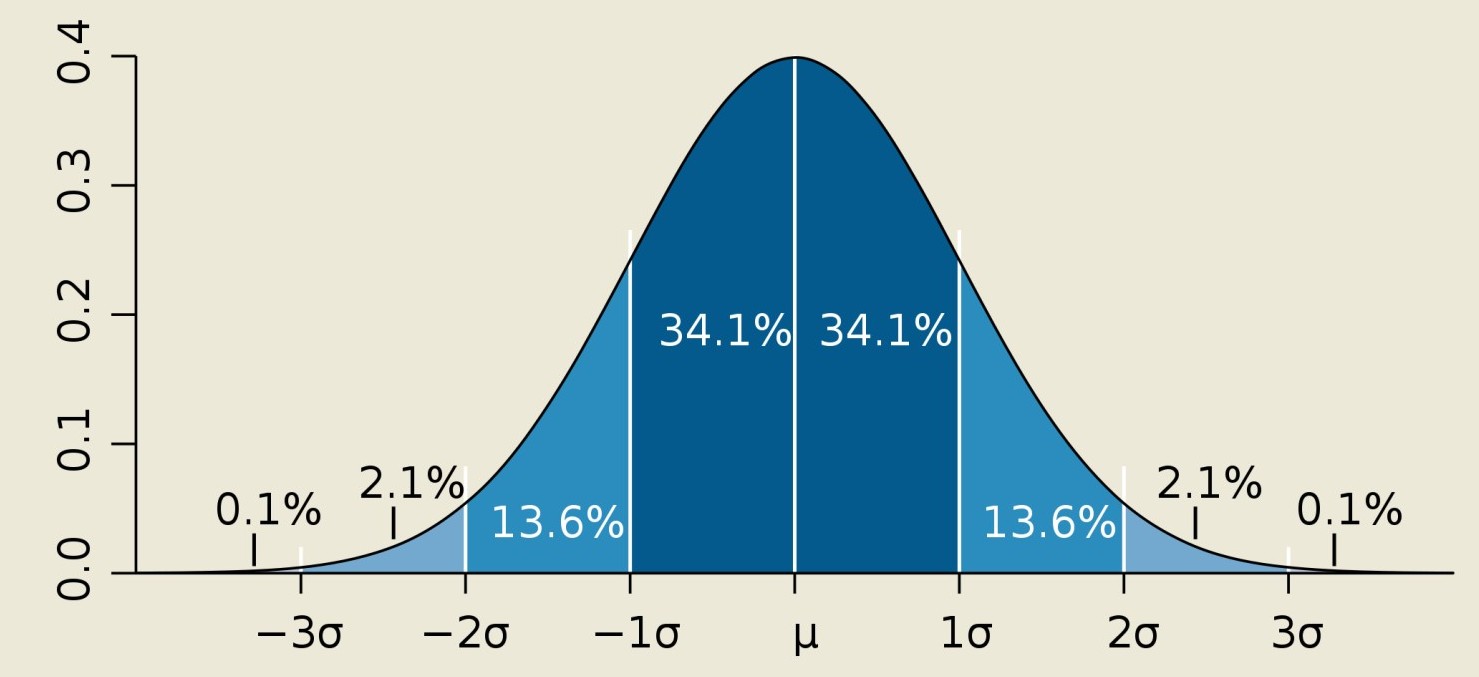
In other words, at some point it is going to snow and snow hard. Just as I, the great skier, found myself overconfident and unable to deal with the new terrain, investors will find themselves doing face-plants when the stock market turns from bull to bear. But here is great news:

Now the stock slopes are still finely groomed with stocks near all-time highs, and we all are given a unique opportunity to make adjustments to our portfolios and investment process. You should start by carefully analyzing each stock position in your portfolio. No drooling over how each of them did for you in the past. Drawing straight lines from the past into the future is very dangerous.

The Future

Instead, focus on the future — a future in which average stock valuations will likely be lower. Returns for a stock are driven by three variables: earnings growth, change in P/E and dividend yield. You should impartially examine each variable to determine if a stock deserves to be in your portfolio.

Then make one of three decisions: buy (more), hold or sell. Just remember, hold is a decision. If you choose not to sell an overvalued stock, one that has low or negative expected returns in the long run, that is a decision. We must all reexamine and future-proof our investment process. Six years of rewards and no risk will loosen the process of even the most disciplined investor.

Finally, if you are feeling very confident about your investment prowess today, take a moment to relive that gut-wrenching feeling you had the last time the stock market took a 20 percent dive. This will reset your confidence to the appropriate level and help you to avoid the mistakes that come from focusing too much on reward and too little on risk.

***

penn station

***

P.S. I took the kids skiing at Beaver Creek a week ago, for the first time this season. My daughter Hannah, who will be ten in a few weeks, has magically improved over the summer. However, Jonah, who is an amazing skier, has completely lost his form. He grew five or six inches since last spring — he’s 14 and pushing 6 feet now. His center of gravity has shifted, and he is still adjusting his technique to his new, oversized body.

Assessment

As a father, I smile when I see Hannah beating Jonah down the slope. Jonah, like any teenager, needs to be humbled. My skiing? The slopes were perfectly groomed. I was awesome! I just hope it doesn’t snow.

***

ABOUT

Vitaliy N. Katsenelson, CFA, is Chief Investment Officer at Investment Management Associates in Denver, Colo. He is the author of Active Value Investing (Wiley 2007) and The Little Book of Sideways Markets (Wiley, 2010).

Conclusion

Your thoughts and comments on this ME-P are appreciated. Feel free to review our top-left column, and top-right sidebar materials, links, URLs and related websites, too. Then, subscribe to the ME-P. It is fast, free and secure.

Speaker: If you need a moderator or speaker for an upcoming event, Dr. David E. Marcinko; MBA – Publisher-in-Chief of the Medical Executive-Post – is available for seminar or speaking engagements. Contact: MarcinkoAdvisors@msn.com

OUR OTHER PRINT BOOKS AND RELATED INFORMATION SOURCES:

***

[PHYSICIAN FOCUSED FINANCIAL PLANNING AND RISK MANAGEMENT COMPANION TEXTBOOK SET]

   Risk Management, Liability Insurance, and Asset Protection Strategies for Doctors and Advisors: Best Practices from Leading Consultants and Certified Medical Planners™ Comprehensive Financial Planning Strategies for Doctors and Advisors: Best Practices from Leading Consultants and Certified Medical Planners™

[Dr. Cappiello PhD MBA] *** [Foreword Dr. Krieger MD MBA]

***

FORECASTS – IT’S THAT TIME OF THE YEAR FOR [Physician] INVESTORS

Join Our Mailing List 

No, not the holidays!

Art

By Arthur Chalekian GEPC

[Financial Consultant]

 ***

It’s the time when physician investors begin to consider pundits’ forecasts for the coming year.

Here are a few of those forecasts:     

1. “Flat is the new up,” was the catch phrase for Goldman Sachs’ analysts last August, and their outlook doesn’t appear to have changed for the United States. In Outlook 2016, they predicted U.S. stocks will have limited upside next year and expressed concern that positive economic news may bring additional Fed tightening. Goldman expects global growth to stabilize during 2016 as emerging markets rebound, and Europe and Japan may experience improvement.

2. Jeremy Grantham of GMO, who is known for gloomy outlooks, is not concerned about the Federal Reserve raising rates, according to Financial Times (FT). FT quoted Grantham as saying,

“We might have a wobbly few weeks … but I’m sure the Fed will stroke us like you wouldn’t believe and the markets will settle down, and most probably go to a new high.”

Grantham expects the high to be followed by a low. He has been predicting global markets will experience a major decline in 2016 for a couple years, and he anticipates the downturn could be accompanied by global bankruptcies.

3. PWC’s Trendsetter Barometer offered a business outlook after surveying corporate executives. After the third quarter of 2015, it found:

“U.S. economic fundamentals remain strong, but markets and executives like predictability, and that’s not what we’ve been getting lately … Trendsetter growth forecasts are down, so are plans for [capital expenditure] spending, hiring, and more. It doesn’t help that we’ve entered a contentious 2016 election season …”

4. The Economist had this advice for investors who are reviewing economic forecasts:

“Economic forecasting is an art, not a science. Of course, we have to make some guess. The average citizen would be well advised, however, to treat all forecasts with a bucket (not just a pinch) of salt.”

***

0be5f030277425_561bf03bbcd62

[End 2015 – Begin 2016]

***

Assessment

Doctor – What are your stock market predictions for 2016?

Conclusion

Your thoughts and comments on this ME-P are appreciated. Feel free to review our top-left column, and top-right sidebar materials, links, URLs and related websites, too. Then, subscribe to the ME-P. It is fast, free and secure.

Speaker: If you need a moderator or speaker for an upcoming event, Dr. David E. Marcinko; MBA – Publisher-in-Chief of the Medical Executive-Post – is available for seminar or speaking engagements. Contact: MarcinkoAdvisors@msn.com

OUR OTHER PRINT BOOKS AND RELATED INFORMATION SOURCES:

***

Risk Management, Liability Insurance, and Asset Protection Strategies for Doctors and Advisors: Best Practices from Leading Consultants and Certified Medical Planners™8Comprehensive Financial Planning Strategies for Doctors and Advisors: Best Practices from Leading Consultants and Certified Medical Planners™

***