STOCK MARKET: Update

By Staff Reporters

***

***

Stocks kept the good vibes going for a second trading day yesterday with tech companies like Apple rising as investors reacted to the weekend’s news that smartphones and computers would be temporarily exempt from “reciprocal” tariffs—at least until new semiconductor tariffs are imposed.

Car companies also jumped after President Trump suggested he wanted to “help” as automakers try to transition their production to the US in the face of 25% auto tariffs.

COMMENTS APPRECIATED

Refer and Subscribe

***

***

DAILY UPDATE: Sleep, Starbucks and Cell Phone Education

MEDICAL EXECUTIVE-POST TODAY’S NEWSLETTER BRIEFING

***

Essays, Opinions and Curated News in Health Economics, Investing, Business, Management and Financial Planning for Physician Entrepreneurs and their Savvy Advisors and Consultants

Serving Almost One Million Doctors, Financial Advisors and Medical Management Consultants Daily

A Partner of the Institute of Medical Business Advisors , Inc.

http://www.MedicalBusinessAdvisors.com

SPONSORED BY: Marcinko & Associates, Inc.

***

http://www.MarcinkoAssociates.com

Daily Update Provided By Staff Reporters Since 2007.
How May We Serve You?
© Copyright Institute of Medical Business Advisors, Inc. All rights reserved. 2024

REFER A COLLEAGUE: MarcinkoAdvisors@msn.com

SPONSORSHIPS AVAILABLE: https://medicalexecutivepost.com/sponsors/

ADVERTISE ON THE ME-P: https://tinyurl.com/ytb5955z

***

Happy Cinco de Mayo 2024

Starbucks – The coffee company known for consistently outperforming itself reported less-than-spectacular earnings this week, sending its stock plunging 12% on Tuesday evening last week on the news—nearly as much as when the company shut all its doors during Covid 19. For the first time since 2020, US same-store sales declined, falling 3% alongside a 7% decrease in foot traffic. Meanwhile, revenue fell 1.8% to $8.56 billion as sales in China—the chain’s second-biggest market—declined 11%, and Starbucks lowered its sales outlook for the year.

CITE: https://www.r2library.com/Resource

Educators have long pushed back against distraction machines (aka phones), with 77% of schools banning them in the classroom as of 2020, according to a National Center for Education Statistics survey. School time still overlaps with screen time: 97% of students are on their phones during school hours, according to a study by Common Sense Media, a nonprofit that informs parents about technology. While much of students’ phone use might be at lunch or recess, teachers complain that kids aren’t waiting for the bell to take a discreet peek at their screens.

CITE: https://tinyurl.com/2h47urt5

Creatine may counteract sleep deprivation. The dietary supplement all over your Instagram feed might one day help workers who have to do a lot on small amounts of sleep, like ER staff, first responders, and anyone sharing a house with a baby.

CITE: https://tinyurl.com/tj8smmes

COMMENTS APPRECIATED

PLEASE SUBSCRIBE: MarcinkoAdvisors@msns.com

Thank You

***

***

***

***

EDUCATIONAL TEXTBOOKS: https://tinyurl.com/4zdxuuwf

***

About the Mobile Health Market

Sensor-Based Mobile Apps Show How M-Health Business Models Could Work

By Markus Pohl

Join Our Mailing List 

Making money with mobile healthcare applications takes much more effort than most developers expected. M-Health apps normally do not get into the app stores’ top ranking lists and thus do not receive high download numbers.

m-Health Applications Business Models

But, there are working business models for the mHealth applications. Within the mobile health app category revenue won’t be generated through app stores. More and more mHealth app publishers have understood that they have to adapt their business model accordingly. Turning away from the “normal” pay-per-download models to practices like charging for medical service (call a doc) or sensor based models.

Sensor Based Models

Sensor based business models seem to have particularly caught the attention of mHealth app publishers over the last 6 months. The idea behind this model is not to sell an app but to use the app to promote the sales of a sensor. Revenue will be generated outside the app store.

Trend Examples: 

Here are some examples to highlight this trend.

  • Health and Wellness Monitoring tools combine fitness-related equipment to track pulse, calories, running speed, heart rate, or use sensor-devices to monitor weight control, fetus observation and eye testing. Target groups for these products are fitness and health-conscious users aged mainly between 35 and 45 years.
  • Chronic Condition Monitoring tools monitor health conditions like heart disease, hypertension, diabetes, asthma and obesity. They generate revenue from selling a sensor-device with a free application. Target groups are healthcare providers, medical personnel and chronically ill people between 30 and 50 years.
  • Diagnosis Tools are mainly targeted at professionals, who increasingly demand more portable and easy-to-use devices for easier communication with patients and peers.
  • Educational and Motivational Tools monitor habit patterns (e.g. sleep monitoring via app/device) or serve as useful didactic instruments for science education (e.g. portable microscopes).

Traditional health care service providers and especially medical device manufacturers should be aware of these trends and start to connect to the smartphone world.

To find a detailed overview of mHealth business models – please see the Mobile Health Market Report 2010-2015. Or, take a look at more mobile healthcare research from research2guidance.

Assessment

Outside app store revenue will drive the market. Sensor-based business models prove how to actually make money with mobile applications.

Conclusion

And so, your thoughts and comments on this ME-P are appreciated. Feel free to review our top-left column, and top-right sidebar materials, links, URLs and related websites, too. Then, subscribe to the ME-P. It is fast, free and secure.

Link: http://feeds.feedburner.com/HealthcareFinancialsthePostForcxos

Speaker: If you need a moderator or speaker for an upcoming event, Dr. David E. Marcinko; MBA – Publisher-in-Chief of the Medical Executive-Post – is available for seminar or speaking engagements. Contact: MarcinkoAdvisors@msn.com

Our Other Print Books and Related Information Sources:

Health Dictionary Series: http://www.springerpub.com/Search/marcinko

Practice Management: http://www.springerpub.com/product/9780826105752

Physician Financial Planning: http://www.jbpub.com/catalog/0763745790

Medical Risk Management: http://www.jbpub.com/catalog/9780763733421

Healthcare Organizations: www.HealthcareFinancials.com

Physician Advisors: www.CertifiedMedicalPlanner.com

Subscribe Now: Did you like this Medical Executive-Post, or find it helpful, interesting and informative? Want to get the latest ME-Ps delivered to your email box each morning? Just subscribe using the link below. You can unsubscribe at any time. Security is assured.

Link: http://feeds.feedburner.com/HealthcareFinancialsthePostForcxos

Sponsors Welcomed: And, credible sponsors and like-minded advertisers are always welcomed.

Link: https://healthcarefinancials.wordpress.com/2007/11/11/advertise

Product DetailsProduct DetailsProduct Details       

Product Details  Product Details

   Product Details 

Why m-Health App Developers Won’t Make Money with Current Pay-Per Download Business Models

A Broadening Business Model

By Markus Pohl

markus.pohl@research2guidance.com

Join Our Mailing List 

Despite the hype around mobile health applications and big market projections mobile health app developers will not be able to create big revenues with a pay per download business models. But how will mHealth apps generate enough sustainability to meet the rising expectations during this hype phase? And how will mHealth business models evolve in the next five years?

The Hype 

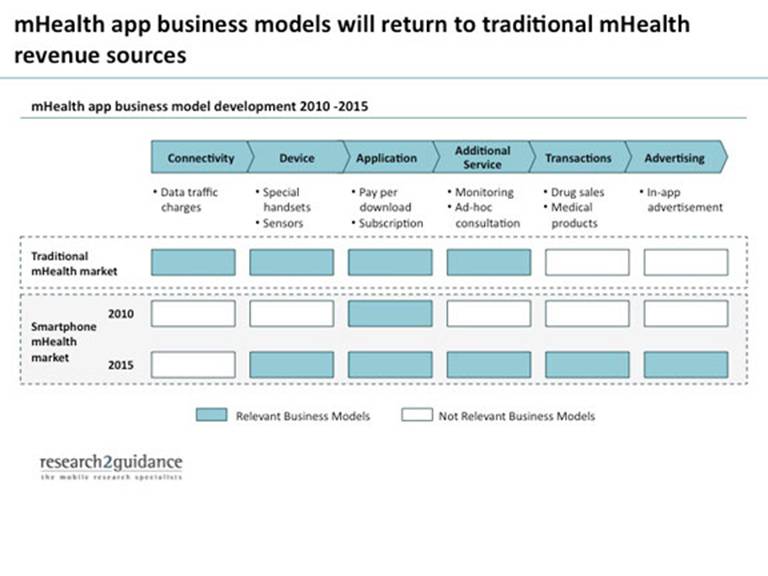
Mobile health applications are experiencing a second hype phase after first enthusiasm in the early 2000s. By looking back a few years we can see how the business will evolve in the future. Business models of traditional mHealth solutions which long existed before the smartphone app market hype already showed the revenue sources which will become important in the future. Traditional mHealth solutions from 2000-2008 have typically been sold in bundles, which include connectivity charges, a device, and the application and/or service charge. In the more sophisticated traditional mHealth solutions the price for the application and the application sales revenues were minor contributors to the total revenue generated by the solution. Frequently the price for the app was not even disclosed.

First Gen  

The first generation of mHealth solutions in the new smartphone applications market have adopted a narrow range of business models, concentrating on revenues generated from application download sales, and subscriptions for content access over a period of time; average of 4-8 USD per download depending on the app store. In a very few cases publishers have linked the application to a device/sensor or service, such as the WiThing Scales Sync which provides a free application for use with a scale which is sold through the publisher’s website.

Broadening Business Model 

The business model will broaden once more when the enabling technology becomes sufficiently advanced. Sensors and special devices that are designed to take advantage of the smartphone interface will facilitate more advanced applications, and at the same time healthcare industry players with the capability of providing complex service offerings will enter the market. These factors will allow revenue generation through multiple sources apart from application downloads including for example through service charges for HCPs remotely monitoring patients’ health condition, or through product sales for special devices and sensors that relate to an application’s functionality.

As the market develops, applications will facilitate the sale of products and services such as medications through a compliance application or a mobile pharmacy application. These device and service sales will become the major revenue source for mHealth application providers by 2015.

Advertising revenues will become a revenue stream, as it will across the smartphone application market and will add to the mHealth providers’ income but only to a little extent.

Assessment 

As opposed to the traditional model, connectivity will not be part of the bundle, as most smartphone users will already have some kind of data plan.

Today’s dominant pay per download business model will give way to those other revenue stream. Developers of mHealth applications should be aware of that and adopt their products and service accordingly.

To see more details on the future trends in mHealth business models please have a look at the “Mobile Health Market Report 2010-2015”.

About research2guidance:

research2guidance is a Berlin-based market research company specialized in the mobile industry. The company’s service offerings include comprehensive market studies, as well as bespoke research and consultancy.

Contact:

research2guidance

+49 30 609 893 363

Conclusion

And so, your thoughts and comments on this ME-P are appreciated. Feel free to review our top-left column, and top-right sidebar materials, links, URLs and related websites, too. Then, subscribe to the ME-P. It is fast, free and secure.

Speaker: If you need a moderator or speaker for an upcoming event, Dr. David E. Marcinko; MBA – Publisher-in-Chief of the Medical Executive-Post – is available for seminar or speaking engagements. Contact: MarcinkoAdvisors@msn.com and http://www.springerpub.com/Search/marcinko

Our Other Print Books and Related Information Sources:

Health Dictionary Series: http://www.springerpub.com/Search/marcinko

Practice Management: http://www.springerpub.com/product/9780826105752

Physician Financial Planning: http://www.jbpub.com/catalog/0763745790

Medical Risk Management: http://www.jbpub.com/catalog/9780763733421

Healthcare Organizations: www.HealthcareFinancials.com

Physician Advisors: www.CertifiedMedicalPlanner.com

Subscribe Now: Did you like this Medical Executive-Post, or find it helpful, interesting and informative? Want to get the latest ME-Ps delivered to your email box each morning? Just subscribe using the link below. You can unsubscribe at any time. Security is assured.

Link: http://feeds.feedburner.com/HealthcareFinancialsthePostForcxos

Sponsors Welcomed: And, credible sponsors and like-minded advertisers are always welcomed.

Link: https://healthcarefinancials.wordpress.com/2007/11/11/advertise

Product DetailsProduct DetailsProduct Details       

Product Details  Product Details

   Product Details 

Understanding HIT Security Risks – The Ugly Truth!

Join Our Mailing List

On the Privacy and Security of Healthcare Records

Dr. Mata

[By Richard J. Mata, MD, CIS]

There is no privacy …  get over it.

Scott McNealy, Former Sun Microsystems CEO

Storing and transmitting health information in electronic form exposes it to risks that do not exist, or exist to a lesser extent, when the information is maintained in paper.  For example, although both paper-based and electronic systems need protection from fire, water, and wear and tear because of aging, electronic data is also vulnerable to hardware or software malfunctions that can make data inaccessible or become corrupt, and to non-secure policies that can make data vulnerable to illegal access.  In addition, cyber-crimes, and unauthorized intrusions originating both internally and externally, are increasing dramatically every year, costing companies millions of dollars.  Nonetheless, electronic medical records (EMRs) are usually considered more secure than paper patient charts because paper records lack an audit trail, papers are easily lost, and their contents can be illegible.

Take Care the Risks

Healthcare organizations must take the new risks seriously, however, because health information is a vital business asset, and protecting it preserves the value of this asset.  In addition, securing patients’ information protects their privacy and enhances the organization’s reputation for professionalism, patient well-being, and trustworthiness.  Hospitals, emerging healthcare organizations (EHOs), physicians, and healthcare entities long ago recognized the value of health information, and implemented security policies and procedures, but as they move more into the electronic arena, it is vital to revise and update policies and procedures to acknowledge the different risks inherent in the digital age.

Three Components of Security

The three classic components of information security are confidentiality, integrity, and availability.  Donn B. Parker, a pioneer in the field of computer information protection,[1] added possession, authenticity, and utility to the original three.  These six attributes of information that need to be protected by information security measures can be defined as follows:  

  • Confidentiality: The protection and ethics of guarding personal information — for example, being cognizant of verbal communication leaks beyond conversation with associated healthcare colleagues.
  • Possession: The ownership or control of information, as distinct from confidentiality — a database of protected health information (PHI) belongs to the patients.
  • Data integrity: The process of retaining the original intention of the definition of the data by an authorized user — this is achieved by preventing accidental or deliberate but unauthorized insertion, modification or destruction of data in a database.  Make frequent backups of data to compare with other versions for changes made.
  • Authenticity: The correct attribution of origin — such as the authorship of an e-mail message or the correct description of information such as a data field that is properly named.  Authenticity may require encryption.
  • Availability: The accessibility of a system resource in a timely manner — for example, the measurement of a system’s uptime.  Is the intranet available?
  • Utility: Usefulness; fitness for a particular use — for example, if data are encrypted and the decryption key is unavailable, the breach of security is in the lack of utility of the data (they are still confidential, possessed, integral, authentic and available).

Ethics

When these attributes are considered in the healthcare context, another factor comes into play: ethics.  According to Dr. J. A. Magnuson, professor of public health informatics at Oregon Health Science University’s Medical Informatics Program, privacy,[2] security, and ethics are inextricably intertwined, and all are critical to public health’s role as a trustee of the public’s data.  As public health becomes increasingly involved in Electronic Data Interchange (EDI;[3]), the information aspects of privacy, security, and ethics become ever more critical.  All doctors take an ethical oath to protect the patient, and the obligation to uphold this oath extends to health data management, even for employees who do not take an oath.

The fields of medicine and information technology (IT) each have separate and related ethical considerations.  Ethics may prohibit technology, for example, when using a specific application that would make a security breach likely.  However, ethics may also demand technology.  Suppose that a new surveillance application would improve public health — is it not ethically imperative to utilize it to save countless lives?  But suppose it also almost guarantees a security breach — what does the ethical position on use of the application become then?  That is an extreme example, though not completely unrealistic.

FISA

Varied Uses

Complicating the picture is the fact that IT in the healthcare arena has so many and varied uses.  For instance, office-, clinic-, and hospital-based medical enterprise resource planning (ERP) is based on the same back-end functions that a company requires, including manufacturing, logistics, distribution, inventory, shipping, invoicing, and accounting.  ERP software can also aid in the control of many business activities, like sales, delivery, billing, production, inventory management, quality management, and human resources management.  However, other applications particular to the medical setting include the following:

  • The EMR, which has the potential to replace medical charts in the future, is feasible.[4]
  • Healthcare application service providers (ASPs)[5] are available via Internet portals.
  • Custom software production may produce more solution-specific applications.
  • Medical speech recognition systems and implementation are replacing dictation systems.
  • Healthcare local area networks (LANs), wide area networks (WANs), voice-over Internet protocol (IP) networks, Web and ATM file servers are ubiquitous.
  • The use of barcodes to monitor pharmaceuticals is decreasing the chance of medication errors and warns providers of potential adverse reactions.
  • Telemedicine and real-time video conferencing are already a reality.
  • Biometrics will be used more often for data access.
  • Personal digital assistant (PDA) wireless connectivity, which relies on digital or broadband technology including satellites, and radio-wave communications are increasingly common.
  • The use of wireless technology in medical devices will be increasing.

No Healthcare Standardization

All of these applications offer advantages, but the security of these IT methods and devices is not yet fully standardized or familiar to health professionals; despite the CCHIT, Office of the National Coordinator for Health Information Technology, etc.  They all involve inherent security and privacy risks, and the prudent healthcare organization will want to ensure that these risks are identified and contained.  For instance, a single firewall or intrusion detection system (IDS) may not be enough.

The process must begin by conducting a security risk assessment — that is, doing a thorough assessment of current systems and data, and performing checks such as real-time intrusion testing, validation of data audit trails, firewall testing, and remediation when gaps or failed systems are exposed.  These activities are part of developing a healthcare security plan, including disaster recovery.

Privacy Officers

To ensure that the risk assessment is thorough, hospital network administrators and Privacy Officers should have a working knowledge of federal regulations and of the following security mechanisms:

  • vulnerability assessment;
  • security policy development;
  • risk management;
  • firewall assessment;
  • security application assessment;
  • network security assessment;
  • incident response and recovery assessment;
  • authentication and authorization systems;
  • security products;
  • firewall implementation;
  • public key infrastructure (PKI) design;
  • virtual private network (VPN) design and implementation
  • intrusion detection systems;
  • penetration testing;
  • security program implementation;
  • security policy assessment; and
  • security awareness training.

The federal government has recognized the importance of health information security by establishing regulatory guidance with its Health Insurance Portability and Accountability Act of 1996 (HIPAA).

The International Standards Organization

Join Our Mailing List 

IT system managers in healthcare settings are also familiar with the comprehensive security model offered by the International Standards Organization (ISO).  For instance, using ISO’s 17799 Code of Practice for Information Security Management, versions 2000, 2005, or 2010 information security is achieved by implementing a suitable set of controls to govern policies, processes, procedures, organizational structures and software and hardware functions.  The Code requires the IT manager to establish, implement, monitor, review, and where necessary, improve these controls to ensure that the specific security and business objectives of a healthcare organization are met.

Assessment

The work of the National Institute of Science and Technology (NIST) in developing innovative technology for the healthcare sector is also of interest to IT system managers.  For instance, research on a computer note-writing system that captures clinical data automatically and a data repository system that captures patient data and integrates it with clinical decision support and knowledge bases are two of the initiatives that have originated with NIST.  In addition, the organization publishes numerous Special Publications that provide guidance on how to establish and maintain IT security.

CASE MODEL: HIT Security

Conclusion

Your thoughts and comments on this ME-P are appreciated. Feel free to review our top-left column, and top-right sidebar materials, links, URLs and related websites, too. Then, subscribe to the ME-P. It is fast, free and secure.

Speaker: If you need a moderator or speaker for an upcoming event, Dr. David E. Marcinko; MBA – Publisher-in-Chief of the Medical Executive-Post – is available for seminar or speaking engagements. Contact: MarcinkoAdvisors@msn.com

OUR OTHER PRINT BOOKS AND RELATED INFORMATION SOURCES:

References:


[1]   Donn B. Parker developed the so-called Parkerian Hexad Principles, which discuss the attributes of information security.

[2]   Privacy generally refers to a ‘people’ context, a state of being free from unauthorized intrusion or invasion.  This concept is as applicable to medical records as it is to your own house.  Confidentiality is viewed more in the context of information, usually dealing with accessing and sharing information or data.

[3]   EDI involves electronic transmission methods, often utilizing networks or the Internet.[3]  The benefits of EDI include speed, data entry savings, and reduction of manual errors; the risks are legion.

[4]   Terms used in the field include electronic medical record (EMR), electronic patient record (EPR), electronic health record (EHR), computer-based patient record (CPR), etc.  These terms can be used interchangeably or generically, but some specific differences have been identified.  For example, an EPR has been defined as encapsulating a record of care provided by a single site, in contrast to an EHR, which provides a longitudinal record of a patient’s care carried out across different institutions and sectors.  However, such differentiations are not consistently observed.

[5]   An application service provider (ASP) is a business that provides computer-based services to customers over a network.

Buy from Amazon

What is M-Health for Physicians?

On “Smart Phones” and Mobiles Devices

By Shahid N. Shah MS

M-Health or “mobile health” is an industry term for collectively defining those tools and technologies that can be used on “smart phones” like iPhone, Blackberry, Android, or on traditional mobile phones from various vendors.

Unlike traditional computers, almost every patient that walks into your medical office, as well as all your own staff, have mobile devices already. If you can find mobile applications that can help your practice you can immediately put to use without large capital expenses, network configuration, and other technical tasks.

www.MedicalBusinessAdvisors.com

The M-Health Initiative

According to the mHealth Initiative, there are 12 major “application clusters” in mobile health: patient communication, access to web-based resources, point of care documentation, disease management, education programs, professional communication, administrative applications, financial applications, emergency care, public health, clinical trials, and body area networks.

www.CertifiedMedicalPlanner.com

The Applications

Almost all of these applications are focused around the patient but most of them will be directly useful to you and your staff as well. Here’s how:

  • Improving physician-patient communications. You can get your staff to send out text messages, e-mails, photos, and other information about your practice to the patient before their visit. You can remind them about appointments, tell them what to expect, ask them for their insurance and check-in information, or let them send you their personal health record link. During the visit you can send them patient education information directly to their phones instead of handing out paper. After the visit you can send medication reminders, additional educational resources, and update to their personal health record, or ask them to join a Health 2.0 social network. PumpOne, GenerationOne, Intouch Clinical, Life:Wire, and Jitterbug phones all have great patient user experiences and you should tell your patients about them.
  • Faster access to information for you and your patients. There are countless web-based resources that are now at your fingertips on a phone. Patients can lookup providers, labs, testing services, etc. that you can refer them to; you can help them join clinical trials, and manage their health records online. None of these require a computer either in your office or in their home, it can all be done on the phone. Check out companies like Healthagen and iSeek.
  • Real-time documentation of office or hospital visits. Most of the things you want to do in your EMR are possible on a smart phone today. You can get your patient profiles, document an encounter with basic order management and lab results review capabilities, and immediate storage into either your own EMR or your hospital’s information system.
  • Help those patients with the most time-consuming treatments. You already know that disease management is an important part of managing the health of chronic patients; diabetes and hypertension are two perfect examples. Help enroll your patients into Diabetes Connect, MediNet, HealthCentral, and similar applications that can help track compliance with your medical treatment guidance. If they use these applications they can simply give you printouts or login credentials so that you can track their progress without doing any data entry yourself. There are patient tools for most common diseases.

Join Our Mailing List

Editor’s Note

Shahid N. Shah is an ME-P thought leader who is writing Chapter 13: “Interoperable e-MRs for the Small-Medium Sized Medical Practice” [On Being the CIO of your Own Office] for the third edition of the best selling book: Business of Medical Practice [Transformational Health 2.0 Skills for Doctors] to be released this fall by Springer Publishing, NY. He is also the CEO of Netspective Communications, LLC.

www.BusinessofMedicalPractice.com

Conclusion

And so, your thoughts and comments on this ME-P are appreciated. Feel free to review our top-left column, and top-right sidebar materials, links, URLs and related websites, too. Then, be sure to subscribe. It is fast, free and secure.

Speaker: If you need a moderator or speaker for an upcoming event, Mr. Shah and Dr. David E. Marcinko; MBA – Publisher-in-Chief of the Medical Executive-Post – are available for seminar or speaking engagements. Contact: MarcinkoAdvisors@msn.com

Get our Widget: Get this widget!

Our Other Print Books and Related Information Sources:

Practice Management: http://www.springerpub.com/prod.aspx?prod_id=23759

Physician Financial Planning: http://www.jbpub.com/catalog/0763745790

Medical Risk Management: http://www.jbpub.com/catalog/9780763733421

Healthcare Organizations: www.HealthcareFinancials.com

Health Administration Terms: www.HealthDictionarySeries.com

Physician Advisors: www.CertifiedMedicalPlanner.com

Subscribe Now: Did you like this Medical Executive-Post, or find it helpful, interesting and informative? Want to get the latest ME-Ps delivered to your email box each morning? Just subscribe using the link below. You can unsubscribe at any time. Security is assured.

Link: http://feeds.feedburner.com/HealthcareFinancialsthePostForcxos

Sponsors Welcomed: And, credible sponsors and like-minded advertisers are always welcomed.

Link: https://healthcarefinancials.wordpress.com/2007/11/11/advertise