CRYPTO-CURRENCY: Historical Review

By Dr. David Edward Marcinko MBA MEd

***
***

SPONSOR: http://www.MarcinkoAssociates.com

President Donald Trump signed a pardon on Wednesday for convicted crypto executive Changpeng Zhao, who founded the Binance crypto exchange, White House Press Secretary Karoline Leavitt said in a statement. “President Trump exercised his constitutional authority by issuing a pardon for Mr. Zhao, who was prosecuted by the Biden Administration in their war on cryptocurrency,” Leavitt said. “In their desire to punish the cryptocurrency industry, the Biden Administration pursued Mr. Zhao despite no allegations of fraud or identifiable victims.”

Zhao was sentenced to four months in prison after reaching a deal with the Justice Dept. to plead guilty to charges of enabling money laundering at Binance, which he ran at the time. The U.S. also ordered Binance to pay more than $4 billion in fines and forfeiture, while Zhao agreed to pay $50 million in fines. A spokesperson for Binance did not immediately respond to a request for comment yesterday.

***

The History of Cryptocurrency: From Concept to Revolution

Cryptocurrency has transformed the global financial landscape, offering a decentralized alternative to traditional banking systems. Its history is rooted in decades of technological innovation, philosophical ideals, and economic experimentation.

🌐 Early Foundations

The concept of digital currency predates Bitcoin by several decades. In 1982, cryptographer David Chaum published a groundbreaking paper on secure digital transactions, laying the foundation for future developments in electronic money. Chaum later founded DigiCash in the 1990s, which introduced the idea of anonymous digital payments using cryptographic protocols. Although DigiCash eventually failed, it was a crucial stepping stone in the evolution of cryptocurrency.

The Birth of Bitcoin

The true revolution began in 2008 when an anonymous figure—or group—known as Satoshi Nakamoto released the Bitcoin whitepaper titled “Bitcoin: A Peer-to-Peer Electronic Cash System.” This document proposed a decentralized digital currency that used blockchain technology to record transactions transparently and securely without the need for a central authority.

On January 3, 2009, Nakamoto mined the first block of the Bitcoin blockchain, known as the Genesis Block. The first real-world Bitcoin transaction occurred in May 2010, when programmer Laszlo Hanyecz paid 10,000 BTC for two pizzas—an event now celebrated annually as Bitcoin Pizza Day.

Blockchain and Beyond

Bitcoin’s success inspired the development of other cryptocurrencies and blockchain platforms. Ethereum, launched in 2015 by Vitalik Buterin, introduced smart contracts—self-executing agreements coded directly into the blockchain. This innovation expanded the use of cryptocurrency beyond simple transactions to decentralized applications (dApps), finance (DeFi), and even digital art (NFTs).

Other notable cryptocurrencies include Litecoin, Ripple (XRP), and Cardano, each offering unique features such as faster transaction speeds, improved scalability, or enhanced privacy.

***

***

⚖️ Challenges and Controversies

Despite its promise, cryptocurrency has faced significant hurdles. Regulatory uncertainty, security breaches, and market volatility have raised concerns among governments and investors. High-profile hacks, such as the Mt. Gox exchange collapse in 2014, highlighted the risks associated with digital assets.

Governments around the world have responded differently—some embracing crypto innovation, others imposing strict regulations or outright bans. The rise of central bank digital currencies (CBDCs) reflects an effort to merge the benefits of crypto with the stability of fiat systems.

🚀 The Future of Crypto

Today, cryptocurrency is more than a niche technology—it’s a global phenomenon. Major companies accept Bitcoin, institutional investors hold crypto assets, and blockchain is being integrated into industries from healthcare to supply chain management.

As the technology matures, the focus is shifting toward scalability, sustainability, and interoperability. Whether it becomes a mainstream financial tool or remains a disruptive alternative, cryptocurrency has undeniably reshaped how we think about money, trust, and digital ownership.

COMMENTS APPRECIATED

EDUCATION: Books

SPEAKING: Dr. Marcinko will be speaking and lecturing, signing and opining, teaching and preaching, storming and performing at many locations throughout the USA this year! His tour of witty and serious pontifications may be scheduled on a planned or ad-hoc basis; for public or private meetings and gatherings; formally, informally, or over lunch or dinner. All medical societies, financial advisory firms or Broker-Dealers are encouraged to submit an RFP for speaking engagements: CONTACT: Ann Miller RN MHA at MarcinkoAdvisors@outlook.com -OR- http://www.MarcinkoAssociates.com

Like, Refer and Subscribe

***

***

IRS: Tax Treatment of NFTs and Crypto-Currency

By Staff Reporters

Remember NFTs? This is an excellent history of OpenSea, the largest NFT marketplace, and all the chaos within its walls.

***

***

You have to report your crypto and NFT transactions to the IRS

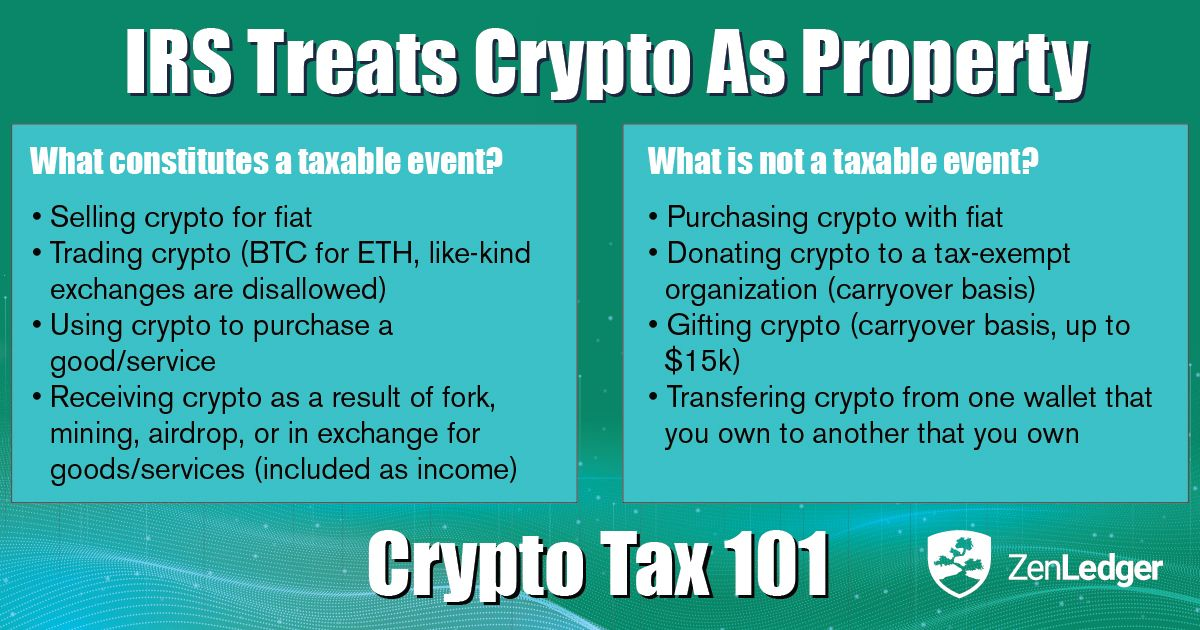
While not technically new, for 2024. the IRS is making a more concerted effort to track cryptocurrency sales and trades. Whenever you sell or trade your crypto or purchase an item with crypto, you trigger a taxable event. Currently, crypto is taxed like property, making it subject to short- or long-term capital gains taxes. This also means you can report any crypto losses to help offset any gains. Since 2022 saw a drastic drop and rise in the value of cryptocurrencies like bitcoin and ethereum, if you sold or traded your crypto at a loss, you may be able to reduce your tax bill by reporting your capital loss. The same goes for NFTs. 

And though the IRS will flag any unreported crypto gains, if you don’t report a loss that can lower your tax burden, the IRS won’t adjust your return on your behalf. “If you leave it off, it stays off. “Tax deductible losses from your virtual currency activity do have real consequences on your tax return, and can save you real dollars.

So we always tell people, if you’ve got something that you don’t fully understand, you certainly should seek out guidance from a trained experienced tax professional.”

CITE: https://www.r2library.com/Resource/Title/082610254

***

ORDER: https://www.amazon.com/Dictionary-Health-Information-Technology-Security/dp/0826149952/ref=sr_1_5?ie=UTF8&s=books&qid=1254413315&sr=1-5

***

***

ORDER: https://www.routledge.com/Comprehensive-Financial-Planning-Strategies-for-Doctors-and-Advisors-Best/Marcinko-Hetico/p/book/9781482240283

***

COMMENTS APPRECIATED

Thank You

***

NFTs 101: Taxes, Risks, and More

Randy Frederick

Nonfungible tokens have become the latest investment craze. Here’s what you need to know.

Until recently, nonfungible tokens (NFTs) were written off by many as a virtual fad and a waste of money. After all, why would someone pay $2.9 million to own the very first tweet when anyone with internet access can view it for free?

But when auction house Christie’s sold the NFT of Everydays: The First 5000 Days, a collage by the artist Beeple, for $69.3 million in March 2021, it suddenly put this emerging asset class on par with collecting a Picasso (whose heirs have jumped on the digital bandwagon by selling NFTs of the artist’s ceramics).

So, what’s all the fuss about?

The basics

Like cryptocurrencies, NFTs are stored on a blockchain, which is a digital, publicly available transaction ledger. However, while a single bitcoin can be exchanged for any other bitcoin—just as a $1 bill can be exchanged for any other $1 bill—each NFT is unique (i.e., nonfungible). In that sense, NFTs are more like the Hope Diamond or Picasso’s Guernica—a one-of-a-kind work for which there is no substitute.

Indeed, an NFT’s inherent scarcity, whether because it’s a unique piece of art or a limited-issue collectible, makes it potentially lucrative—but also substantially less liquid than, say, your average stock or bond. As a result, you may need to drop the price or hold on to your NFT if the demand isn’t there when you want or need to sell it. Other risks include:

  • Security: Like bitcoin, NFTs require a private key that functions as a password. If your key is lost or stolen, you may never again be able to access your NFT. Other security risks involve replicas that purport to be the original—as with any collectibles marketplace—and fraudulent sites designed to steal private keys and their attendant assets.
  • Taxation: Although the IRS has yet to issue specific guidance, NFTs are generally treated as collectibles. As such, if you sell an NFT you’ve held on to for less than a year, any short-term gains will be taxed as ordinary income. Any gains on an NFT held for a year or longer will be taxed at a top collectibles rate of 28%—plus a 3.8% net investment income tax if your modified adjusted gross income exceeds $200,000 ($250,000 for married couples).

Where to start

If, after careful consideration, you’re still interested in dipping your toe in NFT waters, you’ll first need to do three things:

  1. Pick a marketplace: To buy or sell NFTs, you’ll need to choose a reputable marketplace. Both Nifty Gateway and OpenSea are popular, although specialty marketplaces also exist, including ArtOfficial if you’re a fine-art collector and NBA Top Shot for basketball enthusiasts.
  2. Get a wallet: Shopping through most NFT marketplaces requires a Web3 wallet, such as MetaMask, that can store both cryptocurrencies and NFTs. Some marketplaces, like Nifty Gateway, will store your NFT, but you’ll have to pay a fee to transfer it to another wallet should you wish to do so later.
  3. Buy cryptocurrency: Some marketplaces accept payment in so-called fiat currencies, such as the U.S. dollar. However, many marketplaces are built on the Ethereum blockchain and prefer to transact in its native cryptocurrency, ether.

Tread with caution

Although the popularity of NFTs has exploded in the past year, with first-quarter sales topping $11 billion by mid-March 2022—up from $53 million for the fourth quarter of 2020—only time will tell if NFTs will realize their long-term potential or fall tragically short of it. 

Either way, it will be fascinating to see how this new form of digital authentication changes how we invest. (Ernst & Young, for example, is working on NFT-inspired technology that can help collectors track the provenance of fine wines.)

Quantum leap

NFTs experienced exponential growth in 2021.Beginning in Q3 2017, quarterly NFT trading volume remained under $20 million until jumping to $28.01 million in Q3 2020, then $52.98 million in Q4 2020. It went above $1 billion in Q1 2021 and, as of Q1 2022, has remained above $10 billion since Q3 2021.

DappRadar.com

Sales figures include only on-chain transactions conducted on the 49 NFT marketplaces that DappRadar tracks, excluding LooksRare.

*Q1 2022 data as of 03/25/2022.

ASSESSMENT

For the time being, however, there’s a lot to be said for taking a go-slow approach to this new asset class and all the risks it entails. 

In general, those interested in crypto assets like NFTs are wise to limit their exposure to no more than 1% of investable assets.

RELATED: https://www.schwab.com/learn/story/etfs-and-taxes-what-you-need-to-know?cmp=em-XCU


COMMENTS APPRECIATED

Thank You

***

DAILY UPDATE: Cooling Labor Markets with Unemployment Rate Uptick

MEDICAL EXECUTIVE-POST TODAY’S NEWSLETTER BRIEFING

***

Essays, Opinions and Curated News in Health Economics, Investing, Business, Management and Financial Planning for Physician Entrepreneurs and their Savvy Advisors and Consultants

Serving Almost One Million Doctors, Financial Advisors and Medical Management Consultants Daily

A Partner of the Institute of Medical Business Advisors , Inc.

http://www.MedicalBusinessAdvisors.com

SPONSORED BY: Marcinko & Associates, Inc.

***

http://www.MarcinkoAssociates.com

Daily Update Provided By Staff Reporters Since 2007.
How May We Serve You?
© Copyright Institute of Medical Business Advisors, Inc. All rights reserved. 2024

REFER A COLLEAGUE: MarcinkoAdvisors@msn.com

SPONSORSHIPS AVAILABLE: https://medicalexecutivepost.com/sponsors/

ADVERTISE ON THE ME-P: https://tinyurl.com/ytb5955z

***

A cooling labor market raises hopes for a rate cut in the summer. The latest Labor Department data shows the US added 175,000 jobs in April, but much less than the 300,000 added in March and also less than economists expected. Meanwhile, the unemployment rate ticked up to 3.9% from 3.8% in March, and wages rose less than anticipated. All that bad news for us was music to the ears of investors who are holding out hope that the Federal Reserve might still cut interest rates this summer despite most recent economic data showing that inflation is sticking around.

CITE: https://www.r2library.com/Resource

Rate cuts appear to be back on the 2024 menu following Friday’s softer-than-expected jobs report, fueling gains for all three major stock indexes last week. With the report calming worries that inflation is ticking back up, investors now project a 50% likelihood that the Federal Reserve will reduce rates in September.

Coinbase is benefiting from the hype around new bitcoin ETFs. The crypto exchange reported a $1.2 billion quarterly profit last week, and net revenue rose by 115%.

CITE: https://tinyurl.com/2h47urt5

COMMENTS APPRECIATED

PLEASE SUBSCRIBE: MarcinkoAdvisors@msns.com

Thank You

***

***

***

***

EDUCATIONAL TEXTBOOKS: https://tinyurl.com/4zdxuuwf

***

NTFs MARKETPLACE: Put Down by CNN

R.I.P.

By Staff Reporters

***

***

CNN was just accused of a “rug pull” after it suddenly shut down its Web3 project Vault by CNN, leaving collectors blindsided. The news network sparked outrage among collectors who paid thousands for non-fungible tokens sold by Vault, CNN’s own NFT marketplace, which was set up in 2021 to “offer collectors the opportunity to own a piece of history.” Investors could pay for digital ownership of CNN news reports or artistic interpretations. 

Members were told that the company had decided to end what it said was originally a “6-week experiment” and that they would be compensated “pro rata based on the total purchase price of each wallet’s NFTs according to a snapshot taken on October 6, 2022.” A separate message from CNN staffer “Jason” confirmed that this would amount to “roughly 20% of the original mint price for each Vault NFT owned.”

Developers also added that the NFTs would remain under the ownership of those who bought them, and that the website would remain open to be used as a marketplace so that collections could still be viewed. Additionally, unsold NFTs are to be burned, making the remainder “rarer.” 

READ: https://gizmodo.com/cnn-nfts-vault-1849642160

***

FINANCE: https://www.routledge.com/Comprehensive-Financial-Planning-Strategies-for-Doctors-and-Advisors-Best/Marcinko-Hetico/p/book/9781482240283

COMMENTS APPRECIATED

Thank You

****

PODCAST: Turning a PBS Interviewer into an NFT Interviewee

On the Non-Fungible Token Market

***

By Vitaliy Katseneson CFA

***

Turning a PBS Interviewer into Interviewee
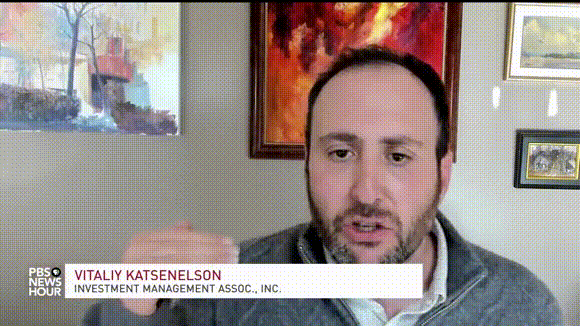
I was interviewed on PBS Newshour about the insanity that is happening in the NFT (non-fungible token) market. You can watch it here. If you read my “I Kid You Not Crazy” article, then you know everything I have to say about NFTs and cryptocurrency. I can sum up my thoughts on NFTs in one sentence: NFTs, just like cryptocurrencies, are a technology of the future, but a speculative bubble induced by excess global liquidity in the present. 

I encourage you to watch this eight-minute video – PBS did a great job. 

COMMENTS APPRECIATED

Thank You

***

https://www.amazon.com/Comprehensive-Financial-Planning-Strategies-Advisors/dp/1482240289/ref=sr_1_1?ie=UTF8&qid=1418580820&sr=8-1&keywords=david+marcinko

***

https://www.amazon.com/Dictionary-Health-Information-Technology-Security/dp/0826149952/ref=sr_1_5?ie=UTF8&s=books&qid=1254413315&sr=1-5

****