MEDICAL PRACTICE: As a Financial Asset Class?

SPONSOR: http://www.MarcinkoAssociates.com

**

***

By Dr. David Edward Marcinko; MBA MEd CMP

***

What Is an Alternative Investment?

An alternative investment is a financial asset that does not fall into one of the conventional investment categories. Conventional categories include stocks, bonds, and cash. Alternative investments can include private equity or venture capital, hedge funds, managed futures, art and antiques, commodities, and derivatives contracts. Real estate is also often classified as an alternative investment.

QUESTION: But what about a medical, podiatric or dental practice?

***

***

An Alternate Asset Class Surrogate?

A medical practice is much like an alternative investment [AI], or alternate asset class in, two respects.

  • First, it provides the work environment that generates personal income which has been considered generous, to date. 
  • Second, it has inherent appreciation and sales value that can be part of an exit (retirement) or succession planning transfer strategy.

Conclusion

So, unlike the emerging thought that offers Social Security payments as a surrogate for an asset classes; or a federally insured AAA bond – a medical practice might also be considered by some folks as an asset class within a well diversified modern investment portfolio.

EDUCATION: Books

SPEAKING: Dr. Marcinko will be speaking and lecturing, signing and opining, teaching and preaching, storming and performing at many locations throughout the USA this year! His tour of witty and serious pontifications may be scheduled on a planned or ad-hoc basis; for public or private meetings and gatherings; formally, informally, or over lunch or dinner. All medical societies, financial advisory firms or Broker-Dealers are encouraged to submit a RFP for speaking engagements: MarcinkoAdvisors@outlook.com 

COMMENTS APPRECIATED

Read, Like, Refer and Subscribe

***

***

INVESTING: Absolute Return Fund

DEFINITION

SPONSOR: http://www.MarcinkoAssociates.com

By Staff Reporters

***

***

As an investment vehicle, an absolute return fund seeks to make positive returns by employing investment management techniques that differ from traditional mutual funds.

Absolute return investment techniques include using short selling, futures, options, derivatives, arbitrage, leverage and unconventional assets.

COMMENTS APPRECIATED

Subscribe Today

***

***

FINANCIAL Derivatives

By Dr. David Edward Marcinko MBA MEd

SPONSOR: http://www.MarcinkoAssociates.com

***

***

Derivatives are securities whose performance and/or structure is derived from the performance and/or structure of other assets, interest rates, or indexes. If used moderately and in appropriate situations, derivatives can help stabilize portfolios and/or enhance returns. However, if used in excess and/or in inappropriate circumstances, they can be harmful, potentially causing portfolio instability and/or losses. Derivatives are similar to medicine in their behavior–usually safe when used as directed, potentially toxic when abused.

There are many different types of derivative securities and many different ways to use them. Some derivative securities, such as mortgage-related and other asset-backed securities, are in many respects like any other investment, although they may be more volatile or less liquid than more traditional debt securities.

Futures and options are commonly used for traditional hedging purposes to attempt to protect portfolios from exposure to changing interest rates, securities prices or currency exchange rates, and for cash management purposes as a low-cost method of gaining exposure to a particular securities market without investing directly in those securities.

Certain other derivative securities may be described as structured investments. A structured investment is a security whose value or performance is linked to an underlying index or other security or asset class. Structured investments include collateralized mortgage obligations (CMOs). Structured investments also include securities backed by other types of collateral.

CITE: https://www.r2library.com/Resource/Title/0826102549

COMMENTS APPRECIATED

Subscribe Today!

***

***

On “Covered Call” Overlays

Buy / Writes

RB

By Ross Barnett Terry

www.TradersExclusive.com

There are many benefits that come with the ownership of stock. They range from prestige to the opportunity to be invested and, through dividends and other corporate actions, share in the prosperity of the company in question. At times we are even awarded shares of stock from companies we are affiliated. The overall goal should always be wealth accumulation. After all, why stay invested in or even work for a company that you truly do not believe in?

The benefits, as stated, all afford the chance at wealth accumulation. Once we start to look at that rate we can even better understand the fact that stocks are truly an investment vehicle similar to bonds, real estate, commodities, etc.

 What is a Call Option?

In its simplest definition, a call option is a contract that specifies that: 1) for a specified price; 2) for a specified amount in time; 3) for a specified price; 4) on a specifically identified or predetermined underlying, in this case, an exchange listed company stock. The contract gives the owner the right to take delivery of shares at the strike price.

CITE: https://www.r2library.com/Resource/Title/0826102549

Example:

In early February, if a physician or other investor wanted to take a position in shares of Pfizer (NYSE: PFE) which are say trading around $31.00. He would be invest $3,100.00 for every 100 shares. Buying a  calls on the $32.00 strike at say .68 and with an expiration date of April 2015 affords the investor the chance at appreciation on 100 shares out to the 3rd week in April  after the strike price (32.00) + the price of the option (.68) (in this case 32.68) is surpassed. That’s less than a penny a day to have the chance at participating in an up move, while being afforded that chance at a greatly reduced risk. So the trade of is foregoing a 5.41% appreciation for a 97.81% reduction in risk. The owner of the option can only lose the price they pay for the contract where as the owner of shares stands to risk any and all of the share value in question.

***

***

We can now see certain benefits that favor owning calls in lieu of owning shares of stock. But why write calls. First understand that, when you enter into a short call position, the seller is guaranteeing that, at any point during the life of the contract the buyer can exercise his right to take possession of those shares and the seller must deliver the shares upon assignment of the short contract.

The benefit of writing a call is that it enhances the rate of return. Normally; but not always, stocks move up or down in reaction to earnings calls or specific event news possibly even industry related. That said once investors react and stocks stabilize, call premiums tend to settle down. This presents the opportunity to enhance the rate of return on shares owned.

Example:

A physician corporate executive owns 1,000 shares of xyz stock and is restricted from selling those shares. Same as renting a condominium that we own for investing, selling options on a monthly basis provides a similar income stream that the rent from the condominium provides.

The executive, physician or investor owns the shares which using the above example of PFE trading at $31.00 is a cash value equivalent $31,000.00. Selling the February 32.5 call on the 1st trading day of the month for say .10 affords the owner of the shares a chance to gain a .03% rate of return in around 21 days’ time, while being afforded the luxury of the stock being able to appreciate to $32.60 which is the predetermined sale price via the sale of the call. If the owner of the shares does this each month they can gain another 3.87% return which, in addition offers a little downside protection should shares fall under pressure for whatever reason.

Professional Management?

Professional management allows for strategic points when stocks react to news or simple market weighting. “The determination to exercise or not must be weighed with all the benefits and costs taken into account; this will require additional homework by the investor” (Grigoletto, 2008). The most important aspect of call writing is active management. The reality is that only approximately 17% of options get exercised. Many expire worthless, some are traded out of before expiration, and some, such as the ones that end up in the money, just slightly above the strike do not warrant being exercised. With the returns investors face today, every possible avenue must be, at the very least, addressed and understood so they can make careful choices based on educated decisions. Considering a separately managed account by industry professionals may be an excellent alternative for many.

More:

Selling

As always in selling options, just as in any type of investment, careful analysis of the underlying investment vehicle in question is key. Additionally, in selling monthly options, the risk of assignment is greatly reduces and the seller can essentially determine how close to the price the owner wants to overlay. Fundamental analysis can help to reduce the chance at assignment. Before seeking advice, the best thing to do is contact an accountant, as well as using due diligence in researching which Registered Investment Advisor [RIA] may best suits your needs.

Assessment

But that said, always remember; the overall goal should is wealth accumulation, capital appreciation and overall enhancement of return on capital. As for the reason to own stocks, again after all, why stay invested in or even work for a company that you truly do not believe in?

Channel Surfing the ME-P

Have you visited our other topic channels? Established to facilitate idea exchange and link our community together, the value of these topics is dependent upon your input. Please take a minute to visit. And, to prevent that annoying spam, we ask that you register. It is fast, free and secure.

About the Author

  • Present: Capital Wealth Planning, LLC
  • Illinois Indiana Regional Business Development Officer
  • Previous: Think Or Swim, LLC
  • Registered Securities Representative
  • Market Maker Chicago Board of Options Exchange (CBOE) 1985 – 2004

Reference

Conclusion

Your thoughts and comments on this ME-P are appreciated. Feel free to review our top-left column, and top-right sidebar materials, links, URLs and related websites, too. Then, subscribe to the ME-P. It is fast, free and secure.

Speaker: If you need a moderator or speaker for an upcoming event, Dr. David E. Marcinko; MBA – Publisher-in-Chief of the Medical Executive-Post – is available for seminar or speaking engagements. Contact: MarcinkoAdvisors@msn.com

OUR OTHER PRINT BOOKS AND RELATED INFORMATION SOURCES:

Comprehensive Financial Planning Strategies for Doctors and Advisors: Best Practices from Leading Consultants and Certified Medical Planners(TM)

ACCOUNTING: Mark to Market [MTM] Fair Value

***

***

By Staff Reporters

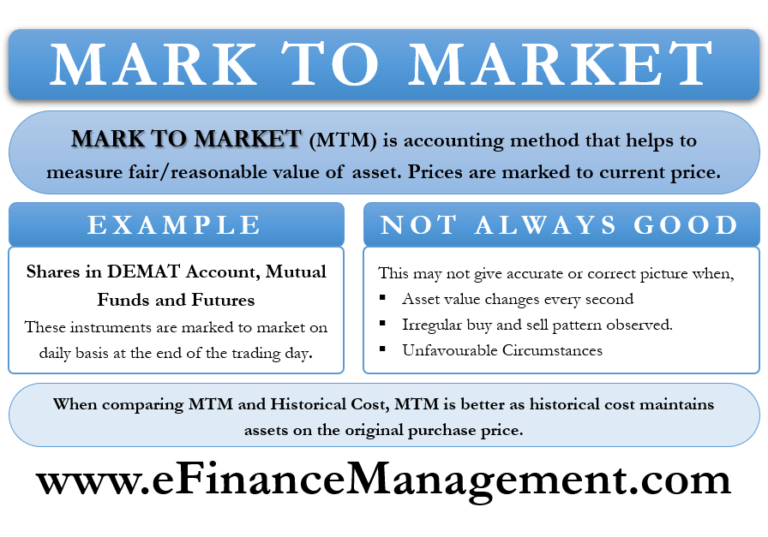
According to Wikipeida, Mark-to-market (MTM or M2M) or fair value accounting is accounting for the “fair value” of an asset or liability based on the current market price, or the price for similar assets and liabilities, or based on another objectively assessed “fair” value.[1] Fair value accounting has been a part of Generally Accepted Accounting Principles (GAAP) in the United States since the early 1990s. Failure to use it is viewed as the cause of the Orange County Bankruptcy,[2][3] even though its use is considered to be one of the reasons for the Enron scandal and the eventual bankruptcy of the company, as well as the closure of the accounting firm Arthur Andersen.[4]

Mark-to-market accounting can change values on the balance sheet as market conditions change. In contrast, historical cost accounting, based on the past transactions, is simpler, more stable, and easier to perform, but does not represent current market value. It summarizes past transactions instead. Mark-to-market accounting can become volatile if market prices fluctuate greatly or change unpredictably. Buyers and sellers may claim a number of specific instances when this is the case, including inability to value the future income and expenses both accurately and collectively, often due to unreliable information, or over-optimistic or over-pessimistic expectations of cash flow and earnings.[5]

Stock brokers allow their clients to access credit via margin accounts. These accounts allow clients to borrow funds to buy securities. Therefore, the amount of funds available is more than the value of cash (or equivalents). The credit is provided by charging a rate of interest and requiring a certain amount of collateral, in a similar way that banks provide loans. Even though the value of securities (stocks or other financial instruments such as options) fluctuates in the market, the value of accounts is not computed in real time. Marking-to-market is performed typically at the end of the trading day, and if the account value decreases below a given threshold (typically a ratio predefined by the broker), the broker issues a margin call that requires the client to deposit more funds or liquidate the account.

COMMENTS APPRECIATE

Thank You

***

***

On Financial Futures for Physicians

What it is – How it works?

By Tim McIntosh MBA CFP CMP® MPH

Courtesy: http://www.CertifiedMedicalPlanner.org

TMA future is a financial derivative that represents the purchase of a particular investment at a predetermined date. Futures are traded on a wide range of investments (e.g., baskets of stocks, interest rates, currencies and commodities) and are useful tools for controlling the risk of cash flow timing for those that wish to lock in a particular price for a security.

Futures versus Options

Likewise, they also provide some insight as to the expected future price in the market of the security.

The key difference between futures and options is that futures obligate both parties to make the agreed upon transaction, whereas options give the option holder the right, but not the requirement, to make the transaction.

Trades

Futures are typically traded on an organized exchange, such as the Chicago Board of Trade (e.g., interest rate and stock index futures) or the Chicago Mercantile Exchange (e.g., foreign exchange and stock futures). The design of the contract traded on an exchange typically includes a pre-defined contract size and delivery month.

Margin Maintenance

Also, futures transactions generally require maintaining a margin deposit (i.e., a fraction of the trade value held in reserve to help ensure the final settlement at the contract settlement date) and the recognition of gains and losses on a daily basis with movements in contract prices.

Japan and world markets tumbling - dollar stronger

Assessment

The pricing of a futures contract is based upon the price of the underlying security (e.g., the S&P 500 Index price), the opportunity cost of cash (e.g., current borrowing rates) and any distributions expected from the security over the period (e.g., dividends).

MORE: Futures

About the Author

Timothy J. McIntosh is Chief Investment Officer and founder of SIPCO.  As chairman of the firm’s investment committee, he oversees all aspects of major client accounts and serves as lead portfolio manager for the firm’s equity and bond portfolios. Mr. McIntosh was a Professor of Finance at Eckerd College from 1998 to 2008. He is the author of The Bear Market Survival Guide and the The Sector Strategist

Conclusion

Your thoughts and comments on this ME-P are appreciated. Feel free to review our top-left column, and top-right sidebar materials, links, URLs and related websites, too. Then, subscribe to the ME-P. It is fast, free and secure.

Speaker: If you need a moderator or speaker for an upcoming event, Dr. David E. Marcinko; MBA – Publisher-in-Chief of the Medical Executive-Post – is available for seminar or speaking engagements. Contact: MarcinkoAdvisors@msn.com

Risk Management, Liability Insurance, and Asset Protection Strategies for Doctors and Advisors: Best Practices from Leading Consultants and Certified Medical Planners™8Comprehensive Financial Planning Strategies for Doctors and Advisors: Best Practices from Leading Consultants and Certified Medical Planners™

***

Investing in Options

 Join Our Mailing List

An Appropriateness Summary

[By William H. Mears; CPA, JD]

Options trading involve a high degree of risk in that the physician or other investor may lose their entire investment when the option expires. As a result, options trading may not be suitable for all doctors or investors.

Suitability

All trading firms must have a procedure in place that requires a customer’s account to be approved for options trading prior to the execution of any options orders. The following steps must be taken before an option trade can be completed:

1. Completion of an Options Agreement. The Options Agreement attests to the client’s receipt of the Risk Disclosure Book, sent out by the broker.

2. Approval of the Options Agreement by a Registered Options Principal. The Registered Options Principal will ensure that the Risk Disclosure Form is sent and approves the client for options trading based on the client’s application.

3. Return of the Options Agreement to the broker/dealer within 15 days.

4. Receipt of Risk Disclosure Form by the customer. The most important step in the options account opening process is the client’s receipt and review of the Risk Disclosure Book.

Assessment

Generally, brokers send out the Risk Disclosure Form first, get approval for options trading by a Registered Options Principal (ROP), do the trade, and get a signed Options Agreement from a client within 15 days of the account approval.

So, have you ever invested in options; why and what were your results?

Channel Surfing the ME-P

Have you visited our other topic channels? Established to facilitate idea exchange and link our community together, the value of these topics is dependent upon your input. Please take a minute to visit. And, to prevent that annoying spam, we ask that you register. It is fast, free and secure.

Conclusion

Your thoughts and comments on this ME-P are appreciated. Feel free to review our top-left column, and top-right sidebar materials, links, URLs and related websites, too. Then, subscribe to the ME-P. It is fast, free and secure.

Speaker: If you need a moderator or speaker for an upcoming event, Dr. David E. Marcinko; MBA – Publisher-in-Chief of the Medical Executive-Post – is available for seminar or speaking engagements. Contact: MarcinkoAdvisors@msn.com

OUR OTHER PRINT BOOKS AND RELATED INFORMATION SOURCES:

Comprehensive Financial Planning Strategies for Doctors and Advisors: Best Practices from Leading Consultants and Certified Medical Planners(TM)