BLOGGING: All Doctors Please Beware!

WARNING – WARNING

By Dr. DavidEdwardMarcinko; MBA MEd

***

***

According to www.NPR.org, there are more than120,000 health care forums on the Internet with opinions ranging from pharmaceuticals, to sexual dysfunction, to acne. The same goes for commercial doctor blogs that promote lotions, balms and potions, diets and vitamins, minerals, herbs, drinks and elixirs, or various other ingest-ants, digest-ants or pharmaceuticals, etc.

And, to other doctors, the blogging craze is a new novelty where there are no rules, protocols, standards or precise figures on how many “medical-doctor” or related physician-blogs are “out there.” Unfortunately, too many recount gory ER scenes, or pictorially illustrate horrific medical conditions, or serious and traumatic injuries. Of course, others simply are medical practice websites, or those that entice patients into more lucrative plastic surgery or concierge medical practices. Some are from self-serving/credible plaintiff-seeking attorneys wishing to assist patients.

Not all physician blogs are geared toward practice information, marketing or medical sensationalism. In fact, just the opposite seems to be the case in extremely candid blogs, like “Ranting Docs”, “White Coat Rants,” “Grunt Docs”, “Cancer Doc,” “The Happy Hospitalist,” “Mom MD”, “Cross-Over Health”, “Angry Docs” and “M.D.O.D.,” which bills itself as “Random Thoughts from a Few Cantankerous American Physicians.”

According to some of these, they are more like personal journals, or public diaries, where doctors vent about reimbursement rates, difficult cases, medical mistakes, declining medical prestige and control, and/or what a “bummer” it is to have so many patients die; not pay, or who are indigent, noncompliant. We call these the “disgruntled doctor sites.” Some even talk about their own patients, coding issues, or various doctor-patient shenanigans.

But, according to psychiatrist and blogger Dr. Deborah Peel and others, the problem with blogging about patients is the danger that one will be able to identify themselves – the doctor – or that others who know them will be able to identify them.”  Her affiliation, Patient Privacy Rights, rightly worries that patients might track back to the individual, and adversely affect their employment, health insurance or other aspects of life.

***

***

And, according to Dr. Jay S. Grife; MA Esq., it is certainly true that if a doctor violates a patient’s privacy there could be legal consequences. Under HIPAA, physicians could face fines or even jail time. In some states, patients can file a civil lawsuit if they believe a doctor has violated their privacy. Still, internet privacy issues are an evolving gray-area that if not wrong, may still be morally and ethically questionable [personal communication].

Our colleague Robert Wachter MD, author of the blog called “Wachter’s World,” says it’s important for doctors to be able to share cases, as long as they change the facts substantially. On the other hand, the author of “Wachter’s World” and a leading expert on patient safety alternately suggests “You might say we as doctors should never be talking about experiences with our patients online or in books or in articles.” But, he says that “patients shouldn’t take all the information on blogs at face value. Taken for what they are — unedited opinions, and in some cases entertainment — blogs can give readers some useful insight into the good, the bad and the ugly of the medical profession”. Link: http://www.the-hospitalist.org/blogs

Well, fair enough! But, doctors unhappy with their current medical career choice, or its modern evolution, should probably consider counseling or even career change guidance, re-education and re-engineering. It is very inappropriate to vent career frustrations in a public venue. It’s far better for the blog to be private and/or by invitation only; if at all [Personal communication].

We believe that a hybrid mash-up of both views can be wholly appropriate, or grossly inappropriate in some cases. Of course the devil is in the details; linguistics and semantics aside. Nevertheless; what is not addressed in electronic physician “mea-culpas” are the professional liability risks and concerns that are evolving in this quasi-professional, quasi-lay, communication forum.

***

***

Example: We have seen medical mistakes, and liability admissions of all sorts, freely and glibly presented. In fact,

“Some physicians find that the act of liability blogging as a professional confession that is useful in moving past their malpractice mistakes. And, it is also a useful way to begin a commitment to a better professional life of caring in the future. It helps eliminate the toxic residue and angst of professional liability and guilt. Moreover, as they are unburdened of past acts of omission or commission, doctors should remember to also forgive those who have wronged them. This helps greatly with the process and brings additional peace.”

However, although some may say that this electronic confession is good for the soul, it may not be good for your professional liability carrier, or you, when plaintiff’s attorneys release a legion of IT focused interns, or automated bots, searching online for your self-admissions and scouring for your self-incriminations. Of course, a direct connection to a specific patient may still not be made and no HIPAA violation is involved. But, a vivid imagination is not need needed to envision this type of blind medical malpractice discovery deposition query even now.

QUESTION: “Doctor Smith, I noted all the medical errors admitted on your blog. What other mistakes did you make in the care and treatment of my client?”

And so, the question of plausible deniability, or culpability, is easily raised.  If you must journalize your thoughts for sanity or stress release; do it in print. And, don’t tell anyone about it so the diary won’t be subpoenaed. Then tear it up and throw it away. Remember, with risk management, “It is all about credibility.” Don’t trash yours! These thoughts may be especially important if you covet a medical career as a researcher, editor, educator, medical expert or something other than a working-class or employed physician.

EDUCATION: Books

SPEAKING: Dr. Marcinko will be speaking and lecturing, signing and opining, teaching and preaching, storming and performing at many locations throughout the USA this year! His tour of witty and serious pontifications may be scheduled on a planned or ad-hoc basis; for public or private meetings and gatherings; formally, informally, or over lunch or dinner. All medical societies, financial advisory firms or Broker-Dealers are encouraged to submit a RFP for speaking engagements: CONTACT: MarcinkoAdvisors@outlook.com 

COMMENTS APPRECIATED

Read, Like Subscribe and Refer

***

***

More On Social Media in Healthcare

Join Our Mailing List

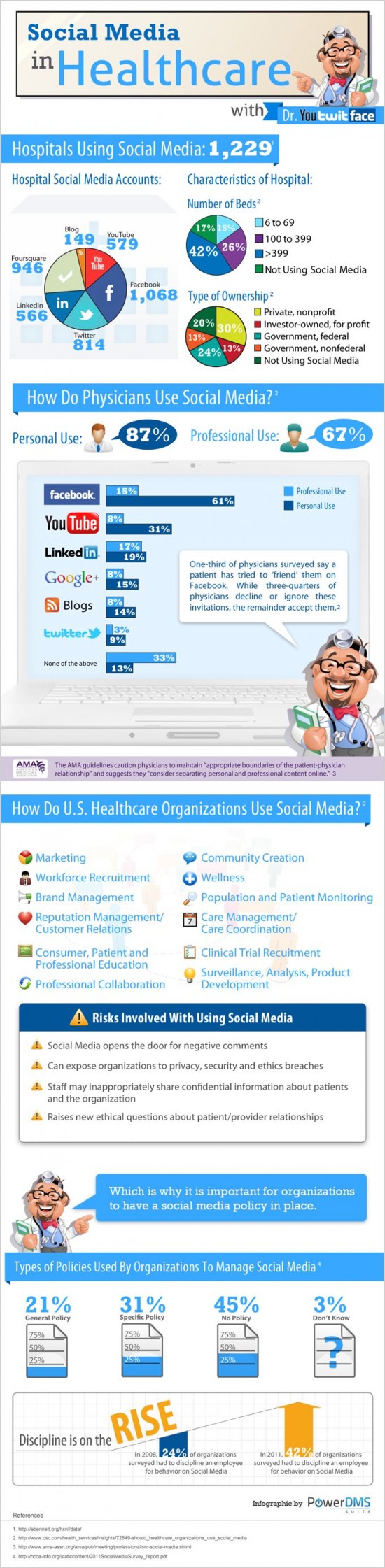
Blurring Personal and Professional Lives

Social media is becoming increasingly more prevalent within the healthcare industry.

But, with more hospitals and doctors joining social-media platforms on a consistent basis, it begs the question of “helpful or harmful”?

Assessment

One thing is certain: clear parameters must be established, so professional and personal lines don’t become blurred.

Source: powerdms.com

Conclusion

Your thoughts and comments on this ME-P are appreciated. Feel free to review our top-left column, and top-right sidebar materials, links, URLs and related websites, too. Then, subscribe to the ME-P. It is fast, free and secure.

Speaker: If you need a moderator or speaker for an upcoming event, Dr. David E. Marcinko; MBA – Publisher-in-Chief of the Medical Executive-Post – is available for seminar or speaking engagements. Contact: MarcinkoAdvisors@msn.com

OUR OTHER PRINT BOOKS AND RELATED INFORMATION SOURCES:

   Product Details

Product DetailsProduct Details

On Healthcare Intranets and Extranets

Join Our Mailing List

A Primer for Physicians and Medical Executives

Dr. Mata

By Richard J. Mata; MD, MS, CMP™ [Hon]

According to the “Dictionary of Heath Information and Technology”,

“An intranet is a private network that uses Internet Protocols, network connectivity, and possibly the public telecommunication system to securely share part of an organization’s information or operations with its employees”.

Sometimes the term refers only to the most visible service, the internal website.  The same concepts and technologies of the Internet, such as clients and servers running on the Internet protocol suite, are used to build an intranet.

Uses in Healthcare

An intranet is commonly used to provide communication and application services.  The advantages of using an intranet in the healthcare setting include the following:

  • Medical Workforce productivity: Intranets can help employees quickly find and view information and applications relevant to their roles and responsibilities.  Via a simple-to-use web browser interface, users can access data held in any database the organization wants to make available, anytime and  subject to security provisions — from anywhere, increasing employees’ ability to perform their jobs faster, more accurately, and with confidence that they have the right information.
  • Time: With intranets, healthcare organizations can make more information available to employees on a “pull” basis (i.e., employees can link to relevant information at a time that suits them) rather than being deluged indiscriminately by e-mails.
  • Communication: Intranets can serve as powerful tools for communication within a healthcare organization; vertically and horizontally.

Vulnerability and Security Protection

Intranets, like other IT systems, need to be protected by security systems. Any intranet is vulnerable to attack by people intent on destruction or on stealing corporate data. The open nature of the Internet and TCP/IP protocols expose a corporation to attack.  Intranets require a variety of security measures, including hardware and software combinations that provide control of traffic; encryption and passwords to validate users; and software tools to prevent and cure viruses, block objectionable sites, and monitor traffic.

Multiple Lines of Defense

The first line of defense is a firewall and these are commonly set up using proxy servers, which allow system administrators to track all traffic coming in and out of an intranet. Another layer of sophistication is added by using a bastion server firewall, configured to withstand and prevent unauthorized access or services. It is typically segmented from the rest of the intranet in its own subnet or perimeter network. In this way, if the server is broken into, the rest of the intranet won’t be compromised.

Authentication Systems

Authentication systems are an important part of any intranet security scheme. They are used to ensure that anyone trying to log into the intranet or any of its resources is the person they claim to be. Authentication systems typically use user names, passwords, fingerprints and iris scans, and various encryption systems.

Protection and Monitoring

Server-based software is used to protect an intranet and its data. Virus-checking software can check every file coming into the intranet to make sure that it is virus-free, and site-blocking software can bar people on the intranet from getting objectionable material. Monitoring software tracks where people have gone and what services they have used, such as HTTP for Web access.

Filtering Systems and Routers

One way of ensuring that the wrong people or erroneous data can’t get into the intranet is to use a filtering router. This is a special kind of router that examines the IP address and header information in every packet coming into the network, and allows in only those packets that have addresses or other data, like e-mail, that the system administrator has decided should be allowed into the intranet. Increasingly, intranets are being used to deliver tools and applications, e.g., collaboration (to facilitate working in groups and for teleconferences) or sophisticated corporate directories, sales and customer relationship management (CRM) tools, project management, etc, to advance productivity. Intranets are also being used as Health 2.0 culture change platforms

Metrics

Intranet traffic, like public-facing website traffic, is better understood by using web metrics software to track overall activity, as well as through surveys of users. Intranet User experience, editorial, and technology teams work together to produce in-house sites. Most commonly, intranets are owned by the communications, HR or IT areas of large healthcare organizations, or some combination of the three.

Assessment

When part of an intranet is made accessible to customers, partners, suppliers, patients, or others outside the healthcare organization – that part becomes part of an extranet.

Conclusion

Your thoughts and comments on this ME-P are appreciated. Feel free to review our top-left column, and top-right sidebar materials, links, URLs and related websites, too. Then, subscribe to the ME-P. It is fast, free and secure.

Link: http://feeds.feedburner.com/HealthcareFinancialsthePostForcxos

Speaker: If you need a moderator or speaker for an upcoming event, Dr. David E. Marcinko; MBA – Publisher-in-Chief of the Medical Executive-Post – is available for seminar or speaking engagements. Contact: MarcinkoAdvisors@msn.com

OUR OTHER PRINT BOOKS AND RELATED INFORMATION SOURCES:

Product DetailsProduct DetailsProduct Details

Product DetailsProduct Details

***

ME-P Now on Technorati Finance and Wikio Health

What is Technorati Authority and Wikio for Blogs?

By Staff Reporters

Pensive WomanOn Friday May 4th, 2007, Technorati.com was updated to include the Technorati Authority for blogs and listed on their Blog page and in search results. This update changed the earlier references of “N blogs link here” and “X links from Y blogs” with the single Technorati Authority number. On the blog page, it also shows the Technorati Rank.

Technorati Authority

Technnorati Authority [TA] is the number of blogs linking to a website, like this ME-P, in the last six months. The higher the number, the more Technorati Authority we have. It is important to note that Technorati measures the number of blogs, rather than the number of links. So, if a blog links to the ME-P many times, it still only counts as +1 toward our authority. Of course, new links mean the +1 will last another 180 days.

Technorati Calculations

Technorati Rank is calculated based on how far we are from the top. The blog with the highest Technorati Authority is the #1 ranked blog. The smaller our Technorati Rank, the closer we are to the top. Since at the lower end of the scale many blogs will have the same Technorati Authority, they will share the same Technorati Rank.

Technorati Rankings

The Technorati Top 100 shows the most popular 100 blogs based on Technorati Authority. The #1 ranked blog is the blog forum with the most other distinct blogs linking to it in the last 6 months. If our blog’s rank is, say 305,316, this indicates that there are 305,315 blog ranks separating our blog from the #1 position.

Help Increase our ME-P Rankings

The best way to increase our ME-P Technorati Authority is to write and submit cogent posts and fascinating comments that are interesting to other like-minded ME-P bloggers; so they’ll link to us. Why? Swagger, and free-labor journalistic entrepreneurship, of course. Linking to source material when you blog is also a great way to engage in conversation and help others find what you find interesting. Finally, since we want to let readers see our Technorati Authority on this blog, we have just installed the TA [and Wikio] widgets for all our ME-P readers and subscribers [June 2009]

Link: http://www.wikio.com/subscribe?url=http%3A%2F%2Ffeeds.feedburner.com%2FHealthcareFinancialsthePostForcxos.

Assessment

Remember, authority is determined by the number of unique blogs indexed by Technorati that have linked to us in the past 180 days. Thus, as links from blogs age out of this window and new links are added, our ME-P authority may rise, fall, or stay the same over time. Also, if the same blog links to us many times in the past 180 days, it only counts once towards our authority though it does renew the age of link. Additionally, the link must appear in our blog reactions to be applied to our authority. If the links are not in our blog reactions, please check to see if the blogs and/or your post with the links are in Technorati. If they are not, then encourage blog owners to ping Technorati; or better yet to claim their blogs in Technorati (gives the blog higher priority). And so, blogs are submitted for review and then indexed by Technorati for their blogs and posts.

Raising ME-P Authority

Your thoughts and comments on this Medical Executive-Post are appreciated to raise our Technorati Authority.

Conclusion

Your thoughts and comments on this ME-P are appreciated. Feel free to review our top-left column, and top-right sidebar materials, links, URLs and related websites, too. Then, subscribe to the ME-P. It is fast, free and secure.

Speaker: If you need a moderator or speaker for an upcoming event, Dr. David E. Marcinko; MBA – Publisher-in-Chief of the Medical Executive-Post – is available for seminar or speaking engagements. Contact: MarcinkoAdvisors@msn.com

OUR OTHER PRINT BOOKS AND RELATED INFORMATION SOURCES:

Product DetailsProduct Details

http://www.BusinessofMedicalPractice.com

***


Social Media in Health 2.0

Join Our Mailing List

Emerging Collaborative Trends

[By Staff Reporters]

stk166326rkeAll readers of the ME-P are aware that social media is going to play a significant role in health 2.0 initiatives going forward.

Social Media Use Growing

According to Dan Bowman of FierceHealthIT, on April 3, 2009, whether we want it to happen or not, social media – much like mobile technology – is going to play a big role in the future of healthcare. From professional networks, to collaborative consumer media and doctor rating websites, healthcare professionals across the nation are jumping on the bandwagon. And, with the federal government pushing physicians’ offices to utilize electronic medical records, it is only a matter of time before healthcare make a concerted push into social media, as well.

Publishers and Editors

“As a medical, practice management and health economics writer for almost four decades, I appreciated how electronic connectivity and social media facilitates communication in a quick and effective manner, and allows broadcast to large groups of people”

Dr. David Edward Marcinko; MBA

[ME-P Publisher-in-Chief]

The Research

A Manhattan Research survey found that 60 million US healthcare consumers use social media to find healthcare information online. A similar survey found that 60 percent of physicians are interested in, or are already using physician social networks. That same study concluded that “physicians who are currently participating in online physician communities and social networks write a mean of 24 more prescriptions a week than” their more old-fashioned counterparts.

Assessment

Of course, more Rxs – or more medical care for that matter – is not a quality indicator at all. Nevertheless, social media is not to be taken lightly.

Link: http://www.fiercehealthit.com/tags/ozmosis?utm_medium=nl&utm_source=internal&cmp-id=EMC-NL-FHI&dest=FHI

Conclusion

Your thoughts and comments on this ME-P are appreciated. Feel free to review our top-left column, and top-right sidebar materials, links, URLs and related websites, too. Then, subscribe to the ME-P. It is fast, free and secure.

Speaker: If you need a moderator or speaker for an upcoming event, Dr. David E. Marcinko; MBA – Publisher-in-Chief of the Medical Executive-Post – is available for seminar or speaking engagements. Contact: MarcinkoAdvisors@msn.com

OUR OTHER PRINT BOOKS AND RELATED INFORMATION SOURCES:

Product Details

*** 

Singing the Wiki Pharma-Blues

Allegations of e-Chicanery at Abbott Laboratories

Staff Reporters

According to Walter Armstrong, of Pharmaceutical Executive on October 1, 2008, Abbott Laboratories recently edited its Wikipedia entry in an attempt to bolster its e-image.

Seeking Image Redeux

A fellow named Jeffrey Light, the young founder and head of tiny DC-based nonprofit Patients not Patents hit the wires recently, charged that Abbott Laboratories edited its entry in Wikipedia, the online everybody-can-play encyclopedia, trying to make itself look better.

Track-Backs

Using a brand-new online tool called the Wiki Scanner, which allows anyone to track-back the source of any change entered into any of Wikipedia’s 2 million articles, Light discovered that at 4:38 P.M. on July 2, 2007, several edits to the article on Abbott were made from a computer at Abbott’s Chicago office.

Assessment

We surmise the aging folks at Abbott are unfamiliar with the blogging concept of track-backs and pings; etc.

Read more:

http://pharmexec.findpharma.com/pharmexec/Back+Page/The-Wiki-Incident/ArticleStandard/Article/detail/463111?contextCategoryId=39722

Conclusion

As creators of the modified wiki enabled printed dictionary series: www.HealthDictionarySeries.com, we are saddened by these developments; if true. And so, your thoughts and comments are appreciated.

Speaker: If you need a moderator or speaker for an upcoming event, Dr. David E. Marcinko; MBA – Publisher-in-Chief of the Executive-Post – is available for seminar or speaking engagements. Contact: MarcinkoAdvisors@msn.com  or Bio: www.stpub.com/pubs/authors/MARCINKO.htm

Subscribe Now: Did you like this Executive-Post, or find it helpful, interesting and informative? Want to get the latest E-Ps delivered to your email box each morning? Just subscribe using the link below. You can unsubscribe at any time. Security is assured.

Link: http://feeds.feedburner.com/HealthcareFinancialsthePostForcxos

Practice Management: http://www.springerpub.com/prod.aspx?prod_id=23759

Physician Financial Planning: http://www.jbpub.com/catalog/0763745790

Medical Risk Management: http://www.jbpub.com/catalog/9780763733421

Healthcare Organizations: www.HealthcareFinancials.com

Health Administration Terms: www.HealthDictionarySeries.com

Physician Advisors: www.CertifiedMedicalPlanner.com

Repeat Warning on Physician Blogs

Join Our Mailing List

Understanding New-Wave Patient Privacy Risks

[By Staff Reporters]Blood Pressure Cuff

Many people are blogging these days, including physicians. Some say the rapidly expanding medium provides a great opportunity for doctors to better educate patients and the public about the practice of medicine.

Warning

But, others warn that medical or just personal opinion blogging, also presents new risks of breaching patient privacy. As blogs proliferate, some hospital privacy officers are considering policies that would provide professional standards for employees engaged in the activity, and protect their institutions from potential violations of HIPAA.

Ohio State Advice

In a recent Report on Patient Privacy [9/22/08], Julie Chicoine, compliance director at The Ohio State University Medical Center, offers the following pointers for physicians:

  • Be careful. “You should … write as if your patients, co-workers, colleagues, etc. are going to read your posting every day, and know that it came from you.
  • Focus on education and general medical principles. Avoid information that is too specific and situations that are likely to be identified by others in your local community.
  • Ask your malpractice carrier if they have issues with this topic.
  • Never post in the heat of passion. No matter what the circumstances, allow yourself a cooling-off period before logging on and sharing your concerns.
  • Blogs are not the appropriate forum for medical mistakes or hospital errors. Pursue those concerns through the appropriate administrative channels within the hospital.
  • Include a disclaimer that posts are not medical advice.

Conclusion

Your thoughts and comments on this ME-P are appreciated. Feel free to review our top-left column, and top-right sidebar materials, links, URLs and related websites, too. Then, subscribe to the ME-P. It is fast, free and secure.

Speaker: If you need a moderator or speaker for an upcoming event, Dr. David E. Marcinko; MBA – Publisher-in-Chief of the Medical Executive-Post – is available for seminar or speaking engagements. Contact: MarcinkoAdvisors@msn.com

OUR OTHER PRINT BOOKS AND RELATED INFORMATION SOURCES:

Product Details