FINANCIAL ADVISORY FEES: What All Doctors Must Know

SPONSOR: http://www.MarcinkoAssociates.com

***

By Dr. David Edward Marcinko MBA MEd CMP

WHAT YOU “MUST KNOW“ ABOUT FINANCIAL ADVISORY FEES

Investment fees still matter despite dropping dramatically over the past several decades due to computer automation, algorithms and artificial intelligence, etc. And, they can make a big difference to your financial health. So, before buying any investment, it’s vital to uncover all real financial advisor and stock broker costs.

HEDGE FUND FEES: https://medicalexecutivepost.com/2025/04/18/stocks-basic-definitions/

SIX TYPES OF FEES AND EXPENSES

1. Up-front salesperson commissions. It is easy to ask; “If I buy this investment today and want to get out tomorrow, how much money do I get back?” If the answer is not “all your money,” the difference is probably upfront fees and commissions. These fees may run as high as 30% of the money invested. If you were to earn 5% a year on the investment, it would take 8 years just to break even.

2. Ongoing advisory fees. These are monthly, quarterly, or annual fees paid to advisors for their investment advice and oversight. This includes working with you to pick the asset classes, set diversification, select a portfolio manager, optimize taxes, re-balance holdings and other periodic tasks.

These fees have many names including wrap fee or investment advisory fees. The normal “rule of thumb” is 1% of assets managed, although fees can range from 0 to 7%. Today, it can even be as low as .5%. It can be charged even if the advisor receives an upfront commission. It can be easy to see, or hidden in the fine print.

3. Additional service fees. Find out specifically what services are included financial advisory fees. Additional fees for financial planning or other services are rarely disclosed. They can range from minimal hand-holding focused on your investments to comprehensive financial planning.

4. Ongoing managerial expense ratio fees. These are incredibly well hidden that you may not see them in your statements or invoices. The only way to know is to read the prospectus or other third party analysis, like Morningstar.com. And, they can vary greatly for the same investment, depending on the class of share you buy.

For example, American Fund’s New Perspective Fund’s expense ratio ranges from 0.45% to 1.54%.  The average expense ratio of a mutual fund that invests in stocks is 1.35%. Conversely, the average expense ratio of a Vanguard S&P 500 Fund is 0.10%. The difference of 1.25% is staggering over time.

5. Miscellaneous fees. Some advisors charge $50 – $100 a year per account to open or close an account, and even fees to dollar cost average your funds into the market.

6. Transaction fees. Every time you buy or sell a fund, a fee is typically paid to a custodian. These can range from $5 to hundreds of dollars per transaction.

7. Fee Only: Paid directly by clients for their services and can’t receive other sources of compensation, such as payments from fund providers. Act as a fiduciary, meaning they are obligated to put their clients’ interests first

8. Fee Based: Paid by clients but also via other sources, such as commissions from financial products that clients purchase. Brokers and dealers (or registered representatives) are simply required to sell products that are “suitable” for their clients.

A “suitable” investment is defined by FINRA as one that fits the level of risk that an investor is willing and able, as measured by personal financial circumstances, to take on. The Financial Industry Regulatory Authority is a private American corporation that acts as a Self Regulatory Organization (SRO) that regulates member stock brokerage firms and exchange markets. These criteria must be met. It is not enough to state that an investor has a risk-friendly investment profile. In addition, they must be in a financial position to take certain chances with their money. It is also necessary for them to

A hedge fund is a limited partnership of private investors whose money is managed by professional fund managers who use a wide range of strategies; including leveraging [debt] or trading of non-traditional assets [real-estate, collectible, commodities, cyrpto-currency, etc] to earn above-average returns. Hedge funds are considered a risky alternative investment and usually require a high minimum investment or net worth. This person is known as an “accredited investor” or “Regulation D” investor by the US Securities Exchange Commission and must have the following attributes:

  • A net worth, combined with spouse, of over $1 million, not including primary residence
  • An income of over $200,000 individually, or $300,000 with a spouse, in each of the past two years

Not a fiduciary.

Ways to minimize fees

Choose the fee structure. The fee structure should align with your needs. Consider the type of advice you seek, the number of times needed and the complexity of your financial situation. You can always negotiating tactics are free to ask for a better deal.

Compare fees. It is essential to research and compare different fees. Be sure to read the fine print for details or costs that are not a base fee.

Robo-advisors: For simple investment goals, with little specificity, robo-advisors may be a cost-effective option. They charge lower fees than conventional financial advisors and provide an automated, algorithmic approach to managing your investments. 

Assessment

The average cost of working with a human financial advisor in 2024 was 0.5% to 2.0% of assets managed, $200 to $400 per hourly consultation, a flat fee of $1,000 to $3,000 for a one-time service, and/or a 3% to 6% commission fee on the product types sold.

ADVISORY FEES: https://medicalexecutivepost.com/2025/02/26/be-aware-financial-advisory-fees-fee-based-versus-fee-only/

Conclusion

When ruminating over financial advisory fees; read and understand the contract with disclosures, do not sign a confidentiality or non-disclosure agreement, and do not waive your right to a lawsuit. According to colleague Dr. Charles F. Fenton IIII JD, forced legal settlements almost always favor the advisor over the client.

References and Readings:

1. https://www.capitalgroup.com [American Funds]

2. Marcinko, DE and Hetico, HR; Comprehensive Financial Planning Strategies for Doctors and Advisors [Best Practices from Leading Consultants and Certified Medical Planners™] Productivity Press, New York, 2017. 

3. Marcinko, DE: Dictionary of Health Economics and Finance. Springer Publishing Company, NY 2006

EDUCATION: Books

SPEAKING: Dr. Marcinko will be speaking and lecturing, signing and opining, teaching and preaching, storming and performing at many locations throughout the USA this year! His tour of witty and serious pontifications may be scheduled on a planned or ad-hoc basis; for public or private meetings and gatherings; formally, informally, or over lunch or dinner. All medical societies, financial advisory firms or Broker-Dealers are encouraged to submit a RFP for speaking engagements: MarcinkoAdvisors@outlook.com 

COMMENTS APPRECIATED

Refer, Like and Subscribe

***

***

Appreciating the Six Types of Investment Fees

dr-marcinkoDR. DAVID EDWARD MARCINKO MBA MEd CMP

SPONSOR: http://www.MARCINKOASSOCIATES.com

investing

Investment fees matter. They can make a big difference to your financial health in the long run. Before you put money into any investment, it’s vital to uncover the real costs.They typically include these six types of fees:

1. An up-front commission earned by the salesperson or their firm. Don’t rely on a vague assurance or a verbal answer: get a specific number in writing.If you have trouble getting a number, ask, “If I buy this investment today and want to get out tomorrow, how much do I get back?” If the answer is not “all your money,” the difference is probably the upfront fees and commissions.

I don’t recommend purchasing financial products with significant upfront commission or costs. I have seen investments where these fees run as high as 30% of the money invested. If you were to earn 5% a year on the investment, it would take 8 years just to break even.

2. Ongoing advisory fees. These are monthly, quarterly, or annual fees you pay advisors for their investment advice and oversight. This includes working with you to pick the asset classes, set the diversification, select the managers, tax optimization, rebalancing, and other periodic tasks.

This fee can have many names including wrap fee or investment advisory fee. The normal “rule of thumb” is 1% of the assets the advisor is managing, although fees can range from 0 to 7%. This fee can be charged to you even if the advisor receives an upfront commission. It can be easy to see or hidden away in the fine print of the investment.

3. Additional fees for services. Find out specifically what services are included in the advisor fee. Additional fees for financial planning or ancillary services are rarely disclosed or discussed.

Services can range from minimal hand-holding only focused on your investments to comprehensive, holistic financial planning. Amazingly, there is no correlation between price and the breadth of services. That’s illogical, but the financial services industry gets away with this, in part because consumers don’t do their homework.

4. Ongoing fees charged by the managers of the specific funds or investment products. These fees are referred to as the fund’s expense ratio. This comes out of the profits generated by the manager, and it is one of the hardest fees to find. Only the most transparent advisor or salesperson will disclose it. It is incredibly well hidden; you will never see it in your brokerage statements or your advisor’s invoices. The only way to know the amount of this fee is to read the prospectus or some other third party analysis of the investment, like Morningstar.

These fees can vary greatly for the same investment, depending on the class of share you buy. For example, American Fund’s New Perspective Fund’s expense ratio ranges from0.45% to 1.54%.  The average expense ratio of a mutual fund that invests in stocks is 1.35%. Conversely, the average expense ratio of a Vanguard S&P 500 fund is 0.10%. The difference of 1.25% is staggering over time.

5. Miscellaneous fees. These are also rarely talked about and hard to find. Many advisors charge $50 to $100 a year per account, hundreds of dollars to open or close an account, and even fees to dollar cost average your funds into the market.

6. Transaction fees. Every time you buy or sell a fund, a fee is typically paid to a custodian. These can range from $5 to hundreds of dollars per transaction.

Assessment

Remember, it’s your job to persist until you find out the total costs of an investment. Next week I’ll suggest ways to ask the tough questions about fees.

Conclusion

Your thoughts and comments on this ME-P are appreciated. Feel free to review our top-left column, and top-right sidebar materials, links, URLs and related websites, too. Then, subscribe to the ME-P. It is fast, free and secure. 

Speaker: If you need a moderator or speaker for an upcoming event, Dr. David E. Marcinko; MBA – Publisher-in-Chief of the Medical Executive-Post – is available for seminar or speaking engagements. https://medicalexecutivepost.com/dr-david-marcinkos-bookings/ 

Contact: MarcinkoAdvisors@msn.com

***

Risk Management, Liability Insurance, and Asset Protection Strategies for Doctors and Advisors: Best Practices from Leading Consultants and Certified Medical Planners™8Comprehensive Financial Planning Strategies for Doctors and Advisors: Best Practices from Leading Consultants and Certified Medical Planners™

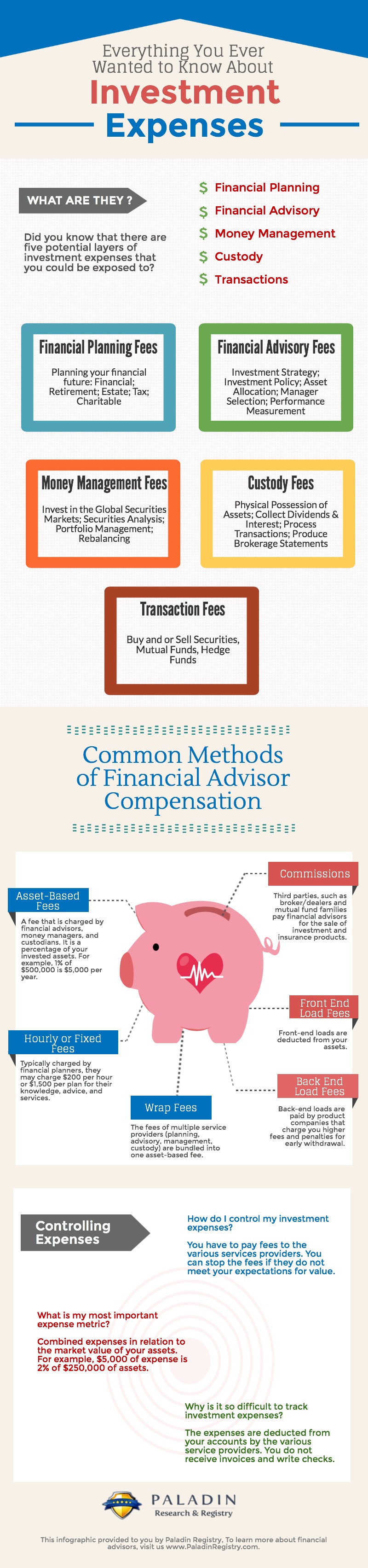
A Review of Investing Expenses

Join Our Mailing List

Peeling Back the Layers of Fees

By PALADIN [Research & Registry]

Advisor Pay

Channel Surfing the ME-P

Have you visited our other topic channels? Established to facilitate idea exchange and link our community together, the value of these topics is dependent upon your input. Please take a minute to visit. And, to prevent that annoying spam, we ask that you register. It is fast, free and secure.

Conclusion

Your thoughts and comments on this ME-P are appreciated. Feel free to review our top-left column, and top-right sidebar materials, links, URLs and related websites, too. Then, subscribe to the ME-P. It is fast, free and secure.

Speaker: If you need a moderator or speaker for an upcoming event, Dr. David E. Marcinko; MBA – Publisher-in-Chief of the Medical Executive-Post – is available for seminar or speaking engagements. Contact: MarcinkoAdvisors@msn.com

OUR OTHER PRINT BOOKS AND RELATED INFORMATION SOURCES:

Comprehensive Financial Planning Strategies for Doctors and Advisors: Best Practices from Leading Consultants and Certified Medical Planners(TM)* 8

Impact of Performance Fees on Mutual Funds and Physician Portfolios

Join Our Mailing List

More Complex than Realized by Some Doctors

[By Dr. David Edward Marcinko; FACFAS, MBA, CMP™]

[By Professor Hope Rachel Hetico; RN, MHA, CMP™]dave-and-hope4

Physician-investors may find themselves paying advisory fees, brokerage commissions, and other sales charges and expenses. All of these layers of expense can reduce or eliminate the advantage of professional management, if not monitored carefully. Also, fees can have a major impact on investment results. As a percentage of the portfolio, they normally range from low of 15–30 basis points (or .15% to .30%, a basis point is one one-hundredth of one percent) to a high of 300–400 basis points or even higher.

Charges are Universal

All portfolio managers, mutual funds, and investment advisors charge fees in one form or another. Ultimately, they must justify their fees by creating value added, or they would not be in business. Value added includes tangibles, such as greater investment return, as well as intangibles, such as assurance that the investment plan is successfully implemented and monitored, investor convenience, and professional service.

Comparisons Required

Always compare investment performance of funds or managed accounts after fees are deducted; only then can adequate comparisons be made. Also, compare fees within asset classes. Management fees and expenses of investing in bonds or bond funds are much different than the fees of investing in, for example, small companies or emerging market stocks. Whereas 100–200 basis points of fees may be appropriate for an equity portfolio or fund, similar charges may offset the advantages of a managed bond portfolio. With managed bond portfolios, real bond returns have limited long-term potential, because returns are ultimately based on interest rates. For example, if a 3% real (i.e., after inflation) return is expected, 200 basis points in fees may produce a negative after-tax result: 3% real return minus 2% fees minus 10% taxes equals a negative 9% total return.fp-book22

Sales Charges

Mutual funds (and some private portfolio managers) charge sales charges to sell or “distribute” the product. Investors who buy funds through the advice of brokers or “commission based” financial planners will pay a sales load. The many combinations of sales charges fall into three basic categories: front-end, deferred (or back-end), and continuous.

Front-End Fees

Front-end fees are a direct assessment against the initial investment and are limited to a maximum of 8.5%. They usually are stated either as a percentage of the investment or as a percentage of the investment, net of sales charges. For example, a 6% charge on a $10,000 investment is really a $600 charge to invest $9,400 or a real charge of 6.4%. Many low-load funds charge in the range of 1% to 3%. Rather than pay brokers or other purveyors, these fund companies or sponsors use the charges to offset selling or distribution costs. Although rare, some funds charge a load against reinvested dividends.

Deferred Charges

Deferred charges (or back-end loads, or redemption fees) come in many forms. Often, the longer the investor stays with the fund the smaller the charge is upon fund redemption. A typical sliding scale used for deferred charges may be 5-4-3-2-1, where redemption in year 1 is charged 5%, and redemption in year 5 is charged 1%; after year 5, there are no sales charges. Sometimes deferred charges are combined with front-end charges.

Redemption Fees

Certain quoted redemption fees may not apply after a period, such as one year. Funds often use such fees to discourage the trading of funds. Frequently, these charges are paid to the fund itself rather than to the fund management company; or broker. Long-term physician investors actually benefit from this fee structure; short-term shareholders who redeem shares bear the additional liquidation costs to satisfy redemption requests.

Continuous Charges

Continuous sales charges, known as 12b-1 fees for the SEC rule governing such charges, represent ongoing charges to pay distribution costs, including those of brokers who sell and maintain accounts, in which case they are known as “trail commissions.” The fund company may be reimbursed for distribution costs as well. In the prospectus, funds quote 12b-1 charges in the form of a maximum charge. This does not mean that the full charge is incurred, however. For example, a fund with a .75% 12b-1 approved plan may actually incur much lower expenses than .75%. Compared to front-end charges, a .75% per year sales charge of this type could be more costly to investment performance, given enough time.

Sales Loads

Portfolio managers can charge sales loads as well, usually in the form of a traditional WRAP fee arrangement (the investor pays a broker an all-inclusive fee that covers portfolio manager fees and transactions costs). No-load funds can be purchased through brokers or discount brokerage firms. The broker charges a commission for such purchases or sales.

Management Advisory Fees

Private account managers and mutual funds charge a fee for managing the portfolio. These fees typically range between 25 and 150 basis points. Bond funds tend to charge in the range of 25 to 100 basis points, and equity funds charge 75 to 150 basis points. Fees charged by private account managers usually are higher because of the direct attention given to a single doctor client. These managers do not pass along additional administrative costs, however, because they pay them out of the management fee. These management fees come in many forms. Tiered fees can charge smaller accounts a higher fee than larger accounts. Mutual funds often charge “group fees”: a fund family may tier its fee structure to encompass all funds offered by the fund family or by a group of similar funds (such as all international equity funds). Performance fees, although subject to SEC regulations, may be charged as well. A performance fee may be charged if the manager exceeds a certain return or outperforms a particular index or benchmark portfolio.

Administrative Expenses and Expense Ratios

Most private managers are compensated with higher management fees, as mentioned above. Therefore, many private accounts usually do not incur separate administrative expenses. Some management firms charge custodial fees or similar account maintenance fees. Mutual funds incur a number of administrative expenses, including shareholder servicing, prospectuses, reporting, legal and auditing costs, and registration and custodial costs. Mutual funds report these expenses and management fees as an expense ratio—the ratio of expenses to the average net assets of the fund. Expense ratios also include distribution costs or 12b-1 charges.insurance-book10 

Brokerage Commissions

Almost all buyers and sellers of securities incur brokerage commissions. Private “wealth managers” usually provide commission schedules to prospective physician-investors or current clients. Some private managers charge higher management fees and a discounted commission schedule, while others charge lower fees and higher commissions. These combinations of management and commission fees make comparison of prospective managers’ cost structures a difficult task. Most portfolio managers obtain research from brokerage firms, which can affect the commission relationship between broker and manager. Reduced commission schedules exchanged for information are known as “soft dollar costs.” Mutual funds may negotiate similar reduced commission schedules. In this regard, more-competitive brokerage firms can charge lower fees to investors. Commissions are not part of the expense ratio, because they are a part of the security cost basis. Firms with higher portfolio turnover are more likely to have higher commission costs than those with low turnover. Asset class impacts such costs as well. For example, small-cap stocks may be more expensive than large-cap stocks, or foreign bonds may be more expensive than domestic bonds.

Total Cost Approach

To arrive at a relevant comparison of fees among funds and managers, and to see what the total effect of fees on investment performance is, analyze the various charges on a net present value basis. Begin with a given investment amount (e.g., $10,000) and factor in fees over time to arrive at the present value of those fees. Present the comparisons in an easy-to-use table.

Sources of Fee Information

Consult the mutual fund prospectus for fee information. The prospectus has a fund expenses section that summarizes sales charges, expense ratios, and management fees; it does not cover commissions, however. Expense ratios usually are reported for the past 10 years. Commission or brokerage fees are more difficult to find. The statement of additional information and often the annual report disclose the annual amounts paid for commissions. When the total commission paid is divided by average asset values a sense of commission costs can be determined. Private wealth managers disclose fee structures in the ADV I filed with the SEC. Managers must disclose these fees to potential and current clients by providing either ADV Part II or equivalent form to the investor.

Reporting Services

Reporting services, such as Morningstar and Lipper, provide similar information from their own research of mutual funds. These services can be extremely beneficial, because fee information is summarized and often accounted for in the reports’ investment return calculations. This helps the investor and planner make good comparisons of funds. Information services that cover private managers provide information, primarily about management fees.

Assessment

To the extent that online trading, deep discount brokerages, lack of SEC and FINRA oversight, and the recent financial, insurance and banking meltdown has affected the above, it is left up to your discretion and personal situation. Generally, all fess are, and should be, negotiable.

Disclaimer: Both contributors are former licensed insurance agents and financial advisors.

Conclusion

Your thoughts and comments on this ME-P are appreciated. Feel free to review our top-left column, and top-right sidebar materials, links, URLs and related websites, too. Then, subscribe to the ME-P. It is fast, free and secure.

Link: http://feeds.feedburner.com/HealthcareFinancialsthePostForcxos

Speaker: If you need a moderator or speaker for an upcoming event, Dr. David E. Marcinko; MBA – Publisher-in-Chief of the Medical Executive-Post – is available for seminar or speaking engagements. Contact: MarcinkoAdvisors@msn.com

OUR OTHER PRINT BOOKS AND RELATED INFORMATION SOURCES:

Comprehensive Financial Planning Strategies for Doctors and Advisors: Best Practices from Leading Consultants and Certified Medical Planners™

***