GIVING CIRCLES: Defined

By Staff Reporters

SPONSOR: http://www.CertifiedMedicalPlanner.org

***

***

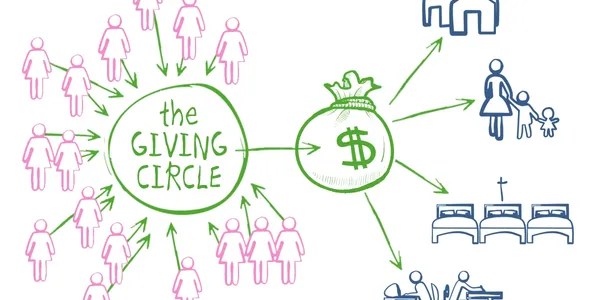
Giving circles are kick starting a new era of philanthropy where individuals give together to make social change happen.

A giving circle brings a group of people with shared values together to collectively discuss and decide where to make a pooled gift.

Philanthropy: https://medicalexecutivepost.com/2021/11/15/national-philanthropy-day-2021/

Giving circles support with their dollars, but also build awareness, volunteer, become board members and more. Individuals multiply their impact and knowledge, have fun, and connect with their local community.

Ethics: https://medicalexecutivepost.com/2024/06/22/medical-ethics-managing-risk-is-a-component-of-caring/

People are coming together around the world to create the change they want to see in the world. Giving circles are a growing global movement with more than 2,500 active circles around the world giving intentionally and thoughtfully.

Donor Advised Funds: https://medicalexecutivepost.com/2024/11/27/a-thanksgiving-donation-in-name-only/

Giving circles are a modern form of collective giving with roots in cultures across the globe for many decades!

EDUCATION: Books

Cite: https://johnsoncenter.org/2023-us-collective-giving-research-initiative/

Visit WhatIsAGivingCircle.com for more on this collective giving model and why people-centered philanthropy is so powerful.

COMMENTS APPRECIATED

Like and Subscribe

***

***

THANKSGIVING: Donor Advised Funds

DONATION: In “Name” Only?

Staff Reporters

***

Proponents of DAFs say that their structure encourages giving: The tax deduction encourages wealthy patrons to dedicate money for charity even before they’ve decided which cause to support. “Donors may have good reasons to postpone grants,” a Stanford Law School article says..

In one hypothetical, a tech founder who “sells a startup for millions of dollars” may want to donate her takings but is too busy to immediately decide how to direct the funds; a DAF is a good choice for this person, the law article notes.

However, while DAFs could in theory grow the charitable pie, in practice, they too often allow the donor the illusion of charity while letting them keep control of their funds, critics say. 

While a gift to a DAF is treated the same as an outright gift to the Red Cross or United Way, in practice, it “effectively allows the donor to retain ongoing control over the charitable disposition and investment of the donated assets,” tax scholars Roger Colinvaux and Ray Madoff wrote in 2019. What’s more, “donors are under no obligation, and have no incentive, ever to release their advisory privileges to make the funds available for charitable use.”

And ultra wealthy donors get a substantially larger tax break than a middle-class worker. As much as 74 cents of every dollar given to charity comes back to the donor in the form of tax breaks, according to calculations by Colinvaux and Madoff, with the highest-earning donors getting the biggest benefits A person in the top tax bracket would save 37% of their federal income tax for every dollar they contribute with a charitable donation; a similar amount of state income tax; and, depending on what they donate and when, they can also avoid capital gains tax and estate tax. (By contrast, a typical worker who makes about $60,000 and doesn’t own stocks would save 22% from their cash contribution, in addition to any state tax savings.) 

What’s more, because there’s no way to track donations from particular DAF accounts, they act as a form of “dark money,” allowing donors to give vast sums, essentially anonymously, to a range of potentially unsavory organizations, including nonprofits that advocate for specific political causes or organizations classified as hate groups, IPS says. 

“This allows DAFs to be used to hide transfers — similar to the way the ultra-wealthy use multiple shell companies to hide the movement of money among offshore accounts,” IPS writes. 

All of these strategies are completely legal, the IPS notes, as are other potentially questionable tactics used by family foundations—such as paying family members to serve as foundation trustees or act as executives of foundations, sometimes at salaries in the hundreds of thousands of dollars a year. However, the IPS argues, they erode public trust in charities and the tax system overall.

“The fact that billionaires opt out of paying taxes, have these closely held family foundations and get to play God about where the money goes, that’s private power — unaccountable private power,” Collins said. 

“At this point philanthropy is at risk of becoming taxpayer-subsidized private power.”

COMMENTS APPRECIATED

Refer a Colleague: MarcinkoAdvisors@msn.com

Your Referral Count: 0

***

***

On “Giving Tuesday” 2022

To Give or Not to Give

By Rick Kahler CFP®

For some, the last Black Friday was a day of fun “hunting” for great deals. For others it can be a day of dread, driven by the obligation to play to the expectation of family and friends.

Ads urge us to buy everything from sweaters to screwdrivers to SUVs on the grounds that they will be perfect gifts to delight our loved ones. Charities send out solicitation letters. “Angel tree” displays in malls and bell-ringers in front of stores.  All of it can be overwhelming.

Money Scripts

We all have our own unconscious beliefs, or money scripts, when it comes to giving. In addition, we’re surrounded by beliefs our society and religions have about giving. Both the personal and the societal beliefs can range across a broad spectrum:

  • “It’s better to give than to receive.”
  • “At this time of year, good people help the needy.”
  • “If poor people weren’t so lazy, they’d provide for their kids at X-mass.”
  • “There are plenty of agencies to take care of those who need help.”
  • “You have so much that you have an obligation to share.”

Like all money scripts, all of these contain partial truths. Giving, whether to family members or to charity, is not a simple black and white issue. Some of the questions it raises might include: How do you know whether you are helping people or enabling them to avoid helping themselves? How do you give to children without encouraging them to be greedy or feel entitled to the latest and greatest of everything? How do you balance helping others and taking care of yourself?

One often overlooked factor is whether the giving is done more to help the recipient or to help the donor feel better.

For example

I remember being in a church group one evening when people were discussing giving. Two of the women there, years earlier when they were struggling single moms with young children, had experienced people from a charity coming to their doors with gift boxes of presents and food for Christmas dinner. Both of them had been humiliated and mortified rather than pleased and grateful. The well-intentioned gifts had felt like a judgment that they weren’t capable of taking care of their own families. No one had asked first whether they wanted or needed any help.

Giving can sometimes be an attempt to hold onto people, to make up to them for one’s past failings, or to be loved by them. One common example of this is divorced parents who overspend on gifts for their children. Public giving may be a way to look good or to gain acceptance or recognition in the community.

One way to respond to the complicated issue of giving is to avoid it. You can close your wallet completely, out of fear that you’ll be taken advantage of, fear that you’ll offend, or simple frustration. Another response is to try to give to every charity that asks and to spend yourself into debt buying lavish gifts for everyone you care about.

***

 ***

Neither of these makes a lot of sense. Like many other of life’s decisions, the question of how to give, how much to give, and to whom is a personal, individual matter. There isn’t a formula for doing it right.

Assessment

The only suggestion I have is that you give as consciously as possible. Consider the beliefs behind your giving. Discuss giving and receiving with your spouse and your kids. Stop and think before you decide to give or not to give. Then you’re more likely to give wisely and with thoughtful compassion.

Conclusion

Your thoughts and comments on this ME-P are appreciated. Feel free to review our top-left column, and top-right sidebar materials, links, URLs and related websites, too. Then, subscribe to the ME-P. It is fast, free and secure.

Speaker: If you need a moderator or speaker for an upcoming event, Dr. David E. Marcinko; MBA – Publisher-in-Chief of the Medical Executive-Post – is available for seminar or speaking engagements.

Book Marcinko: https://medicalexecutivepost.com/dr-david-marcinkos-bookings/

Subscribe: MEDICAL EXECUTIVE POST for curated news, essays, opinions and analysis from the public health, economics, finance, marketing, IT, business and policy management ecosystem.

DOCTORS:

“Insurance & Risk Management Strategies for Doctors” https://tinyurl.com/ydx9kd93

“Fiduciary Financial Planning for Physicians” https://tinyurl.com/y7f5pnox

“Business of Medical Practice 2.0” https://tinyurl.com/yb3x6wr8

HOSPITALS:

“Financial Management Strategies for Hospitals” https://tinyurl.com/yagu567d

“Operational Strategies for Clinics and Hospitals” https://tinyurl.com/y9avbrq5

***

Risk Management, Liability Insurance, and Asset Protection Strategies for Doctors and Advisors: Best Practices from Leading Consultants and Certified Medical Planners™8Comprehensive Financial Planning Strategies for Doctors and Advisors: Best Practices from Leading Consultants and Certified Medical Planners™

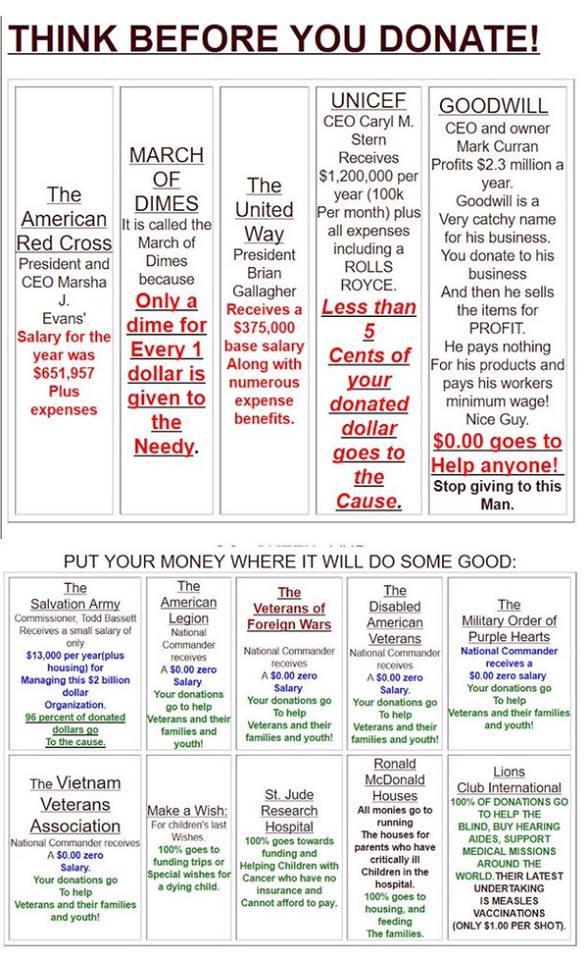
Donor Beware!

Cautious Corporate Giving?

[By staff reporters]

*** ***

NOTE: This chart has not been independently verified by us.

Assessment: Your thoughts are appreciated.

THANK YOU

Risk Management, Liability Insurance, and Asset Protection Strategies for Doctors and Advisors: Best Practices from Leading Consultants and Certified Medical Planners™8Comprehensive Financial Planning Strategies for Doctors and Advisors: Best Practices from Leading Consultants and Certified Medical Planners™

***

MONEY: Spend it -OR- Give it Away

MONEY: The two choices

By Rick Kahler CFP®

A colleague recently reminded me that there are ultimately two things we can do with money: spend it or give it away. That’s it.

At first glance, this seems too simplistic. What about saving? What about investing for our future security? What about creating wealth?

Even when we are in the process of accumulating money and building wealth, we do so for the inevitable day we choose to spend it or give it away. Investing for retirement is about providing money to spend when we’re no longer earning an income. And whatever we have left at the end of life is ultimately given away.

Furthermore, the decision to spend or give away money is always a choice, even when it may seem we have no choice.

Here is why 

Most money experts break spending into “discretionary” and “non-discretionary” categories. Another way to frame this is “wants” and “needs.” Discretionary spending includes items that we want which aren’t necessary for survival, such as entertainment, vacations, designer clothes, and gourmet food. Non-discretionary items, or needs, include basic housing, food, clothing, and transportation.

Discretionary spending is clearly a choice. Yet even though we may tell ourselves we have “no choice” but to spend money on non-discretionary needs, fundamentally we always have a choice.

We may think we make the mortgage or rent payment because we “have” to, but actually it’s a choice because the alternative is to find a new place to live or be homeless. We make the car payment because we choose not to walk or use public transportation. We may choose to work at a job we dislike because it allows us to spend money on other choices we deem more important than job satisfaction. We choose to pay our taxes in order to avoid serious consequences like heavy fines or even going to jail.

We choose to earn and spend our funds in the ways we do, not because we “have to,” but because there is a payoff that makes the choice worthwhile.

Giving money away may seem more obviously a matter of choice. Yet giving to charity or to family members out of guilt or a sense of obligation sometimes seems like a “must.”

The choice

Yet in every case, it’s still a choice. Even when we give because it seems to be the only way to avoid detrimental or catastrophic consequences, we’re still making a choice. In some cases, choosing not to give (to a child, for example) may result in some wonderfully rich life lessons or behavioral changes.

The one time it seems that we really have no choice on whether we spend or give away our money is when we die. But even then, the choices about giving what we have left are made during our lifetime. Those who don’t do estate planning are choosing to let others decide how their money will be given away, with those decisions constrained by the provisions of their state’s laws.

Assessment

The bottom line is that when it comes to spending or giving money, we always have a choice. Ultimately, all of the money we choose not to spend while we are alive is money we are choosing to give away after death.

When we view our spending and giving as a matter of choice, it may be easier to see the importance of making money choices thoughtfully and consciously. The way we use our financial resources is crucial both for supporting our own life aspirations and for giving back to our families and communities. Choosing to spend consciously and give wisely is one more way we can choose to live richer, more fulfilling lives.

Conclusion

Your thoughts and comments on this ME-P are appreciated. Feel free to review our top-left column, and top-right sidebar materials, links, URLs and related websites, too. Then, subscribe to the ME-P. It is fast, free and secure.

Speaker: If you need a moderator or speaker for an upcoming event, Dr. David E. Marcinko; MBA – Publisher-in-Chief of the Medical Executive-Post – is available for seminar or speaking engagements.

Book Marcinko: https://medicalexecutivepost.com/dr-david-marcinkos-bookings

Subscribe: MEDICAL EXECUTIVE POST for curated news, essays, opinions and analysis from the public health, economics, finance, marketing, IT, business and policy management ecosystem.

***

Doctors Uniquely Giving Locally in 2013

Join Our Mailing List

On Innovative Charitable Giving

By Rick Kahler MS CFP® ChFC CCIM www.KahlerFinancial.com

Rick Kahler CFP“Shop locally.” “Eat locally.” Do a quick Internet search for either of these terms and you get a host of results. Plenty of people are interested in saving energy and supporting locally-owned businesses by doing their buying close to home.

So, many doctors – like other folks – are committed to eating locally grown food that there’s even a name for them: locavores. Being a locavore in South Dakota in the wintertime, by the way, can be a challenge.

If buying locally matters to you, here’s another aspect of it to think about: giving locally as we begin the new year 2013.

The Holiday Season

This time of year especially, we are flooded with requests from worthwhile causes. Many of these are well-known national or international organizations with sophisticated fund-raising efforts. Amid their appeals, requests from local charities may be easy to overlook. Yet many small organizations do a great deal of good in their home towns.

Issues to Consider

Before you decide whether giving locally or nationally is a better option for your gift budget, here are a few things to consider:

1. No matter whether an organization is local or international, always check to see how much of the money it raises goes to administrative costs and how much actually reaches the people the charity serves. Most charities have websites where this information is readily available.

2. What kind of giving matters most to you? If you want to support the arts, chances are that a local organization like your community theatre or concert association will make good use of your funds. If you’d rather support agencies that help with natural disasters, an international organization is probably the most effective place for your money.

3. Do you want to give actual items rather than money? If so, local charities would usually be better choices. Many places, for example, use “Angel Trees” to ask for gifts for children or the elderly. If you’d prefer to help the hungry with canned goods rather than cash, you’ll want to give to your local food bank or homeless shelter.

4. Find out whether you can specify that your gift is used locally. Many national organizations like the Red Cross, Salvation Army, or food banks are happy to receive gifts that are designated for your local chapter.

5. Just as local government is closer to the people it serves, local charities may be more in touch with specific community needs. If you give locally, you can talk to people in charge and find out exactly where your money goes.

6. Giving locally allows you to combine financial giving with hands-on service that may be more satisfying than just giving money. You could help serve meals at a shelter, pack gift boxes, volunteer at a food bank, or distribute gifts.

7. Just because a charity is local, however, don’t automatically assume it uses its money wisely or efficiently. Always check. Sometimes a small organization may be trying to duplicate what an older or larger organization can do more efficiently. Sometimes local organizations are run by people who are well-meaning but don’t necessarily have the skills or contacts to make the best use of the donations they receive.

8. Remember that giving is an individual decision. Choose the level and type of giving that fits best for you, instead of trying to match what others do or give what someone else thinks you should.

charity

Assessment

Finally, keep a balanced perspective. There are many worthwhile organizations, and you can’t possibly give to them all. Don’t waste energy feeling guilty about the ones you skip. Instead, appreciate the giving you do in your own way and let it add joy and satisfaction to your holiday season.

Conclusion

Your thoughts and comments on this ME-P are appreciated. Feel free to review our top-left column, and top-right sidebar materials, links, URLs and related websites, too. Then, subscribe to the ME-P. It is fast, free and secure.

Link: http://feeds.feedburner.com/HealthcareFinancialsthePostForcxos

Speaker: If you need a moderator or speaker for an upcoming event, Dr. David E. Marcinko; MBA – Publisher-in-Chief of the Medical Executive-Post – is available for seminar or speaking engagements. Contact: MarcinkoAdvisors@msn.com

Our Other Print Books and Related Information Sources:

Health Dictionary Series: http://www.springerpub.com/Search/marcinko

Practice Management: http://www.springerpub.com/product/9780826105752

Physician Financial Planning: http://www.jbpub.com/catalog/0763745790

Medical Risk Management: http://www.jbpub.com/catalog/9780763733421

Hospitals: http://www.crcpress.com/product/isbn/9781439879900

Physician Advisors: www.CertifiedMedicalPlanner.org

Product Details  Product Details


End of Year Tax Giving Tips for Charitable Giving

On IRS published IR-2011-18

By Children’s Home Society of Florida Foundation

Join Our Mailing List

On December 14, 2011, the IRS published IR-2011-18 and suggested a number of tax tips for end-of-year charitable giving. These included several specific recommendations.

1. IRA Rollover – For individuals age 70½ and older who are IRA owners, they may have their IRA custodian make a direct transfer to qualified charities of up to $100,000. These direct transfers may fulfill part or all of the required minimum distribution for this year.

2. Clothing and Household Goods – Deductions for gifts of clothing and household goods are permitted if they are in “good used condition or better.” A gift item that has a value over $500 may be of a different quality, provided that there is an appraisal.

3. Gifts of Money – All gifts of money must be documented through a bank record or receipt. The gift should show the date, amount of the gift and the name of the charitable organization. Bank records may include a cancelled check, a bank statement or a credit card statement. Gifts may also be made through payroll deductions. In this case, the taxpayer should retain a pay stub, Form W-2 or a pledge card that shows the amount, the date of the gift and the name of the charity. If the gift is $250 or more, a contemporaneous written acknowledgement from the charity is required. This receipt must be in the taxpayer’s possession on the date of filing his or her tax return.

4. Timing – A contribution is deductible in the year when it is given. Credit card contributions may be made through December 31st, 2011. Similarly, checks that are sent through U.S. mail by December 31 are deductible if they clear in the normal course.

5. Charities – Deductions are only permitted for gifts to qualified charities. IRS Publication 78 is available on http://www.irs.gov and lists the qualified charitable organizations.

6. Itemized Deductions – Individuals who wish to claim their charitable gifts will need to itemize deductions on Schedule A of Form 1040. Normally, a taxpayer will itemize only if his or her charitable gifts, state and local taxes, mortgage interest and other deductions are larger than the standard deduction.

7. Clothing and Household Item Receipts – The taxpayer should obtain a receipt from the charity. It must list the name of the charity, the date of the gift and a reasonably-detailed description of the gift items.

8. Boat, RV or Car – The gift is usually limited to the gross proceeds from sale if the vehicle is valued at over $500. The charity will send IRS Form 1098-C to the taxpayer and this should be attached to Form 1040.

Conclusion

Your thoughts and comments on this ME-P are appreciated. Feel free to review our top-left column, and top-right sidebar materials, links, URLs and related websites, too. Then, subscribe to the ME-P. It is fast, free and secure.

Link: http://feeds.feedburner.com/HealthcareFinancialsthePostForcxos

Speaker: If you need a moderator or speaker for an upcoming event, Dr. David E. Marcinko; MBA – Publisher-in-Chief of the Medical Executive-Post – is available for seminar or speaking engagements. Contact: MarcinkoAdvisors@msn.com

OUR OTHER PRINT BOOKS AND RELATED INFORMATION SOURCES:

DICTIONARIES: http://www.springerpub.com/Search/marcinko
PHYSICIANS: www.MedicalBusinessAdvisors.com
PRACTICES: www.BusinessofMedicalPractice.com
HOSPITALS: http://www.crcpress.com/product/isbn/9781466558731
CLINICS: http://www.crcpress.com/product/isbn/9781439879900
BLOG: www.MedicalExecutivePost.com
FINANCE: Financial Planning for Physicians and Advisors
INSURANCE: Risk Management and Insurance Strategies for Physicians and Advisors

Product Details  Product Details