PRIVATE EQUITY COMPENSATION: Carried Interest [Pros and Cons]

DEFINITION

By Staff Reporters

SPONSORS: http://www.MarcinkoAssociates.com

***

***

Carried interest accounts for the bulk of private equity fund managers’ compensation. It is calculated as a share of fund profits, historically 20% above a threshold rate of return for limited partners.

In contrast with most other forms of employment compensation and business income, carried interest earned from fund investments held for at least three years is taxed as a long-term capital gain at a rate below the top marginal income tax rate.

Critics of the provision contend it taxes highly compensated private equity managers at a lower rate than comparably paid providers of labor or business services.

Defenders of carried interest argue taxing it as income would be unfair because it represents capital gains even if they’re not derived from recipients’ capital.

COMMENTS APPRECIATED

Refer and Subscribe

***

***

TRUST: Deferred Sales

DEFINITION

By Staff Reporters

***

***

A deferred sales trust (DST) is an advanced tax strategy that allows investors to delay capital gains taxes on the sale of assets that have significantly risen in value, such as real estate or businesses. By selling the asset to a trust, the seller can receive payments over time, spreading out tax liabilities and allowing the profits to grow tax-deferred.

For example, a business owner may sell their company to a DST, avoiding a large tax bill upfront and instead receive income over multiple years. However, DSTs can be complex, and there are often fees involved in setting up and maintaining the trust.

Now, let’s point out some of the pros and cons of Deferred Sales Trusts.

One potential positive feature of using an installment sale to defer your capital gains taxes rather than a 1031 exchange is that installment sales don’t come with the same strict guidelines that govern 1031 exchanges. In particular, in light of the Tax Cuts and Jobs Act of 2017, 1031 exchanges are restricted to real property, whereas Deferred Sales Trusts and other installment sale arrangements can be used to defer capital gains for any kind of asset.

Conversely, the IRS has provided little to no guidance on how to defer taxes using an installment sale.

The basic rationale behind why you don’t receive capital gain is that you are not profiting immediately from the sale made with a Deferred Sales Trust. Given this rationale, there are various constraints on how a Deferred Sales Trust must be organized so that no capital gains taxes are in fact realized.

  • The third party to whom you transfer your asset generally cannot be a “related person” to you, such as a family member or a corporation in which you hold an interest. Except in special circumstances, if you attempt to set up a Deferred Sales Trust with a related person it will be viewed as a “sham trust” made just for the purposes of avoiding capital gains taxes, and will not be protected by the provisions in Section 453.
  • As with the 1031 exchange, you, the seller, cannot at any point in the transfer of your asset be in constructive receipt of the proceeds from the third party’s sale of that asset. To successfully defer capital gains taxes, either the third party or the trust of which they are trustee must be the only party which receives cash in the sale of the transferred asset. This includes receipt of a bond which is payable on demand.

This has been a general, informal introduction to Deferred Sales Trusts. As always, before attempting to carry out any important financial decision, investors should consult with a qualified tax or legal advisor regarding the specifics of their situation.

COMMENTS APPRECIATED

Subscribe, Like and Share!

***

***

NEW TAX PROPOSAL: Higher Capital Gains?

By Staff Reporters

***

***

House proposes raising capital gains tax to 28.8%

  • House Democrats proposed a top federal rate of 25% on long-term capital gains, according to legislation issued by the House Ways and Means Committee.
  • The new rate would apply to gains realized after Sep. 13th.
  • In 2022, it would kick in for single filers with taxable income over $400,000 and for married couples at $450,000, according to a Committee aide.

***

COMMENTS APPRECIATED

Thank You

***

2021-Tax Hits on Distributed Stock Market Gains

Doctors Must Understand the Tax Man

By Staff Reporters

***

Mutual-fund physician and other investors with holdings in taxable accounts need to prepare for a tax hit on distributed gains — even if they reinvest the distributions. They can offset some or all of the gains (and taxes) if they’ve sold positions at a loss.

CITE: https://www.r2library.com/Resource/Title/082610254

Physicians and people who own mutual funds in tax-sheltered accounts such as 401(k)s or individual retirement accounts and are reinvesting the distributions, on the other hand, don’t have to worry. In those accounts, taxes only count when investors sell holdings in retirement, and those who have funds in qualified Roth IRAs won’t have to pay even then.

MORE: https://www.marketwatch.com/story/brace-yourself-for-an-extra-tax-hit-from-large-mutual-fund-payouts-11639175633?mod=home-page

***

Comprehensive Financial Planning Strategies for Doctors and Advisors: Best Practices from Leading Consultants and Certified Medical Planners™

ORDER: https://www.amazon.com/Comprehensive-Financial-Planning-Strategies-Advisors/dp/1482240289/ref=sr_1_1?ie=UTF8&qid=1418580820&sr=8-1&keywords=david+marcinko

***
YOUR COMMENTS ARE APPRECIATED.

Thank You

***

On the TAXATION of Capital Gains and Losses

UPDATE FOR PHYSICIANS AND ALL INVESTORS

By Dr. David E. Marcinko MBA CMP®

CMP logo

SPONSOR: http://www.CertifiedMedicalPlanner.org

Almost everything you own and use for personal or investment purposes is a capital asset. Examples include a home, personal-use items like household furnishings, and stocks or bonds held as investments. When you sell a capital asset, the difference between the adjusted basis in the asset and the amount you realized from the sale is a capital gain or a capital loss.

CITE: https://www.r2library.com/Resource/Title/0826102549

Generally, an asset’s basis is its cost to the owner, but if you received the asset as a gift or inheritance, refer to Topic No. 703 for information about your basis.

For information on calculating adjusted basis, refer to Publication 551, Basis of Assets. You have a capital gain if you sell the asset for more than your adjusted basis. You have a capital loss if you sell the asset for less than your adjusted basis. Losses from the sale of personal-use property, such as your home or car, aren’t tax deductible.

IRS: https://www.irs.gov/taxtopics/tc409

MORE: https://medicalexecutivepost.com/2021/04/23/bidens-capital-gains-tax-proposal/

RELATED: https://medicalexecutivepost.com/2021/05/01/capital-gains-tax-non-sense/

YOUR COMMENTS ARE APPRECIATED.

Thank You

***

Capital Gains Tax Non-Sense?

Please Stow Your Outrage About a Capital Gains Tax Hike!

There is no evidence for any of the calamities that opponents argue would befall the economy and markets.

See the source image
By Scott Sumner

To anyone with knowledge of public finance theory, reading media reports of capital gains taxation is almost painful. Here’s an example from Bloomberg:

A group of economists recently argued in the Chicago Booth Review that the prevailing wisdom among scorekeepers that the revenue-maximizing rate is about 30% may be misplaced — and could allow for an even higher rate. A pair of Princeton University economists published research in December showing that hikes may raise “substantially more tax revenue” than scorekeepers currently believe and that the revenue-maximizing rate may be about 40% — almost exactly where Biden’s proposal falls.

Economists and analysts have also made the case that cuts in capital gains rates have a negligible impact on investment decisions and economic growth. (Though, like much around capital gains, that debate isn’t entirely settled.)

LINK: https://www.bloomberg.com/opinion/articles/2021-04-26/stow-your-outrage-about-a-capital-gains-tax-hike?srnd=premium&sref=XgZBm7li

Your thoughts are appreciated.

THANK YOU

DICTIONARY: Health Economics and Finance

Product Details

FOREWORD: https://medicalexecutivepost.com/wp-content/uploads/2007/10/dr-getzen.pdf

***

Do You Have a Taxable Investment Account – Doctor?

Join Our Mailing List

Is it Time to Harvest?

[By Lon Jefferies MBA CFP®]

Lon JeffriesTax harvesting is the process of selling assets for the purpose of creating either long-term capital gains or losses to minimize your tax bill. This procedure is usually conducted near the end of a calendar year.

While many people are familiar with the concept of tax loss harvesting, fewer physicians or clients are familiar with the more recently developed process of tax gain harvesting. Between these two procedures, virtually everyone with a taxable (not tax-advantaged) investment account should make adjustments to their portfolio before the year ends.

Who Qualifies For the 0% Capital Gains Rate?

First, it is important to understand that capital gains (the growth on investments within a taxable, non retirement investment account) are taxed differently than ordinary income (wages, pensions, Social Security, IRA distributions, etc.). While short-term capital gains (recognized on the sale of assets held less than a year) are essentially considered ordinary income, long term capital gains, or recognized gains on assets held more than a year, are taxed at advantageous tax rates. While ordinary income tax rates range from 10% to 39.6%, capital gains tax rates range from 0% to 20%.

Second, it is crucial to understand what enables a taxpayer to qualify for the 0% capital gains rate. If a taxpayer is in the 10% or 15% ordinary income tax bracket, they qualify for the 0% long-term capital gains rate.

For a married couple filing jointly, the 15% tax bracket ends at $73,800 of taxable income ($36,900 for single taxpayers). Thus, if a married taxpayer has a taxable income (which includes long-term capital gains but is also after deductions and exemptions) of less than $73,800, all their long-term capital gains will be tax free. If the taxpayer is in a tax bracket anywhere between 25% and 35% (taxable income of $73,800 and $457,600, or between $36,900 and $406,750 for single tax filers), they will pay long-term capital gains taxes at 15%. Only those in the top tax bracket of 39.6% (married taxpayers with a taxable income over $457,600 and single taxpayers with taxable income over $406,750) will pay capital gains taxes at 20%.

Tax Loss Harvesting

During the calendar year, assets have been purchased and sold in most taxable investments accounts. The sale of an asset creates a net gain or loss, both having tax implications. Investors should have an understanding of what their long-term capital gains tax rate will be so they can determine whether a taxable gain or loss is preferable.

For instance, an individual who does not qualify for the 0% capital gains tax rate may wish to minimize the amount of taxable gains they recognize during the year, which would reduce their tax bill. If the investor currently has a net long-term capital gain (which is probable after the strong year the market had in 2013), then it is likely worthwhile to sell any assets in the portfolio that are currently worth less than the investor’s purchase price. This tax loss harvesting would reduce the net gain recognized during the year and lower the investor’s tax bill.

In some cases, by taking advantage of all potential losses within a portfolio an investor has the ability to negate all capital gains created during the year, completely eliminating their capital gains tax bill. Further, the IRS will allow investors to recognize a net capital loss of up to a -$3,000 per year. This -$3,000 loss can be used to lower the taxpayers ordinary income. This is particularly advantageous in that the capital loss reduces a type of income that is taxed at higher tax rates.

Harvesting Gains

Harvesting gains from a taxable portfolio is a more recently developed concept. Once the 0% long-term capital gains tax rate became a permanent part of the tax code with the passing of the American Taxpayer Relief Act of 2012 (signed January 2nd, 2013), in some scenarios it began making sense to recognize long-term capital gains on purpose to potentially avoid a larger tax bill in the future.

Suppose a taxpayer’s taxable income is consistently $65,000 a year. Additionally, suppose our hypothetical taxpayer won’t withdraw funds from his taxable account during the next few years, but may need a large lump sum distribution five years down the road. Recall that the 0% capital gains rate ends when a married taxpayer’s taxable income (which includes long-term capital gains) exceeds $73,800. Consequently, this hypothetical taxpayer has the ability to recognize $8,800 ($73,800 – $65,000) in long-term capital gains every year without increasing his tax bill. If this $8,800 in gains is recognized every year by simply selling and immediately repurchasing appreciated assets, he would raise the cost basis of his investment by $44,000 ($8,800 gain recognized annually for five straight years). He could then sell and withdraw that $44,000 without creating a tax liability.

Alternatively, if the investor does not harvest gains during the years when no distributions are taken, withdrawing $44,000 of gains five years down the road would create a sizable tax bill. He would still be able to recognize $8,800 of gains tax free in the year of distribution, but the remaining $35,200 of gains would cause his taxable income to be over the $73,800 limit, eliminating access to the 0% capital gains rate. That $35,200 would be taxed at the 15% capital gains rate, creating a federal tax bill of $5,280. With proper planning, this significant tax bill can be avoided.

***

Portfolio analysis

***

The Bottom Line

Tax harvesting has no purpose in tax-advantaged retirement accounts such as IRAs and 401ks because all distributions from these accounts are taxed as ordinary income. However, taxable individual or trust investment accounts can almost certainly benefit from tax harvesting. Speak to your accountant and financial planner to understand whether capital gains or losses are desirable for you this year and determine the amount of taxable gains already recognized. This will help you determine what type of harvesting should take place.

Tax harvesting can be a difficult and confusing concept. However, a competent financial planner who utilizes this procedure within your taxable investment account can significantly lower your tax bill. Speak to your adviser to ensure you are reaping the tax benefits available to you.

Channel Surfing the ME-P

Have you visited our other topic channels? Established to facilitate idea exchange and link our community together, the value of these topics is dependent upon your input. Please take a minute to visit. And, to prevent that annoying spam, we ask that you register. It is fast, free and secure.

Conclusion

Your thoughts and comments on this ME-P are appreciated. Feel free to review our top-left column, and top-right sidebar materials, links, URLs and related websites, too. Then, subscribe to the ME-P. It is fast, free and secure.

Speaker: If you need a moderator or speaker for an upcoming event, Dr. David E. Marcinko; MBA – Publisher-in-Chief of the Medical Executive-Post – is available for seminar or speaking engagements. Contact: MarcinkoAdvisors@msn.com

OUR OTHER PRINT BOOKS AND RELATED INFORMATION SOURCES:
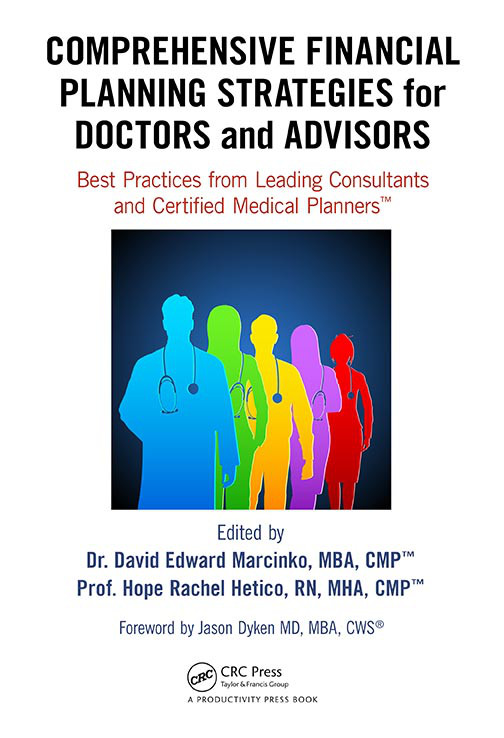
Financial Planning MDs 2015

Comprehensive Financial Planning Strategies for Doctors and Advisors: Best Practices from Leading Consultants

Understanding the 2010 Estate Tax Basis Problems

AICPA Tax Basis Issues

By Children’s Home Society of Florida Foundation

Join Our Mailing List 

At a July 27, 2010 conference sponsored by the American Institute of Certified Public Accountants, Treasury Representative Catherine Hughes discussed the basis issues that are arising concerning 2010 decedents.

2010 Estate Tax Repeal

While the estate tax is repealed during 2010, under Internal Revenue Code Sec. 1022 there are new and complex rules on basis adjustments. For large estates, a majority of the assets will be transferred with a “flow through” of the basis. That is, the heirs will be able to use the basis of the decedent in any future sales for the purpose of reporting capital gain. Because many decedents have few or no records of the basis, it is quite possible that these heirs will pay capital gains tax on the full value of future sales.

Allowances for Basis “Step-Up”

However, there are allowances for a basis “step-up” of $1.3 million. In addition, for a surviving spouse, the basis step-up can be $3 million. The step-up in basis cannot be greater than the fair market value of the applicable property. Determining how to allocate the adjusted basis step-up in an estate has caused great concern among estate planning attorneys and CPAs. Treasurer Representative Hughes stated, “I anticipate there will be a lot of mistakes where there isn’t an affirmative allocation” of basis. Treasury is studying the situation and may issue guidance with recommended default allocation rules.

Assessment

While Congress continues to debate estate tax law and, therefore, has not made any decision on a potential retroactive estate tax, the nonpartisan Tax Policy Center this week released an estimate of the potential number of 2011 taxable estates. If a $1 million exemption is applicable in 2011, there will be an estimated 43,500 estates subject to tax. If the 2009 exemption amount of $3.5 million per decedent is applicable next year, the number of taxable estates is reduced to $650,000.

Editor’s Note: The discussion in Washington on the practical aspects of allocating the basis step-up now suggests that there may not be a mandatory retroactive estate tax law. With the pending election, it now seems very likely that Congress will not act on the estate tax before December. The Senate continues to have great difficulty developing a plan acceptable to 60 Senators and to the House of Representatives. However, Senators now recognize that a $1 million exemption and tax on 43,500 estates will impact a large number of middle-class children and other beneficiaries. Therefore, it seems quite likely that a compromise should be passed in December. However, as the AICPA basis adjustment discussion suggests, this compromise is now less likely to mandate an extension of the 2009 exemption for 2010. As a result, attorneys and CPAs will need to address the very complex and uncertain basis adjustment problems for 2010 estates.

Conclusion

Your thoughts and comments on this ME-P are appreciated. Feel free to review our top-left column, and top-right sidebar materials, links, URLs and related websites, too. Then, subscribe to the ME-P. It is fast, free and secure.

Link: http://feeds.feedburner.com/HealthcareFinancialsthePostForcxos

Speaker: If you need a moderator or speaker for an upcoming event, Dr. David E. Marcinko; MBA – Publisher-in-Chief of the Medical Executive-Post – is available for seminar or speaking engagements. Contact: MarcinkoAdvisors@msn.com

OUR OTHER PRINT BOOKS AND RELATED INFORMATION SOURCES:

Product Details  Product Details