DAILY UPDATE: 2025 IRS Tax Brackets as Stock Markets Barely Budge

MEDICAL EXECUTIVE-POST TODAY’S NEWSLETTER BRIEFING

***

Essays, Opinions and Curated News in Health Economics, Investing, Business, Management and Financial Planning for Physician Entrepreneurs and their Savvy Advisors and Consultants

Serving Almost One Million Doctors, Financial Advisors and Medical Management Consultants Daily

A Partner of the Institute of Medical Business Advisors , Inc.

http://www.MedicalBusinessAdvisors.com

SPONSORED BY: Marcinko & Associates, Inc.

***

http://www.MarcinkoAssociates.com

Daily Update Provided By Staff Reporters Since 2007.
How May We Serve You?
© Copyright Institute of Medical Business Advisors, Inc. All rights reserved. 2024

REFER A COLLEAGUE: MarcinkoAdvisors@msn.com

SPONSORSHIPS AVAILABLE: https://medicalexecutivepost.com/sponsors/

ADVERTISE ON THE ME-P: https://tinyurl.com/ytb5955z

Your Referral Count -0-

The IRS has announced the annual inflation adjustments for the year 2025, including tax rate schedules, tax tables and cost-of-living adjustments. These are the official numbers for the tax year 2025—that tax year begins January 1, 2025. These are not the numbers that you’ll use to prepare your 2024 tax returns in 2025 (you’ll find those official 2024 tax numbers here). These are the numbers that you’ll use to prepare your 2025 tax returns in 2026.

CITE: https://www.r2library.com/Resource

STOCKS UP

  • Philip Morris International was smoking hot today, rising 10.47% to a record high thanks to strong demand for its Zyn nicotine pouches.
  • Americans just love a pickup truck: General Motors revved 9.85% higher on an impressive beat-and-raise earnings report.
  • Trump Media & Technology Group rose 9.87% to its highest level since July as the “Trump trade” wagering on the former president to regain the White House picks up steam.
  • Quest Diagnostics isn’t just a sad, windowless building where you get your blood drawn—it’s also been a pretty profitable investment. Shares rose 6.88% on strong earnings and revenue growth.

STOCKS DOWN

  • Stop us if you’ve heard this one before: Target is cutting the price of 2,000 products ahead of the holiday season. Shares sank 1.13% as shareholders digest what appears to be a desperate move to boost sales.
  • Verizon Communications dropped 5.03% after missing on both revenue and earnings estimates. But the real problem was slowing customer growth and phone sales.
  • Defense contractors were in the earnings spotlight today, and none of them did well. GE Aerospace tumbled 9.07% despite beating analyst forecasts and Lockheed Martin fell 6.12% after sales missed estimates.
  • Genuine Parts, better known as NAPA Auto Parts, plummeted 20.96% after earnings missed estimates and the company announced lower fiscal year forecasts.

CITE: https://tinyurl.com/2h47urt5

Here’s where the major benchmarks ended:

  • The SPX fell 2.78 points (–0.05%) to 5,851.20; the Dow Jones Industrial Average® ($DJI) lost 6.71 points (–0.02%) to 42,924.89; and the $COMP gained 33.12 points (0.18%) to 18,573.13.
  • The 10-year Treasury note yield (TNX) added two basis points to 4.2%.
  • The CBOE Volatility Index® (VIX) fell to 18.15, down from above 20 a week ago.

CITE: https://tinyurl.com/tj8smmes

Visualize: How private equity tangled banks in a web of debt, from the Financial Times.

COMMENTS APPRECIATED

PLEASE SUBSCRIBE: MarcinkoAdvisors@msn.com

Thank You

***

***

***

***

EDUCATIONAL TEXTBOOKS: https://tinyurl.com/4zdxuuwf

***

IRS: New Taxation Rates and Brackets for 2023

By Staff Reporters

***

***

The IRS just released inflation-adjusted marginal rates and brackets for 2023 on Tuesday, and many workers will see higher take-home pay in the new year as less tax is withheld from their paychecks.

Additionally, the agency released the standard deduction for next year. It is increasing by $900 to $13,850 for single taxpayers, and by $1,800 for married couples, to $27,700. For heads of household, the 2023 standard deduction will be $20,800. That’s an increase of $1,400.

Here are the marginal rates for for tax year 2023, depending on your tax status.

Single filers

  • 10%: income of $11,000 or less
  • 12%: income between $11,000 to $44,725
  • 22%: income between $44,725 to $95,375
  • 24%: income between $95,375 to $182,100
  • 32%: income between $182,100 to $231,250
  • 35% income between $231,250 to $578,125
  • 37%: income greater than $578,125

Married filing jointly

  • 10%: income of $22,000 or less
  • 12%: income between $22,000 to $89,450
  • 22%: income between $89,450 to $190,750
  • 24%: income between $190,750 to $364,200
  • 32%: income between $364,200 to $462,500
  • 35% income between $462,500 to $693,750
  • 37%: income greater than $693,750

Additionally, the maximum Earned Income Tax Credit for 2023 is $7,430 for those who have three or more qualifying children. The maximum contribution to a healthcare flexible spending account is also increasing, from $2,850 to $3,050.

Wealthy Americans will also be able to exclude significantly more assets from the estate tax in 2023. Individuals will be able to transfer up to $12.92 million tax-free to their descendants, up from just over $12 million in 2022. A married couple can pass on double that. And the annual exclusion for gifts increases to $17,000.

***
COMMENTS APPRECIATED

Thank You

***

INVESTING: https://www.routledge.com/Comprehensive-Financial-Planning-Strategies-for-Doctors-and-Advisors-Best/Marcinko-Hetico/p/book/9781482240283

***

***

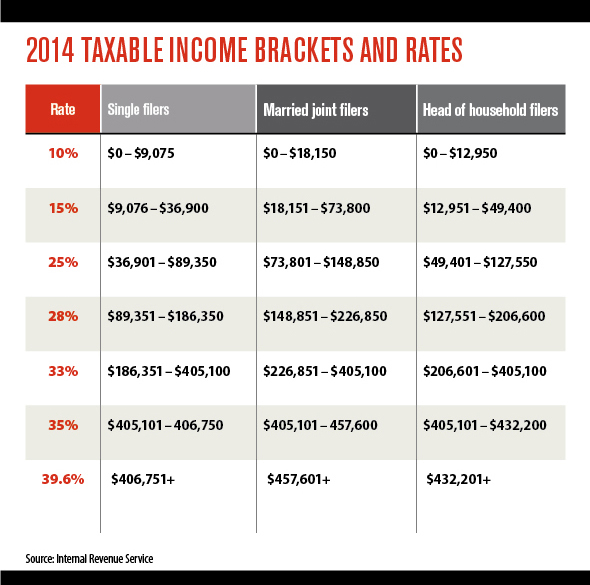
Income Tax Brackets and Rates for 2014

Join Our Mailing List

An ME-P Update

[By Internal Revenue Service]

***

Tax Brackets

***

More:

Conclusion

Your thoughts and comments on this ME-P are appreciated. Feel free to review our top-left column, and top-right sidebar materials, links, URLs and related websites, too. Then, subscribe to the ME-P. It is fast, free and secure.

Speaker: If you need a moderator or speaker for an upcoming event, Dr. David E. Marcinko; MBA – Publisher-in-Chief of the Medical Executive-Post – is available for seminar or speaking engagements. Contact: MarcinkoAdvisors@msn.com

OUR OTHER PRINT BOOKS AND RELATED INFORMATION SOURCES:

Financial Planning MDs 2015

TEXTBOOK

Comprehensive Financial Planning Strategies for Doctors and Advisors: Best Practices from Leading Consultants and Certified Medical Planners™


Why You Should [Still] Know Your Marginal Tax Rate?

Join Our Mailing List

And … Other Financial Planning Topics of Import

Lon JefferiesBy Lon Jefferies MBA CFP®

In 2014, the federal tax brackets are 10%, 15%, 25%, 28%, 33%, 35%, and 39.6%. For a taxpayer who is married and files jointly, regardless of how much the household makes, the first $18,150 of income after accounting for deductions and exemptions will only be taxed at the 10% rate.

Similarly, any income the household makes that is more than $18,150 but less than $73,800 is taxed at the 15% rate. At that point, the next $75,050 is taxed at 25%, and so on.

Consequently, not all income a household makes during the course of the year is taxed at the same rate. A marginal tax bracket is the tax rate that applies to the last dollar the household made.

It is crucial for all taxpayers to know their marginal tax rate. This information can help a client identify which type of investment accounts fits their situation best, how to structure an investment portfolio, and how to determine the value of certain deductions when filing their tax return.

Roth or Traditional Retirement Accounts

Contributions to traditional retirement accounts like IRAs and 401(k)s allow taxpayers to avoid recognizing income earned during the tax year and push the need to acknowledge the revenue into a future year. This is valuable because many people are in a higher tax bracket during their working years than they are during retirement. For instance, for a person who is currently in the 25% marginal tax bracket, it may be advantageous to delay recognizing the income until the investor retires and has less income, causing him to be in only the 15% marginal tax bracket. Doing this would enable the taxpayer to pay taxes at only 15% as opposed to 25%.

Alternatively, a Roth IRA or Roth 401(k) allows an investor to pay taxes on contributed income during the year it was earned but the money then grows tax-free. Consequently, a Roth retirement account is great for someone who believes they may be in a higher marginal tax bracket in the future. For example, a young employee in the early stages of his career who is in the 15% tax bracket but believes he may be in the 25% or 28% bracket in the future would benefit from paying all taxes on the income at his current rate of 15% and then getting tax-free investment growth. This would prevent the investor from having to pay the higher future tax rate of 25% or 28% on the invested dollars.

Knowing your marginal tax bracket can help you determine if you would favor paying taxes on your invested dollars at your current tax rate or if you believe you may benefit from pushing the need to recognize the income into a future tax year. This is a critical decision when planning for retirement and it can’t accurately be made without knowing your marginal tax rate.

Capital Gains Rate

A long term capital gains tax rate is the rate that applies to the growth of any asset held for longer than a year that is not within a tax-advantaged account. If you buy stock outside a tax-advantaged account, or purchase investment property, any growth in the value of the investment will be taxed as capital gains when sold.

An investor’s capital gains tax rate is determined by the investor’s marginal tax rate. For most taxpayers the long term capital gains tax rate is 15%. However, if a taxpayer is in the 10% or 15% marginal tax bracket, the long term capital gains tax rate is an amazing 0%! Additionally, many taxpayers in either the 35% or 39.6% tax bracket may end up paying capital gains at a rate of 20%.

Clearly, knowing your marginal tax bracket will help you analyze the appeal of making investments outside of tax-advantaged accounts. People who qualify for the 0% capital gains tax should actively search for ways to take advantage of this benefit.

Additionally, knowing your marginal tax rate can help you determine the best time to recognize long-term capital gains. If your marginal tax rate will be 25% in 2014 — leading to a capital gains tax rate of 15% — but you believe your marginal rate will be 15% in 2015 — leading to a capital gains tax rate of 0% — it would save you money and lower your tax bill to defer recognizing long-term capitals gains until next year.

***

FP

***

Annuities

Annuities are promoted as a way for invested dollars to obtain tax-deferred growth. However, when money is withdrawn from an annuity it is taxed at the investor’s marginal tax rate as opposed to his long term capital gains tax rate. Knowing your marginal tax bracket can help determine whether an annuity adds any value to your portfolio, or whether it could actually be detrimental.

Suppose an investor is in the 15% marginal tax bracket. If this person invests in an annuity, he will avoid paying taxes on any of the investment’s growth until the funds are withdrawn from the annuity. However, at that point the investment’s growth will be taxed at the taxpayer’s marginal income tax bracket of 15%. Alternatively, if this same investor utilized a taxable investment account rather than an annuity, the investment’s growth would be taxed at the investor’s capital gains tax rate of 0% when sold. In this case, investing in an annuity actually created a tax bill for this investor!

Clearly, knowing your marginal tax rate and your resulting capital gains tax rate can help you determine the best type of investment accounts for your personal situation.

Itemized Deductions

The value of your itemized deductions is essentially determined by your marginal tax bracket. For a simplified example, consider a taxpayer who could generate an additional $10,000 of deductions. Doing so would mean the individual would pay taxes on $10,000 of income less than he would without the deduction. If the individual is in the 15% tax bracket, generating the deduction would lower the person’s tax bill by $1,500 dollars ($10,000 x 15%). However, if the individual is in the 25% tax bracket, the same deduction would lower the person’s tax bill by $2,500 ($10,000 x 25%).

Consequently, knowing your marginal tax bracket can help determine when large itemized deductions should be taken. If you would like to donate funds to your favorite charitable institution, knowing which year you will be in the highest marginal tax bracket can help you determine the best time to make the contribution.

***

FA

***

Marginal Tax Rates Change

Many people’s income is relatively constant year-after-year. For these people, there may not be much fluctuation in their marginal tax bracket. However, any time you have a significant increase or decrease in income recognized during a year, your marginal tax rate may change. Whenever possible, it is best to anticipate how your current marginal tax rate might compare to your future marginal tax rate.This is another strong factor that can impact all the key financial decisions effected by your marginal tax rate.

Conclusion

Your thoughts and comments on this ME-P are appreciated. Feel free to review our top-left column, and top-right sidebar materials, links, URLs and related websites, too. Then, subscribe to the ME-P. It is fast, free and secure.

Link: http://feeds.feedburner.com/HealthcareFinancialsthePostForcxos

Speaker: If you need a moderator or speaker for an upcoming event, Dr. David E. Marcinko; MBA – Publisher-in-Chief of the Medical Executive-Post – is available for seminar or speaking engagements. Contact: MarcinkoAdvisors@msn.com

OUR OTHER PRINT BOOKS AND RELATED INFORMATION SOURCES:

Product DetailsProduct DetailsProduct Details

Product DetailsProduct Details

Product Details

Doctors and the “Buffett Rule”

Join Our Mailing List

Once Earned – Twice Taxed

By Rick Kahler MS CFP® ChFC CCIM www.kahlerfinancial.com

The recent discussion of the “Buffett Rule” proposal to increase taxes on the wealthy [medical professionals and dividend seeking investors?] has focused attention on U. S. tax rates. It’s giving Americans a chance to better understand our tax policy and the economics of the free market system.

Mitt Romney, the probable Republican Presidential candidate, has come under attack from both Democrats and other Republican primary candidates for his high income and net worth and his low overall tax rate. The arguments are that Romney made his money by the wrong type of capitalism and that he pays too little in federal taxes.

A Tale of Two Tax Returns

The tax returns Romney has made public show most of his money comes from investment returns on his holdings rather than from wages or a salary. His overall tax rate in 2010 was 13.9% and his estimated rate for 2011 is 15.4%. This caused a predictable outcry that his tax rate is lower than the income tax bracket of many middle class Americans.

President Obama’s 2011 tax return shows a tax rate of just over 20%. Former Republican candidate Newt Gingrich paid 31% of his 2010 income in federal taxes.

Unfair Appearance

To the uninformed, these varying tax rates initially look unfair. What many people don’t understand is the big difference between “ordinary income” (from wages, a salary, short-term capital gains, and interest) and “passive income” (from stock dividends and long-term capital gains). The federal government taxes ordinary income at up to 35% and passive income at 15%.

Why the different rates?

First, let’s look at dividend income and long-term capital gains taxes on investments held over 12 months. Dividends come from corporations that must first pay income taxes on any profits. Long-term capital gains come from shares of a company purchased and held for more than 12 months.

Since the effective corporate rate is 39.2% (the top federal rate and the average state tax rate), the corporation has already paid taxes on all income, including what is paid out to investors as dividends. Prior to the Bush tax cuts in 2001, dividends were then additionally taxed at almost 40%. This meant every dollar of dividend income was taxed twice, once at the corporate level and again at the individual level. The result was that 60 cents out of every dollar of profit made by a company was paid to the federal government. The Bush tax cuts continued the practice of double taxation, but lowered the amount paid at the individual level to 15%.

The same double taxation applied to long-term capital gains, except that the tax rate was a flat 28% before the Bush tax cuts reduced it to 15%.

This double tax makes it seem that the wealthy pay less tax than they really do. An individual may pay 15% on passive income of, say, five million dollars. Yet corporations have already paid taxes of around 39.2% on that same income, for a total tax rate of 54.2%. Of the five million in profit, over two and a half million goes to Uncle Sam. That would seem to be more than a “fair share.”

Assessment

According to Congressional Budget Office figures from 2011, the top 1% of taxpayers pay an average of 29.5%, those in the percentiles from 81% to 99% pay 22.8%, those from 21% through 80% pay 15.1%, and the bottom 20% pay 4.7%. Those numbers, of course, don’t include the 49.5% of Americans who pay no federal income tax at all.

Even factoring in the different tax rates on ordinary and passive income, it’s clear that the more money Americans earn, the more tax they pay. What could be more fair than that?

Conclusion

Your thoughts and comments on this ME-P are appreciated. Feel free to review our top-left column, and top-right sidebar materials, links, URLs and related websites, too. Then, subscribe to the ME-P. It is fast, free and secure.

Link: http://feeds.feedburner.com/HealthcareFinancialsthePostForcxos

Speaker: If you need a moderator or speaker for an upcoming event, Dr. David E. Marcinko; MBA – Publisher-in-Chief of the Medical Executive-Post – is available for seminar or speaking engagements. Contact: MarcinkoAdvisors@msn.com

Our Other Print Books and Related Information Sources:

Health Dictionary Series: http://www.springerpub.com/Search/marcinko

Practice Management: http://www.springerpub.com/product/9780826105752

Physician Financial Planning: http://www.jbpub.com/catalog/0763745790

Medical Risk Management: http://www.jbpub.com/catalog/9780763733421

Hospitals: http://www.crcpress.com/product/isbn/9781439879900

Physician Advisors: www.CertifiedMedicalPlanner.org

Product Details  Product Details

Tim Geithner and Harry Reid Support Top Tax Rate Increases

Obama Plans to Increase Top Two Tax Brackets

By Children’s Home Society of Florida Foundation

Join Our Mailing List 

On a national media program on July 25, 2010, Treasury Secretary Timothy Geithner emphasized that the Obama administration plans to increase the tax rates for the top two brackets. When asked whether the 2001/2003 tax reductions should be extended for all brackets, Secretary Geithner stated, “I don’t believe they should and I don’t believe they will.”

New Top Rates

In the view of Secretary Geithner, the increase of the top two rates to 36% and 39.6% affects only “2% to 3% of Americans, the highest-earning Americans in the country.” He suggested that the increased rates on top earners will not have a “negative effect on growth.”

[picapp align=”none” wrap=”false” link=”term=income+tax&iid=76590″ src=”http://view.picapp.com/pictures.photo/image/76590/drawer-full-receipts/drawer-full-receipts.jpg?size=500&imageId=76590″ width=”337″ height=”506″ /]

Steny Speaks

House Majority Leader Steny Hoyer (D-MD) agreed with Secretary Geithner. He advocated extending the tax cuts for middle-income taxpayers and remarked that their taxes are “lower than they were in any single year” when compared to prior administrations. However, in his view, the increase in the top two brackets is necessary to keep America from going “deeper into debt.”

So Does Orrin

Sen. Orrin Hatch (R-UT) is a member of the Senate Finance Committee. He spoke on the floor of the Senate and expressed frustration over the decision by Majority Leader Harry Reid (D-NV) to refuse to allow a vote on the Hatch proposal to extend all of the tax cuts. Sen. Hatch offered a motion to commit the pending small business bill back to the Finance Committee in order to amend it and extend all of the tax cuts.

Sen. Hatch indicated that this “largest tax increase in history” will dramatically impact small businesses. These businesses, with between 20 to 500 workers, are owned by individuals who face substantial tax increases.

In the view of Sen. Hatch, the top bracket tax increases will reduce the ability of small business to perform its normal function during an economic recovery of generating 70% of new jobs. Sen. Hatch noted that new jobs typically have three components.

Assessment

First, there must be entrepreneurs who are willing to take risks. Second, there must be adequate access to capital. He indicated that the banks and large companies currently hold record amounts of cash reserves, so there certainly is cash available. Third, there must be “reasonable economic certainly” so that the businesses are willing to expand. With the prospect of higher taxes and greater regulations, Sen. Hatch indicates that there is a high level of uncertainly that is directly reducing job growth in America.

Conclusion

And so, your thoughts and comments on this ME-P are appreciated. How will this turn of events impact medical professionals? Feel free to review our top-left column, and top-right sidebar materials, links, URLs and related websites, too. Then, subscribe to the ME-P. It is fast, free and secure.

Speaker: If you need a moderator or speaker for an upcoming event, Dr. David E. Marcinko; MBA – Publisher-in-Chief of the Medical Executive-Post – is available for seminar or speaking engagements. Contact: MarcinkoAdvisors@msn.com

Get our Widget: Get this widget!

Our Other Print Books and Related Information Sources:

Practice Management: http://www.springerpub.com/prod.aspx?prod_id=23759

Physician Financial Planning: http://www.jbpub.com/catalog/0763745790

Medical Risk Management: http://www.jbpub.com/catalog/9780763733421

Healthcare Organizations: www.HealthcareFinancials.com

Health Administration Terms: www.HealthDictionarySeries.com

Physician Advisors: www.CertifiedMedicalPlanner.com

Subscribe Now: Did you like this Medical Executive-Post, or find it helpful, interesting and informative? Want to get the latest ME-Ps delivered to your email box each morning? Just subscribe using the link below. You can unsubscribe at any time. Security is assured.

Link: http://feeds.feedburner.com/HealthcareFinancialsthePostForcxos

Sponsors Welcomed: And, credible sponsors and like-minded advertisers are always welcomed.

Link: https://healthcarefinancials.wordpress.com/2007/11/11/advertise