







 Support our online development, and advance our onground research initiatives in free market economics, as we seek to showcase the brightest Next-Gen minds.
THE ME-P DISCLAIMER: Posts, comments and opinions do not necessarily represent iMBA, Inc., but become our property after submission. Copyright © 2006 to-date. iMBA, Inc allows colleges, universities, medical and financial professionals and related clinics, hospitals and non-profit healthcare organizations to distribute our proprietary essays, photos, videos, audios and other documents; etc. However, please review copyright and usage information for each individual asset before submission to us, and/or placement on your publication or web site. Attestation references, citations and/or back-links are required. All other assets are property of the individual copyright holder.
Support our online development, and advance our onground research initiatives in free market economics, as we seek to showcase the brightest Next-Gen minds.
THE ME-P DISCLAIMER: Posts, comments and opinions do not necessarily represent iMBA, Inc., but become our property after submission. Copyright © 2006 to-date. iMBA, Inc allows colleges, universities, medical and financial professionals and related clinics, hospitals and non-profit healthcare organizations to distribute our proprietary essays, photos, videos, audios and other documents; etc. However, please review copyright and usage information for each individual asset before submission to us, and/or placement on your publication or web site. Attestation references, citations and/or back-links are required. All other assets are property of the individual copyright holder.


DEFINED
By Staff Reporters
***
***
Stocks ticked down yesterday, ending a six-day rally after some influential CEOs—including JPMorgan Chase’s Jamie Dimon—warned that markets have grown too complacent about tariffs and potential stagflation. But it was a spectacular day for Warby Parker, which climbed more than 15% after Google announced it’s partnering with the eyewear company on Google Glass (RIP) a new smart glasses device.
***
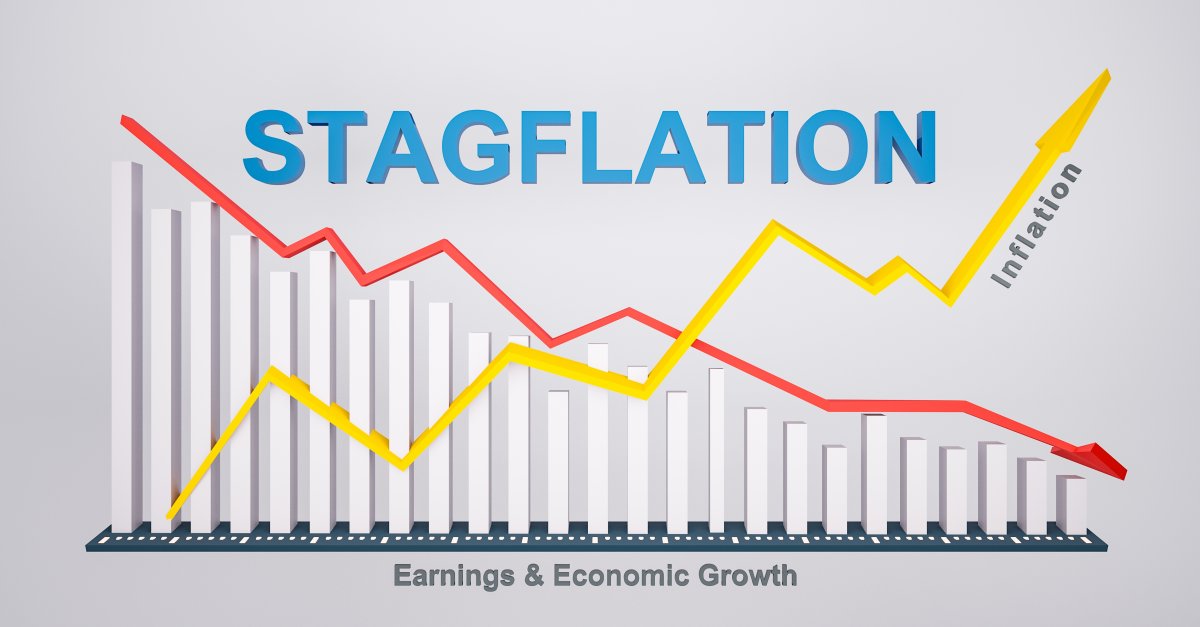
- Stagflation is the simultaneous appearance in an economy of slow growth, high unemployment, and rising prices.
- Once thought by economists to be impossible, stagflation has occurred repeatedly in the developed world since the 1970s.
- Policy solutions for slow growth tend to worsen inflation, and vice versa. That makes stagflation hard to fight.
Stagflation is the combination of high inflation, stagnant economic growth, and elevated unemployment.
The term stagflation, a blend of “stagnation” and “inflation,” was popularized by British politician Lain MacLeod in the 1960s, during a period of economic distress in the United Kingdom. It gained broader recognition in the 1970s after a series of global economic shocks, particularly the 1973 oil crisis, which disrupted supply chains and led to rising prices and slowing growth. Stagflation challenges traditional economic theories, which suggest that inflation and unemployment are inversely related, as depicted by the Phillips Curve.
***
***
According to Wikipedia, stagflation presents a policy dilemma, as measures to curb inflation—such as tightening monetary policy—can exacerbate unemployment, while policies aimed at reducing unemployment may fuel inflation.
In economic theory, there are two main explanations for stagflation: supply shocks, such as a sharp increase in oil prices, and misguided government policies that hinder industrial output while expanding the money supply too rapidly.
NOTE: A portmanteau word or part of a word made by combining the spellings and meanings of two or more other words or word parts (such as smog from smoke and fog).
MORE: https://medicalexecutivepost.com/2019/06/25/what-is-a-portmanteau/
The stagflation of the 1970s led to a re-evaluation of Keynesian economic policies and contributed to the rise of alternative economic theories, including monetarism and supply-side economics.
PHILLIPS CURVE: https://medicalexecutivepost.com/2024/10/04/about-the-phillips-curve/
COMMENTS APPRECIATED
Read, Like, Refer and Subscribe
***
***
Share this:

Filed under: "Ask-an-Advisor", Financial Planning, Funding Basics, Glossary Terms, Investing, LifeStyle | Tagged: Chase, demand, Dimon, economics, economy, finance, inflation, Keynesian, Lain Macleod, monetarism, Phillips Curve, Portmanteau, stagflation, stagnation, supply, supply shock, Warby Parker, wikipedia | Leave a comment »




 The Leading Business Education Network for Doctors, Financial Advisors and Health Industry Consultants