Understanding Pre-Payment Health Plans

By Staff Reporters

SPONSOR: http://www.CertifiedMedicalPlanner.org

***

***

Classic: A pre-payment plan refers to health insurance plans that provide medical or hospital benefits in service rather than dollars, such as the plans offered by various Health Maintenance Organizations. A method providing in advance for the cost of predetermined benefits for a population group, through regular periodic payments in the form of premiums, dues, or contributions including those contributions that are made to a health and welfare fund by employers on behalf of their employees!

Modern:  A Prepaid Group Practice Plan specifies health services are rendered by participating physicians to an enrolled group of persons, with a fixed periodic payment made in advance by (or on behalf of) each person or family. If a health insurance carrier is involved, a contract to pay in advance for the full range of health services to which the insured is entitled under the terms of the health insurance contract.

Examples:

  • Pre-Paid Hospital Service Plan: The common name for a health maintenance organization (HMO), a plan that provides comprehensive health care to its members, who pay a flat annual fee for services.
  • Pre-Paid Premium: An insurance or other premium payment paid prior to the due date. In insurance, payment by the insured of future premiums, through paying the present (discounted) value of the future premiums or having interest paid on the deposit.
  • Pre-Paid Prescription Plan: A drug reimbursement plan that is paid in advance.

COMMENTS APPRECIATED

Refer and Like

***

***

An Integrated Approach to Healthcare Network Alignment and Scalable Innovation‏

More on Healthcare Network Design and Automation

Join Our Mailing List

[Part 5 in a 6 part series]

By Sam Muppalla – Vice President, McKesson Health Solutions Network Performance Management

Previously, on this ME-P, I wrote about the barriers to alignment across product, network, care and reimbursement innovations. And, yes, I teased you with the three-word preview of what was to come this week: Integrated Building Blocks. The idea of building blocks lies at the heart of an approach to achieving alignment and scaling innovation, so let’s dive in.

Unlocking potential administrative, IT and medical savings — while also creating sustainable alignment of the innovation engines — requires various building blocks be in place as a sound foundation for network design and implementation. These building blocks deliver the required functionality in the most efficient manner. When these building blocks are utilized in an integrated fashion, the current barriers are removed and innovation alignment is achieved.

Four Essential Building Blocks

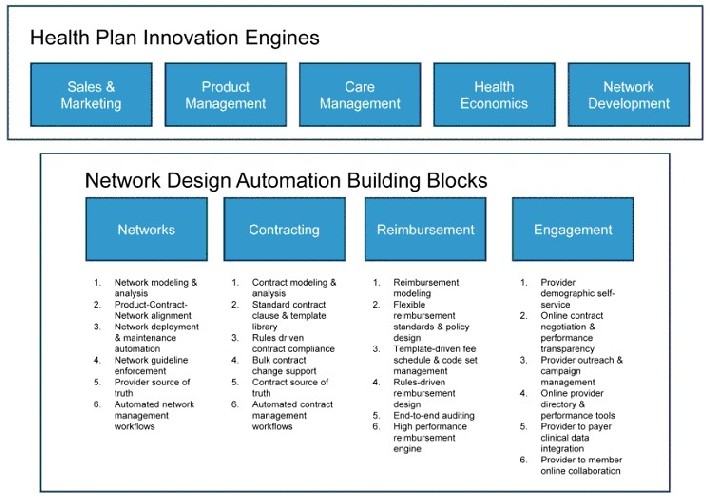
There are four essential network design automation building blocks that comprise the foundation for innovation: networks, contracting, reimbursement and engagement.

Each of these building blocks enables capabilities by delivering necessary functionality within and across the spectrum of network design. Reaching levels of maturity with this capability unlocks additional value and alignment.

Networks

The network building block enables health plans to differentiate and compete. The purpose is to differentiate their value for each customer segment by aligning the product and care model designs with the underlying network designs. It ensures network performance by facilitating the selection of appropriate providers into networks and the alignment of provider reimbursement with network design objectives. It enables networks to be mapped to member-facing and provider-facing products. The provider-facing products can be used for contracting and provider rate differentiation. The member-facing products can be aligned with benefits and serve as steerage targets for benefit designers.

These constructs, in conjunction with each other, enable productization of care model and payment innovation. For example, a health plan could define a “Medical Home Network” that consists of medical homes and supporting providers in a given geography. It could then enable PCMH-specific reimbursement (e.g., PMPM capitation + Fee For Services (FFS) for preventive services + P4P for EBM) by defining a provider-facing product and associating specific reimbursement policies with that provider product. Additionally, it could also define a member-facing product (e.g., PPO Value) which combines the medical home network with the general market PPO network. This in turn will allow the health plan to define a benefit extension which gives a 10 percent premium reduction to members who use Medical Home Network providers for their primary care. In short, a health plan is now able to monetize its care innovation (PCMH), align benefit design to network design for steerage, and align its provider payment with member incentives (around preventive services), while incenting higher quality care (P4P).

The network building block also achieves administrative cost leadership through comprehensive provider data governance and automation of core provider processes.

Contracting

The contracting building block is designed to enable health plans to reduce contract administrative costs while increasing provider payment accuracy. It optimizes the management of the provider contracting lifecycle through the automation of contract authoring, offering negotiating and acceptance while ensuring the standardization of terms and policies. This building block achieves reduced medical expenditure driven by contract standards adherence, reduced claims mis-payments, and increased speed to market for new payment innovations. It also can support rules-based enforcement of network level reimbursement guidelines to ensure consistent network performance.

Reimbursement

The reimbursement building block enables health plans to maximize the effectiveness of their medical expenditures by paying for value versus volume and by incenting team-based performance. It is the single source of truth for all forms of reimbursement including traditional claims pricing, episodes of care, shared savings, capitation and P4P. This building block enables the mixing and matching of reimbursement methodologies to incent optimal provider performance. It supports a modeling engine to analyze the financial impact of reimbursement and contract changes. It incorporates network-aware provider/contract selection for claims pricing intake. This is a rules driven, high performance service that leverages provider relationship information to select the right provider, the right governing contract and the right reimbursement model for each incoming claim. Additionally, it includes provider transparency services that enable health plan provider portals to support online pricing lookups and reimbursement status/detail inquiries for providers. These services can be extended to support provider performance scorecards and benchmarks.

Engagement

The engagement building block is designed to increase collaboration and participation. It enables meaningful engagement among health plans, providers and members in order to improve health outcomes and reduce costs. This building block achieves reduced administrative and service costs, increased member participation and adherence, increased provider satisfaction and adoption of care/payment initiatives, and the enablement of collaborative/integrated care delivery models such as PCMH and ACO.

Utilizing flexible, automated and integrated building block capabilities is the key to sustainable success that not only unlocks the promise of affordable care to customer segments but also delivers on reduced administrative, medical and IT costs. Incorporating information technologies that can facilitate, if not altogether replace, the manual interactions will be an important part of every organization’s evolution.

Assessment

Next week, in our final part 6 of this series, we’ll wrap up this discussion with a look at some of the potential savings health plans could achieve through alignment and an integrated approach to network design. The potential savings are not slight, so stay tuned. As always, if you just don’t want to wait for next week, visit our website and download the entire Unlocking Affordable Care by Aligning Products white paper; it’s available now.

Conclusion

Your thoughts and comments on this ME-P are appreciated. Feel free to review our top-left column, and top-right sidebar materials, links, URLs and related websites, too. Then, subscribe to the ME-P. It is fast, free and secure.

Speaker: If you need a moderator or speaker for an upcoming event, Dr. David E. Marcinko; MBA – Publisher-in-Chief of the Medical Executive-Post – is available for seminar or speaking engagements. Contact: MarcinkoAdvisors@msn.com

OUR OTHER PRINT BOOKS AND RELATED INFORMATION SOURCES:


Product Details

Strengthening Physician Hospital Relationships

A PHO Primer 

By Dr. David Edward Marcinko MBA, CMP™

[Publisher-in-Chief]

Contrary to popular belief, physician-hospital relationships are not always driven by formal economics partnerships such as joint ventures, employment or medical director stipends. A concerted physician outreach program demonstrates a hospital’s commitment to working together more effectively.

Example

For example, Bon Secours Hampton Roads Health System in Virginia uses a systematic outreach program in which senior leadership, supplemented by physicians sales staff, meet regularly with physicians to identify critical operational issues that are disrupting their practice. The program is so important to building referral relationships with physicians who have other options for alignment that the system CEO reviews the issues list daily.

Link: www.BusinessofMedicalPractice.com

Key Areas 

Regardless of the partnership model, consultant Carolyn Merriman believes effective physician-hospital relationships call for alignment in four key areas:

  • Leadership – physicians are included in developing the strategic direction of the hospital and its programs and services.
  • Input – physician input is sought from people and areas beyond the traditional medical executive committee, often using younger, informal leaders who are the future leaders of the medical staff.
  • Communication – physicians feel heard and responded to as they identify issues and challenges they encounter as they practice medicine, and they feel that processes are in place for effectively resolving the issues.
  • Relationship Management – executives understand what motivates physicians professionally and personally and use that information to build a solid foundation of trust and mutual respect as they build and foster relationships.

Assessment

In a 2007 survey, the American College of Healthcare Executives (ACHE) found that physician-hospital relations was the third most pressing issue for hospital CEOs, topped only by financial challenges and care for the uninsured. Within the physician-hospital category, specific concerns included creating win-win collaboration, physician requests for payment for service to the hospital, competition with physician-owned facilities/equipment, medical staff structures/leadership and niche providers. 

Certainly from the physician’s perspective, a better relationship with hospital leaders and hospital staff makes life infinitely easier. We do, after all, share a common denominator—the patient. Like the physician, the hospital is equally interested in providing patients with the very best quality and service possible.

Conclusion

And so, your thoughts and comments on this ME-P are appreciated. Feel free to review our top-left column, and top-right sidebar materials, links, URLs and related websites, too. Then, subscribe to the ME-P. It is fast, free and secure.

Link: http://feeds.feedburner.com/HealthcareFinancialsthePostForcxos

Speaker: If you need a moderator or speaker for an upcoming event, Dr. David E. Marcinko; MBA – Publisher-in-Chief of the Medical Executive-Post – is available for seminar or speaking engagements. Contact: MarcinkoAdvisors@msn.com

Our Other Print Books and Related Information Sources:

Health Dictionary Series: http://www.springerpub.com/Search/marcinko

Practice Management: http://www.springerpub.com/product/9780826105752

Physician Financial Planning: http://www.jbpub.com/catalog/0763745790

Medical Risk Management: http://www.jbpub.com/catalog/9780763733421

Healthcare Organizations: www.HealthcareFinancials.com

Physician Advisors: www.CertifiedMedicalPlanner.com

Subscribe Now: Did you like this Medical Executive-Post, or find it helpful, interesting and informative? Want to get the latest ME-Ps delivered to your email box each morning? Just subscribe using the link below. You can unsubscribe at any time. Security is assured.

Link: http://feeds.feedburner.com/HealthcareFinancialsthePostForcxos

Sponsors Welcomed: And, credible sponsors and like-minded advertisers are always welcomed.

Link: https://healthcarefinancials.wordpress.com/2007/11/11/advertise

Product Details 

Healthcare Reform Articles from Kevin Pho MD

Aggregating Content – Disseminating Knowledge

By Ann Miller; RN, MHA

[Executive Director] Books

Here are five interesting new articles on the healthcare reform debates from colleauge Kevin Pho, MD. 

Kevin practices at the Nashua Medical Group near the Massachusetts border. He is board certified in internal medicine and provides both comprehensive adult and primary care services.

Related posts:

Give them a click, read em’ and comment now.

Assessment

Join Our Mailing List 

Remember, how we put things together – sets us apart!

Channel Surfing

Have you visited our other topic channels? Established to facilitate idea exchange and link our community together, the value of these topics is dependent upon your input. Please take a minute to visit. And, to prevent that annoying spam, we ask that you register.  

Link: http://feeds.feedburner.com/HealthcareFinancialsthePostForcxos

Our Other Print Books and Related Information Sources:

Practice Management: http://www.springerpub.com/prod.aspx?prod_id=23759

Physician Financial Planning: http://www.jbpub.com/catalog/0763745790

Medical Risk Management: http://www.jbpub.com/catalog/9780763733421

Healthcare Organizations: www.HealthcareFinancials.com

Health Administration Terms: www.HealthDictionarySeries.com

Physician Advisors: www.CertifiedMedicalPlanner.com

Subscribe Now: Did you like this Medical Executive-Post, or find it helpful, interesting and informative? Want to get the latest ME-Ps delivered to your email box each morning? Just subscribe using the link below. You can unsubscribe at any time. Security is assured.

Link: http://feeds.feedburner.com/HealthcareFinancialsthePostForcxos

Sponsors Welcomed

And, credible sponsors and like-minded advertisers are always welcomed.

Link: https://healthcarefinancials.wordpress.com/2007/11/11/advertise

Independent Medical Practitioner as Solo Primary Care Surrogate

Join Our Mailing List

Doctors Facing a Bleak Future Business and Financial Planning Model

By Dr. David Edward Marcinko; MBA, CMP™

[Publisher-in-Chief]dem2

According to Physicians News, on March 19, 2009, the demand for family physicians is growing. Proposals for health system reform focus on increasing the number of primary care physicians in America. Yet, despite these trends, the number of future physicians who chose family medicine dipped this year, according to the 2009 National Resident Matching Program. What gives?

NRMP

The National Resident Matching Program [NRMP] recently announced that a total of 2,329 graduating medical students matched to family medicine training programs. This is a decrease in total student matches from 2008, when 2,404 family medicine residency positions were filled.

Primary Care Demand Explodes

Meanwhile, demand for primary care physicians continues to skyrocket. For example, in its most recent recruitment survey, Merritt Hawkins, a national physician recruiting company, reported primary care physician search assignments had more than doubled from 341 in 2003 to 848 last year. 

The Decline of Solo Medical Practitioners

Regular readers and subscribers to this Medical Executive- Post are aware of the declining number of solo medical practitioners; we have been sounding the alarm here, in our books, journal, speaking engagements and elsewhere for years now.dhimc-book4

In fact, the statistic that we often cite is that more than 40% of the nation’s physicians are employed doctors; not employers as in the past. This business model shift has occurred over the past decade or so, and has accelerated of late. The decline in solo and independent doctors has occurred elsewhere as well, but much more slowly [i.e., dentistry, podiatry and osteopathy] as these specialties have been somewhat isolated from the traditional allopathic mainstream.

Going forward, this solitary model seems to be a good thing, and a fortunate result of the un-intended consequence of previously keeping these folks out of the healthcare mainstream.

The Decline of Independent Medical Practitioners

Now, in the March 2009 issue of Healthcare Finance News, we learn that the number of hospital owned physician practices has been climbing over the last four years, according to the Medical Group Management Association [MGMA]. Think: PHOs back-in-the-day. ho-journal3

And, while this trend only marginally affects patients and patient care, it is quite disruptive to physicians, their families, personal wealth accumulation, retirement and estate planning endeavors.

For example, according to Professor Hope Rachel Hetico, RN, MHA, CMP™ of our firm www.MedicalBusinessAdvisors.com

“The professional good-will valuation component of a medical practice is being decimated. Today, some practices are being bought and sold for tangible asset value, only.

Assessment

Therefore, allow me to identify this emerging trend which suggests independent medical practice as reflective of solo primary medical care. In other words, as independence goes the way of the “dodo-bird”, so goes primary care practitioners precisely at a time when the later is needed more than the former.

Why? Employed doctors stay that way by making money for their employer and hospital-bosses. Specialists make more money than primary care doctors. So, if you want to stay an employed doctor; which specialty would you pursue?

Answer: The NRMP class this year spoke out loud and clear. Any specialty but primary care!

Channel Surfing the ME-P

Have you visited our other topic channels? Established to facilitate idea exchange and link our community together, the value of these topics is dependent upon your input. Please take a minute to visit. And, to prevent that annoying spam, we ask that you register. It is fast, free and secure.

Conclusion

Your thoughts and comments on this ME-P are appreciated. Feel free to review our top-left column, and top-right sidebar materials, links, URLs and related websites, too. Then, subscribe to the ME-P. It is fast, free and secure.

Speaker: If you need a moderator or speaker for an upcoming event, Dr. David E. Marcinko; MBA – Publisher-in-Chief of the Medical Executive-Post – is available for seminar or speaking engagements. Contact: MarcinkoAdvisors@msn.com

OUR OTHER PRINT BOOKS AND RELATED INFORMATION SOURCES:

Product DetailsProduct Details

Product Details