BONDS: Revenue

DEFINITION

By Staff Reporters

SPONSOR: http://www.MarcinkoAssociates.com

***

***

Revenue bonds are one of the biggest sectors in the municipal debt market.

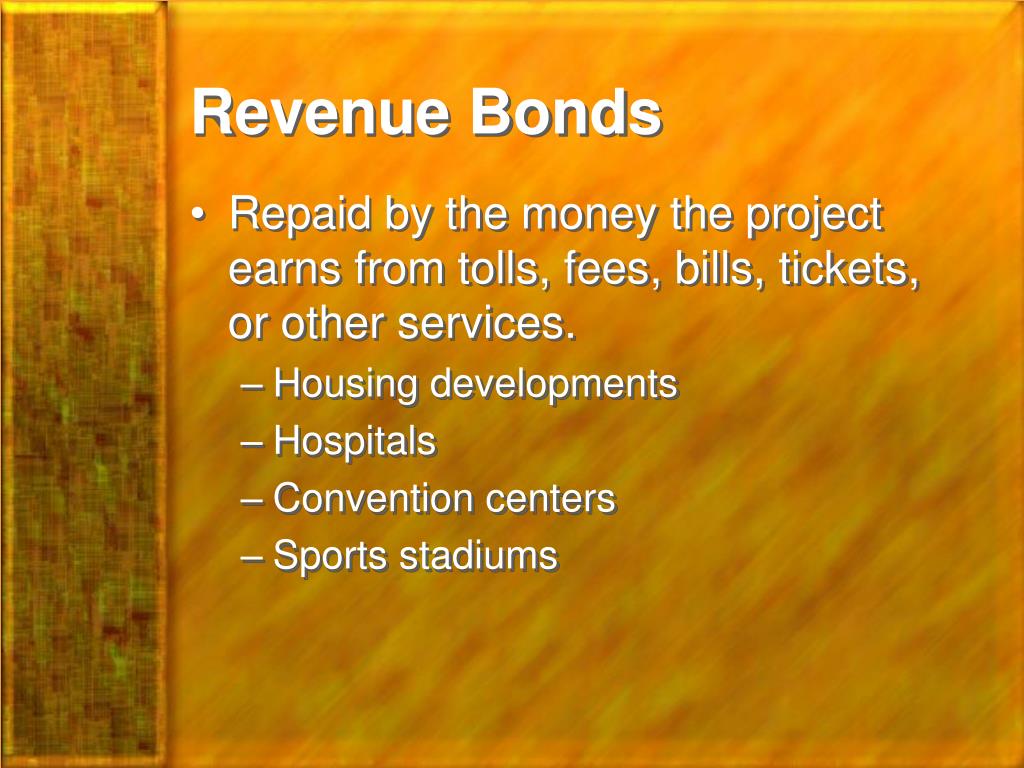
Unlike a general obligation (GO) bond, revenue bonds are not backed by a municipal issuer’s taxing authority. Instead, interest and principal are secured by the net revenues (tolls, fees, or other charges tied to usage) from the project or facility being financed.

Revenue bonds are issued to finance a variety of capital projects, including construction or refurbishment of utility and waste disposal systems, highways, bridges, tunnels, air and seaport facilities, schools and hospitals.

COMMENTS APPRECIATED

Subscribe and Refer

***

***

PODCAST: Hospital Debt and Tax Exempt Bonds

By Eric Bricker MD

***

***

CITE: https://www.r2library.com/Resource/Title/082610254

COMMENTS APPRECIATED

Thank You

***

ORDER: https://www.routledge.com/Comprehensive-Financial-Planning-Strategies-for-Doctors-and-Advisors-Best/Marcinko-Hetico/p/book/9781482240283

****

Understanding Municipal Bond Underwriting

A Primer for Physician Investors

By Dr. David Edward Marcinko MBA CMP™

[Publisher-in-Chief]

While the underwriting procedures for corporate bonds are almost identical to corporate stock, there are significant differences in the underwriting of municipal securities. Municipal securities – hospitals for example – are exempt from the registration filing requirements or the Securities Act of 1933. A state or local government, in the issuance of municipal securities, is not required to register the offering with the SEC, so there is no filing of a registration statement and there is no prospectus which would otherwise have to be given to investors.

Municipal Underwriting

There are two main methods of financing when it comes to municipal securities. One method is known as negotiated. In the case of a negotiated sale, the municipality looking to borrow money would approach an investment bank and negotiate the terms of the offering directly with the firm. This is really not very different from the equity process.

Competitive Bidding

The other type of municipal underwriting is known as competitive bidding. Under the terms of competitive bidding, an issuer announces that it wishes to borrow money and is looking for syndicates to submit competitive bids. The issue will then be sold to the syndicate which submits the best bid, resulting in the municipality having the lowest net interest cost (lowest expense to the issuer).

If the issue is to be done by a competitive bid, the municipality will use a Notice of Sale to announce that fact. The notice of sale will generally include most or all of the following information.

  • Date, time, and place. This does not mean when the bonds will be sold to the public, but when the issue will be awarded (sold) to the syndicate issuing the bid.
  • Description of the issue and the manner in which the bid is to be made (sealed bid or oral).
  • Type of bond (general obligation, revenue, etc.)
  • Semi-annual interest payment dates and the denominations in which the bonds will be printed.
  • Amount of good faith deposit required, if any.
  • Name of the law firm providing the legal opinion and where to acquire a bid form.
  • The basis upon which the bid will be awarded, generally the lowest net interest cost.

The Bond Attorney

Since municipal securities are not registered with the SEC, the municipality must hire a law firm in order to make sure that they are issuing the securities in compliance with all state, local and federal laws. This is known as the bond attorney, or independent bond counsel. Some functions are included below:

  1. Establishes the exemption from federal income tax by verifying requirements for the exemption.
  2. Determines proper authority for the bond issuance.
  3. Identifies and monitors proper issuance procedures.
  4. Examines the physical bond certificates to make sure that they are proper
  5. Issues the debt and a legal opinion, since municipal bonds are the only securities that require an opinion.
  6. Does not prepare the official statement.

When medical or other investors purchase new issue municipal securities from syndicate or selling group members, there is no prospectus to be delivered to investors, but there is a document which is provided to purchasers very similar in nature to a prospectus. It is known as an Official Statement. The Official Statement contains all of the information an investor needs to make a prudent decision regarding a proposed municipal bond purchase.

Underwriting Syndicate

The formation of a municipal underwriting syndicate is very similar to that for a corporate issue. When there is a negotiated underwriting, an Agreement Among Underwriters (AAU) is used. When the issue is competitive bid, the agreement is known as a Syndicate Letter. In the syndicate letter, the managing underwriter details all of the underwriting agreements among members of the syndicate. Eastern (undivided) and Western (divided) accounts are also used, but there are several different types of orders in a municipal underwriting.

Order Types

The traditional types of orders, in priority order, are:

  • Pre-Sale Order: Made before the syndicate actually offers the bonds. They have first priority over any other order turned in.
  • Syndicate (group net) Order: Made once the offering is under way at the public offering price. The purchase is credited to each syndicate member in proportion to its allotment. An institutional buyer will frequently purchase” group net”, since many of the firms in the syndicate may consider this buyer to be their client and he wishes to please all of them.
  • Designated Order: Sales to medical investors (usually healthcare institutions) at the public offering price where the investor designates which member or members of the syndicate are to be given credit.
  • Member Orders: Purchased by members of the syndicate at the take-down price (spread). The syndicate member keeps the full take-down if the bonds are sold to investors, or earns the take-down less the concession if the sale is made to a member of the selling group. Should the offering be over-subscribed, and the demand for the new bonds exceeds the supply, the first orders to be filled are the pre-sale orders. Those are followed by the syndicate (sometimes called group net) orders, the designated orders, and the last orders filled are the member’s.

Assessment

Finally, be aware that the term bond scale is a listing of coupon rates, maturity dates, and yield or price at which the syndicate is re-offering the bonds to the public. The scale is usually found in the center of a tombstone ad and on the front cover of the official statement. One of the reasons why the word “scale” is used – is that like the scale on a piano – it normally goes up. A regular or positive scale is one in which the yield to maturity is lowest on the near term maturities and highest on the long term maturities. This is also known as a positive yield curve, since the longer the maturity, the higher the yield. In times of very tight money, such as in 1980-81, one might find a bond offering with a negative scale. A negative (sometimes called inverted) scale is just the opposite of a positive one, with, yields on the short term maturities are higher than those on the long term maturities.

http://www.amazon.com/Financial-Planning-Handbook-Physicians-Advisors/dp/0763745790/ref=sr_1_1?ie=UTF8&s=books&qid=1276795609&sr=1-1 

Conclusion

Your thoughts and comments on this ME-P are appreciated. Feel free to review our top-left column, and top-right sidebar materials, links, URLs and related websites, too. Then, subscribe to the ME-P. It is fast, free and secure.

Speaker: If you need a moderator or speaker for an upcoming event, Dr. David E. Marcinko; MBA – Publisher-in-Chief of the Medical Executive-Post – is available for seminar or speaking engagements. Contact: MarcinkoAdvisors@msn.com

OUR OTHER PRINT BOOKS AND RELATED INFORMATION SOURCES:

Risk Management, Liability Insurance, and Asset Protection Strategies for Doctors and Advisors: Best Practices from Leading Consultants and Certified Medical Planners™8Comprehensive Financial Planning Strategies for Doctors and Advisors: Best Practices from Leading Consultants and Certified Medical Planners™

***


On Hospital Tax-Exempt Debt

Join Our Mailing List

An important means of external financing for hospitals

By Calvin W. Wiese CPA CMA

By Dr. David Edward Marcinko MBA

www.CertifiedMedicalPlanner.org

Tax-exempt debt has become an important means of external financing for hospitals, primarily because its cost is very attractive. Interest rates on tax-exempt financing are lower than interest rates on financing that is not tax-exempt because the interest income earned by the holders is exempt from federal income tax. In some states, it is also exempt from state income tax and in some cities; it is also exempt from city income tax. Thus, the holders of these debt instruments (usually bonds) are willing to accept lower rates of interest.

State and Local Governments Only

Hospitals themselves are not capable of issuing tax-exempt debt. Only state and local governments are. A state or local government issues tax-exempt debt for hospitals and then loans the proceeds to hospitals. This is called “conduit” financing: the state or local government acts as a conduit through which hospitals can access tax-exempt debt markets. State and local governments are authorized to loan proceeds of their bond issues to hospitals through state statutes, and each state statute is different. Some states authorize any state or local government to issue bonds to loan to hospitals. Other states restrict such power to special purpose governmental entities only. And some states restrict this power to a single governmental entity that is specially formed for the sole purpose of issuing tax-exempt bonds on behalf of hospitals.

The IRS

The Internal Revenue Service (IRS) regulates the issuance of tax-exempt financing. While the IRS code nominally provides that debt instruments issued by state and local governments are exempt from federal income tax, it imposes special rules on conduit issues. Thus, tax-exempt issues whose proceeds are loaned to hospitals must comply with special IRS rules. Although very complex, these rules primarily regulate the use of proceeds, restricting the use of tax-exempt proceeds to the acquisition of property, plant components and equipment.

Given state statutes, IRS code and applicable security laws (both state and federal), issuing tax-exempt bonds is legally complex. Many lawyers get paid handsome fees every time tax-exempt debt is issued. The quarterback of the legal team is the bond counsel who represents the interests of the bondholders; the bond counsel issues the critical tax opinion that investors rely upon to claim tax-exemption on the interest from these instruments. Everything revolves around getting this opinion.

The Underwriter’s

Given its critical nature, only highly qualified lawyers are accepted by the market to provide this opinion. Underwriter’s counsel represents the interests of the investment bankers; their primary concern is compliance with security laws. Issuer’s counsel represents the interests of the state or local government, and hospital counsel represents the interests of the hospital; both have relatively minor roles. In the event credit enhancement is involved, credit enhancement counsel represents their interests and has significant influence on the process.

The Trustees

Another unique party to most tax-exempt bond issues is the bond trustee. The bond trustee is usually a bank who performs a fiduciary duty on behalf of the bond holders throughout the life of the bonds. The face of the faceless bond holders, they act on their behalf. And they, too, are represented by counsel in the bond issuance process.

State or local government typically appoints bond counsel. In many cases, they work with only a single firm. Not unusually, these relationships are quite cozy, and often result in fees being paid that are well in excess of what otherwise would be paid.

The Documents

An excess of documents is involved in most tax-exempt financings. The heart of the documents is the indenture, which is the agreement between the bond trustee (on behalf of the bond holders) and the state or local government issuer. It contains the promises made to the bond holders, and it describes the work of the bond trustee. The bond trustee will only perform actions on behalf of bond holders that are explicitly set forth in the bond indenture. The bond indenture is the security given to the bond holders, describing all their recourses.

Assessment

The bond indenture is typically supported by the loan agreement between the state or local government that issues the bonds and the hospital to which the proceeds are loaned. Its terms complement the terms of the bond indenture, which together, form the conduit.

Conclusion

Your thoughts and comments on this ME-P are appreciated. Feel free to review our top-left column, and top-right sidebar materials, links, URLs and related websites, too. Then, subscribe to the ME-P. It is fast, free and secure.

Link: http://feeds.feedburner.com/HealthcareFinancialsthePostForcxos

Speaker: If you need a moderator or speaker for an upcoming event, Dr. David E. Marcinko; MBA – Publisher-in-Chief of the Medical Executive-Post – is available for seminar or speaking engagements. Contact: MarcinkoAdvisors@msn.com

Our Other Print Books and Related Information Sources:

Health Dictionary Series: http://www.springerpub.com/Search/marcinko

Practice Management: http://www.springerpub.com/product/9780826105752

Physician Financial Planning: http://www.jbpub.com/catalog/0763745790

Medical Risk Management: http://www.jbpub.com/catalog/9780763733421

Hospitals: http://www.crcpress.com/product/isbn/9781439879900

Physician Advisors: www.CertifiedMedicalPlanner.org

     From Our Newest Textbook Release

Buy from Amazon

Learn How to Profit and Thrive in the PP-ACA Era

BOOK FOREWORD / TESTIMONIAL

Understanding Managed Bond Funds

Considerations for the Physician-Investor

By Staff Reportersdhimc-book11

Proper diversification among types of bonds is an important investment objective. The maturity schedule and the number of issuers are often very important, along with the issuers’ creditworthiness.

Individual Constraints

The constraints on purchases of individual bond issues often put the physician-investor at a disadvantage. Minimum amounts of investments are imposed by the marketplace or the issuer. Many doctor-investors find it impractical to meet these requirements and also obtain proper diversification (the amount of portfolio funds committed to debt-based securities simply is not large enough to obtain diversification and at the same time meet the other limitations). Accordingly, many investors find mutual funds devoted to debt-based securities most effective in achieving diversification.

A Large Marketplace

The mutual fund marketplace has many types of bond funds, and diversification can be obtained quite easily. The investor with a relatively reduced amount to invest in debt-based securities should consider using mutual funds.

Assessment

For more terminology information, please refer to the Dictionary of Health Economics and Finance.

www.HealthDictionarySeries.com

Conclusion

And so, your thoughts and comments on this Medical Executive-Post are appreciated?

Link: http://feeds.feedburner.com/HealthcareFinancialsthePostForcxos

Speaker: If you need a moderator or speaker for an upcoming event, Dr. David E. Marcinko; MBA – Publisher-in-Chief of the Executive-Post – is available for seminar or speaking engagements. Contact: MarcinkoAdvisors@msn.com  or Bio: www.stpub.com/pubs/authors/MARCINKO.htm

Get our Widget: Get this widget!

Our Other Print Books and Related Information Sources:

Practice Management: http://www.springerpub.com/prod.aspx?prod_id=23759

Physician Financial Planning: http://www.jbpub.com/catalog/0763745790

Medical Risk Management: http://www.jbpub.com/catalog/9780763733421

Healthcare Organizations: www.HealthcareFinancials.com

Health Administration Terms: www.HealthDictionarySeries.com

Physician Advisors: www.CertifiedMedicalPlanner.com

Subscribe Now: Did you like this Medical Executive-Post, or find it helpful, interesting and informative? Want to get the latest E-Ps delivered to your email box each morning? Just subscribe using the link below. You can unsubscribe at any time. Security is assured.

Link: http://feeds.feedburner.com/HealthcareFinancialsthePostForcxos