How Investment Banking Works for Corporations

By Dr. David Edward Marcinko MBA MEd

***

***

SPONSOR: http://www.MarcinkoAssociates.com

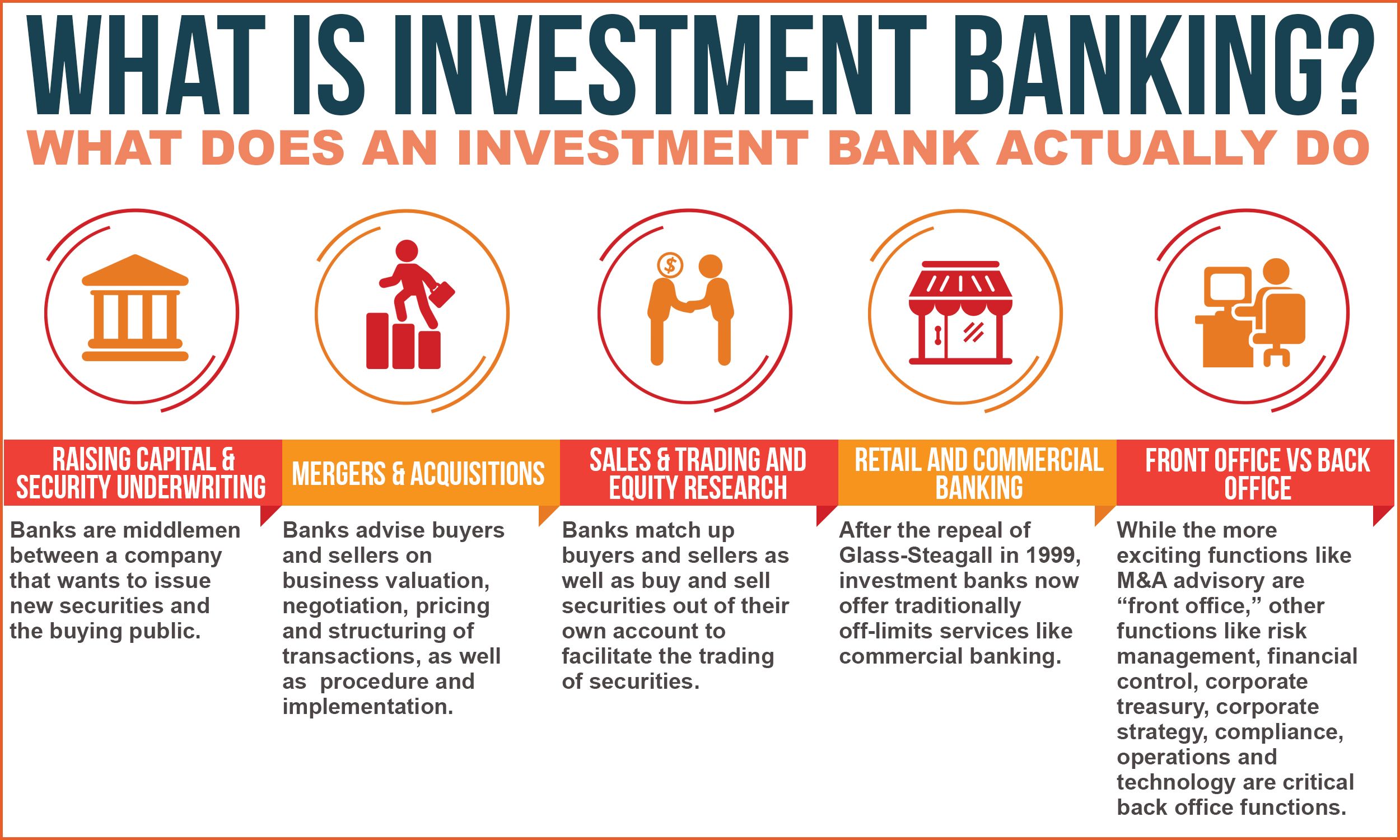
Investment bankers are not really bankers at all. The fact that the word banker appears in the name is partially responsible for the false impressions that exist in the medical community regarding the functions they perform.

For example, they are not permitted to accept deposit, provide checking accounts, or perform other activities normally construed to be commercial banking activities. An investment bank is simply a firm that specializes in helping other corporations obtain money they need under the most advantageous terms possible. When it comes to the actual process of having securities issued, the corporation approaches an investment banking firm, either directly, or through a competitive selection process and asks it to act as adviser and distributor.

MORE: https://www.amazon.ca/Management-Liability-Insurance-Protection-Strategies/dp/1498725988

Investment bankers, or under writers, as they are sometimes called, are middlemen in the capital markets for corporate securities. The corporation requiring the funds discusses the amount, type of security to be issued, price and other features of the security, as well as the cost to issuing the securities. All of these factors are negotiated in a process known as negotiated underwriting. If mutually acceptable terms are reached, the investment banking firm will be the middle man through which the securities are sold to the general public. Since such firms have many customers, they are able to sell new securities, without the costly search that individual corporations may require to sell its own security.

Thus, although the firm in need of additional capital must pay for the service, it is usually able to raise the additional capital at less expense through the use of an investment banker, than by selling the securities itself. The agreement between the investment banker and the corporation may be one of two types. The investment bank may agree to purchase, or underwrite, the entire issue of securities and to re-offer them to the general public. This is known as a firm commitment.

When an investment banker agrees to underwrite such a sale; it agrees to supply the corporation with a specified amount of money. The firm buys the securities with the intention to resell them. If it fails to sell the securities, the investment banker must still pay the agreed upon sum.

Thus, the risk of selling rests with the underwriter and not with the company issuing the securities.

INVESTMENT BANKING: https://medicalexecutivepost.com/2024/04/17/understanding-tnvestment-banking-rules-securities-markets-brokerage-accounts-margin-and-debt/

***

The alternative agreement is a best efforts agreement in which the investment banker makes his best effort to sell the securities acting on behalf of the issuer, but does not guarantee a specified amount of money will be raised. When a corporation raises new capital through a public offering of stock, one might inquire where the stock comes from. The only source the corporation has is authorized, but previously un-issued stock. Anytime authorized, but previously un-issued stock (new stock) is issued to the public, it is known as a primary offering.

If it’s the very first time the corporation is making the offering, it’s also known as the Initial Public Offering (IPO). Anytime there is a primary offering of stock, the issuing corporation is raising additional equity capital.

A secondary offering, or distribution, on the other hand, is defined as an offering of a large block of outstanding stock. Most frequently, a secondary offering is the sale of a large block of stock owned by one or more stockholders. It is stock that has previously been issued and is now being re-sold by investors. Another case would be when a corporation re-sells its treasury stock.

STOCK BROKERS: https://medicalexecutivepost.com/2024/09/04/understanding-traditional-full-service-brokers/

COMMENTS APPRECIATED

EDUCATION: Books

SPEAKING: Dr. Marcinko will be speaking and lecturing, signing and opining, teaching and preaching, storming and performing at many locations throughout the USA this year! His tour of witty and serious pontifications may be scheduled on a planned or ad-hoc basis; for public or private meetings and gatherings; formally, informally, or over lunch or dinner. All medical societies, financial advisory firms or Broker-Dealers are encouraged to submit an RFP for speaking engagements: CONTACT: Ann Miller RN MHA at MarcinkoAdvisors@outlook.com -OR- http://www.MarcinkoAssociates.com

Like and Subscribe

***

***

IPOs: Delayed

By Staff Reporters

***

***

Initial Public Offering Defined

IPO stands for initial public offering. It is when a company takes a portion of their shares and makes them available for the general public to buy on the open market. It is a way for the company to raise money by selling those shares to the general public. You can usually access shares from an IPO by working directly with an investment bank.

Paused IPOs

Private companies StubHub and Klarna each paused their imminent plans to go public.

Klarna, which was set to IPO on this Monday, was expected to jump-start the frozen IPO market this year with an expected ~$15 billion valuation.

StubHub, meanwhile, reportedly wants to wait for the market to calm down before resuming its plans to go public.

COMMENTS APPRECIATED

Refer, Read, Like and Subscribe

***

***

IPO: Road Show with Pros and Cons

By Staff Reporters

SPONSOR: http://www.MarcinkoAssociates.com

***

***

What Is a Roadshow?

In general, a roadshow is a series of meetings or presentations in which key members of a private company, usually executives, pitch the initial public offering, or IPO, to prospective investors. Effectively, the company is taking its branding message on the road to meet with investors in different cities, hence the name.

The IPO roadshow presentation is an important part of the IPO process in which a company sells new shares to the public for the first time. Whether a company’s IPO succeeds or not can hinge on interest generated among investors before the stock makes its debut on an exchange.

There are also some cases where company executives will embark on a road show to meet with investors to talk about their company, even if they’re not planning an IPO.

Pros and Cons of a Roadshow

According to Rebecca Lake, if the company goes public and no one buys its shares, then the IPO ends up being a flop, which can affect the company’s success in the near and long term. If the company experiences an IPO pop, in which its price goes much higher than its initial offering price, it could be a sign that underwriters mispriced the stock.

A roadshow is also important for helping determine how to price the company’s stock when the IPO launches. If the roadshow ends up being a smashing success, for example, that can cause the underwriters to adjust their expectations for the stock’s IPO price.

On the other hand, if the roadshow doesn’t seem to be generating much buzz around the company at all, that could cause the price to be adjusted downward.

In a worst-case scenario, the company may decide to pull the plug on the IPO altogether or to go a different route, such as a private IPO placement.

COMMENTS APPRECIATED

Refer, Like and Subscribe

***

***

Investing “Tips” on Initial Public Offerings [IPOs]

Some Investing Tips and Pearls

By Dr. David Marcinko MBA MEd CMP

http://www.MarcinkoAssociates.com

Initial public offerings, known as IPOs, tend to attract a lot of investor interest – especially when the company is well-known. However, that excitement isn’t always matched by investment returns.

“Tips and Pearls”

So, here are some tips to consider before you decide to invest in an IPO:

• Don’t let the excitement surrounding an IPO cloud your judgment. Too often, there is little financial information about the companies themselves, and many are not profitable. This can translate into extremely volatile stock prices.

• While an IPO’s stock price tends to rise on the day it begins trading, investors who bought shares at the end of the first day haven’t always fared well. The stocks have often fallen below the closing first-day price after six months.

High volatility and a falling stock price are not generally a recipe for attractive investor returns.

So what steps should you take if you’re still interested in an IPO?

1. Understand that the opening price will likely be different from the official IPO price. New issues can experience extreme volatility in the first few hours and days of trading in the secondary market. When the company’s stock opens for secondary trading and becomes more widely available, the price can be significantly different from the IPO price set by the security underwriters. In addition, new issues often do not begin trading the moment the market opens.

2. Use a limit order. This can help you avoid paying more for the stock than you intended. Once you understand the risks of purchasing a stock during its first public trading days, work with your financial advisor to determine the highest price you’re willing to pay for the stock, and then set that amount as your limit.

3. Remember that an IPO must be priced before an order can be accepted. For example, Edward Jones typically does not accept orders until after an IPO has been priced, which is usually the morning the new issue begins trading. In addition, your financial advisor is not permitted to accept market orders for any IPO prior to its trading in the secondary market.

***

https://www.amazon.com/Comprehensive-Financial-Planning-Strategies-Advisors/dp/1482240289/ref=sr_1_1?ie=UTF8&qid=1418580820&sr=8-1&keywords=david+marcinko

***

Assessment

Remember to always do your homework before deciding on any investment, including an IPO. This includes working with your financial advisor or accountant to determine whether the investment is suitable for your portfolio.

Conclusion

Your thoughts and comments on this ME-P are appreciated. Feel free to review our top-left column, and top-right sidebar materials, links, URLs and related websites, too. Then, subscribe to the ME-P. It is fast, free and secure.

Speaker: If you need a moderator or speaker for an upcoming event, Dr. David E. Marcinko; MBA – Publisher-in-Chief of the Medical Executive-Post – is available for seminar or speaking engagements.

Book Marcinko: https://medicalexecutivepost.com/dr-david-marcinkos-bookings/

Subscribe: MEDICAL EXECUTIVE POST for curated news, essays, opinions and analysis from the public health, economics, finance, marketing, IT, business and policy management ecosystem.

***

Risk Management, Liability Insurance, and Asset Protection Strategies for Doctors and Advisors: Best Practices from Leading Consultants and Certified Medical Planners™8Comprehensive Financial Planning Strategies for Doctors and Advisors: Best Practices from Leading Consultants and Certified Medical Planners™

***

NYSE: Game-On for IPOs

By Staff Reporters

SPONSOR: http://www.CERTIFIEDMEDICALPLANNER.org

***

***

DEFINITION: An initial public offering (IPO) or stock launch is a public offering in which shares of a company are sold to institutional investors and usually also to retail (individual) investors An IPO is typically underwritten by one or more investment banks who also arrange for the shares to be listed on one or more stock exchanges. Through this process, colloquially known as floating, or going public, a privately held company is transformed into a public company. Initial public offerings can be used to raise new equity capital for companies, to monetize the investments of private shareholders such as company founders or private equity investors, and to enable easy trading of existing holdings or future capital raising by becoming publicly traded.

CITE: https://www.r2library.com/Resource

After the IPO, shares are traded freely in the open market at what is known as the free float. Stock exchanges stipulate a minimum free float both in absolute terms (the total value as determined by the share price multiplied by the number of shares sold to the public) and as a proportion of the total share capital (i.e., the number of shares sold to the public divided by the total shares outstanding). Although IPO offers many benefits, there are also significant costs involved, chiefly those associated with the process such as banking and legal fees, and the ongoing requirement to disclose important and sometimes sensitive information.

Cite: Wikipedia

***

Now, the NYSE is the world’s largest stock exchange, and for good reason. From thrilling new entries into the public market to a relentless commitment to transformative tech, the NYSE is constantly upping their game.

Related: https://medicalexecutivepost.com/2023/09/19/ipos-more-caution-ahead/

***

***

COMMENTS APPRECIATED

Join Us

***

IPOs: More Caution Ahead

By Staff Reporters

http://www.MARCINKOASSOCIATES.com

***

***

From 2020 to 2021, when VC money was cheap and tech IPOs were hot, the tech companies that went public via IPO were mostly growth-focused unicorns that had yet to see any profits. But Instacart, which has turned a profit for the last five quarters, is something different.

Chip design company Arm, which debuted last week in the year’s biggest IPO, was the first venture-capital-backed startup to go public in the US since December 2021. It may have broken the ice, but Instacart is the next big test.

However, being profitable and being valuable aren’t the same thing. In 2020, investors valued Instacart at $39 billion, its highest valuation and roughly $29 billion more than what it’s expected to be worth to investors today.

  • Late-stage investors in Instacart, such as Fidelity and T. Rowe Price, stand to lose 40% or more.
  • Sequoia Capital—Instacart’s largest external shareholder—was also one of its earliest. Its initial $8 million investment in 2013 is worth $1 billion today, but its later investment of $50 million in 2021 has shrunk to $12 million.

***

COMMENTS APPRECIATED

Thank You

***

***

Arm IPO: NASDAQ Success over NYSE

By Staff Reporters

***

***

Stocks shot up yesterday on the strength of Arm’s IPO. Investors were pleased with the British chip-maker’s debut: Shares surged 25%, leading to the best day for the Dow since early August.

Arm’s debut was also a big win for NASDAQ, which hopes to parlay the successful IPO into grabbing more listings over rival NYSE.

IPOs: https://medicalexecutivepost.com/2023/05/01/initial-public-offerings/

COMMENTS APPRECIATED

Thank You

***

***

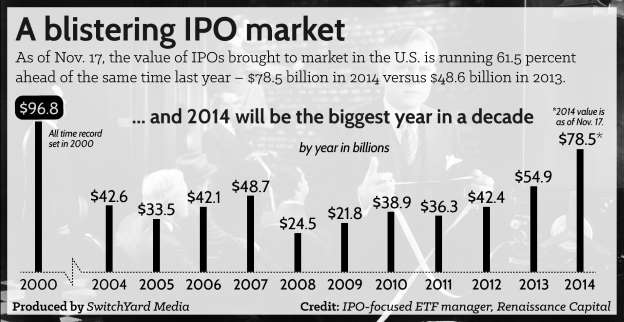
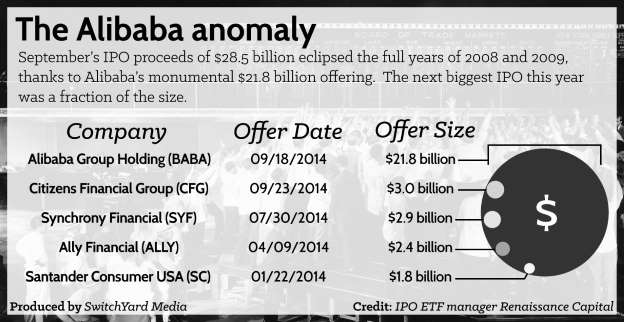
2014 – A Near Record Year for IPOs

Join Our Mailing List

A 2014 Wrap-Up 

[By Inside the Ticker]

***

1

***

2

***

3

***

More:

Assessment

Channel Surfing the ME-P

Have you visited our other topic channels? Established to facilitate idea exchange and link our community together, the value of these topics is dependent upon your input. Please take a minute to visit. And, to prevent that annoying spam, we ask that you register. It is fast, free and secure.

Conclusion

Your thoughts and comments on this ME-P are appreciated. Feel free to review our top-left column, and top-right sidebar materials, links, URLs and related websites, too. Then, subscribe to the ME-P. It is fast, free and secure.

Speaker: If you need a moderator or speaker for an upcoming event, Dr. David E. Marcinko; MBA – Publisher-in-Chief of the Medical Executive-Post – is available for seminar or speaking engagements. Contact: MarcinkoAdvisors@msn.com

OUR OTHER PRINT BOOKS AND RELATED INFORMATION SOURCES:

Financial Planning MDs 2015

Comprehensive Financial Planning Strategies for Doctors and Advisors: Best Practices from Leading Consultants

***