FINANCIAL MODELING TERMS: All Physicians Should Review and Know

By Staff Reporters

SPONSOR: http://www.CertifiedMedicalPlanner.org

***
***

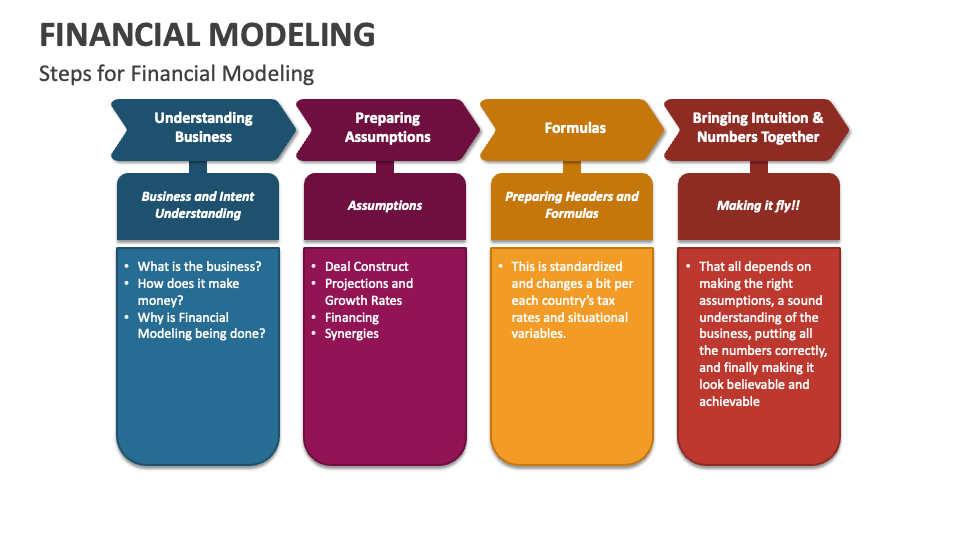
Financial Modeling is one of the most highly valued, but thinly understood, skills in financial analysis. The objective of financial modeling is to combine accounting, finance, and business metrics to create a forecast of a company’s future results.

According to Jeff Schmidt, a financial model is simply a spreadsheet, usually built in Microsoft Excel, that forecasts a business’s financial performance into the future. The forecast is typically based on the company’s historical performance and assumptions about the future and requires preparing an income statement, balance sheet, cash flow statement, and supporting schedules (known as a three-statement model, one of many types of approaches to financial statement modeling). From there, more advanced types of models can be built such as discounted cash flow analysis (DCF model), leveraged buyout (LBO), mergers and acquisitions (M&A), and sensitivity analysis

***

DEFINED TERMS

Discounted Cash Flow (DCF): A valuation method used to estimate the value of an investment based on its expected future cash flows, adjusted for the time value of money. It’s like deciding whether a treasure chest is worth diving for now, based on the gold coins you’ll be able to cash in later.

Sensitivity Analysis: This involves changing one variable at a time to see how it affects an outcome. Imagine tweaking your coffee-to-water ratio each morning to achieve the perfect brew strength.

Budget – A budget is the amount of money a department, function, or business can spend in a given period of time. Usually, but not always, finance does this annually for the upcoming year.

Rolling ForecastA rolling forecast maintains a consistent view over a period of time (often 12 months). When one period closes, finance adds one more period to the forecast.

Topside – A topside adjustment is an overlay to a forecast. This is typically completed by the corporate or headquarter team. As individual teams submit a forecast, the consolidated result might not make sense or align with expectations. When this occurs, the high-level teams use a topside adjustment to streamline or adjust the consolidated view.

Monte Carlo Simulation: Picture yourself at the casino, but instead of gambling your savings away, you’re using this technique to predict different outcomes of your business decisions based on random variables. It’s like playing financial roulette with the odds in your favor.

What-If Analysis: Ever daydream about what would happen if you took that leap of faith with your business? This tool allows you to explore various scenarios without risking a dime. It’s like trying on outfits in a virtual dressing room before making a purchase.

Leveraged Buyout (LBO) Model: This is a bit like orchestrating a heist, but legally. It’s about acquiring a company using borrowed money, with plans to pay off the debts with the company’s own cash flows. High stakes, high rewards.

Mergers and Acquisitions (M&A) Model: Picture two puzzle pieces coming together. This model evaluates how combining companies can create a new, more valuable entity. It’s the corporate version of a matchmaker.

Three Statement Model: The holy trinity of financial modeling, linking the income statement, balance sheet, and cash flow statement. It’s like weaving a tapestry where each thread is crucial to the overall picture.

Capital Asset Pricing Model (CAPM): A formula that calculates the expected return on an investment, considering its risk compared to the market. It’s like choosing the best roller coaster in the park, balancing thrill and safety.

Cash Flow Forecasting: This is your financial weather forecast, predicting the cash flow climate of your business. It helps you plan for sunny days and save for the rainy ones.

Cost of Capital: The price of financing your business, whether through debt or equity. It’s like the interest rate on your growth engine, pushing you to maximize every dollar invested.

Debt Schedule: A timeline of your business’s debts, showing when and how much you owe. It’s your roadmap to becoming debt-free, one milestone at a time.

Equity Valuation: Determining the value of a company’s shares. It’s like assessing the worth of a rare gemstone, ensuring investors pay a fair price for a piece of the treasure.

Financial Leverage: Using debt to amplify returns on investment. It’s like using a lever to lift a heavy object, increasing force but also risk.

Forecast Model: A crystal ball for your finances, projecting future performance based on past and present data. It’s your guide through the financial wilderness, helping you navigate with confidence.

Operating Model: A detailed blueprint of how a business generates value, mapping out operational activities and their financial impact. It’s like laying out the inner workings of a clock, ensuring every gear turns smoothly.

Revenue Growth Model: This tracks potential increases in sales over time, charting a course for expansion. It’s like plotting your ascent up a mountain, anticipating the effort required to reach the summit.

COMMENTS APPRECIATED

Subscribe, Like, Refer and Learn

***

***

The Legacy of Dr. Jack Treynor

The History Behind A Popular Investing Theory

[By Dr. David Edward Marcinko MBA CMP™]

http://www.CertifiedMedicalPlanner.org

[Publisher-in-Chief]

In his 1959 “Portfolio Selection,” Harry Markowitz PhD [father of MPT], said that investors should diversify against market risk but that determining the required return from such a group of diversified assets was another matter. Seven years later, economist Jack Treynor PhD wrestled with the issue of how investors can measure the expected risk in a portfolio against its expected return. Meanwhile, William Sharpe developed his own measure of risk and return known as the Capital Asset Pricing Model (CAPM) first published in the Journal of Finance in 1964 and discussed elsewhere on the ME-P.

A Seminal Paper

Treynor’s 1961 paper entitled “Toward a Theory of Market Value of Risky Assets” concluded that investors expect greater compensation for the larger risk they take in the stock market than they do from risk-free assets, such as Treasury bills. He called it the “equity risk premium” and created a method to predict it.

Fisher Black Collaboration

In 1973, Treynor collaborated with Fischer Black to devise a method for predicting the risk premium and to demonstrate its overarching importance in the behavior of capital markets as well as in portfolio selection. From 1969 through 1981 he furthered the work of many leading financial theorists, including Sharpe and Black, when he edited the Financial Analysts Journal.

Intellectual Band-Aid

In an interview about a decade ago, Treynor stated his belief that modern finance is preoccupied with statistical, rather than economic, thinking about risk. He explained that beta has come under attack in recent years because it is a statistical concept of risk. An economic concept of risk would have a lot more predictive value—it would be tied more intimately into fundamental analysis of companies and portfolios. He refers to beta as “just an intellectual Band-Aid.”

The Jensen Alpha

Treynor also described Bill Jensen’s alpha as looking at a market line established by a large number of funds and identifying those that had returns above the market line. Accordingly, a portfolio manager can increase his or her alpha by simply buying and selling larger positions of the same research recommendations.

Assessment

Black and Treynor developed a ratio of alpha to residual risk (return squared /risk squared), which shows that when you have everything else equal and you increase this ratio, you improve performance. And, they actually introduced the term Sharpe ratio.

Note: “It’s All About Odds,” Jonathan Burton, Dow Jones Asset Management, July/August 1997, pp. 20–28, Dow Jones Financial Publishing Corp., (732) 389-8700.

Conclusion

Your thoughts and comments on this ME-P are appreciated. Feel free to review our top-left column, and top-right sidebar materials, links, URLs and related websites, too. Then, subscribe to the ME-P. It is fast, free and secure.

Speaker: If you need a moderator or speaker for an upcoming event, Dr. David E. Marcinko; MBA – Publisher-in-Chief of the Medical Executive-Post – is available for seminar or speaking engagements. Contact: MarcinkoAdvisors@msn.com

OUR OTHER PRINT BOOKS AND RELATED INFORMATION SOURCES:

Product DetailsProduct DetailsProduct Details

Product Details  Product Details

Determining Intrinsic Stock Value Using the Dividend Discount Model

Join Our Mailing List

What it is – How it works?

By Dr. David Edward Marcinko MBA CMP™

http://www.CertifiedMedicalPlanner.org

DEMM high-def White

The Dividend Discount Model (DDM) is one of the most widely used valuation methods for estimating a stock’s intrinsic value.  A stock can be thought of as the right to receive future dividends. A stock’s intrinsic value is defined as the present value of its dividends under the DDM.

In its simplest form (i.e., zero-growth), the DDM determines a stock’s value by dividing the stock’s dividend by the investor’s required rate of return.  The investor’s required rate of return should reflect current interest rates plus the risk associated with investing in the stock.

Rate of Return

The rate of return determined under the CAP-M [Capital Asset Pricing Model] is frequently used in the DDM.

For example, assuming that ABC Corporation pays a $2.00 dividend per share and that an investor requires a 10 percent return for holding ABC stock, the stock’s intrinsic value is $20 ($2/0.10).

Shortcomings

Shortcomings of the zero growth DDM include the following:

  • The model assumes that the stock’s dividends will remain constant over time.
  • The model assumes that dividends are the only source of return available to stock investors, ignoring the effect of reinvested earnings.
  • The model can only be used to value stocks that pay dividends.
  • The model assumes that the company and the dividends last forever.

Despite its shortcomings, the DDM highlights the point that the stock market is discounting mechanism and that financial investments should be assessed in light of the future cash flows that they are expected to provide investors.

A Variation

One variation on the DDM that may be appealing to healthcare professionals involves determining the present value of a stock’s earnings rather than simply its dividends.

Theoretically, owning a stock entitles investors to a claim on the earnings that are left after accounting for the company’s costs (including interest costs).  A model accounting for a stock’s earnings rather than just dividends may help account for the capital appreciation element of owning stocks because a corporation can either invest its earnings back into the company to pursue growth opportunities or distribute the earnings to shareholders in the form of dividends.

Stock_Market

Conclusion

Your thoughts and comments on this ME-P are appreciated. Feel free to review our top-left column, and top-right sidebar materials, links, URLs and related websites, too. Then, subscribe to the ME-P. It is fast, free and secure.

Link: http://feeds.feedburner.com/HealthcareFinancialsthePostForcxos

Speaker: If you need a moderator or speaker for an upcoming event, Dr. David E. Marcinko; MBA – Publisher-in-Chief of the Medical Executive-Post – is available for seminar or speaking engagements. Contact: MarcinkoAdvisors@msn.com

OUR OTHER PRINT BOOKS AND RELATED INFORMATION SOURCES:

DICTIONARIES: http://www.springerpub.com/Search/marcinko
PHYSICIANS: www.MedicalBusinessAdvisors.com
PRACTICES: www.BusinessofMedicalPractice.com
HOSPITALS: http://www.crcpress.com/product/isbn/9781466558731
CLINICS: http://www.crcpress.com/product/isbn/9781439879900
BLOG: www.MedicalExecutivePost.com
FINANCE: Financial Planning for Physicians and Advisors
INSURANCE: Risk Management and Insurance Strategies for Physicians and Advisors

Product Details  Product Details

The Living Legacy of Dr. Harry Markowitz

Creating Diversified Portfolios of Uncorrelated Assets

By Dr. David Edward Marcinko MBA CMP™

[Publisher-in-Chief]

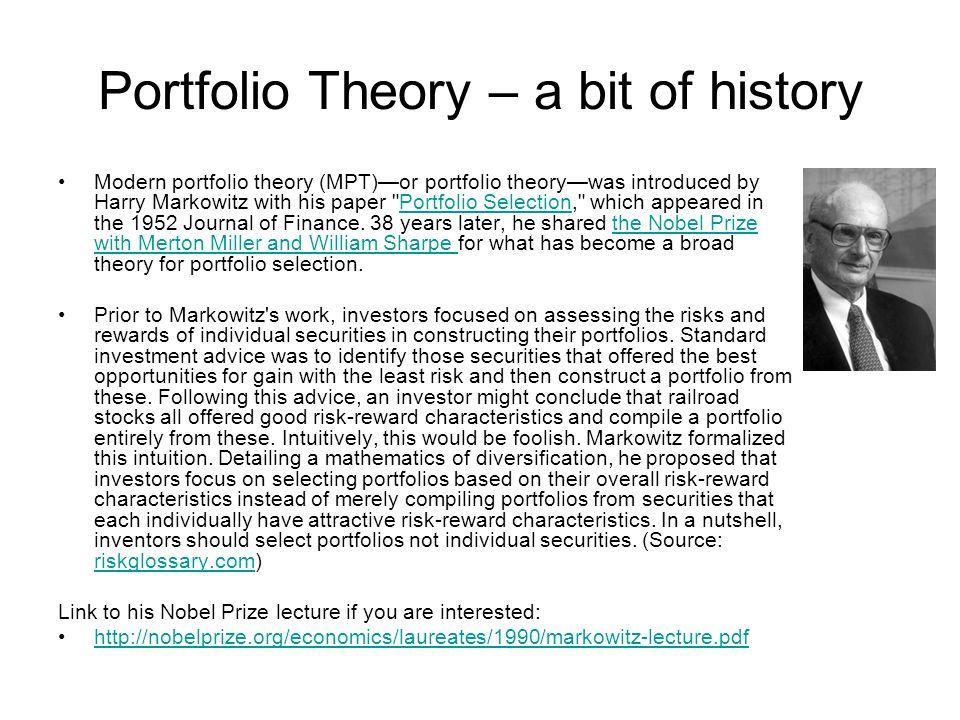
More than a half century ago, a paper appeared in The Journal of Finance written by a 24-year-old doctoral candidate in economics at the University of Chicago—Harry Markowitz. It was called “Portfolio Selection” and suggested that investors take into account risk in pursuit of the highest return—a concept that we take for granted today [Modern Portfolio Theory].

Markowitz drew a trade-off curve between risk and reward and called it the “efficient frontier.” A rational physician executive or other investor who knew his or her risk tolerance could choose an appropriate portfolio from a point on this curve. Markowitz led investors to diversified portfolios of uncorrelated investments.

Dissertation Follow-up

Markowitz followed up his dissertation in 1959 with a book entitled Portfolio Selection [Efficient Diversification of Investment]. His many contributions to finance earned him the Nobel Prize in Economic Science in 1990 along with William Sharpe and Merton Miller. He reasoned that diversification is about avoiding the covariance.

If risks are uncorrelated, you can reduce the risk of a portfolio to practically zero by sufficient diversification. This doesn’t work if risks are correlated. If one invests in a very large number of securities that are correlated, risk does not approach zero but rather the average covariance, which is a very substantial amount of risk.

Where It All Started

It was at the RAND Corporation that Markowitz met William [Bill] Sharpe who was working on his PhD at UCLA. Markowitz takes issue with Sharpe’s Capital Asset Pricing Model (CAPM), which claims that the expected return of a security depends only on its beta—ignoring fundamental analysis.

CAPM also implies that the market portfolio is efficient, even though investors in the market may not act rationally. It says that the market portfolio is a mean-variance efficient portfolio. Markowitz disputes this conclusion. He points to Fama and French and others who have found that expected returns are more closely related to book-to-price or size—not to beta.

hm

Assessment

The still living Markowitz fends off criticism of mean-variance analysis only being valid when probability distributions are normal by stating that he realizes that probability distributions are not normal in the real world.

But, if they are similar to a normal distribution, mean variance does a good job at approximating expected utility. He admits that when they are too dispersed, mean variance doesn’t work well.

Note: Travels along the Efficient Frontier,” an interview with Harry Markowitz by Jonathan Burton, Dow Jones Asset Management, May/June 1997, pp. 21–28, Dow Jones Financial Publishing Corp.

Conclusion

And so, your thoughts and comments on this ME-P are appreciated. Do you use MPT when investing, or CAP-M? Feel free to review our top-left column, and top-right sidebar materials, links, URLs and related websites, too. Then, subscribe to the ME-P. It is fast, free and secure.

OUR OTHER PRINT BOOKS AND RELATED INFORMATION SOURCES:

Product DetailsProduct DetailsProduct Details

Product Details  Product Details

Comprehensive Financial Planning Strategies for Doctors and Advisors: Best Practices from Leading Consultants and Certified Medical Planners™

***