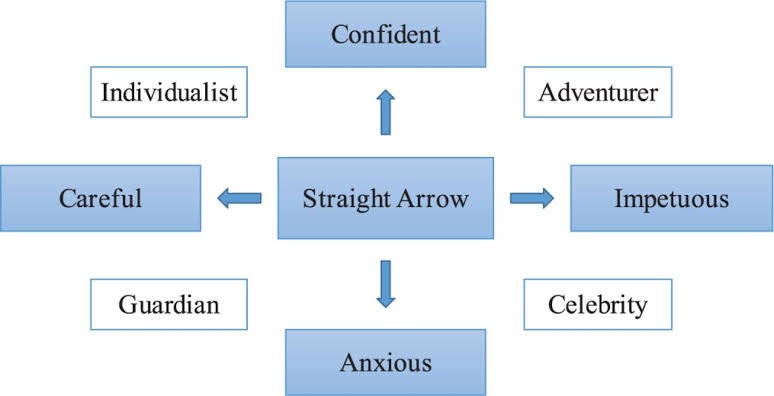
Bielard, Biehl and Kaiser: Five-Way Investor Personality Model

BEHAVIORAL PSYCHOLOGY AND PROFESSIONAL FINANCIAL ADVICE

By Staff Reporters

SPONSOR: http://www.MarcinkoAssociates.com

***

***

Fund managers Tom Bailard, Larry Biehl and Ron Kaiser identified five types of investors, each type characterized by their investment preferences and actions. These 5 types are: Individualists, Adventurers, Celebrities, Guardians and Straight Arrows. Key to the different categories is their different attitude to seeking professional financial advice. Defined below:

Individualists have faith in their own investment abilities so do not approach a financial adviser. But they are also cautious.

Adventurers are what may be called high rollers, in that they like big bets, tend not to diversify and are happy to put all their eggs in one basket. They, too, are unlikely to seek financial advice.

Celebrities tend to follow the crowd in investment terms but are aware of their lack of expertise so frequently consult advisers.

Guardians are fearful of losing money, thus prefer rock-solid investments such as government bonds. They, too, are likely to seek professional investment advice.

Straight Arrows exhibit some of the characteristics of individualists and some of adventurers.

COMMENTS APPRECIATED

Refer and Subscribe

***

***

NINE: Psychological Reasons We Do Dumb Things with Money [$$$$]

Yep – Even the Smart Folks!

By Lon Jefferies MBA CMP® CFP®

Dr. David Edward Marcinko MBA MEd CMP®

Lon Jeffries

In the Business Insider, Mandi Woodruff describes nine mental blocks that cause smart people to do dumb things. Review the list and itemize the factors that have negatively impacted your finances.

The Factors

  • Anchoring happens when we place too much emphasis on the first piece of information we receive regarding a given subject. For instance, when shopping for a wedding ring a salesman might tell us to spend three months’ salary. After hearing this, we may feel like we are doing something wrong if we stray from this advice, even though the guideline provided may cause us to spend more than we can afford.
  • Myopia (or nearsightedness) makes it hard for us to imagine what our lives might be like in the future. For example, because we are young, healthy, and in our prime earning years now, it may be hard for us to picture what life will be like when our health depletes and we know longer have the earnings necessary to support our standard of living. This short-sightedness makes it hard to save adequately when we are young, when saving does the most good.
  • Gambler’s fallacy occurs when we subconsciously believe we can use past events to predict the future. It is common for the hottest sector during one calendar year to attract the most investors the following year. Of course, just because an investment did well last year doesn’t mean it will continue to do well this year. In fact, it is more likely to lag the market.
  • Avoidance is simply procrastination. Even though you may only have the opportunity to adjust your health care plan through your employer once per year, researching alternative health plans is too much work and too boring for us to get around to it. Consequently, we stick with a plan that may not be best for us.
  • Confirmation bias causes us to place more emphasis on information that supports the opinion we already have. Consequently, we tend to ignore or downplay opinions that don’t mirror our own, leading us to make uninformed decisions.

NOTE: An interesting example of the confirmation bias is the case of David Rosenberg, who is one of the most well-known perpetual bears on Wall Street. In October, Mr. Rosenberg’s analysis forced him to warm to the current investment environment. His fans and followers, rather than appreciating his research and ability to adjust to new information, criticized him for changing his opinion.

As it turned out Mr. Rosenberg had fans not because of his expert analysis, but because he added intellectual heft to his followers pessimism and quasi-political desire for the system to collapse. Their view was that things were in permanent decline and his analysis, charts, and voice added respectability to their pre-existing bias. Mr. Rosenberg has now lost his fan base not because he was wrong for the last four years, but because he changed his mind.

head

  • Loss aversion affected many investors during the crash of 2008. During the crash, many people decided they couldn’t afford to lose more and sold their investments. Of course, this caused the investors to sell at market troughs and miss the quick, dramatic recovery.
  • Overconfident investing happens when we believe we can out-smart other investors via market timing or through quick, frequent trading. Data convincingly shows that people who trade most often underperform the market by a significant margin over time.
  • Mental accounting takes place when we assign different values to money depending on where we get it from. For instance, even though we may have an aggressive saving goal for the year, it is likely easier for us to save money that we worked for than money that was given to us as a gift.
  • Herd mentality makes it very hard for humans to not take action when everyone around us does. For example, we may hear stories of people making significant profits buying, fixing up, and flipping homes and have the desire to get in on the action, even though we have no experience in real estate.

Assessment

The good news is that being aware of these tendencies can help us avoid mistakes. We’ll never be perfect, but avoiding detrimental decisions based on mental prejudices can give us an advantage in our financial and retirement planning efforts.

Conclusion

Your thoughts and comments on this ME-P are appreciated. Feel free to review our top-left column, and top-right sidebar materials, links, URLs and related websites, too. Then, subscribe to the ME-P. It is fast, free and secure.

Speaker: If you need a moderator or speaker for an upcoming event, Dr. David E. Marcinko; MBA – Publisher-in-Chief of the Medical Executive-Post – is available for seminar or speaking engagements. Contact: MarcinkoAdvisors@msn.com

OUR OTHER PRINT BOOKS AND RELATED INFORMATION SOURCES:

ADVISORS: www.CertifiedMedicalPlanner.org
BLOG: www.MedicalExecutivePost.com

Risk Management, Liability Insurance, and Asset Protection Strategies for Doctors and Advisors: Best Practices from Leading Consultants and Certified Medical Planners™8Comprehensive Financial Planning Strategies for Doctors and Advisors: Best Practices from Leading Consultants and Certified Medical Planners™

Invite Dr. Marcinko

***

Retail Spending Therapy – Even for Doctors!

Join Our Mailing List 

More Than Just Shopping?

[By Rick Kahler CFP® http://www.KahlerFinancial.com]

Rick Kahler CFP“It’s not just shopping, it’s retail therapy.”

As a bumper sticker or a joke between friends, this may be amusing. For those who shop to relieve stress, it’s not nearly so funny.

Medicating or soothing painful feelings with money is no healthier a behavior than medicating with alcohol or food. When stressed or in difficult circumstances, some people drink, some people eat, and some people shop.

My Experience

I have worked with several people with extreme forms of this behavior, who described their spending clearly as an addiction. It gave them a physical “high” similar to that experienced by an alcoholic or drug addict. Like other addictions, it had destructive consequences, such as creating overwhelming debt, draining life savings, destroying relationships, and even stealing from family members or employers.

Using spending as a medicator does not always show up in such dramatic ways, however. Even people who seem to live moderately and manage money responsibly can be “therapy shoppers” who spend in order to make themselves feel better.

Case Example:

When I first met Dr. Alexandra, for example, she was single, in her 40s, with a well-paying job as a local hospitalist and substantial net worth. She was investing part of her income, was current on all her financial obligations, and had only a modest amount of debt. She was certainly not spending beyond her means or jeopardizing her future security. She didn’t appear to be in any financial difficulty.

When we looked at her budget, however, the doctor was clearly uncomfortable with some of her spending habits. Instead of simply reassuring her that she was managing her money well and not overspending, I explored this issue with her. Eventually I brought up the possibility that she might be medicating her difficult job emotions with spending. It was an “aha” moment for her. She told me, “I’ve been doing that for years.”

Alexandra’s problem wasn’t the amount she spent. It was the reasons behind her spending. If she had a stressful day at work, she would go to the mall, in much the same way another person might stop at a bar for a couple of drinks on the way home. Shopping, finding bargains, and buying herself gifts were unthinking actions she used to soothe herself when she was upset.

***

Frenzy

***

She never stopped to ask herself whether she needed, had a use for, or even wanted the things she bought. She didn’t spend more than she could afford, but she was spending time as well as money unproductively. She was also cluttering her house and her life with clothes she didn’t wear, knickknacks she didn’t care about, and gadgets she didn’t use.

Once she realized the emotional reason for her shopping, Alexandra was able to find more constructive ways to deal with stress. She learned that a conversation with a friend, writing in her journal, meditating, or taking a walk could serve the same purpose as a trip to the mall and were healthier responses to difficult days.

Modifying Behavior

For Alexandra, recognizing that she was using shopping to soothe her emotions was enough to help her change. Others, whose behavior is more deeply ingrained, might find change more difficult. In some cases, they might benefit greatly from working with a psychologist, financial therapist or other counselor with the expertise to help them look at the emotions underlying their spending patterns.

Assessment

If you think you may be using spending to deal with stress, it’s important to look beyond the numbers. The main issue isn’t whether your “retail therapy” is affordable or whether it is causing serious financial difficulties. If a pattern of spending is creating discomfort for you, it may be a good idea to explore what’s behind that spending. 

Conclusion

Your thoughts and comments on this ME-P are appreciated. Feel free to review our top-left column, and top-right sidebar materials, links, URLs and related websites, too. Then, subscribe to the ME-P. It is fast, free and secure.

Speaker: If you need a moderator or speaker for an upcoming event, Dr. David E. Marcinko; MBA – Publisher-in-Chief of the Medical Executive-Post – is available for seminar or speaking engagements. Contact: MarcinkoAdvisors@msn.com

OUR OTHER PRINT BOOKS AND RELATED INFORMATION SOURCES:

Product DetailsProduct DetailsProduct Details

Product Details  Product Details

Product Details

On Financial Therapy Rising

Join Our Mailing List

Uniting Financial Planning and Behavioral Psychology

By Rick Kahler MS CFP® ChFC CCIM www.KahlerFinancial.com

The driver of the van that was to take me from the University of Missouri to the St. Louis airport asked where I was from. When I said, “Rapid City” and we struck up a conversation about his childhood trip to the Sturgis Rally. At one point he asked me, “What were you doing visiting MU?”

A Topic at the Financial Therapy Association (FTA) Conference

There I explained I had attended the third annual Financial Therapy Association (FTA) Conference. There was a silence. Then he continued talking about his memories of visiting the Black Hills.

Bringing up the topic of financial therapy tends to leave people speechless. It isn’t a common term. Plus, it combines two topics that most people want to avoid: therapy and finances. Put them together, and you have a real conversation killer.

Fortunately, there was plenty of conversation for the 85 professionals and students at the three-day FTA conference. For those attending for the first time, it was a “coming home” experience.

Mental Health Needs

Financial therapy addresses a need that until recent years most financial and mental health professionals didn’t talk about or didn’t even know existed. It’s the unconscious and unspoken thoughts, beliefs, and feelings around all things financial. Certified Financial Planners® aren’t required to have training in even basic communication skills, much less the more complex fundamentals of psychology or neuroscience.

Likewise, therapists and psychologists aren’t taught to deal with money, either in working with clients or in managing their own businesses.

As a result, neither profession provides the tools to address clients’ problematic and often self-destructive beliefs and behaviors around money. Destructive behaviors around money usually aren’t about the money.

For this reason, giving people more information about how money, investing, or financial planning works isn’t enough.

Financial Psychology

The exploration of financial psychology or emotion and money isn’t new. Dr. Jacob Needleman and Olivia Mellan were among the mental health pioneers who began raising questions around the psychological side of money in the 1990’s. About the same time, two financial planners, George Kinder and Dick Wagner, co-founded a leaderless group of financial planners, coaches, and therapists called the Nazrudin project to explore the emotional side of money. The Nazrudin project, which still meets annually, spawned scores of books, courses, and organizations raising the awareness and skill level of financial professionals and therapists.

The Nazrudin project was the primary influence that gave me, along with others, the idea of uniting financial planning with experiential therapy. I began referring to it as financial therapy after hearing the term from therapist Bari Tessler.

Financial Therapy

Typically, financial therapy involves a client-centered financial planner (typically only compensated by fee for service), and a therapist or psychologist, that conjointly work with clients. In my experience, this process helps clients who are in some way financially stuck make significant progress.

Academia Required

Link: www.CertifiedMedicalPlanner.org

The one thing missing in the evolution of financial therapy until recently was the involvement of academia. For the first time, the FTA unites academics, therapists, and financial planners in a common pursuit of defining and developing the concept of financial therapy. This is essential if financial therapy is to become a profession.

It may be some time before we see practitioners with advanced degrees in financial therapy. Before that time comes, the FTA has a lot of work to do, including coming up with a scholarly definition of financial therapy.

Assessment

In the meantime, Jeff Zaslow, who reported on our first financial therapy workshop in 2003 for The Wall Street Journal, wrote that it “combines experiential therapy with nuts-and-bolts financial planning.” As we work to foster the emerging profession of financial therapy, that’s still an accurate and effective way to describe it.

Conclusion

Your thoughts and comments on this ME-P are appreciated. Feel free to review our top-left column, and top-right sidebar materials, links, URLs and related websites, too. Then, subscribe to the ME-P. It is fast, free and secure.

Link: http://feeds.feedburner.com/HealthcareFinancialsthePostForcxos

Speaker: If you need a moderator or speaker for an upcoming event, Dr. David E. Marcinko; MBA – Publisher-in-Chief of the Medical Executive-Post – is available for seminar or speaking engagements. Contact: MarcinkoAdvisors@msn.com

Our Other Print Books and Related Information Sources:

Health Dictionary Series: http://www.springerpub.com/Search/marcinko

Practice Management: http://www.springerpub.com/product/9780826105752

Physician Financial Planning: http://www.jbpub.com/catalog/0763745790

Medical Risk Management: http://www.jbpub.com/catalog/9780763733421

Hospitals: http://www.crcpress.com/product/isbn/9781439879900

Physician Advisors: www.CertifiedMedicalPlanner.org

Product DetailsProduct DetailsProduct Details

Product Details  Product Details