DONOR ADVISED FUND: Defined

WHAT IS A DONOR ADVISED FUND?

Sponsor: http://www.CertifiedMedicalPlanner.org

***

***

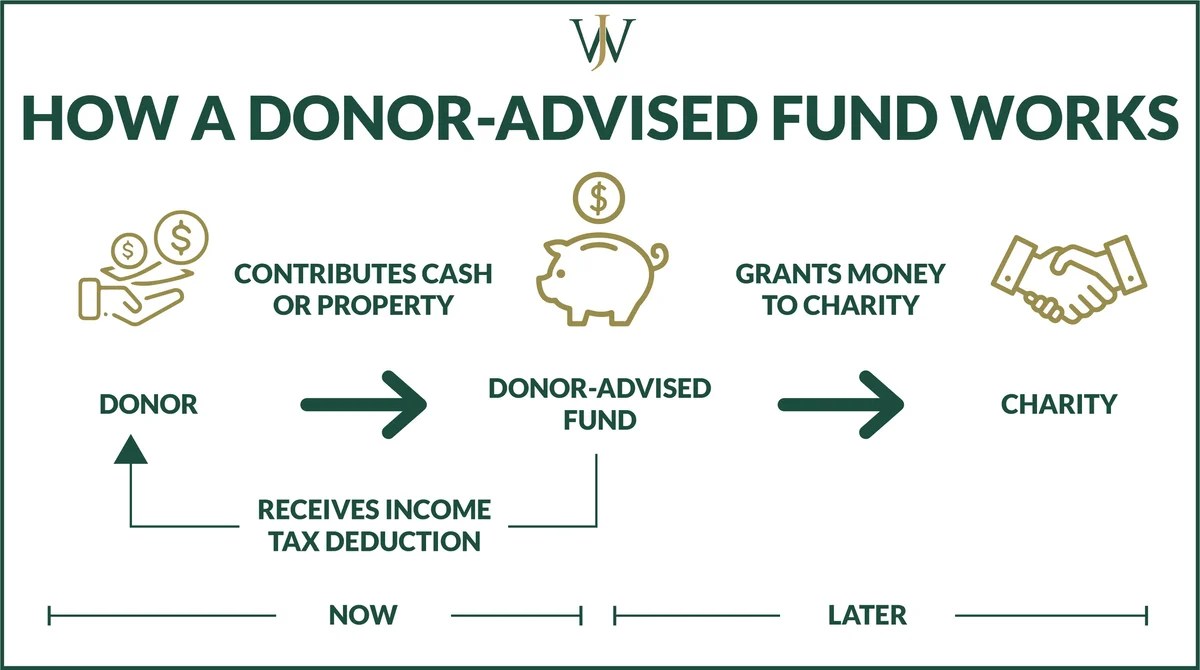
A donor-advised fund is a private account created to manage and distribute charitable donations on behalf of an organization, family, or individual. Donor-advised funds can democratize philanthropy by aggregating the contributions of multiple donors, thus multiplying their impact on worthy causes. Donor-advised funds also have abundant tax advantages.

DONOR DEPENDENCY: https://medicalexecutivepost.com/2025/01/02/culture-donation-dependency/

Donor-advised funds have become increasingly popular, as they offer the donor greater ease of administration while still allowing them to maintain significant control over the placement and distribution of charitable gifts. But, unlike private foundations, donor-advised fund holders enjoy a federal income tax deduction of up to 60% of adjusted gross income (AGI) for cash contributions and up to 30% of AGI for the appreciated securities they donate. Donors to these funds can contribute cash, stock shares, and other assets. When they transfer assets such as limited-partnership interests, they can avoid capital gains taxes and receive immediate fair market value tax deductions.

MEDICAL ETHICS: https://medicalexecutivepost.com/2024/06/20/medical-ethics-physician-and-financial-organizations/

According to the National Philanthropic Trust’s 2023 Donor-Advised Fund Report, these funds have continued to grow in recent years, despite some headwinds including the Covid-19 pandemic and occasional stock market setbacks. Total grants awarded by donor-advised funds in 2022 increased by 9% to $52.16 billion, while total contributions rose by 9% to $85.5 billion.

Many donor-advised funds accept non-cash assets—such as checks, wire transfers, and cash positions from a brokerage account—in addition to cash and cash equivalents.

Donating non-cash assets may be more beneficial for individuals and businesses, leading to bigger tax bigger write-offs.

PHILANTHROPY: https://medicalexecutivepost.com/2021/11/15/national-philanthropy-day-2021/

COMMENTS APPRECIATED

Like and Refer

***

***

AGI: What it is – How it Works?

ADJUSTED GROSS INCOME

https://medicalexecutivepost.com/wp-content/uploads/2018/06/david-edward-marcinko.png

BY Dr. DAVID EDWARD MARCINKO MBA CMP®

CMP logo

SPONSOR: http://www.CertifiedMedicalPlanner.org

The U.S. individual tax return is based around the concepts of Adjusted Gross Income (AGI) and Taxable Income (TI).  AGI is the amount that shows up at the bottom of page one of Form 1040, individual income tax return.  It is the sum of all of the taxpayer’s income less certain allowed adjustments (like alimony, one-half of self-employment taxes, a percentage of self-employed health insurance, retirement plan contributions and IRAs, moving expenses, early withdrawal penalties and interest on student loans).  This amount is important because it is used to calculate various limitations within the area of itemized deductions (e.g., medical deductions: 10 percent of AGI; miscellaneous itemized deductions: 2 percent of AGI). 

When a healthcare professional taxpayer hears the phrase “an above the line deduction”, the line being referenced is the AGI line on the tax return.  Generally, it is better for a deduction to be an above the line deduction, because that number helps a taxpayer in two ways.  First, it reduces AGI, and second, since it reduces AGI, it is also reducing the amounts of limitations placed on other deductions as noted above.

Obviously, if there is an above the line there is also a “below the line” deduction.  These below the line deductions are itemized deductions (or the standard deduction if itemizing is not used) plus any personal exemptions allowed. AGI less these deductions provides the taxable income on which income tax is actually calculated. All of that being said, it is better for a deduction to be an above the line deduction. Although this is a bit dry, it helps to understand the concepts in order to know where items provide the most benefit to the medical professional taxpayer.

                            PERSONAL TAXATION CALCULATIONS

Gross Income (all income, from whatever source derived, including illegal activities, cash, indirect for the benefit of, debt forgiveness, barter, dividends, interest, rents, royalties, annuities, trusts, and alimony payments-no more)

    Less non-taxable exclusions (municipal bonds, scholarships, inheritance, insurance

                                            proceeds, social security and unemployment income [full or

                                            partial exclusion], etc.).

Total Income

    Less Deductions for AGI (alimony, IRA contributions, capital gains, 1/2 SE tax,

                                               moving, personal, business and investment expenses, and

                                               penalties, etc.). 

Adjusted Gross Income (bottom Form 1040)

    Less Itemized Deductions from AGI, (medical, charitable giving, casualty,

involuntary conversions, theft, job and miscellaneous expenses, etc.), or

    Less Standard Deduction (based on filing status)

    Less Personal Exemptions (per dependents, subject to phase outs)

Taxable Income

   Calculate Regular Tax

      Plus Additional Taxes (AMT, etc.)

      Minus Credits (child care, foreign tax credit, earned income housing, etc.)

      Plus Other Taxes

Total Tax Due

YOUR THOUGHTS ARE APPRECIATED.

CITE: https://www.r2library.com/Resource/Title/0826102549

Thank You

***

***

How Much Money Do You Make – Doctor?

Join Our Mailing List

Ruminations on the Last Taboo!

By Rick Kahler MS CFP® http://www.KahlerFinancial.com

Rick Kahler CFP“How much money do you make?”

We don’t ask people, let alone doctors and medical professionals, that question; but we’d love to know the answer.

In this country, we’re fixated on a person’s annual income. That’s the primary measure we use to determine social status and define success.

Income Qualifier?

Income also is the qualifier for government welfare programs. It defines people as poor, middle class, or rich. And, of course, it determines how much of your income the government will take. The more you bring in, the higher the percentage of your earnings you will pay in federal, state, and local taxes.

Income as a Poor Indicator of Net Worth

While we project a lot of things onto someone’s income, most of what we project is untrue. Income is not the best indicator of a person’s wealth or net worth.

Examples:

Last year Dr. Brent’s tax return showed an adjusted gross income of $20,000. Dr. Bill’s was $2 million. Who is richer? Most people would say Bill. The US and state governments also would say Bill. Actually, Brent is far and away the wealthier of the two.

Why and How?

Consider these two real-life examples:

  • Dr. Bill lives in New York, New York, which has both high property taxes and a city income tax. Paying city, state, and federal income taxes, plus property taxes on his luxurious home, takes around half of his salary. With take-home pay of about $1 million, Bill spends $1.2 million a year on his mortgage payments, college and private school tuition, and his lifestyle. He overspends his net income by $200,000 a year. He owes more on his condo than it’s worth, and he has significant credit card debt. When you total his assets and liabilities, he has a negative net worth of $1 million. He has managed to hold everything together so far, but technically, Bill is bankrupt.

Jaguar XJ

  • Dr. Brent lives in Rapid City, South Dakota. He is retired, owns a modest home which is paid for, and lives on about $40,000 a year. He didn’t pay any income taxes last year, partly because some of his income is from tax-free municipal bonds and mostly because he wrote off a large investment loss which left him with $20,000 of adjusted gross income. Brent has no debt. His net worth is $5,000,000.

Steering Jaguar

The truth is that what people make tells us very little about whether they are rich or not. In these examples, judging from income alone, it would be easy to reach the inaccurate conclusion that Bill must be far wealthier than Brent. His lifestyle is certainly more lavish—which of course is part of the reason he isn’t wealthy.

Many people who have high incomes but are heavily in debt might have lifestyles lower than others who make significantly less but have no debt. It’s not uncommon that people with high incomes choose to live a lifestyle that is far below what they could afford. In fact, this is one of the best ways to build real wealth.

The Income Non-Indicator

Income is a poor indicator of whether someone is rich. Even more important, it’s a poor indicator of how they handle money. I once worked with a family with an annual income of around $5 million who had a net worth of minus $3.5 million. They may have looked like “millionaires,” but they were not.

On the other hand, I work with many clients who have annual incomes around $100,000 a year, spend $60,000 a year, and are worth $2 to $5 million.

Assessment

The bottom line is that wealth is defined by net worth, not income. A high income doesn’t equal wealth; it equals a better opportunity to build wealth. Not everyone is wise enough to take advantage of that opportunity.

More:

Conclusion

Your thoughts and comments on this ME-P are appreciated. Feel free to review our top-left column, and top-right sidebar materials, links, URLs and related websites, too. Then, subscribe to the ME-P. It is fast, free and secure.

Speaker: If you need a moderator or speaker for an upcoming event, Dr. David E. Marcinko; MBA – Publisher-in-Chief of the Medical Executive-Post – is available for seminar or speaking engagements. Contact: MarcinkoAdvisors@msn.com

OUR OTHER PRINT BOOKS AND RELATED INFORMATION SOURCES:

Product Details  Product Details

Product Details

Explaining the New Taxpayer Relief Act

Join Our Mailing List

aka … The Fiscal Cliff Deal Wake-Up Call

By Lon Jefferies MBA CFP®

www.NetWorthAdvice.com

Lon JeffriesBelow is a brief summary of the major implications of the Taxpayer Relief Act that was passed by congress. The changes under the act are permanent and do not expire like the previous round of Bush tax cuts. Note, however, that laws can always be changed.

The Tax Increase That Will Impact Us All

As of December 31, 2012, the Payroll Tax Cut expired. The cut reduced the FICA tax rate by 2% in 2011 and 2012. Consequently, this Social Security tax rate will return to 6.2% for employees (as opposed to the 4.2% rate during the last two years). This tax will apply to any income below the Social Security Wage Base of $113,700.

Essentially, this change will cause an average taxpayer earning $50k per year to pay $1,000 more in federal taxes.

Income Tax Brackets

The top tax bracket will increase from 35% to 39.6% and will apply to individuals with taxable income in excess of $400k and married couples with incomes over $450k. No other changes were made to the federal income tax.

Income Tax Brackets

Taxpayers in the 10% or 15% or income tax bracket will continue paying 0% tax on long-term capital gains and dividends. A 15% capital gains and dividend tax will continue to apply to all other taxpayers not in the highest tax bracket (again, individuals with incomes above $400k and married couples with incomes above $450k). For taxpayers in the top tax bracket, the capital gains and dividend tax effectually rises to 23.8% – consisting of 20% for capital gains or dividends plus an additional 3.8% Medicare tax to boot.

Phaseout of Deductions and Exemptions

Total itemized deductions are reduced by 3% of any excess income over an established limit. That limit is adjusted gross income (AGI) of $250k for individuals and $300k for married couples. Personal exemptions are also phased out once AGI is above the same limits. The exemptions are reduced by 2% for each $2,500 of excess income over these limits.

Professional Wake Up Call

Estate Taxes

While the top estate tax rate has been increased from 35% to 40%, individuals will continue to pay no taxes on estates less than $5,120,000. This figure will continue to rise with inflation. Note: couples essentially get two of these exemptions, allowing them to pass $10,240,000 to heirs without paying estate taxes.

Alternative Minimum Tax

The new AMT exemption amount will be $50,600 for individuals and $78,750 for married couples. These figures will be adjusted annually for inflation. Speak to an account to determine how this impacts your tax return.

Bonus – Potential 401k to Roth 401k Conversions

If your employer offers Roth 401k accounts, you can now convert your traditional 401k investments to the Roth plan while still employed. This process will be similar to converting a traditional IRA to a Roth IRA and taxes will be due upon conversion. However, your employer isn’t required to offer a Roth 401k, so speak to your employer’s HR department to determine if this is an option. Further, speak with your financial planner for information on whether this is a strategy you should explore.

Conclusion

Your thoughts and comments on this ME-P are appreciated. Feel free to review our top-left column, and top-right sidebar materials, links, URLs and related websites, too. Then, subscribe to the ME-P. It is fast, free and secure.

Link: http://feeds.feedburner.com/HealthcareFinancialsthePostForcxos

Speaker: If you need a moderator or speaker for an upcoming event, Dr. David E. Marcinko; MBA – Publisher-in-Chief of the Medical Executive-Post – is available for seminar or speaking engagements. Contact: MarcinkoAdvisors@msn.com

Our Other Print Books and Related Information Sources:

Health Dictionary Series: http://www.springerpub.com/Search/marcinko

Practice Management: http://www.springerpub.com/product/9780826105752

Physician Financial Planning: http://www.jbpub.com/catalog/0763745790

Medical Risk Management: http://www.jbpub.com/catalog/9780763733421

Hospitals: http://www.crcpress.com/product/isbn/9781439879900

Physician Advisors: www.CertifiedMedicalPlanner.org

Product Details  Product Details

Product Details

2012 Year End Tax Planning for Medical Professionals

Join Our Mailing List

How to Reduce Exposure to Higher post-2012 Taxes on Investment Income and Gains

By Perry Dalesandro CPA perry@dalecpa.com

Doctors and most all individuals face the prospect of a darker tax climate in 2013 for investment income and gains. Under current law, higher-income taxpayers will face a 3.8% surtax on their investment income and gains under changes made by the Affordable Care Act. Additionally, if current tax-reduction provisions sunset, all taxpayers will face higher taxes on investment income and gains, and the vast majority of taxpayers also will face higher rates on their ordinary income. This Alert explores year-end planning moves that can help reduce exposure to higher post-2012 taxes on investment income and   gains. This first part explains who has to worry about the 3.8% surtax and what it covers. It also briefly discusses key sunset rules, and begins examining some essential year-end moves.

Future parts will describe other planning moves in detail.

Who has to worry about the 3.8% Surtax and what it covers

For tax years beginning after Dec. 31, 2012, a 3.8% surtax applies to the lesser of (1) net investment income or (2) the excess of modified adjusted gross income (MAGI) over the threshold amount ($250,000 for joint filers or surviving spouses, $125,000 for a married individual filing a   separate return, and $200,000 in any other case). MAGI is adjusted gross income (AGI) increased by the amount excluded from income as foreign earned income (net of the deductions and exclusions disallowed with respect to the foreign earned income).

Illustration 1: For 2013, a single taxpayer has net investment income of $50,000 and MAGI of $180,000. He won’t be liable for the tax, because his MAGI ($180,000) doesn’t exceed his threshold amount ($200,000).

Illustration 2: For 2013, a single taxpayer has net investment income of $100,000 and MAGI of $220,000. He would pay the tax only on the $20,000 amount by which his MAGI exceeds his threshold amount of $200,000, because that is less than his net investment income of $100,000. Thus, the surtax would be $760 ($20,000 × 3.8%).

Observation: An individual will pay the 3.8% tax on the full amount of his net investment income only if his MAGI exceeds his threshold amount by at least the amount of the net investment income.

Ilustration 3: For 2013, a single taxpayer has net investment income of $100,000 and MAGI of $300,000. Because his MAGI exceeds his threshold amount by $100,000, he would pay the tax on his full $100,000 of net investment income. Thus, the tax would be $3,800 ($100,000 × .038).

The tax is taken into account in determining the amount of estimated tax that an individual must pay, and is not deductible in computing an individual’s income tax.

What is net investment income? For purposes of the Medicare contribution tax, “net investment income” means the excess, if any, of:

(1) the sum of:

… gross income from interest, dividends, annuities, royalties,   and rents, unless those items are derived in the ordinary course of a trade or business to which the Medicare contribution tax doesn’t apply (see below),

… other gross income derived from a trade or business to which the Medicare contribution tax does apply (below),

… net gain (to the extent taken into account in computing taxable income) attributable to the disposition of property other than property held in a trade or business to which the Medicare contribution tax doesn’t apply, over

(2) the allowable deductions that are properly allocable to that gross income or net gain.

Trades and businesses to which tax applies. The 3.8% surtax applies to a trade or business if it is a passive activity of the taxpayer, or a trade or business of trading in financial instruments or commodities.

Investment income won’t include amounts subject to self-employment tax. Specifically, net investment income won’t include any item taken into account in determining self-employment income and subject to the self-employment Medicare tax

Observation: Thus, the same item of income can’t be subject to both self-employment tax and the Medicare contribution tax. If self-employment tax applies, the Medicare contribution tax won’t apply.

The tax doesn’t apply to trades or businesses conducted by a sole proprietor, partnership, or S corporation. But income, gain, or loss on working capital isn’t treated as derived from a trade or business and thus is subject to the tax.

Exception for certain active interests in partnerships and S corporations. Gain or loss from a disposition of an interest in a partnership or S corporation is taken into account by the partner or shareholder as net investment income only to the extent of the net gain or loss that the transferor would take into account if the entity had sold all its property for fair market value immediately before the disposition.

Retirement plan distributions. Investment income doesn’t include distributions from tax-favored retirement plans, such as qualified employer plans and IRAs.

Looming Sunsets Would Affect Almost all Taxpayers

Unless Congress acts, the Bush-era tax breaks-those in the EGTRRA and JGTRRA legislation of 2001 and 2003-will come to an end (i.e., they will sunset) at the end of 2012. Depending on how the November elections play out, the sunsets may be: (1) abolished for everyone, (2) deferred for everyone (as they were in December of 2010, when they originally were to   sunset), or (3) deferred for all taxpayers other than those with higher incomes. Still a fourth, albeit unlikely, possibility is that the parties will not be able to agree on remedial legislation and the Bush-era tax breaks actually will sunset at the end of 2012 for everyone.

There are scores of income tax rules that would be altered if the Bush-era tax breaks sunset at the end of 2012, but arguably the most important ones are as follows:

Tax brackets. The 10% bracket will disappear (lowest bracket will be 15%); the 15% tax bracket for joint filers &  qualified surviving spouses will be 167% (rather than 200%) of the 15% tax bracket for individual filers; and the top four tax brackets will rise from 25%, 28%, 33% and 35% to 28%, 31%, 36% and 39.6%.

Taxation of capital gains and qualified dividends.  Currently, most long-term capital gains are taxed at a maximum rate of 15%, and qualified dividend income is taxed at the same rates that apply to   long-term capital gains. Under the sunset, most long-term capital gains will be taxed at a maximum rate of 20% (18% for certain assets held more than five years). And, dividends paid to individuals will be taxed at the same rates that apply to ordinary income.

If the EGTRRA/JGTRRA sunset rules go into effect at the end of 2012 and dividends and interest are taxed at ordinary income rates up to 39.6% in 2013, it seems highly unlikely that dividends and interest also would be subjected to a 3.8% surtax on net investment income (i.e., Congress would at least repeal the surtax).

Year-end Planning for Investments

Beginning below, and to be continued in future articles, are specific steps that taxpayers can take now in order to reduce or avoid exposure to the 3.8% surtax as well as possibly higher tax rates on capital gains and dividend income.

Accelerate Home Sales

The sale of a residence after 2012 can trigger the 3.8% surtax in one of two ways. It also can expose taxpayers to a higher capital gain tax rate if the sunset rules affect them next year.

  •  Under Code Sec. 121, when taxpayers sell their principal residences, they may exclude up to $250,000 in capital gain if single, and $500,000 in capital gain if married. Gain on a post-2012 sale in excess of   the excluded amount will increase net investment income for purposes of the 3.8% surtax and net capital gain under the general tax rules. And if  taxpayers sell a second home (vacation home, rental property, etc.) after 2012, they pay taxes on the entire capital gain and all of it will be subject to the 3.8% surtax.

Recommendation: A taxpayer expecting to realize a gain on a principal residence substantially in excess of the applicable $250,000/$500,000 limit who is planning to sell either this year  or the next should try to complete the sale before 2013. Doing so rather than selling after 2012 will remove the portion of the gain that doesn’t qualify for the Code Sec. 121 exclusion from the reach of the 3.8% tax. It also will reduce the taxpayer’s exposure to possibly higher rates of tax on capital gains under the sunset rules.

Illustration 4: A married couple  earn a combined salary of $260,000. They plan to sell their principal residence for $1.2 million, and should net a gain of about $700,000, of which $500,000 will be excluded under Code Sec. 121. If they sell this year they  will pay a tax of $30,000 (15%) on their $200,000 of taxable residence gain.  If they wait till next year to sell, their gain will be fully exposed to the  surtax, which in their case equals 3.8% multiplied by the lesser of: (1) $200,000 of net investment income; or (2) $210,000 ($460,000 of MAGI  [$260,000 salary + $200,000 of taxable home sale gain] − the $250,000  threshold). Thus, the tax on their gain will be at least $37,600 ([.15 +   .038] × $200,000). The tax could be even more if they are subject to a higher capital gains tax next year under the sunset rule (or a modified sunset rule).

Illustration 5: A single taxpayer earns a salary of $170,000 and also has $30,000 of investment income (interest and dividends). He plans to sell his vacation home for $500,000 and will net a gain of approximately $400,000. If he sells this year, he’ll pay a $60,000 tax on his gain (.15 × $400,000). If he waits till next year, his MAGI will swell to $600,000 ($170,000 salary + $30,000 investment income +  $400,000 gain). He will pay an additional $15,200 of tax on his vacation home  gain (3.8% of $400,000), on top of the regular capital gain tax.  Additionally, sale of the vacation home in 2013 will expose his $30,000 of  investment income to an additional $1,140 of tax (3.8% of $30,000).

Conclusion

Your thoughts and comments on this ME-P are appreciated. Feel free to review our top-left column, and top-right sidebar materials, links, URLs and related websites, too. Then, subscribe to the ME-P. It is fast, free and secure.

Link: http://feeds.feedburner.com/HealthcareFinancialsthePostForcxos

Product Details  Product Details

Our Other Print Books and Related Information Sources:

Health Dictionary Series: http://www.springerpub.com/Search/marcinko

Practice Management: http://www.springerpub.com/product/9780826105752

Physician Financial Planning: http://www.jbpub.com/catalog/0763745790

Medical Risk Management: http://www.jbpub.com/catalog/9780763733421

Hospitals: http://www.crcpress.com/product/isbn/9781439879900

Physician Advisors: www.CertifiedMedicalPlanner.org

Our Newest Textbook Release

Buy from Amazon

Learn How to Profit and Thrive in the PP-ACA Era

BOOK FOREWORD / TESTIMONIAL

On Employer Based Health Insurance Premium Costs

Join Our Mailing List

One Client’s Comparative Expense Analysis Experience

By Dr. David Edward Marcinko; MBA

[Publisher-in-Chief]

Hospital Costs

A colleague posted an interesting essay recently on his blog The Incidental Economist. Austin Frakt PhD is a health economist with an educational background in physics and engineering. After receiving a PhD in statistical and applied mathematics, he spent four years at a research and consulting firm conducting policy evaluations for various federal health agencies. Here is the post.

Link: http://theincidentaleconomist.com/index.php?s=Kaiser%2FHRET+

The Survey

In his essay, Austin reported these figures from a cited survey:

“The 2009 Kaiser/HRET employer health benefits survey found that employees pay 17% of the $4,824 annual premium for single coverage and 27% of the $13,375 annual premium for family coverage (all average figures)”.

Case Report Model

So, if the survey is correct, it got me thinking about how much a long-time client paid as a doctor-employer, when she last practiced in a certain medical group back in 2000. And, especially about how much she would be paying today if still in business with the same group. This brief case-report with comparative expense analysis [CEA} is the up-shot.

My Client’s Story

Her health insurance premium costs including doctor-partners, was about $13,500 annually, per employee. This was a sunk cost, but an above the AGI line deductible business expense to the practice and entirely employer paid as a fringe benefit [all valid corporate expenses are deductible as there is no AGI line on a business tax return]. She and her three partners were both very magnanimous to their employees, and naïve. They became virtually insolvent a few years later and were bought out by a larger medical group for a pittance. Today, they are grunt employee doctors in a 25 plus physician group practice.

My Numbers

Now, if I crunched the numbers correctly as an citizen economist, on my HP12-C calculator, using health insurance inflation rates of 3%, 5% and 7% respectively for a decade [low], she would be now be paying somewhere between $18,143 and $21,990 and $26,556 in 2010 [dangerously assuming linear economics]. Each of her 15-18 employees at the time was a female, head of household, with 1-4 dependents of their own; no singles. Her own family unit included a professional husband and young daughter in private elementary school. They were the most health conscious of the bunch.

Her Situation

So, she left the group in 2000, and we transitioned her to solo private practice with a HD-HCP indemnity-styled [better] plan that pays 100% after her $5,000, and later $10,000, deductible. She has 100% prescription drug coverage, no OB coverage and no networks, second opinions or pre-certification requirements. Today, she has more than $50-K in the savings portion [cash account earning 3.5%, tax deferred].

Her Reaction

As she just turned age 55, there as was significant jump in her family coverage premiums from about $1,350/quarter to $1,650/quarter! Of course, her carrier offered a ten percent discount to $1,485 quarter, when she pitched a fit, and completed a health and wellness survey which “they” verified.

My Intervention

So, I used my “insider” knowledge as a doctor, financial advisor and insurance agent and went back to the open market place for coverage. Her new direct halth insurance coverage [she used a non-fiduciary insurance agent intermediary previously] is better, and her premium is only $1,248/quarter or about $5,000 annually to age 58. Bye, bye insurance agent. Link:  www.CertifiedMedicalPlanner.com

Now, if we use the non-inflated [a conservative unlikely scenario] 27% employee premium contribution for the present value projections of $18,143 and $21,990 and $26,556 today – each employee would be responsible for about $4,898, $5,937 and $7,170 respectively [please again recall both our conservative nature and the repeat danger of linear economic assumptions].

Where Did the Money Go?

So, under the 3-5% health insurance inflation scenario, my client would have been contributing about $5,417 for her heath insurance. This is very close to what she is annually paying now! So, where did the much larger employer’s contribution portion of the money go? Probably to overhead costs, marketing, advertising, sales and commissions, HR, high-risk pool premiums, ie … down the drain?

What did my client do with the monetary difference? Well, she paid all family doctor and drug bills that were under the high-deductible threshold; some went to her annual family health club membership dues, covered extras and various “wants and nice-to-haves”, and the remainder of course, went into her savings account portion. In other words … not down the drain.

There is an additional $1.000 “catch up” savings provision for those over age 55. She paid it – to herself.

The Road Ahead – More Expensive

I informed my colleague-client that there likely will be another big premium jump when she turns 58, 60 and age 62 respectively. We will report back to ME-P readers on market competition and related health insurance pricing at that time, ceteris paribus.

Assessment

Does the competitive open marketplace find a way to reduce HI costs– sooner or later? High Deductible HealthCare Plans were launched as a temporary pilot project in 1997 and initially sold poorly. In the past few years however, there has been a boom in HD-HCPs and the pilot project was made permanent. What other HI innovations may be in the future?

Of course, President Obama was against them in his original healthcare reform plan. But, now in his weakened political position, they seem acceptable to him. So, go figure. Utility depends on political winds, not economic efficacy, I suppose. 

Conclusion

Your thoughts and comments on this ME-P are appreciated. Feel free to review our top-left column, and top-right sidebar materials, links, URLs and related websites, too. Then, subscribe to the ME-P. It is fast, free and secure.

Speaker: If you need a moderator or speaker for an upcoming event, Dr. David E. Marcinko; MBA – Publisher-in-Chief of the Medical Executive-Post – is available for seminar or speaking engagements. Contact: MarcinkoAdvisors@msn.com

OUR OTHER PRINT BOOKS AND RELATED INFORMATION SOURCES:

Product DetailsProduct Details