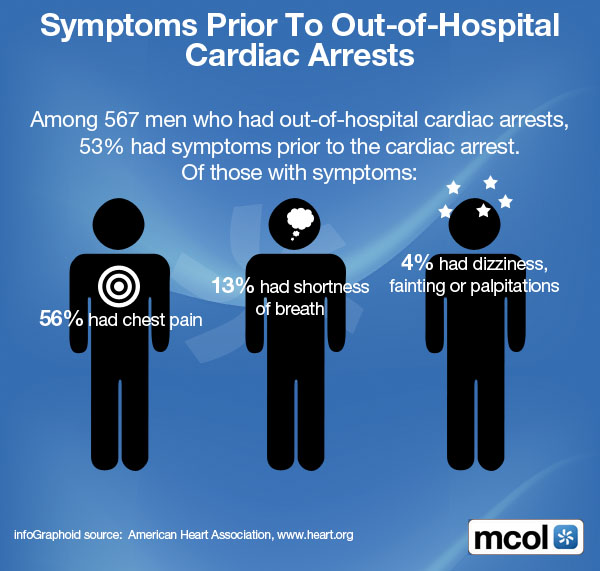
Symptoms prior to Out-of-Hospital cardiac arrests

Join Our Mailing List

Of those with symptoms

By www.MCOL.com

Cardiac arrests

Conclusion

Your thoughts and comments on this ME-P are appreciated. Feel free to review our top-left column, and top-right sidebar materials, links, URLs and related websites, too. Then, subscribe to the ME-P. It is fast, free and secure.

Link: http://feeds.feedburner.com/HealthcareFinancialsthePostForcxos

Speaker: If you need a moderator or speaker for an upcoming event, Dr. David E. Marcinko; MBA – Publisher-in-Chief of the Medical Executive-Post – is available for seminar or speaking engagements. Contact: MarcinkoAdvisors@msn.com

OUR OTHER PRINT BOOKS AND RELATED INFORMATION SOURCES:

DICTIONARIES: http://www.springerpub.com/Search/marcinko
PHYSICIANS: www.MedicalBusinessAdvisors.com
PRACTICES: www.BusinessofMedicalPractice.com
HOSPITALS: http://www.crcpress.com/product/isbn/9781466558731
CLINICS: http://www.crcpress.com/product/isbn/9781439879900
ADVISORS: www.CertifiedMedicalPlanner.org
PODIATRISTS: www.PodiatryPrep.com
BLOG: www.MedicalExecutivePost.com
FINANCE: Financial Planning for Physicians and Advisors
INSURANCE: Risk Management and Insurance Strategies for Physicians and Advisors

Product DetailsProduct Details

Product Details

Pennsylvania dental patients’ stolen social security numbers posted online

Join Our Mailing List 

EDR Data breach in Williamsport, Pennsylvania

By D. Kellus Pruitt DDS

1-darrellpruittOver the last 7 years, I have absorbed a surprising amount of criticism for warning my community that electronic dental records continue to grow both more expensive and more dangerous than paper dental records. That chunk of bad news which not one dental leader is ready to acknowledge is becoming increasingly difficult for even the most popular practice management consultants and other 3rd parties to hide. Unresponsiveness from those who profit from EDR sales is unethical and has already harmed dental patients.

Vulnerability Notes

In the Vulnerability Notes that have been issued by the US Department of Homeland Security to dental software giant Dentrix in the last year, security expert Justin Shafer was thanked in both for alerting authorities to Dentrix’s weaknesses.

Though evasive EDR stakeholders were able to fend off transparency far too long, it is fast becoming obvious to the world that their free ride with no accountability has always been destined to end ugly, and greed is to blame. Unforgiving media coverage of the nation’s loss of confidence in EDRs just might start in day or so in the parking lot of dentist’s office near Williamsport, Pennsylvania. Take cover, Dentrix

Eyeing Dentrix 

In the last two years, Justin Shafer’s uninvited watchful eye over Dentrix’s vulnerabilities may have already helped protect millions of dental patients from identity theft. Nevertheless, Dentrix’s security problems which company officials apparently hide, continue to endanger the welfare of uninformed Americans. I have learned that Shafer doesn’t give up easily. He’s in HIT for the long haul.

Yesterday morning, he posted a heads-up on the City of Williamsport’s Facebook, as well four other local Facebooks, warning of the results of a dental office data breach of Dentrix software: Dental patients’ social security numbers have become available on a zip file from Piratebay.

Shafer: “I am willing to bet there are a lot of your citizens SSN’s in this database. Look at rsc_dat.dat and patient.dat… Seems a dental database ended up on piratebay. You may already know.. you may not.”

He explained it to me this way: “the practice info is in rsc_dat.dat, patient info is in pat_dat.dat. It’s a nightmare, and I told dentrix and the doctor a full year ago.”

Insightful or clueless dentist?

Assessment 

Did your opinion of censorship in dental care recently undergo change?

Conclusion

Your thoughts and comments on this ME-P are appreciated. Feel free to review our top-left column, and top-right sidebar materials, links, URLs and related websites, too. Then, subscribe to the ME-P. It is fast, free and secure.

Link: http://feeds.feedburner.com/HealthcareFinancialsthePostForcxos

Speaker: If you need a moderator or speaker for an upcoming event, Dr. David E. Marcinko; MBA – Publisher-in-Chief of the Medical Executive-Post – is available for seminar or speaking engagements. Contact: MarcinkoAdvisors@msn.com

OUR OTHER PRINT BOOKS AND RELATED INFORMATION SOURCES:

DICTIONARIES: http://www.springerpub.com/Search/marcinko
PHYSICIANS: www.MedicalBusinessAdvisors.com
PRACTICES: www.BusinessofMedicalPractice.com
HOSPITALS: http://www.crcpress.com/product/isbn/9781466558731
CLINICS: http://www.crcpress.com/product/isbn/9781439879900
BLOG: www.MedicalExecutivePost.com
FINANCE: Financial Planning for Physicians and Advisors
INSURANCE: Risk Management and Insurance Strategies for Physicians and Advisors

Product DetailsProduct Details

Product Details

An ME-P Thanksgiving Day 2013 Tribute

Join Our Mailing List

A Letter from the Publisher-in-Chief

By Dr. David E. Marcinko; MBA, CMP™

Washington, DC: “I do therefore invite my fellow citizens … to set apart … a day of thanksgiving and praise to our beneficent father who dwelleth in the heavens.”

— Abraham Lincoln

Dear ME-P Readers & Subscribers

These words were spoken in the middle of Lincoln’s Thanksgiving Proclamation on Oct. 3, 1863 while the country waged a horrific civil war. In light of the political and macro-economic challenges we’ve been confronting in our country today, and the accompanying rancor in the healthcare industrial complex, this is the perfect time to revisit those wise and carefully chosen words.

Thanksgiving Proclamation

And so, I’ve included Lincoln’s Thanksgiving Proclamation in its entirety below. From my way of thinking, it should be required reading by every American every Thanksgiving. In particular, our target market of medical professionals and financial advisors should reflect on the lifestyle opportunities afforded to those who work hard, work smart, and who work to serve their patients and clients in a fiduciary capacity.

October 3, 1863

The year that is drawing towards its close, has been filled with the blessings of fruitful fields and healthful skies. To these bounties, which are so constantly enjoyed that we are prone to forget the source from which they come, others have been added, which are of so extraordinary a nature, that they cannot fail to penetrate and soften even the heart which is habitually insensible to the ever watchful providence of Almighty God. In the midst of a civil war of unequaled magnitude and severity, which has sometimes seemed to foreign States to invite and to provoke their aggression, peace has been preserved with all nations, order has been maintained, the laws have been respected and obeyed, and harmony has prevailed everywhere except in the theatre of military conflict; while that theatre has been greatly contracted by the advancing armies and navies of the Union. Needful diversions of wealth and of strength from the fields of peaceful industry to the national defense, have not arrested the plough, the shuttle or the ship; the axe has enlarged the borders of our settlements, and the mines, as well of iron and coal as of the precious metals, have yielded even more abundantly than heretofore. Population has steadily increased, notwithstanding the waste that has been made in the camp, the siege and the battle-field; and the country, rejoicing in the consciousness of augmented strength and vigor, is permitted to expect continuance of years with large increase of freedom. No human counsel hath devised nor hath any mortal hand worked out these great things. They are the gracious gifts of the Most High God, who, while dealing with us in anger for our sins, hath nevertheless remembered mercy. It has seemed to me fit and proper that they should be solemnly, reverently and gratefully acknowledged as with one heart and one voice by the whole American People. I do therefore invite my fellow citizens in every part of the United States, and also those who are at sea and those who are sojourning in foreign lands, to set apart and observe the last Thursday of November next, as a day of Thanksgiving and Praise to our beneficent Father who dwelleth in the Heavens. And I recommend to them that while offering up the ascriptions justly due to Him for such singular deliverances and blessings, they do also, with humble penitence for our national perverseness and disobedience, commend to His tender care all those who have become widows, orphans, mourners or sufferers in the lamentable civil strife in which we are unavoidably engaged, and fervently implore the interposition of the Almighty Hand to heal the wounds of the nation and to restore it as soon as may be consistent with the Divine purposes to the full enjoyment of peace, harmony, tranquility and Union. In testimony whereof; I have hereunto and caused the seal of the United States to be affixed.

Blessed to be Americans

We are blessed and thankful to be Americans. And yes, we are blessed to be living in a country that has afforded so many wonderful opportunities; like publishing this ME-P.

That said, I think it is important to revisit the birthing of our beloved Thanksgiving holiday. If only we had Lincoln’s leadership and greatness to help us through our challenges of today.

But, if Father Abe was alive and editing this ME-P, he’d likely tell you a story, send in a post or comment, share a humorous but poignant anecdote, interject his kindness, and/or tell you to take advantage of the opportunities of today, both in healthcare and personal financial planning for medical professionals.

IOW: Engage, contribute and opine on our ME-P platform to the fullest extent possible. Promote it and hold us accountable.

Our Thanks to You

Join Our Mailing List 

On behalf of our ME-P staff, we want to thank all of you who have e-mailed and subscribed to us. We will continue to do our best to answer each letter and strive to make your subscription more worthwhile than ever before.

Assessment

If you have any topic suggestions or special requests, please contact us at: MarcinkoAdvisors@msn.com

Conclusion

Your thoughts and comments on this ME-P are appreciated. Feel free to review our top-left column, and top-right sidebar materials, links, URLs and related websites, too. Then, subscribe to the ME-P. It is fast, free and secure.

Link: http://feeds.feedburner.com/HealthcareFinancialsthePostForcxos

Speaker: If you need a moderator or speaker for an upcoming event, Dr. David E. Marcinko; MBA – Publisher-in-Chief of the Medical Executive-Post – is available for seminar or speaking engagements. Contact: MarcinkoAdvisors@msn.com

OUR OTHER PRINT BOOKS AND RELATED INFORMATION SOURCES:

LEXICONS: http://www.springerpub.com/Search/marcinko
PHYSICIANS: www.MedicalBusinessAdvisors.com
PRACTICES: www.BusinessofMedicalPractice.com
HOSPITALS: http://www.crcpress.com/product/isbn/9781466558731
CLINICS: http://www.crcpress.com/product/isbn/9781439879900
ADVISORS: www.CertifiedMedicalPlanner.org
BLOG: www.MedicalExecutivePost.com

Product DetailsProduct DetailsProduct Details

Product Details  Product Details

   Product Details 

Should HHS Secretary Kathleen Sebelius be Replaced?

 Join Our Mailing List

A Voting and Opinion Poll

[By Ann Miller RN MHA]

We are all aware that critics are calling for the head of Kathleen Sebelius after the clumsy online rollout of the PP-ACA.

And so, we ask:

Assessment

After you vote; please leave a cogent opinion, too.

Conclusion

Your thoughts and comments on this ME-P are appreciated. Feel free to review our top-left column, and top-right sidebar materials, links, URLs and related websites, too. Then, subscribe to the ME-P. It is fast, free and secure.

Link: http://feeds.feedburner.com/HealthcareFinancialsthePostForcxos

Speaker: If you need a moderator or speaker for an upcoming event, Dr. David E. Marcinko; MBA – Publisher-in-Chief of the Medical Executive-Post – is available for seminar or speaking engagements. Contact: MarcinkoAdvisors@msn.com

OUR OTHER PRINT BOOKS AND RELATED INFORMATION SOURCES:

LEXICONS: http://www.springerpub.com/Search/marcinko
PHYSICIANS: www.MedicalBusinessAdvisors.com
PRACTICES: www.BusinessofMedicalPractice.com
HOSPITALS: http://www.crcpress.com/product/isbn/9781466558731
CLINICS: http://www.crcpress.com/product/isbn/9781439879900
ADVISORS: www.CertifiedMedicalPlanner.org
BLOG: www.MedicalExecutivePost.com

Product DetailsProduct Details

Product Details

Understanding NYSE / NASD Minimum Credit Requirements

Join Our Mailing List

A Primer for Physician Investors and Medical Professionals

By: Dr. David Edward Marcinko; MBA, CMP™

[Editor-in-Chief]

[PART 8 OF 8]

NOTE: This is an eight part ME-P series based on a weekend lecture I gave more than a decade ago to an interested group of graduate, business and medical school students. The material is a bit dated and some facts and specifics may have changed since then. But, the overall thought-leadership information of the essay remains interesting and informative. We trust you will enjoy it.

Introduction

We have seen that there are rules which stipulate that no brokerage firm may arrange for any credit to any client whose margin account does not have an equity of at least $2,000. The principal application of this rule is to initial transactions in newly opened margin accounts, however, it does apply at all times. 

Example: A doctor buys 100 shares, at $15, in a new margin account. His margin call is $1,500.

Rationale: $2,000 would be too much to require as it exceeds the total purchase price. However, a loan to the doctor isn’t allowed to be extended until, and unless, the account has equity of $2,000. The trade is simply paid in full -100% of the purchase price is the margin call. 

Example: A doctor buys 200 shares, at $15, in a new margin account (assume Regulation T = 60%).

His margin call is $2,000 

Rational: Regulation T 60% would be $1,800 (60% x $3,000). Since this would be $200 shy of the minimum equity level of $2,000, the call is the $2,000 minimum equity. 

Example: A doctor buys 300 shares, at $15, in a new margin account. (assume Regulation T = 60%) His margin call is $2, 700. 

Rationale: The account will have equity of $2, 700 (60% x $4,500), which is more than the $2,000 minimum. Therefore, the Regulation T initial requirement prevails.

The important points to remember about minimum credit requirements are:

1. You are not called upon to pay more than the purchase price.

2. You cannot be granted a loan until the account has an equity of at least $2,000.

3. If a decline in the market value of an existing account puts the equity below $2,000, there is no requirement to bring the equity back up to $2,000.

4. You may not withdraw money or securities from the account, if in doing so, you either:

  1. bring the equity below $ 2,000, or
  2. bring the equity below the maintenance level

These are the only times SMA may not be withdrawn from an account

The Short Sale

Selling short is engaged in by medical professionals who anticipate a market decline. By selling borrowed property (shares of stock) at the current market value, the doctor expects to return the borrowed property (shares of the same issuer bought in the marketplace) to the lender, normally the investor’s brokerage firm, when the market price is lower, thus profiting from the drop in price.

Essentially this is the buy low, and sell high philosophy. However, when executing a short sale one is selling high initially, then buying low later to “cover”, or close out the deal by buying low and selling high in the reverse order .

Bear in mind that the short seller is borrowing property, not money. However, due to the high degree of risk inherent in short selling, it is permitted only in a margin account. A Regulation T call is required as a show of good faith, a way the client demonstrates the financial wherewithal to buy back the property. Let’s look at a short sale transaction and the subsequent effects of market fluctuations on equity, as we did previously with buying on margin (long margin).

Credit Balance and Equity

A doctor shorts (sells short) 100 shares at $100 per share with Regulation T at 60%. The margin account would be credited with the proceeds of the sale, though the doctor has no access to these monies at this point in the deal. The account should also be credited with the doctor’s required Regulation T margin call. Therefore, the credit balance in a doctor’s margin account is the sum of the  proceeds of the short sale, plus the Regulation T margin call. This number will not change, regardless of future market fluctuations. The credit balance in a short margin account is a constant.

What does change with market fluctuations?

  1. the cost of buying back the borrowed property to cover the short sale.
  2. the equity in the account.

Equity in a short margin account is computed as follows:

Credit of  $ 16,000 – CMV  $10,000 equals $ 6,000 equity.

Now, let’s evaluate the effect of appreciation in the market price

If the stock rises to $120 per share, then the credit of $16,000 – CMV $ 2, 000, equals $ 4,000 equity.

Remember, the credit balance does not change when CMV fluctuates. The equity in this account is no longer Regulation T.

Let’s determine the amount by which the account is restricted (remember, any margin account with equity below Regulation T is restricted). Or, 60% X $12,000 = $ 7,200 – $ 4,000 = $ 3,200

Also, it should be clear, the equity percentage of this account is less than 60%, by the formula:

Equity / CMV = $ 4,000/$ 12,000 = 33.33%

This is the basic principle of the short sale; as the market price of the shorted stock increases, the equity decreases. The reverse is also true; as the price declines, the equity rises. Remember, short sellers are anticipating a market decline. Also, when buying long, or selling short, any change in market value causes a dollar for dollar change in equity.

Minimum Maintenance Requirements (Short) 

If the market continues to appreciate to $160 per share, the equity drops to zero.

Suppose that the market price rose to its theoretical maximum, or infinity? The doctor’s loss would be infinite. Remember, the maximum potential loss on a short sale is unlimited!

To protect against such an occurrence, industry Self Regulatory Organizations (SROs) developed regarding the minimum equity that must be maintained in a margin account. The minimum maintenance in a short account is equity of 30% of CMV. Note that this is higher than the 25 % figure for long margin accounts due to the nature of extreme risk of loss in the short sale.

Given that the CMV has risen to $160 per share ($16,000 total CMV), the minimum equity required to be maintained under SRO rules is 30% x CMV or  $4,800 equity. The doctor would receive a $4,800 maintenance call to bring his equity from -0- to the $4,800 minimum.

Remember, as in (cash) long accounts, there is no requirement to bring a margin account up to Regulation T equity. The maintenance equity is the percentage up to which the account must be brought when and if equity drops below the 25% or 30% levels.

Excess Equity (SMA) and Buying Power

We have seen what market appreciation does to a short seller. Let’s evaluate the effects of market depreciation in value. If the declines to $85, per share, then $ 16,000 credit – CMV $ 8,500 = $ 7,500 equity. Again, market fluctuations don’t affect credit balance. The equity in the account is now higher than Regulation T, and SMA (excess equity) has just been created.

And, as before, excess equity (SMA) can be used to buy more securities. Couldn’t it also be used as the Regulation T down payment on another sale? Yes, this is another use of SMA that is called shorting power or “selling power”. The formula for buying power as well as shorting power is exactly the same: Remember, it’s SMA / RT to use buying power.

In this case, $2,400 / 60% = $4,000 of buying (shorting) power after the decline to $85, the doctor could buy long or sell short another $4,000 worth of stock and use his SMA to meet his 60% ($2,400) Regulation T Margin call. Recall, the margin call for a short sale is the same as for a long purchase.

Cheap Stock Rule

The SROs created a set of special maintenance rules in short margin accounts to protect against unreasonable risk in low-priced issues. These rules are appropriately labeled the “cheap stock” rules.

At all times, a doctor must maintain equity in a short margin account of the greater of the following:

  1. 30% of the CMV (SRO Minimum Maintenance Requirement)
  2. $2,000 (SRO Minimum Credit Requirement)

3.   Equity as required under the rules  below

The cheap stock rules are as follows:

Stock Price                                     Minimum Maintained Equity

0 – $2.50 per share             $ 2.50 per share

$2.50 – $5.00 per share      100% of per share price

$5.00 per share and up       $ 5.00 per share

Example: A doctor shorts 1,000 shares of a $1.50 per share stock. How much must he deposit initially and how much must be maintained in the account?

First, since Regulation T won’t come into play until equity hits $2,000, the SRO minimum credit requirement of $2,000 should come into play. However, since this is a cheap stock, we determine if the requirements of those special rules require more than $2,000. They do, and require a minimum be maintained in this short margin account of at least $2.50 per share sold short (1,000 shares at $2.50 each = $2,500 minimum that needs to be in this account at all times to comply with SRO rules).

Furthermore, if the market begins to rise, the cheap stock rules would require that at all times the amount of money in the account be at least 100% of the price per share until the stock hits $5. For example, if the stock rose to $4 per share, the doctor would have to have $4,000 in the account to carry the position (1,000 shares times 100% of CMV, $4 per share in this case).

Day Trading and the Internet

Internet day trading has become something of an, investment bubble of late, suggesting that something lighter than air can pop and disappear in an instant. This has occurred despite the fact that most lay and healthcare professionals who engage in such activities, do not appreciated even the basic rules of margin and debt, as reviewed review. History is filled with examples: from the tulip mania of 1630 Holland and the British South Sea Bubble of the 1700’s; to the Florida land boom of the roaring twenties and the Great Crash of 1929; and to $ 875 an ounce gold in the eighties and to the collapse of Japans stock and real estate market in  early 1990’s. To this list, one might now add day Internet trading

The cost of compulsive gambling, arising from internet day trading activities, may be high for the physician, his family and society at large. Compulsive gamblers, in the desperation phase of their gambling, exhibit high suicide ideation, as in the case of Mark O Barton’s the murderous day-trader in Atlanta. His idea actually became a final act of desperation. Less dramatically is a marked increase in subtle illegal activity. These acts include fraud, embezzlement, CPT up-coding, medical over utilization, excessive full risk HMO contracting, and other “alleged white collar crimes.”  Higher healthcare and social costs in police, judiciary (civil and criminal) and corrections result because of compulsive gambling. The impact on family members is devastating. Compulsive gamblers cause havoc and pain to all family members. The spouses and other family members also go through progressive deterioration in their lives. In this desperation phase, dysfunctional families are left with a legacy of anger, resentment, isolation and in many instances, outright hate.

Recent Updates

Since most people, including medical professions,  initially loose at day trading, they give up and decide not to do it anymore. As there is a minimum amount of money, about $ 25,000-50,000 of trading capital needed to start, this loss is a powerful de-motivator. Still, scared by the Barton incident, the NASD and NYSE have recently proposed new rules for those who engage in questionable day trading activities.  One proposal would provide that a minimum equity of $ 25,000 be maintained at all times, versus the current $ 2,000 for other margin accounts. If the amount of a pattern day trader fell below the new threshold, no further trading would be permitted until the threshold was maintained.

Options Trading

Stock options are contracts that obligate medical investors to either buy or sell a stock at a specific price, by a specific date. For example, a put option is a bet on falling prices. Let’s suppose Dr. Jane Smith holds a put option on XYZ stock, with a $ 50 exercise price, and the stock falls to $ 45. The value of the put rises in the options market because it lets her sell a $ 50 share, which is above the market price. A call option, on the other hand, is a bet on rising prices. Again, Dr. Smith holds a call option on XYZ stock, with an exercise price of $ 50. If the share rises to $ 55, the value of the option increase since she may buy for $ 50, a stock now worth $ 55.

In 1999, Charles Schwab, the biggest on-line brokerage executed more than 30 million option trades. Due to this demand, Schwab launched other complex services, such as the on-line simultaneous buying and selling of options. Also crowding the options field, are new upstart on-line brokerages, such as: Interactive Brokers, Preferred Capital Markets Technology and CyberCorp. They provide powerful software which will allow options in the future to trade as effortlessly and efficiently as stocks.

In  mid-2000 the Reuters Group PLC Instinet Corporation, the electronic network most widely used by institutional investors, opened an Internet brokerage aimed at consumers, including healthcare practitioners. Instinet will let retail clients place orders alongside institutions, and will offer access to charts, news and research. Thus, artificially empowering the individual investor, as well as again tempting the compulsive prone addict.

Acknowledgements

The assistance Mr. James Nash, of the Investment Training Institute, in Tucker, GA is acknowledged in the preparation of this ME-P.

Conclusion

Your thoughts and comments on this ME-P are appreciated. Feel free to review our top-left column, and top-right sidebar materials, links, URLs and related websites, too. Then, subscribe to the ME-P. It is fast, free and secure.

Link: http://feeds.feedburner.com/HealthcareFinancialsthePostForcxos

Speaker: If you need a moderator or speaker for an upcoming event, Dr. David E. Marcinko; MBA – Publisher-in-Chief of the Medical Executive-Post – is available for seminar or speaking engagements. Contact: MarcinkoAdvisors@msn.com

OUR OTHER PRINT BOOKS AND RELATED INFORMATION SOURCES:

LEXICONS: http://www.springerpub.com/Search/marcinko
PHYSICIANS: www.MedicalBusinessAdvisors.com
PRACTICES: www.BusinessofMedicalPractice.com
HOSPITALS: http://www.crcpress.com/product/isbn/9781466558731
CLINICS: http://www.crcpress.com/product/isbn/9781439879900
ADVISORS: www.CertifiedMedicalPlanner.org
PODIATRISTS: www.PodiatryPrep.com
BLOG: www.MedicalExecutivePost.com

Web Sites of Interest

http://www.tradehard.com

The ultimate super site for investment bankers and traders. Started by a group of well known stockbrokers, day traders, and money managers. This site offers advice about how to work the market to your advantage.

http://www.internetinvesting.com

This is an investor’s guide to on-line brokers, discount brokers, day trading and after hours investing. The site offers stock quotes, financial news, investment banking strategies, a book list and daily commentary about the market. This is a serious text heavy resource.

References and Readings

  • Atkinson,  W., and Crawford, AJ.:  On-line investing raises questions about suitability. Wall Street Journal, November, 28, 1999.
  • Farrell, C.: Day Trade On-line. John Wiley & Sons, New York, 1999.
  • Friedfertig, M.: Electronic Day Trader’s Secretes. McGraw-Hill, New York, 1999.
  • Gibowicz, Peter: Registered Representative (Study Program ,Volume II). Edward Fleur Financial Education Corporation, New York, 1998.
  • Gibowicz, Peter: Quick Seven. Edward Fleur Financial Education Corporation, New York, 1998.
  • Gibowicz, Peter: Registered Representative (Study Program, Volume I). Edward Fleur Financial Education Corporation, New York, 1998.
  • Kadlec, CW.: Dow 100,000: Fact or Fiction. New York Institute of Finance, New York, 1999
  • Nash, J: Securities Markets. In, Nash, J: (International Training Institute Manual). Atlanta, 1999.
  • Nassar, DS: How to Get Started in Electronic Day Trading. McGraw-Hill, New York,
  • 1999.
  • Schmuckler, E:  The Addictive Personality. In, Marcinko, DE (2001 Financial Planning for Medical Professionals. Harcourt Professional Publishing, New York, 2000. 

Product DetailsProduct DetailsProduct Details

Product Details  Product Details

Product DetailsProduct Details

Product Details


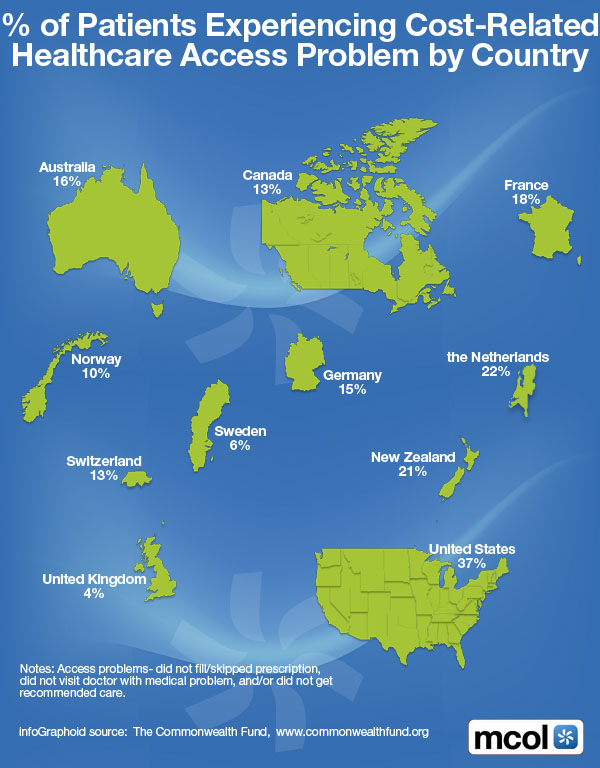
Percentages of Patients Experiencing Cost-Related Healthcare Access Problems

Join Our Mailing List

An Infographic by Country

By www.MCOL.com

dem

Assessment

Now, compare this to healthcare access difficulties in the USA.

Conclusion

Your thoughts and comments on this ME-P are appreciated. Feel free to review our top-left column, and top-right sidebar materials, links, URLs and related websites, too. Then, subscribe to the ME-P. It is fast, free and secure.

Link: http://feeds.feedburner.com/HealthcareFinancialsthePostForcxos

Speaker: If you need a moderator or speaker for an upcoming event, Dr. David E. Marcinko; MBA – Publisher-in-Chief of the Medical Executive-Post – is available for seminar or speaking engagements. Contact: MarcinkoAdvisors@msn.com

OUR OTHER PRINT BOOKS AND RELATED INFORMATION SOURCES:

DICTIONARIES: http://www.springerpub.com/Search/marcinko
PHYSICIANS: www.MedicalBusinessAdvisors.com
PRACTICES: www.BusinessofMedicalPractice.com
HOSPITALS: http://www.crcpress.com/product/isbn/9781466558731
CLINICS: http://www.crcpress.com/product/isbn/9781439879900
ADVISORS: www.CertifiedMedicalPlanner.org
PODIATRISTS: www.PodiatryPrep.com
BLOG: www.MedicalExecutivePost.com
FINANCE: Financial Planning for Physicians and Advisors
INSURANCE: Risk Management and Insurance Strategies for Physicians and Advisors

Product DetailsProduct DetailsProduct Details

Product Details  Product Details

Product DetailsProduct Details

Product Details

How to Succeed as an “Active-Passive” Investor [Part II]

Join Our Mailing List

An Oxymoron—Part Two

By Rick Kahler CFP® http://www.KahlerFinancial.com

Rick Kahler CFPContinued from last week, here are the remaining keys to help fine-tune your core passive investment strategy for optimum success.

5. Asset allocation.

This is critical. Study after study shows the most important determinate in your overall investment success isn’t picking the right stocks, bonds, or real estate. According to one researcher, a good asset allocation strategy can add about 0.5% to your long-term return. It’s your overall mix of various asset classes that will ultimately have the greatest impact on your success or failure. Investing your entire 401(k) in several stock index funds can be as insane as putting everything into bond funds. Even a mix of stocks and bonds, while better, can leave a portfolio over-exposed to the fortunes of one sector and exposed to the failing of one country’s economy.

6. Manager and index selection.

Especially if you are over 40 and have retirement in sight, successful passive investing isn’t quite as easy as calling Vanguard and putting everything in an S&P 500 index fund. Every asset class has multiple indexes, with managers who all have their differences in philosophy, execution, and fees. Some adhere to traditional indexes while others build their own indexes based on their research. Picking the right index with the right manager can add up to 2% over the long haul to the annual return generated by a good asset allocation.

7. Rebalancing.

Once you set your target allocations, you need to periodically sell off the advancing asset classes to purchase more of the lagging classes. Suppose you want 30% of your portfolio in U.S. stocks and 30% in bonds. If stocks are doing well and bonds are not, over time you might end up with 35% stocks and 25% bonds. Selling stocks and buying bonds to rebalance the allocations is a disciplined form of “buy low and sell high.” Without it, your portfolio will miss out on some extra returns and over time take on more risk and volatility. Research shows that periodic rebalancing can add 0.5% to 1.5% annually over the long term.

8. Asset placement and taxes.

Other adjustments need ongoing attention in any portfolio. Asset class location helps minimize tax consequences by matching the assets with the right account. IRA’s are best for certain asset classes, while Roth IRA’s do best with others and taxable accounts with still others. This matching can add up to 0.5% annually, so getting it right can be a big deal. It’s also important to tweak asset class allocations to adjust for long-term bear or bull markets, significant economic or tax policy changes, or changing personal situations. Another necessity is minimizing taxes by efficient and timely loss and gain harvesting.

9. Uncovering scams and ill-suited investments.

Recently a client asked me about a start-up online business in which several of her friends had invested. While there were many things about it that concerned me, at the core this just wasn’t an investment opportunity that suited my client’s expertise, goals, or risk tolerance. I strongly urged her to pass, and she did. Within six months the offering was found to be a well-pitched scam, and everyone who invested lost their money. Having someone to help investigate the legitimacy of investment ideas can always be helpful.

10. Keeping it sensibly simple.

Keeping things simple for simplicity’s sake doesn’t always produce the desired benefits. While it’s simple to put your whole portfolio into one stock or one mutual fund, the results could end up adding layers of complexity to your life. The right amount of sensible complexity can turn a good passive investing strategy into a highly successful one. 

MD

Assessment

How to Succeed as an “Active-Passive” Investor [Part I]

Conclusion

Your thoughts and comments on this ME-P are appreciated. Feel free to review our top-left column, and top-right sidebar materials, links, URLs and related websites, too. Then, subscribe to the ME-P. It is fast, free and secure.

Link: http://feeds.feedburner.com/HealthcareFinancialsthePostForcxos

Speaker: If you need a moderator or speaker for an upcoming event, Dr. David E. Marcinko; MBA – Publisher-in-Chief of the Medical Executive-Post – is available for seminar or speaking engagements. Contact: MarcinkoAdvisors@msn.com

OUR OTHER PRINT BOOKS AND RELATED INFORMATION SOURCES:

LEXICONS: http://www.springerpub.com/Search/marcinko
PHYSICIANS: www.MedicalBusinessAdvisors.com
PRACTICES: www.BusinessofMedicalPractice.com
HOSPITALS: http://www.crcpress.com/product/isbn/9781466558731
CLINICS: http://www.crcpress.com/product/isbn/9781439879900
ADVISORS: www.CertifiedMedicalPlanner.org
BLOG: www.MedicalExecutivePost.com

Product DetailsProduct DetailsProduct Details

Product Details  Product Details

Product DetailsProduct Details

Why Physician-Investors Must Understand TAMPs

Join Our Mailing List 

Third Party Outsourcing of Your Investments

By Dr. David Edward Marcinko MBA CMP™

Dr David E Marcinko MBATurnkey Asset Management Programs (TAMPs) allow independent financial advisors [FAs], Registered Investment Advisors [RIAs] – typically fiduciaries – to outsource the management of some or all of their clients’ assets.

More recently, Certified Public Accountants, law firms and banks also are using them to enter the financial advice marketplace

Managed Account Services

With a TAMP, financial advisors gain access to managed account services that allow them to offload time-consuming functions, such as research, portfolio construction, rebalancing, reconciliation, performance reporting, and tax optimization and reporting, which allows them to focus on clients’ personal financial needs, marketing, advertising and sales concerns

Fee-Based Accounts

TAMPs are a form of fee-account, which charge fees based on a percentage of the total assets managed in the program. TAMPs appeal to independent financial advisors who are building a fee-only business, because they can avoid the cost of building their own fee-accounts platform and can implement a TAMP in about 90 days, instead of the year or longer required to develop the same capabilities in-house.

TAMPs also help independent advisors avoid employee hiring and payroll costs related to internal administration and research, which for a modest program requiring a staff of 8-10 employees can typically cost $1 million per year in ongoing overhead. Because TAMPs serve financial advisors, individual retail investors are not able to directly invest their assets in a TAMP.

###

TAMPs

###

“Meet and Greet” Meetings

So, the next time your FA has a quarterly meeting with you to discuss the status of your investment account or retirement portfolio, just realize that s/he is usually only the middleman. S/he is not buying, selling or trading stocks for you. An “anonymous omniscient other” behemoth firm is actually doing the work and merely placing your name on a glossy automated printed report. Your FA passes the report along as his/her alone, complete with his/her name and firm embossed, therein.  Usually with a supplication like this.

The courtesy of your referral is our only reward.

And, the day of your quarterly meeting, in his/her fancy office, is probably the first and only day the report is even reviewed by the FA. This is why most of the FAs time is spent prospecting, or in marketing, advertising and/or other sales activities.  All the heavy-lifting is done elsewhere.

In the industry, this type of Financial Advisor is known as an asset aggregator. And, in the retail sector, most FAs are asset aggregators or gatherers.

http://en.wikipedia.org/wiki/Turnkey_Asset_Management_Program

Number Crunching

Now, let’s say you have one millions dollars to invest and the FA charges you one percent of your AUMs; annually. This is common in the industry with ranges up to 3%, or so. Yep; that’s ten grand out of your pocket.

The Financial Advisor thus receives about $5,000/per year and the TAMP gets the same; year after year. This is reduced to $2,500 or so, to the FA, after office overhead costs. It does not matter if the market, or your account, is up or down. Such the deal!

Nevertheless, the money is automatically flowing away from you much like an annuity; or cash cow. Since you do not actually write a check out to the FA or firm, you may forget about the fees. Get the idea!

Therefore, a firm with $100 million dollars in AUMs earns about: $1-M X 50% = $500,000/year. With scale-ability, it is easy to see how Wall Street has all those skyscrapers in Manhattan, Chicago, London or Tokyo. AUM fees go up drastically, with little increase in overhead. Remember the economic concepts of marginal revenues and marginal costs!

In the industry, we call this Recurring Income. RI is preferred over a one time stock-broker commission [one-time sale] because it’s producing revenue for the TAMP and FA 24/7/365.

To be sure, it is difficult for FAs to obtain such clients; but once in the fold, clients are loathe to leave.

Assessment

Is it a wonder why big firms and wire-houses [brokerages] place their employee FAs under non-compete clauses? In other words, you the client, are owned by the company. You are not a client of the individual FA. So, when an FA leaves or retires, your account stays with the firm unless you transfer it. Expect to receive a very hard sell to stay, when you threaten to leave.

More:

Conclusion

Now, you know why sales skills are needed – over financial acumen – in this business. A great personality trumps education and brain power, most every time.

Your thoughts and comments on this ME-P are appreciated. Feel free to review our top-left column, and top-right sidebar materials, links, URLs and related websites, too. Then, subscribe to the ME-P. It is fast, free and secure.

Link: http://feeds.feedburner.com/HealthcareFinancialsthePostForcxos

Speaker: If you need a moderator or speaker for an upcoming event, Dr. David E. Marcinko; MBA – Publisher-in-Chief of the Medical Executive-Post – is available for seminar or speaking engagements. Contact: MarcinkoAdvisors@msn.com

OUR OTHER PRINT BOOKS AND RELATED INFORMATION SOURCES:

LEXICONS: http://www.springerpub.com/Search/marcinko
PHYSICIANS: www.MedicalBusinessAdvisors.com
PRACTICES: www.BusinessofMedicalPractice.com
HOSPITALS: http://www.crcpress.com/product/isbn/9781466558731
CLINICS: http://www.crcpress.com/product/isbn/9781439879900
ADVISORS: www.CertifiedMedicalPlanner.org
BLOG: www.MedicalExecutivePost.com

Product DetailsProduct DetailsProduct Details

  Risk Management, Liability Insurance, and Asset Protection Strategies for Doctors and Advisors: Best Practices from Leading Consultants and Certified Medical Planners™8Comprehensive Financial Planning Strategies for Doctors and Advisors: Best Practices from Leading Consultants and Certified Medical Planners™

***

Invite Dr. Marcinko

***

Even More 2013 Year End Tax Planning Tips for Physicians

Join Our Mailing List 

Last Minute Considerations for Medical Professionals … and Us All

By Robert Whirley CPA

2500-190 North Winds Parkway

Alpharetta GA 30009-2245

Dear ME-P Readers:

Year-end tax planning could be especially productive this year because timely action could nail down a host of tax breaks that won’t be around next year unless Congress acts to extend them, which, at the present time, looks doubtful. I have tried to keep this brief but, as typical, the changes this year are voluminous.

High-Income Earners

High-income-earners have other factors to keep in mind when mapping out year-end plans. For the first time, they have to take into account the 3.8% surtax on unearned income and the additional 0.9% Medicare (hospital insurance, or HI) tax that applies to individuals receiving wages with respect to employment in excess of $200,000 ($250,000 for married couples filing jointly and $125,000 for married couples filing separately).

Medicare Tax

The additional Medicare tax may require year-end actions. Employers must withhold the additional Medicare tax from wages in excess of $200,000 regardless of filing status or other income. Self-employed persons must take it into account in figuring estimate tax. There could be situations where an employee may need to have more withheld toward year end to cover the tax.

For example, an individual earns $200,000 from one employer during the first half of the year and a like amount from another employer during the balance of the year. He would owe the additional Medicare tax, but there would be no withholding by either employer for the additional Medicare tax since wages from each employer don’t exceed $200,000.

Also, in determining whether they may need to make adjustments to avoid a penalty for underpayment of estimated tax, individuals also should be mindful that the additional Medicare tax may be over-withheld. This could occur, for example, where only one of two married spouses works and reaches the threshold for the employer to withhold, but the couple’s income won’t be high enough to actually cause the tax to be owed.

Checklist

I have compiled a checklist of additional actions based on current tax rules that may help you save tax dollars if you act before year-end. Not all actions will apply in your particular situation, but you will likely benefit from many of them.

Tax

[Year-End Tax Planning Moves for Individuals]

• Increase the amount you set aside for next year in your employer’s health flexible spending account (FSA) if you set aside too little for this year.

• If you become eligible to make health savings account (HSA) contributions in December of this year, you can make a full year’s worth of deductible HSA contributions for 2013.

• Realize losses on stock while substantially preserving your investment position. There are several ways this can be done. For example, you can sell the original holding, then buy back the same securities at least 31 days later. It may be advisable for us to meet to discuss year-end trades you should consider making.

• Postpone income until 2014 and accelerate deductions into 2013 to lower your 2013 tax bill. This strategy may enable you to claim larger deductions, credits, and other tax breaks for 2013 that are phased out over varying levels of adjusted gross income (AGI). These include child tax credits, higher education tax credits, the above-the-line deduction for higher-education expenses, and deductions for student loan interest. Postponing income also is desirable for those taxpayers who anticipate being in a lower tax bracket next year due to changed financial circumstances. Note, however, that in some cases, it may pay to actually accelerate income into 2013. For example, this may be the case where a person’s marginal tax rate is much lower this year than it will be next year or where lower income in 2014 will result in a higher tax credit for an individual who plans to purchase health insurance on a health exchange and is eligible for a premium assistance credit.

• If you believe a Roth IRA is better than a traditional IRA, and want to remain in the market for the long term, consider converting traditional-IRA money invested in beaten-down stocks (or mutual funds) into a Roth IRA if eligible to do so. Keep in mind, however, that such a conversion will increase your adjusted gross income for 2013.

• If you converted assets in a traditional IRA to a Roth IRA earlier in the year, the assets in the Roth IRA account may have declined in value, and if you leave things as-is, you will wind up paying a higher tax than is necessary. You can back out of the transaction by recharacterizing the rollover or conversion, that is, by transferring the converted amount (plus earnings, or minus losses) from the Roth IRA back to a traditional IRA via a trustee-to-trustee transfer. You can later reconvert to a Roth IRA.
• It may be advantageous to try to arrange with your employer to defer a bonus that may be coming your way until 2014.

• Consider using a credit card to prepay expenses that can generate deductions for this year.

• If you expect to owe state and local income taxes when you file your return next year, consider asking your employer to increase withholding of state and local taxes (or pay estimated tax payments of state and local taxes) before year-end to pull the deduction of those taxes into 2013 if doing so won’t create an alternative minimum tax (AMT) problem.

• Take an eligible rollover distribution from a qualified retirement plan before the end of 2013 if you are facing a penalty for underpayment of estimated tax and the increased withholding option is unavailable or won’t sufficiently address the problem. Income tax will be withheld from the distribution and will be applied toward the taxes owed for 2013. You can then timely roll over the gross amount of the distribution, as increased by the amount of withheld tax, to a traditional IRA. No part of the distribution will be includible in income for 2013, but the withheld tax will be applied pro rata over the full 2013 tax year to reduce previous underpayments of estimated tax.

• Estimate the effect of any year-end planning moves on the alternative minimum tax (AMT) for 2013, keeping in mind that many tax breaks allowed for purposes of calculating regular taxes are disallowed for AMT purposes. These include the deduction for state property taxes on your residence, state income taxes (or state sales tax if you elect this deduction option), miscellaneous itemized deductions, and personal exemption deductions. Other deductions, such as for medical expenses, are calculated in a more restrictive way for AMT purposes than for regular tax purposes in the case of a taxpayer who is over age 65 or whose spouse is over age 65 as of the close of the tax year. As a result, in some cases, deductions should not be accelerated.

• Accelerate big ticket purchases into 2013 in order to assure a deduction for sales taxes on the purchases if you will elect to claim a state and local general sales tax deduction instead of a state and local income tax deduction. Unless Congress acts, this election won’t be available after 2013.

• You may be able to save taxes this year and next by applying a bunching strategy to “miscellaneous” itemized deductions, medical expenses and other itemized deductions.

• If you are a homeowner, make energy saving improvements to the residence, such as putting in extra insulation or installing energy saving windows, or an energy efficient heater or air conditioner. You may qualify for a tax credit if the assets are installed in your home before 2014.

• Unless Congress extends it, the up-to-$4,000 above-the-line deduction for qualified higher education expenses will not be available after 2013. Thus, consider prepaying eligible expenses if doing so will increase your deduction for qualified higher education expenses. Generally, the deduction is allowed for qualified education expenses paid in 2013 in connection with enrollment at an institution of higher education during 2013 or for an academic period beginning in 2013 or in the first 3 months of 2014.

• You may want to pay contested taxes to be able to deduct them this year while continuing to contest them next year.

• You may want to settle an insurance or damage claim in order to maximize your casualty loss deduction this year.

• If you are age 70-1/2 or older, own IRAs and are thinking of making a charitable gift, consider arranging for the gift to be made directly by the IRA trustee. Such a transfer, if made before year-end, can achieve important tax savings.

• Take required minimum distributions (RMDs) from your IRA or 401(k) plan (or other employer-sponsored retired plan) if you have reached age 70-1/2. Failure to take a required withdrawal can result in a penalty of 50% of the amount of the RMD not withdrawn. If you turned age 70-1/2 in 2013, you can delay the first required distribution to 2013, but if you do, you will have to take a double distribution in 2014-the amount required for 2013 plus the amount required for 2014. Think twice before delaying 2013 distributions to 2014-bunching income into 2014 might push you into a higher tax bracket or have a detrimental impact on various income tax deductions that are reduced at higher income levels. However, it could be beneficial to take both distributions in 2014 if you will be in a substantially lower bracket that year, for example, because you plan to retire late this year.

• Make gifts sheltered by the annual gift tax exclusion before the end of the year and thereby save gift and estate taxes. You can give $14,000 in 2013 to each of an unlimited number of individuals but you can’t carry over unused exclusions from one year to the next. The transfers also may save family income taxes where income-earning property is given to family members in lower income tax brackets who are not subject to the kiddie tax.

US capitol

[Year-End Tax-Planning Moves for Businesses & Business Owners]

• Businesses should consider making expenditures that qualify for the business property expensing option. For tax years beginning in 2013, the expensing limit is $500,000 and the investment ceiling limit is $2,000,000. And a limited amount of expensing may be claimed for qualified real property. However, unless Congress changes the rules, for tax years beginning in 2014, the dollar limit will drop to $25,000, the beginning-of-phaseout amount will drop to $200,000, and expensing won’t be available for qualified real property. The generous dollar ceilings that apply this year mean that many small and medium sized businesses that make timely purchases will be able to currently deduct most if not all their outlays for machinery and equipment. What’s more, the expensing deduction is not prorated for the time that the asset is in service during the year. This opens up significant year-end planning opportunities.

• Businesses also should consider making expenditures that qualify for 50% bonus first year depreciation if bought and placed in service this year. This bonus writeoff generally won’t be available next year unless Congress acts to extend it. Thus, enterprises planning to purchase new depreciable property this year or the next should try to accelerate their buying plans, if doing so makes sound business sense.

• Nail down a work opportunity tax credit (WOTC) by hiring qualifying workers (such as certain veterans) before the end of 2013. Under current law, the WOTC won’t be available for workers hired after this year.

• Make qualified research expenses before the end of 2013 to claim a research credit, which won’t be available for post-2013 expenditures unless Congress extends the credit.

• If you are self-employed and haven’t done so yet, set up a self-employed retirement plan.

• Depending on your particular situation, you may also want to consider deferring a debt-cancellation event until 2014, and disposing of a passive activity to allow you to deduct suspended losses.

• If you own an interest in a partnership or S corporation you may need to increase your basis in the entity so you can deduct a loss from it for this year.

Assessment

These are just some of the year-end steps that can be taken to save taxes.

Conclusion

Your thoughts and comments on this ME-P are appreciated. Feel free to review our top-left column, and top-right sidebar materials, links, URLs and related websites, too. Then, subscribe to the ME-P. It is fast, free and secure.

Link: http://feeds.feedburner.com/HealthcareFinancialsthePostForcxos

Speaker: If you need a moderator or speaker for an upcoming event, Dr. David E. Marcinko; MBA – Publisher-in-Chief of the Medical Executive-Post – is available for seminar or speaking engagements. Contact: MarcinkoAdvisors@msn.com

OUR OTHER PRINT BOOKS AND RELATED INFORMATION SOURCES:

LEXICONS: http://www.springerpub.com/Search/marcinko
PHYSICIANS: www.MedicalBusinessAdvisors.com
PRACTICES: www.BusinessofMedicalPractice.com
HOSPITALS: http://www.crcpress.com/product/isbn/9781466558731
CLINICS: http://www.crcpress.com/product/isbn/9781439879900
ADVISORS: www.CertifiedMedicalPlanner.org
BLOG: www.MedicalExecutivePost.com

Product DetailsProduct DetailsProduct Details

Product Details  Product Details

Product DetailsProduct Details

Product Details

The Price of Pleasure

Join Our Mailing List

Sin Taxes

By Carrie Braza

Sin-taxes

More

Conclusion

Your thoughts and comments on this ME-P are appreciated. Feel free to review our top-left column, and top-right sidebar materials, links, URLs and related websites, too. Then, subscribe to the ME-P. It is fast, free and secure.

Link: http://feeds.feedburner.com/HealthcareFinancialsthePostForcxos

Speaker: If you need a moderator or speaker for an upcoming event, Dr. David E. Marcinko; MBA – Publisher-in-Chief of the Medical Executive-Post – is available for seminar or speaking engagements. Contact: MarcinkoAdvisors@msn.com

OUR OTHER PRINT BOOKS AND RELATED INFORMATION SOURCES:

LEXICONS: http://www.springerpub.com/Search/marcinko
PHYSICIANS: www.MedicalBusinessAdvisors.com
PRACTICES: www.BusinessofMedicalPractice.com
HOSPITALS: http://www.crcpress.com/product/isbn/9781466558731
CLINICS: http://www.crcpress.com/product/isbn/9781439879900
ADVISORS: www.CertifiedMedicalPlanner.org
BLOG: www.MedicalExecutivePost.com

Product DetailsProduct DetailsProduct Details

Product Details  Product Details

Is HEALTHCARE.GOV Fundamentally Flawed?

Join Our Mailing List

You Decide

By Ayo Fathiah

Hello Dr. David Edward Marcinko,

My name is Ayo, I’m the mother of two beautiful kids and one of the Americans that was relying on healthcare.gov to provide me with a reasonably priced health insurance.

I came across your ME-P articles when researching what exactly has gone wrong with the website. I was one of the millions that tried to sign up during the first days after the launch and couldn’t get through due to a bunch of errors. While I’m still trying to find the best insurance for my family, I just wanted to share with you some stats showing why the website was a major flop.

***

interface

***

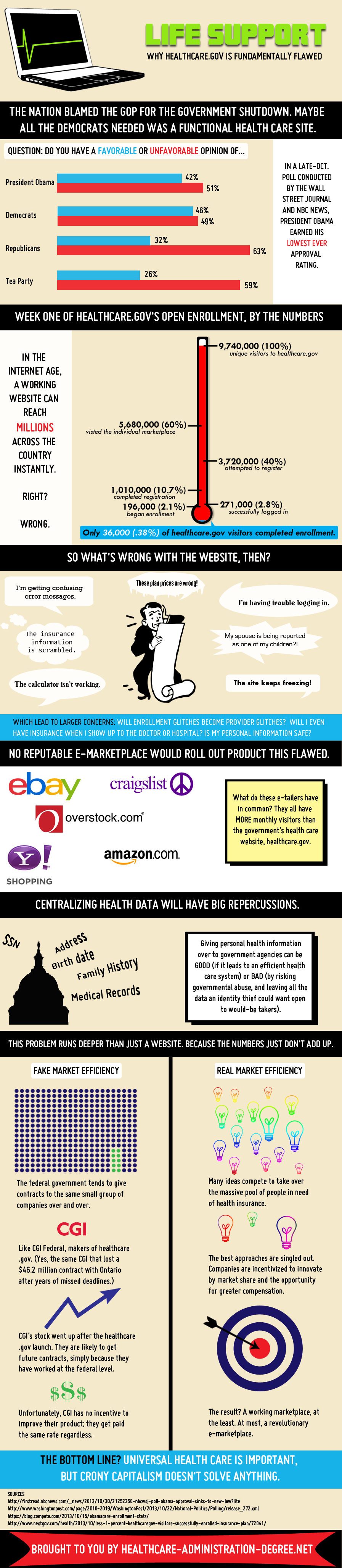
And, I thought it might be interesting to your readers, because I saw a many readers talking about it. Isn’t it surprising that less than 1% of people that went on the website signed up for an insurance?

HCdotGOV_final

The Website

1.) Had extremely low login success rates. 2.) Long delays and time outs 3.) Confusing Error Messages 4.) Non-functional calculators 5.) Scrambled insurance information 6.) Spouses reported as children 7.) Plan pricing misreported.

Assessment

Leading to the larger questions:

  • Will enrollment glitches become provider glitches?
  • Will people who enrolled with the glitchy show up at hospitals with no insurance?
  • Will the information of those who enrolled be at risk?

DANGER: Centralized data SSN Address Ages Names Health conditions Family History

Leads to centralized power over everyday Americans

Good: if we can make an efficient healthcare system

Bad: Governmental Abuse, and all the data an identity thief could want

But this problem runs deeper than just a website… Because the numbers just don’t add up.

Universal healthcare is important, but crony capitalism doesn’t solve anything.

Citations:

  1. http://msnbcmedia.msn.com/i/MSNBC/Sections/A_Politics/_Today_Stories_Teases/Late_October_NBC_WSJ.pdf
  2. https://blog.compete.com/2013/10/15/obamacare-enrollment-stats/
  3. http://www.nextgov.com/health/2013/10/less-1-percent-healthcaregov-visitors-successfully-enrolled-insurance-plan/72041/

Conclusion

Your thoughts and comments on this ME-P are appreciated. Feel free to review our top-left column, and top-right sidebar materials, links, URLs and related websites, too. Then, subscribe to the ME-P. It is fast, free and secure.

Link: http://feeds.feedburner.com/HealthcareFinancialsthePostForcxos

Speaker: If you need a moderator or speaker for an upcoming event, Dr. David E. Marcinko; MBA – Publisher-in-Chief of the Medical Executive-Post – is available for seminar or speaking engagements. Contact: MarcinkoAdvisors@msn.com

OUR OTHER PRINT BOOKS AND RELATED INFORMATION SOURCES:

LEXICONS: http://www.springerpub.com/Search/marcinko
PHYSICIANS: www.MedicalBusinessAdvisors.com
PRACTICES: www.BusinessofMedicalPractice.com
HOSPITALS: http://www.crcpress.com/product/isbn/9781466558731
CLINICS: http://www.crcpress.com/product/isbn/9781439879900
ADVISORS: www.CertifiedMedicalPlanner.org
BLOG: www.MedicalExecutivePost.com

Product DetailsProduct DetailsProduct Details

Product Details  Product Details

Product DetailsProduct Details

Product Details

The PP-ACA from Medicine to Dentistry

Obamacare and Dentistry

[By D. Kellus Pruitt DDS]

1-darrellpruitt It seems that problems with the PP-ACA have migrated from traditional medicine to the world of dentistry.

“MaineCare dentists hit with massive fines for minor clerical errors, they say – Some clinics face more than $200,000 in penalties under a new audit system that threatens to wipe out services for kids.”

-Joe Lawlor [Staff writer] Portland Press Herald [November 6, 2013]

http://www.pressherald.com/news/MaineCare_dentists_hit_with_massive_fines_for_minor_clerical_errors__they_say_.html

 “The new system gives auditors, who work for a private contractor, financial incentives to find small errors by paying them more for each mistake they discover.” Maine adopted the auditing system to comply with the federal Affordable Care Act, otherwise known as Obamacare.

 Lawlor continues: “The audits are intended to root out fraud and abuse, but dentists told the Portland Press Herald that auditors are finding typographical or clerical errors that do not compromise patients’ care or defraud the government.”

A Clawback?

Dr. Michael Dowling, co-owner of Falmouth Pediatric Dentistry, tells the Herald, “This is not finding fraud and abuse. This is a clawback. They (state officials) are trying to take back money that we billed them legitimately.”

Still want to help the poor so much that you are willing to take your chances with the ACA auditing system, Doc?

Dentists facing bankruptcy

According to Lawlor, some dentists are actually facing bankruptcy because of ridiculously expensive fines over minor errors. Other Maine dentists who are otherwise willing to work for charity-level fees in order to help children who have nowhere else to turn, are dropping out of MaineCare. President Obama’s plan to use outrageous fines to fund the state and federal coffers, as well as the bonuses of ambitious auditors, is destined to fail.

How can the Affordable Care Act [PP-ACA] possibly make care more affordable for children with toothaches, if it runs off all the dentists?

Mobile-Security

Assessment

Is it beginning to look to you like Obamacare might have been designed to serve the interests of unaccountable healthcare stakeholders rather than the interests of doctors and patients – the healthcare principals? Why do we put up with this crap, Doc?

Conclusion

Your thoughts and comments on this ME-P are appreciated. Feel free to review our top-left column, and top-right sidebar materials, links, URLs and related websites, too. Then, subscribe to the ME-P. It is fast, free and secure.

Link: http://feeds.feedburner.com/HealthcareFinancialsthePostForcxos

Speaker: If you need a moderator or speaker for an upcoming event, Dr. David E. Marcinko; MBA – Publisher-in-Chief of the Medical Executive-Post – is available for seminar or speaking engagements. Contact: MarcinkoAdvisors@msn.com

OUR OTHER PRINT BOOKS AND RELATED INFORMATION SOURCES:

LEXICONS: http://www.springerpub.com/Search/marcinko
PHYSICIANS: www.MedicalBusinessAdvisors.com
PRACTICES: www.BusinessofMedicalPractice.com
HOSPITALS: http://www.crcpress.com/product/isbn/9781466558731
CLINICS: http://www.crcpress.com/product/isbn/9781439879900
ADVISORS: www.CertifiedMedicalPlanner.org
BLOG: www.MedicalExecutivePost.com

Product DetailsProduct Details

How to Succeed as an “Active-Passive” Investor [Part I]

Join Our Mailing List 

An Oxymoron—Part One

By Rick Kahler CFP® http://www.KahlerFinancial.com

Rick Kahler CFPA fundamental principle I preach is that having a core of passively managed mutual funds is the foundation of successful long-term wealth building. I practice that principle, as well: about 75% of the securities in my personal portfolio are passively selected.

My commitment to this approach has evolved both from my own years of investing experience and from reading reams of research. I’m convinced that “beating the market” over the long term is as elusive a goal as capturing a wild jackalope.

Fundamental Strategy

Does that mean investing is as simple as giving most of your money to passive managers and kicking back? Not quite. Yes, investing in the index funds of a diversified group of asset classes and leaving them alone is a good fundamental strategy that will help you secure your financial future. To be even more successful, however, it helps to actively apply some additional strategies.

Additional Strategies

I was reminded of this by a June 2013 blog post from Bob Seawright of Madison Avenue Securities. Here, inspired by and adapted from his “top ten” list, are some of the factors that strongly affect the success of passive investors. While financial professionals can help with all of these strategies, investors going it alone can also benefit from paying attention to them.

Link: http://rpseawright.wordpress.com/2013/06/04/financial-advice-a-top-ten-list/

Top Ten List

1. What’s the point?

A successful investment strategy starts with establishing clear, objective, and realistic goals. Most people bypass this step, thinking it is unrelated to their investment selection. Yet very few people on their deathbeds focus on how great it was to get a 7% annual return on their investments. Drilling down to what is really important in your life is no simple task, but it is essential. Creating a life worth living means using portfolio returns to support your dreams and desires! Knowing where you are going and why is the first step to establishing a successful portfolio.

2. A written investment plan.

Yes, you need your investment strategy in writing. This both insures that you have one and helps you clarify it. I find that writing things down often helps me find gaps and inconsistencies in what I thought was a complete and rational plan.

A written investment plan should state:

a. Your investment philosophy. Are you a passive or active investor, or both?

b. Your goals and objectives for your funds. This answers the question, “How and when will this money support my life?”

c. Guidelines and constraints you will adhere to in managing your money. What tenure do you want in a manager, what is your upper limit on expense ratios, how much flexibility will you give a manager, what quantifiable factors will take you out of a market or bring you back in?

A written plan will bring structure and discipline to your investment strategy, qualities most investors lack.

3. Manage your behavior.

We all have blind spots, biases, and delusions. How you behave in the face of market declines and advances will affect your long-term portfolio returns more than any other single factor. To make this even more challenging, your brain is naturally wired for investment failure. Identifying and reframing your money scripts can help you rewire your brain for success instead. Working with a financial coach or therapist can be invaluable to help you negotiate your own mind.

4. Financial planning.

Many people think financial planning is limited to investment advice. Yet it is much broader and deeper. Financial planning not only helps you build wealth, but helps you use it wisely to support the life you want.

Doctors

More:

Assessment

Six more keys to successful passive investing will be covered soon in Part II.

How to Succeed as an “Active-Passive” Investor [Part II]

Conclusion

Your thoughts and comments on this ME-P are appreciated. Feel free to review our top-left column, and top-right sidebar materials, links, URLs and related websites, too. Then, subscribe to the ME-P. It is fast, free and secure.

Link: http://feeds.feedburner.com/HealthcareFinancialsthePostForcxos

Speaker: If you need a moderator or speaker for an upcoming event, Dr. David E. Marcinko; MBA – Publisher-in-Chief of the Medical Executive-Post – is available for seminar or speaking engagements. Contact: MarcinkoAdvisors@msn.com

OUR OTHER PRINT BOOKS AND RELATED INFORMATION SOURCES:

LEXICONS: http://www.springerpub.com/Search/marcinko
PHYSICIANS: www.MedicalBusinessAdvisors.com
PRACTICES: www.BusinessofMedicalPractice.com
HOSPITALS: http://www.crcpress.com/product/isbn/9781466558731
CLINICS: http://www.crcpress.com/product/isbn/9781439879900
ADVISORS: www.CertifiedMedicalPlanner.org
BLOG: www.MedicalExecutivePost.com

Product DetailsProduct DetailsProduct Details

Product Details  Product Details

Empathy – the business of treating people [Video]

Join Our Mailing List

A Cleveland Clinic Initiative

[By staff reporters]

If you haven’t seen this viral video yet, you’re in for tear-jerking treat.

A production of Cleveland Clinic highlighting the need to “understand” people in the medical setting. The direct implication is that such understanding goes beyond the medical setting, and can be transferred to all settings where people interact.

Watch “If We Could See Inside Others’ Hearts” here:

Delacroix[DELACROIX]

Assessment

This short film captures the essence of the “business” of treating people: empathy.

More: www.CertifiedMedicalPlanner.org

Conclusion

Your thoughts and comments on this ME-P are appreciated. Feel free to review our top-left column, and top-right sidebar materials, links, URLs and related websites, too. Then, subscribe to the ME-P. It is fast, free and secure.

Link: http://feeds.feedburner.com/HealthcareFinancialsthePostForcxos

Speaker: If you need a moderator or speaker for an upcoming event, Dr. David E. Marcinko; MBA – Publisher-in-Chief of the Medical Executive-Post – is available for seminar or speaking engagements. Contact: MarcinkoAdvisors@msn.com

OUR OTHER PRINT BOOKS AND RELATED INFORMATION SOURCES:

LEXICONS: http://www.springerpub.com/Search/marcinko
PHYSICIANS: www.MedicalBusinessAdvisors.com
PRACTICES: www.BusinessofMedicalPractice.com
HOSPITALS: http://www.crcpress.com/product/isbn/9781466558731
CLINICS: http://www.crcpress.com/product/isbn/9781439879900
ADVISORS: www.CertifiedMedicalPlanner.org
BLOG: www.MedicalExecutivePost.com

Product DetailsProduct Details

Product Details

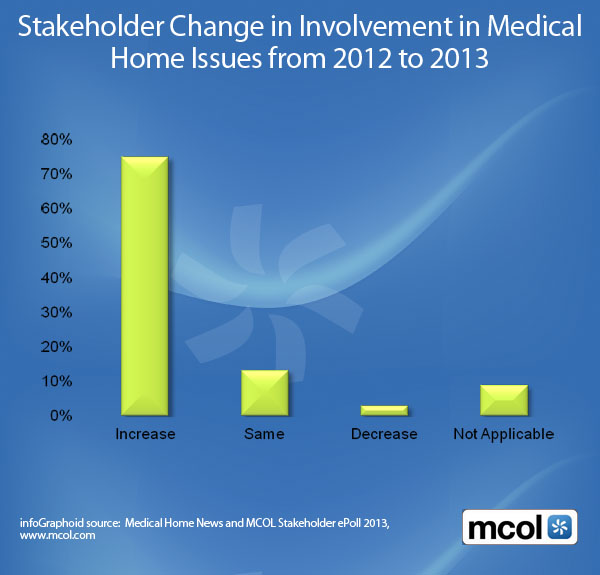
Stakeholder Changes for Involvement in Medical Homes [2012-13]

Join Our Mailing List

Update on the Patient Centered Medical Home Movement

By: www.MCOL.com

The medical home, also known as the patient-centered medical home (PCMH), is a team based health care delivery model led by a physician, PA, NP or ANP that provides comprehensive and continuous medical care to patients with the goal of obtaining maximized health outcomes. It is “an approach to providing comprehensive primary care for children, youth and adults”.

The provision of medical homes may allow better access to health care, increase satisfaction with care, and improve health. Joint principles that define a PCMH have been established through the cohesive efforts of the American Academy of Pediatrics (AAP), American Academy of Family Physicians (AAFP), American College of Physicians (ACP), and American Osteopathic Association (AOA).

MHs

Assessment

With a medical home, care coordination is an essential component of the PCMH. Care coordination requires additional resources such as health information technology, and appropriately trained staff to provide coordinated care through team-based models.

Additionally, payment models that compensate PCMHs for their effort devoted to care coordination activities and patient-centered care management that fall outside the face-face patient encounter may help encourage coordination.

More:

Conclusion

Your thoughts and comments on this ME-P are appreciated. Feel free to review our top-left column, and top-right sidebar materials, links, URLs and related websites, too. Then, subscribe to the ME-P. It is fast, free and secure.

Link: http://feeds.feedburner.com/HealthcareFinancialsthePostForcxos

Speaker: If you need a moderator or speaker for an upcoming event, Dr. David E. Marcinko; MBA – Publisher-in-Chief of the Medical Executive-Post – is available for seminar or speaking engagements. Contact: MarcinkoAdvisors@msn.com

OUR OTHER PRINT BOOKS AND RELATED INFORMATION SOURCES:

LEXICONS: http://www.springerpub.com/Search/marcinko
PHYSICIANS: www.MedicalBusinessAdvisors.com
PRACTICES: www.BusinessofMedicalPractice.com
HOSPITALS: http://www.crcpress.com/product/isbn/9781466558731
CLINICS: http://www.crcpress.com/product/isbn/9781439879900
ADVISORS: www.CertifiedMedicalPlanner.org
BLOG: www.MedicalExecutivePost.com

Product DetailsProduct DetailsProduct Details

Product DetailsProduct Details

Product Details

What All Doctors Need to Know About the Expiring Tax Provisions‏

Join Our Mailing List 

Avoid Losing Out on these Tax Breaks

By Bobby Whirley CPA and Kim Dore

Whirley & Associates, LLC

Certified Public Accountants

2500 Northwinds Parkway

Suite 190 – Alpharetta, GA 30009

770.932.1919 (ph) and 770.932.1192 (fax)

Dear ME-P Subscribers,

We wanted to let ME-P readers know about several important tax provisions affecting individuals and businesses that are slated to expire at the end of this year. While a budget conference is underway between the House and Senate, there is no way to know whether any agreement resulting from these negotiations will extend any expiring tax provisions. Because of this uncertainty, where possible, you should take action now to avoid losing out on tax breaks.

· Above-the-line deduction for certain higher education expenses – An above-the-line deduction is allowed for an individual taxpayer’s qualified tuition and related expenses. For 2013, the maximum deduction is $4,000 for taxpayers with modified AGI of not more than $65,000 ($130,000 for joint filers), and $2,000 for taxpayers with modified AGI that is equal to or more than the above amount but not more than $80,000 ($160,000 for joint filers). In general, the deduction is allowed for any tax year only to the extent the expenses are in connection with enrollment at an institution of higher education during that tax year. However, the deduction is allowed for qualified tuition and related expenses paid during a tax year if they are in connection with an academic term beginning during that tax year or during the first three months of the next tax year. The deduction does not apply for tax years beginning after 2013.

So, you may want to prepay in 2013 tuition due for an academic term beginning in Jan., Feb. or Mar. 2014 if that would increase your 2013 tax savings from the expiring deduction.

· Non-business energy credit –  Subject to limits (listed below), a taxpayer may be able to take a credit under Code Sec. 25C equal to the sum of: (1) 10% of the amount paid or incurred for qualified energy efficiency improvements, such as insulation material, exterior windows and skylights, and exterior doors, installed during 2013; and (2) any residential energy property costs, such as electric heat pumps, central air conditioners, natural gas, propane, or oil water heaters, or qualified natural gas, propane, and oil hot water boilers, paid or incurred in 2013. The expenses must be for property originally placed in service by the taxpayer and located in the U.S., and used as a principal residence at the time of installation. However, the credit is limited as follows:

·        A total combined credit limit of $500 for all tax years after 2005.

·        A combined credit limit of $200 for windows for all tax years after 2005.

·        A credit limit for residential energy property costs for 2013 of $50 for any advanced main air circulating fan; $150 for any qualified natural gas, propane, or oil furnace or hot water boiler; and $300 for any item of energy efficient building property.

So, if you have not made full use of the credit and are contemplating making such energy efficient improvements in the near future, you should do so before year-end to take advantage of the credit.

Tax

· Home mortgage debt forgiveness relief – For indebtedness discharged before Jan. 1, 2014, taxpayers generally may exclude up to $2 million of mortgage debt forgiveness on their principal residence. Gross income doesn’t include any discharge of qualified principal residence indebtedness. Generally, this relief allows the exclusion of income realized as a result of modification of the terms of the mortgage, foreclosure on a principal residence, or where the mortgage loan is not fully satisfied (e.g., in a short sale) and a lender cancels the unsatisfied debt. The basis of the taxpayer’s principal residence is reduced by the excluded amount, but not below zero.

So, if you are in the process of attempting to secure such relief from your lender you should take all possible steps to ensure that the discharge occurs before January 1st. of next year.

· Mortgage insurance premiums treated as deductible interest  – Mortgage insurance premiums paid or accrued by a taxpayer in connection with acquisition indebtedness with respect to the taxpayer’s qualified residence are treated as deductible qualified residence interest, subject to a phase-out based on the taxpayer’s AGI. However, this provision does not apply to premiums paid or accrued after Dec. 31, 2013 or properly allocable to any period after that date.

Thus, prepaying 2014 premiums this year won’t yield a deduction.

·  Above-the-line deduction for expenses of elementary and secondary school teachers. An eligible educator is allowed an above-the-line deduction, not in excess of $250, for otherwise allowable trade or business expenses paid or incurred by him in connection with books, supplies (other than nonathletic supplies for courses of instruction in health or physical education), computer equipment (including related software and services) and other equipment, and supplementary materials used by him in the classroom. The deduction is allowed only to the extent the expenses exceed the amount excludable for the tax year. This provision does not apply for tax years beginning after 2013.

So, a teacher who is not over the limit and who plans to purchase items in 2014 that would qualify for the deduction if it remained in effect should consider accelerating the purchases to 2013 to gain a deduction this year.

More:

Conclusion

Your thoughts and comments on this ME-P are appreciated. Feel free to review our top-left column, and top-right sidebar materials, links, URLs and related websites, too. Then, subscribe to the ME-P. It is fast, free and secure.

Link: http://feeds.feedburner.com/HealthcareFinancialsthePostForcxos

Speaker: If you need a moderator or speaker for an upcoming event, Dr. David E. Marcinko; MBA – Publisher-in-Chief of the Medical Executive-Post – is available for seminar or speaking engagements. Contact: MarcinkoAdvisors@msn.com

OUR OTHER PRINT BOOKS AND RELATED INFORMATION SOURCES:

LEXICONS: http://www.springerpub.com/Search/marcinko
PHYSICIANS: www.MedicalBusinessAdvisors.com
PRACTICES: www.BusinessofMedicalPractice.com
HOSPITALS: http://www.crcpress.com/product/isbn/9781466558731
CLINICS: http://www.crcpress.com/product/isbn/9781439879900
ADVISORS: www.CertifiedMedicalPlanner.org
BLOG: www.MedicalExecutivePost.com

Product Details  Product Details

Video on Wall Street’s View on Prospects for the Health Care Industry

Join Our Mailing List

Nashville Health Care Council

[By staff reporters]

The Nashville Health Care Council’s recent signature: “Wall Street’s View on Prospects for the Health Care Industry” panel discussion and video, offers timely insights and forecasts for Nashville’s $70 billion health care industry.

Medical tree

Video link: http://www.healthsharetv.com/content/wall-streets-view-prospects-health-care-industry

Assessment

The effects of the PP-ACA are still being revealed under the law of unintended consequences.

Conclusion

Your thoughts and comments on this ME-P are appreciated. Feel free to review our top-left column, and top-right sidebar materials, links, URLs and related websites, too. Then, subscribe to the ME-P. It is fast, free and secure.

Link: http://feeds.feedburner.com/HealthcareFinancialsthePostForcxos

Speaker: If you need a moderator or speaker for an upcoming event, Dr. David E. Marcinko; MBA – Publisher-in-Chief of the Medical Executive-Post – is available for seminar or speaking engagements. Contact: MarcinkoAdvisors@msn.com

OUR OTHER PRINT BOOKS AND RELATED INFORMATION SOURCES:

LEXICONS: http://www.springerpub.com/Search/marcinko
PHYSICIANS: www.MedicalBusinessAdvisors.com
PRACTICES: www.BusinessofMedicalPractice.com
HOSPITALS: http://www.crcpress.com/product/isbn/9781466558731
CLINICS: http://www.crcpress.com/product/isbn/9781439879900
ADVISORS: www.CertifiedMedicalPlanner.org
BLOG: www.MedicalExecutivePost.com

Product DetailsProduct Details

Product Details

Update on Estate and Probate Law

Join Our Mailing List 

INCREASING TRUST INCOME TAX EFFICIENCY AFTER ATRA WITH BETTER BYPASS TRUST OPTIONS [Ohio]

By Edwin P. Morrow III; JD LL.M, MBA CFP® RFC® CMP® [Hon]

Ed Morrow III JDDave, Ann and ME-P Readers,

Many doctors are flummoxed with whether they need any “AB” trust in light of the new tax laws.  

I’ve written quite a lot on this and have attached a short and a long version to review:

VIEW: Ohio Law

VIEW: Optimal Basis Increase Trust Sept 2013

You could delete the outdated ME-P sections on EGTTRA and replace them with some of this (although it may be too much for doctors and laypeople, so I’ve also toned-it-down similar to the shorter version above).

Assessment

Also, you should cover captive insurance companies if you have not already. Which physician/practice owners should consider it?  How do you start? How do you choose a captive manager and attorney?  What should you watch out for?  I could do that too, I think I have some material.

More on Alternative Insurance Companies:

More on Asset Protection:

ABOUT THE AUTHOR:

Mr. Edwin P. Morrow III, a friend of the Medical Executive-Post, is a Wealth Specialist and Manager, Wealth Strategies Communications Ohio State Bar Association Certified Specialist, Estate Planning, Probate and Trust Law Key Private Bank Wealth Advisory Services. 10 W. Second St., 27th Floor Dayton, OH 45402. He is an ME-P “thought leader”.

This essay is based on presentation by the author at the Wealth Management Conference at Columbus on June 13, 2013.

Conclusion

Your thoughts and comments on this ME-P are appreciated. Feel free to review our top-left column, and top-right sidebar materials, links, URLs and related websites, too. Then, subscribe to the ME-P. It is fast, free and secure.

Link: http://feeds.feedburner.com/HealthcareFinancialsthePostForcxos

Speaker: If you need a moderator or speaker for an upcoming event, Dr. David E. Marcinko; MBA – Publisher-in-Chief of the Medical Executive-Post – is available for seminar or speaking engagements. Contact: MarcinkoAdvisors@msn.com

OUR OTHER PRINT BOOKS AND RELATED INFORMATION SOURCES:

LEXICONS: http://www.springerpub.com/Search/marcinko
PHYSICIANS: www.MedicalBusinessAdvisors.com
PRACTICES: www.BusinessofMedicalPractice.com
HOSPITALS: http://www.crcpress.com/product/isbn/9781466558731
CLINICS: http://www.crcpress.com/product/isbn/9781439879900
ADVISORS: www.CertifiedMedicalPlanner.org
BLOG: www.MedicalExecutivePost.com

Product DetailsProduct DetailsProduct Details

Product Details  Product Details

Healthcare News TV Videos

Join Our Mailing List

Announcing More New Videos:

Advocacy

Conclusion: Your thoughts and comments on this ME-P are appreciated. Feel free to review our top-left column, and top-right sidebar materials, links, URLs and related websites, too. Then, subscribe to the ME-P. It is fast, free and secure.Link: http://feeds.feedburner.com/HealthcareFinancialsthePostForcxos

Speaker: If you need a moderator or speaker for an upcoming event, Dr. David E. Marcinko; MBA – Publisher-in-Chief of the Medical Executive-Post – is available for seminar or speaking engagements. Contact: MarcinkoAdvisors@msn.com

OUR OTHER PRINT BOOKS AND RELATED INFORMATION SOURCES:

LEXICONS: http://www.springerpub.com/Search/marcinko
PHYSICIANS: www.MedicalBusinessAdvisors.com
PRACTICES: www.BusinessofMedicalPractice.com
HOSPITALS: http://www.crcpress.com/product/isbn/9781466558731
CLINICS: http://www.crcpress.com/product/isbn/9781439879900
ADVISORS: www.CertifiedMedicalPlanner.org
BLOG: www.MedicalExecutivePost.com

Product DetailsProduct DetailsProduct Details

Product Details  Product Details

Product DetailsProduct Details

Product Details


Percentage with Private Health Insurance 2013

Join Our Mailing List

An Infographic

By www.MCOL.com

ImageProxyDEM

Conclusion

Your thoughts and comments on this ME-P are appreciated. Feel free to review our top-left column, and top-right sidebar materials, links, URLs and related websites, too. Then, subscribe to the ME-P. It is fast, free and secure.

Link: http://feeds.feedburner.com/HealthcareFinancialsthePostForcxos

Speaker: If you need a moderator or speaker for an upcoming event, Dr. David E. Marcinko; MBA – Publisher-in-Chief of the Medical Executive-Post – is available for seminar or speaking engagements. Contact: MarcinkoAdvisors@msn.com

OUR OTHER PRINT BOOKS AND RELATED INFORMATION SOURCES:

LEXICONS: http://www.springerpub.com/Search/marcinko
PHYSICIANS: www.MedicalBusinessAdvisors.com
PRACTICES: www.BusinessofMedicalPractice.com
HOSPITALS: http://www.crcpress.com/product/isbn/9781466558731
CLINICS: http://www.crcpress.com/product/isbn/9781439879900
ADVISORS: www.CertifiedMedicalPlanner.org
BLOG: www.MedicalExecutivePost.com

Product DetailsProduct DetailsProduct Details

Product Details  Product Details

Product DetailsProduct Details

Product Details