






 Support our online development, and advance our onground research initiatives in free market economics, as we seek to showcase the brightest Next-Gen minds.
THE ME-P DISCLAIMER: Posts, comments and opinions do not necessarily represent iMBA, Inc., but become our property after submission. Copyright © 2006 to-date. iMBA, Inc allows colleges, universities, medical and financial professionals and related clinics, hospitals and non-profit healthcare organizations to distribute our proprietary essays, photos, videos, audios and other documents; etc. However, please review copyright and usage information for each individual asset before submission to us, and/or placement on your publication or web site. Attestation references, citations and/or back-links are required. All other assets are property of the individual copyright holder.


By Dr. David Edward Marcinko; MBA MEd
SPONSOR: http://www.MarcinkoAssociates.com
***
***
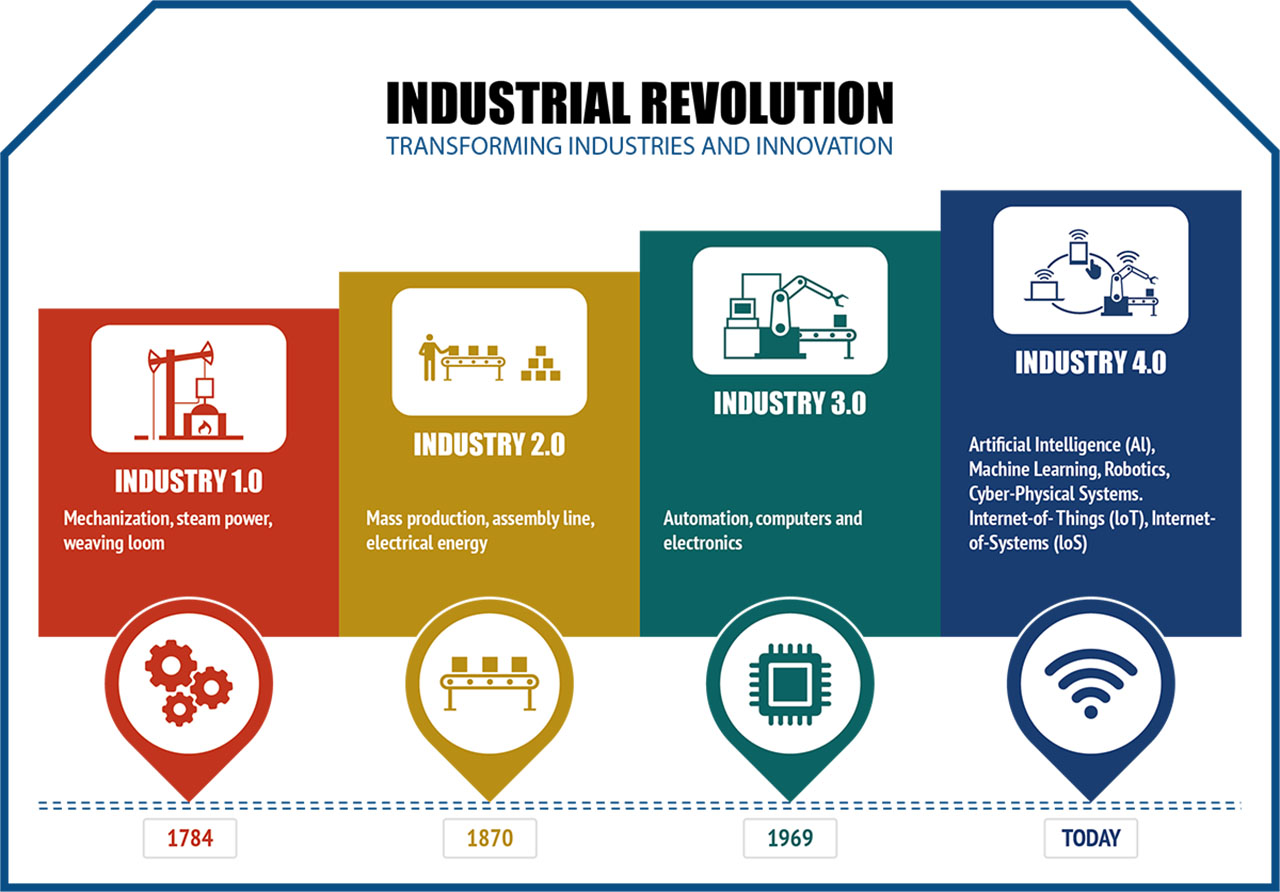
The Fourth Industrial Revolution, often called Industry 4.0, refers to the current period of rapid technological change in which digital technologies are becoming deeply integrated with industries, economies, and everyday life. Unlike previous industrial revolutions, which were driven mainly by mechanization, electricity, and mass production, the Fourth Industrial Revolution is characterized by the combination of digital, physical, and biological technologies. Artificial intelligence, robotics, the Internet of Things, big data, cloud computing, biotechnology, and advanced manufacturing are among the major technologies shaping this transformation. These developments are changing how people work, communicate, produce goods, and solve problems.
The First Industrial Revolution began in the eighteenth century with the use of steam power and mechanized production. The Second Industrial Revolution followed with electricity, assembly lines, and mass production. The Third Industrial Revolution introduced computers, electronics, and information technology, allowing many processes to become automated and digitally connected. The Fourth Industrial Revolution builds upon these earlier developments by connecting machines, data, people, and intelligent systems in increasingly sophisticated ways. Its defining feature is not simply the existence of new technologies but the way these technologies interact and reinforce one another.
Artificial intelligence is one of the most important elements of the Fourth Industrial Revolution. AI systems can analyze enormous quantities of information, recognize patterns, generate content, assist with decision-making, and perform tasks that previously required human judgment. Businesses are increasingly using AI to improve customer service, detect fraud, optimize supply chains, and automate routine activities. In healthcare, AI can support the analysis of medical images and help researchers identify potential treatments. In education, intelligent technologies can provide personalized learning experiences. These applications demonstrate how digital intelligence can influence many areas of society.
Robotics and automation are also transforming production. Modern robots are capable of performing precise and repetitive tasks quickly and consistently. Factories can use interconnected machines to monitor production and identify problems with minimal human intervention. This can increase productivity, reduce waste, and improve workplace safety in certain situations. However, automation can also change the nature of employment. Jobs involving repetitive tasks may decline, while demand for workers with technical, analytical, creative, and interpersonal skills may increase. As a result, education and lifelong learning are becoming increasingly important.
Another major feature of the Fourth Industrial Revolution is the Internet of Things, in which everyday objects and industrial equipment are connected through digital networks. Sensors can collect information about machines, vehicles, buildings, and other physical objects and transmit that information for analysis. Smart homes can automatically adjust lighting and temperature, while connected industrial systems can identify equipment problems before they cause major failures. Cities can also use connected technologies to manage transportation, energy consumption, and public services more efficiently.
The Fourth Industrial Revolution has significant potential benefits for society. New technologies can increase productivity, encourage innovation, reduce production costs, and create new industries. Digital tools can improve communication and provide access to information on an unprecedented scale. Technological advances may also contribute to solutions for major challenges such as climate change, disease, food production, and energy efficiency. For businesses, digital transformation can make it easier to develop new products and reach customers across geographical boundaries.
At the same time, this transformation creates important challenges. One concern is the potential displacement of workers whose jobs can be automated. Although technological progress can create new employment opportunities, the transition may be difficult for people whose existing skills become less valuable. Another concern is inequality. Individuals, businesses, and countries with greater access to technology, education, and investment may benefit more quickly than those without such resources. This could increase economic and social divisions if the benefits of technological development are not broadly distributed.
Privacy and cybersecurity are additional concerns. As more devices collect and exchange personal information, the amount of data available to companies and governments continues to grow. Protecting this information from misuse, theft, and unauthorized access is therefore essential. Cyberattacks against businesses, governments, hospitals, and critical infrastructure can cause serious economic and social consequences. Responsible management of data and strong cybersecurity practices are consequently important parts of the digital transformation.
The Fourth Industrial Revolution also raises ethical questions about the role of technology in human life. Decisions made with the assistance of artificial intelligence can affect employment, healthcare, education, finance, and other important areas. It is therefore necessary to consider issues such as fairness, accountability, transparency, and human oversight. Technology itself is neither automatically beneficial nor harmful; its consequences depend largely on how people design, regulate, and use it.
In conclusion, the Fourth Industrial Revolution represents a major transformation in the relationship between technology, society, and the economy. Artificial intelligence, robotics, connected devices, biotechnology, and advanced digital systems are changing how people live and work. These technologies offer significant opportunities for economic growth, innovation, and improved quality of life, but they also create challenges involving employment, inequality, privacy, cybersecurity, and ethics. The success of the Fourth Industrial Revolution will therefore depend not only on technological innovation but also on society’s ability to prepare people for change and ensure that technological progress is used responsibly. Education, adaptability, ethical decision-making, and inclusive access to technology will be essential as humanity enters an increasingly interconnected and automated future.
SPEAKING: Dr. Marcinko will be speaking and lecturing, signing and opining, teaching and preaching, storming and performing at many locations throughout the USA this year! His tour of witty and serious pontifications may be scheduled on a planned or ad-hoc basis; for public or private meetings and gatherings; formally, informally, or over lunch or dinner. All medical societies, financial advisory firms or Broker-Dealers are encouraged to submit an RFP for speaking engagements: CONTACT: Ann Miller RN MHA at MarcinkoAdvisors1738@outlook.com -OR- http://www.MarcinkoAssociates.com
Like, Refer and Subscribe
SEND IN YOUR TOPIC IDEAS, TODAY!
HOSPITALS: http://www.crcpress.com/product/isbn/9781466558731
CLINICS: http://www.crcpress.com/product/isbn/9781439879900
ADVISORS: www.CertifiedMedicalPlanner.org
FINANCE: Financial Planning for Physicians and Advisors
INSURANCE: Risk Management and Insurance Strategies for Physicians and Advisors
Dictionary of Health Economics and Finance
Dictionary of Health Information Technology and Security
Dictionary of Health Insurance and Managed Care
***
Share this:

Filed under: iMBA, Inc. | Tagged: AI, artificial intelligence, electricity, industrial-revolution-ai, Marcinko, philosophy, politics, Technology | Leave a comment »

