BOARD CERTIFICATION EXAM STUDY GUIDES Lower Extremity Trauma
[Click on Image to Enlarge]
ME-P Free Advertising Consultation
The “Medical Executive-Post” is about connecting doctors, health care executives and modern consulting advisors. It’s about free-enterprise, business, practice, policy, personal financial planning and wealth building capitalism. We have an attitude that’s independent, outspoken, intelligent and so Next-Gen; often edgy, usually controversial. And, our consultants “got fly”, just like U. Read it! Write it! Post it! “Medical Executive-Post”. Call or email us for your FREE advertising and sales consultation TODAY [678.779.8597] Email: MarcinkoAdvisors@outlook.com
Medical & Surgical e-Consent Forms
ePodiatryConsentForms.com
iMBA Inc., OFFICES
Suite #5901 Wilbanks Drive, Norcross, Georgia, 30092 USA [1.678.779.8597]. Our location is real and we are now virtually enabled to assist new long distance clients and out-of-town colleagues.
ME-P Publishing
SEEKING INDUSTRY INFO PARTNERS?
If you want the opportunity to work with leading health care industry insiders, innovators and watchers, the “ME-P” may be right for you? We are unbiased and operate at the nexus of theoretical and applied R&D. Collaborate with us and you’ll put your brand in front of a smart & tightly focused demographic; one at the forefront of our emerging healthcare free marketplace of informed and professional “movers and shakers.” Our Ad Rate Card is available upon request [678-779-8597].
A sunk cost fallacy is a simple logical fallacy that means sticking with a losing or failed venture or activity because you have already invested considerable time, energy, money, or other things you can’t get back. It’s the idea that because you already have incurred costs, you stick with it to “get your money’s worth.”
The sunk cost fallacy differs from other logical fallacies because it’s not a rhetorical fallacy. You may also experience a discussion with a “red herring” or “straw man” fallacy with someone. But the sunk cost fallacy is an illogical choice as a way to justify to yourself why you keep doing something.
Posted on June 4, 2024 by Dr. David Edward Marcinko MBA MEd CMP™
MEDICAL EXECUTIVE-POST–TODAY’SNEWSLETTERBRIEFING
***
Essays, Opinions and Curated News in Health Economics, Investing, Business, Management and Financial Planning for Physician Entrepreneurs and their Savvy Advisors and Consultants
“Serving Almost One Million Doctors, Financial Advisors and Medical Management Consultants Daily“
A Partner of the Institute of Medical Business Advisors , Inc.
Dollar General has ended a pilot program with mobile care provider DocGo, becoming the latest retailer to wind down primary care operations, spokespeople from both companies confirmed to Healthcare Brew on May 31st. The retail giant—the largest in the US by number of stores—began the healthcare partnership in 2023 after announcing ambitions to establish itself as a “health destination” two years prior. DocGo and Dollar General offered mobile health clinics with basic, preventive, and urgent care services at three stores in Tennessee. Dollar General executives previously said in a June 2023 press release that they would expand the DocGo pilot program to more stores.
The S&P 500® index (SPX) rose 5.89 points (0.1%) to 5,283.40; the Dow Jones Industrial Average® ($DJI) lost 115.29 points (0.3%) to 38,571.03; the NASDAQ Composite® ($COMP) advanced 93.65 points (0.6%) to 16,828.67.
The 10-year Treasury note yield (TNX) declined more than 11 basis points to 4.40%, near a two-week low.
The CBOE Volatility Index® (VIX) rose 0.19 to 13.11.
🟢 What’s up?
GameStop shares rose 21% after Roaring Kitty revealed his position in the stock. Fellow meme stocks popped in tandem, including AMC Holdings rising by 11.43%.
Bio-Path Holdings soared 56.80% after announcing strong phase 2 trial results for its new acute myeloid leukemia treatment.
Coherent shares popped 22.98% after the company announced it had poached Jim Anderson, the extremely competent CEO of Lattice Semiconductor—whose shares plummeted 15.49%.
What’s down?
GSK dropped 8.65% on the news that a Delaware court will allow scientific evidence to be heard in a series of lawsuits regarding the discontinued heartburn drug Zantac.
Boston Beer fell 3.25% after shareholders decided to take their winnings and run following Friday’s big pop after news of its apparent acquisition by Suntory.
Tractor Supply shares toppled 6.21%, likely on poor manufacturing news from the ISM Index, while Halliburton shares fell 5.34%, likely on poor oil news from OPEC+.
Dozens of Mexican stocks and ETFs tumbled today on the election of a new president. The steepest decline was seen by Grupo Financiero Banorte, SAB, which fell 11.38%.
Cyberattacks around the country are wreaking havoc on the ground at targeted hospitals, but a new study shows that security breaches hurt surrounding providers, too. The research published in JAMA on May 29 found that cyberattacks led to a decrease in emergency department (ED) visits at attacked hospitals and an increase in ED patients at nearby hospitals.
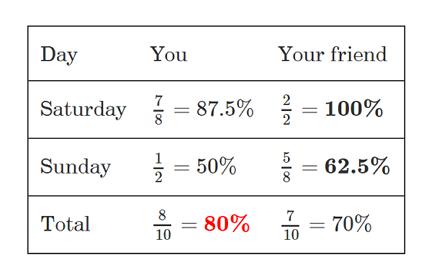
Simpson’s paradox (or Simpson’s reversal, Yule–Simpson effect, amalgamation paradox, or reversal paradox) is a phenomenon in probability and statistics, in which a trend appears in several different groups of data but disappears or reverses when these groups are combined.
This result is often encountered in social-science and medical-science statistics and is particularly problematic when frequency data is unduly given causal interpretations. The paradox can be resolved when causal relations are appropriately addressed in the statistical modeling.
Simpson’s paradox has been used as an exemplar to illustrate to the non-specialist or public audience the kind of misleading results misapplied statistics can generate. Martin Gardner wrote a popular account of Simpson’s paradox in his March 1976 Mathematical Games column in Scientific American.
Edward H. Simpson first described this phenomenon in a technical paper in 1951, but the statisticians Karl Pearson et al., in 1899, and Udny Yule, in 1903, had mentioned similar effects earlier. The name Simpson’s paradox was introduced by Colin R. Blyth in 1972.
The quality-adjusted life year or quality-adjusted life-year (QALY) is a generic measure of disease burden, including both the quality and the quantity of life lived.
It is used in economic evaluation to assess the value for money of medical interventions. One QALY equates to one year in perfect health. If an individual’s health is below this maximum, QALYs are accrued at a rate of less than 1 per year.
ASSESSMENT: To be dead is associated with 0 QALYs. QALYs can be used to inform personal decisions, to evaluate programs, and to set priorities for future programs
Your thoughts and comments on this ME-P are appreciated. Feel free to review our top-left column, and top-right sidebar materials, links, URLs and related websites, too. Then, subscribe to the ME-P. It is fast, free and secure.
Speaker: If you need a moderator or speaker for an upcoming event, Dr. David E. Marcinko; MBA – Publisher-in-Chief of the Medical Executive-Post – is available for seminar or speaking engagements. Contact: MarcinkoAdvisors@msn.com
In 2021, women’s life expectancy was 79.3, while men’s was 73.5—the largest gap since 1996, according to a new study in JAMA Internal Medicine. Covid contributed to 40% of the difference, as men are more likely to work in industries with high rates of exposure, like transportation (and women are more likely to be vaccinated).
But the opioid epidemic was also a major factor: Drug overdoses, which are more common in men than women, accounted for about 30% of the life expectancy gap.







 Support our online development, and advance our onground research initiatives in free market economics, as we seek to showcase the brightest Next-Gen minds.
THE ME-P DISCLAIMER: Posts, comments and opinions do not necessarily represent iMBA, Inc., but become our property after submission. Copyright © 2006 to-date. iMBA, Inc allows colleges, universities, medical and financial professionals and related clinics, hospitals and non-profit healthcare organizations to distribute our proprietary essays, photos, videos, audios and other documents; etc. However, please review copyright and usage information for each individual asset before submission to us, and/or placement on your publication or web site. Attestation references, citations and/or back-links are required. All other assets are property of the individual copyright holder.
Support our online development, and advance our onground research initiatives in free market economics, as we seek to showcase the brightest Next-Gen minds.
THE ME-P DISCLAIMER: Posts, comments and opinions do not necessarily represent iMBA, Inc., but become our property after submission. Copyright © 2006 to-date. iMBA, Inc allows colleges, universities, medical and financial professionals and related clinics, hospitals and non-profit healthcare organizations to distribute our proprietary essays, photos, videos, audios and other documents; etc. However, please review copyright and usage information for each individual asset before submission to us, and/or placement on your publication or web site. Attestation references, citations and/or back-links are required. All other assets are property of the individual copyright holder.




 What’s down?




 The Leading Business Education Network for Doctors, Financial Advisors and Health Industry Consultants