
Why Invest … At all!
DJIA plummets 470 today!
By Lon Jefferies CFP MBA lon@networthadvice.com | http://www.networthadvice.com
 Why do we invest in the stock market? To make money so we can improve our standard of living, right?
Notice that we aren’t investing just to get our money back. If we simply wanted our money back, we would place the money in a savings account at a bank where we would likely be able to access it any time and know that we could redeem it at full value.
However, making money is better than simply getting our invested dollars back, so there has to be a trade off for receiving that additional benefit.
Market Corrections
Of course, the trade off is that investing in the market involves more risk than simply depositing money in a bank account. The additional return that is required by investors for investing in an asset that could potentially lose money is called the equity risk premium. There must be a potential downside in exchange for the larger reward that can be obtained by investing in the stock market. Otherwise, no one would ever deposit money into the more secure bank accounts and people would always invest in the stock market generating superior returns. Unfortunately, this would make things too easy, and as we have learned our whole lives, the easier a goal is the less reward we get for achieving that goal. That is why positions that can only be filled by a select few individuals with rare talents (CEOs, doctors, Lebron James) are handsomely compensated.
By now, most people know that over a sufficiently lengthy period of time, the stock market has historically produced returns of approximately 10% per year. This seems like a simple and easy way to make money, so why don’t all investors buy stocks and hold them for extended periods of time? The fact that we aren’t all rich suggests that buying stocks and allowing the market time to do its thing isn’t easy. This is because enduring risk and suffering losses creates negative emotions that get the best of many investors, causing them to sell at the wrong time and stop investing new dollars.
Yet, when we refer back to the concept that the tougher the task the greater the reward, we should be happy that buying and holding stocks isn’t easy because it makes the strategy more profitable.
For this reason, the next time the market goes through a correction or even a crash, wise investors should be grateful. Market volatility causes unsuccessful investors to sell when prices are down and increases the rewards for those who can stick with their investment strategy by holding their assets or even buying new positions.
***

[Publisher Dr. DE Marcinko’s Grateful Bear Market ReSet and ReLaxation Time]
***
Supply and Demand
Supply and demand suggests that when the markets are decreasing in value, more people are selling assets than buying. The people who are selling their investments at a loss create an equity risk premium for those who can endure market volatility. This increases the reward for successful investors by both providing an opportunity to buy assets when they are inexpensive, and reminding the marketplace that investing in volatile positions is unpleasant. Of course, things that are unpleasant aren’t easy to accomplish, which means there is a large benefit for achieving those things.
Thus, market corrections are great for successful investors because it is volatility and easily-rattled buy-and-sell investors that enable buy-and-hold investors to make significant profits over the long term. In fact, it wouldn’t be possible for stock market investors to make money without periodic intervals of unpleasantness as it is this discomfort which causes some investors to sell and creates an equity risk premium for the rest of us.
***
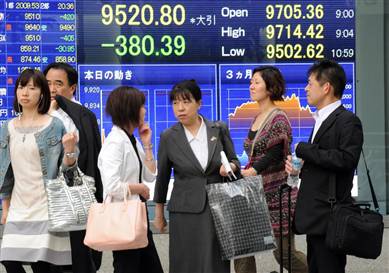
[Japanese Markets]
***
Great Fall of China
Until the Great Fall of China recently, it has been easy for investors to buy and hold for the last six years as the market has been nothing but accommodating since early 2009.
However, when things get too easy, it reduces our reward for being a long-term investor because everyone can do it. For this reason, we need the market to experience a correction at some point to shake out the unsuccessful investors, causing them to sell assets and create an equity risk premium once more.
Assessment
When the next correction occurs, you can either sell assets and create a risk premium for others, or you can stay invested and take advantage of the money unsuccessful investors leave on the table. Successful investors with a sufficiently lengthy investment time horizon remind themselves of this concept frequently so that when the market experiences a decline they aren’t overcome by fear but grateful for the opportunity provided by the short-sighted.
Conclusion
Your thoughts and comments on this ME-P are appreciated. Feel free to review our top-left column, and top-right sidebar materials, links, URLs and related websites, too. Then, subscribe to the ME-P. It is fast, free and secure.
Speaker: If you need a moderator or speaker for an upcoming event, Dr. David E. Marcinko; MBA – Publisher-in-Chief of the Medical Executive-Post – is available for seminar or speaking engagements. Contact: MarcinkoAdvisors@msn.com
OUR OTHER PRINT BOOKS AND RELATED INFORMATION SOURCES:
Sponsors Welcomed: Credible sponsors and like-minded advertisers are always welcomed.

Front Matter with Foreword by Jason Dyken MD MBA

“BY DOCTORS – FOR DOCTORS – PEER REVIEWED – FIDUCIARY FOCUSED”
Filed under: Investing, Portfolio Management | Tagged: Great Fall of China, Investing, Lon Jefferies MBA CFP®, Market Corrections, Supply and Demand | 6 Comments »







 Support our online development, and advance our onground research initiatives in free market economics, as we seek to showcase the brightest Next-Gen minds.
THE ME-P DISCLAIMER: Posts, comments and opinions do not necessarily represent iMBA, Inc., but become our property after submission. Copyright © 2006 to-date. iMBA, Inc allows colleges, universities, medical and financial professionals and related clinics, hospitals and non-profit healthcare organizations to distribute our proprietary essays, photos, videos, audios and other documents; etc. However, please review copyright and usage information for each individual asset before submission to us, and/or placement on your publication or web site. Attestation references, citations and/or back-links are required. All other assets are property of the individual copyright holder.
Support our online development, and advance our onground research initiatives in free market economics, as we seek to showcase the brightest Next-Gen minds.
THE ME-P DISCLAIMER: Posts, comments and opinions do not necessarily represent iMBA, Inc., but become our property after submission. Copyright © 2006 to-date. iMBA, Inc allows colleges, universities, medical and financial professionals and related clinics, hospitals and non-profit healthcare organizations to distribute our proprietary essays, photos, videos, audios and other documents; etc. However, please review copyright and usage information for each individual asset before submission to us, and/or placement on your publication or web site. Attestation references, citations and/or back-links are required. All other assets are property of the individual copyright holder.







 The Leading Business Education Network for Doctors, Financial Advisors and Health Industry Consultants