
More Complex than Realized by Some Doctors
[By Dr. David Edward Marcinko; FACFAS, MBA, CMP™]
[By Professor Hope Rachel Hetico; RN, MHA, CMP™]
Physician-investors may find themselves paying advisory fees, brokerage commissions, and other sales charges and expenses. All of these layers of expense can reduce or eliminate the advantage of professional management, if not monitored carefully. Also, fees can have a major impact on investment results. As a percentage of the portfolio, they normally range from low of 15–30 basis points (or .15% to .30%, a basis point is one one-hundredth of one percent) to a high of 300–400 basis points or even higher.
Charges are Universal
All portfolio managers, mutual funds, and investment advisors charge fees in one form or another. Ultimately, they must justify their fees by creating value added, or they would not be in business. Value added includes tangibles, such as greater investment return, as well as intangibles, such as assurance that the investment plan is successfully implemented and monitored, investor convenience, and professional service.
Comparisons Required
Always compare investment performance of funds or managed accounts after fees are deducted; only then can adequate comparisons be made. Also, compare fees within asset classes. Management fees and expenses of investing in bonds or bond funds are much different than the fees of investing in, for example, small companies or emerging market stocks. Whereas 100–200 basis points of fees may be appropriate for an equity portfolio or fund, similar charges may offset the advantages of a managed bond portfolio. With managed bond portfolios, real bond returns have limited long-term potential, because returns are ultimately based on interest rates. For example, if a 3% real (i.e., after inflation) return is expected, 200 basis points in fees may produce a negative after-tax result: 3% real return minus 2% fees minus 10% taxes equals a negative 9% total return.
Sales Charges
Mutual funds (and some private portfolio managers) charge sales charges to sell or “distribute” the product. Investors who buy funds through the advice of brokers or “commission based” financial planners will pay a sales load. The many combinations of sales charges fall into three basic categories: front-end, deferred (or back-end), and continuous.
Front-End Fees
Front-end fees are a direct assessment against the initial investment and are limited to a maximum of 8.5%. They usually are stated either as a percentage of the investment or as a percentage of the investment, net of sales charges. For example, a 6% charge on a $10,000 investment is really a $600 charge to invest $9,400 or a real charge of 6.4%. Many low-load funds charge in the range of 1% to 3%. Rather than pay brokers or other purveyors, these fund companies or sponsors use the charges to offset selling or distribution costs. Although rare, some funds charge a load against reinvested dividends.
Deferred Charges
Deferred charges (or back-end loads, or redemption fees) come in many forms. Often, the longer the investor stays with the fund the smaller the charge is upon fund redemption. A typical sliding scale used for deferred charges may be 5-4-3-2-1, where redemption in year 1 is charged 5%, and redemption in year 5 is charged 1%; after year 5, there are no sales charges. Sometimes deferred charges are combined with front-end charges.
Redemption Fees
Certain quoted redemption fees may not apply after a period, such as one year. Funds often use such fees to discourage the trading of funds. Frequently, these charges are paid to the fund itself rather than to the fund management company; or broker. Long-term physician investors actually benefit from this fee structure; short-term shareholders who redeem shares bear the additional liquidation costs to satisfy redemption requests.
Continuous Charges
Continuous sales charges, known as 12b-1 fees for the SEC rule governing such charges, represent ongoing charges to pay distribution costs, including those of brokers who sell and maintain accounts, in which case they are known as “trail commissions.” The fund company may be reimbursed for distribution costs as well. In the prospectus, funds quote 12b-1 charges in the form of a maximum charge. This does not mean that the full charge is incurred, however. For example, a fund with a .75% 12b-1 approved plan may actually incur much lower expenses than .75%. Compared to front-end charges, a .75% per year sales charge of this type could be more costly to investment performance, given enough time.
Sales Loads
Portfolio managers can charge sales loads as well, usually in the form of a traditional WRAP fee arrangement (the investor pays a broker an all-inclusive fee that covers portfolio manager fees and transactions costs). No-load funds can be purchased through brokers or discount brokerage firms. The broker charges a commission for such purchases or sales.
Management Advisory Fees
Private account managers and mutual funds charge a fee for managing the portfolio. These fees typically range between 25 and 150 basis points. Bond funds tend to charge in the range of 25 to 100 basis points, and equity funds charge 75 to 150 basis points. Fees charged by private account managers usually are higher because of the direct attention given to a single doctor client. These managers do not pass along additional administrative costs, however, because they pay them out of the management fee. These management fees come in many forms. Tiered fees can charge smaller accounts a higher fee than larger accounts. Mutual funds often charge “group fees”: a fund family may tier its fee structure to encompass all funds offered by the fund family or by a group of similar funds (such as all international equity funds). Performance fees, although subject to SEC regulations, may be charged as well. A performance fee may be charged if the manager exceeds a certain return or outperforms a particular index or benchmark portfolio.
Administrative Expenses and Expense Ratios
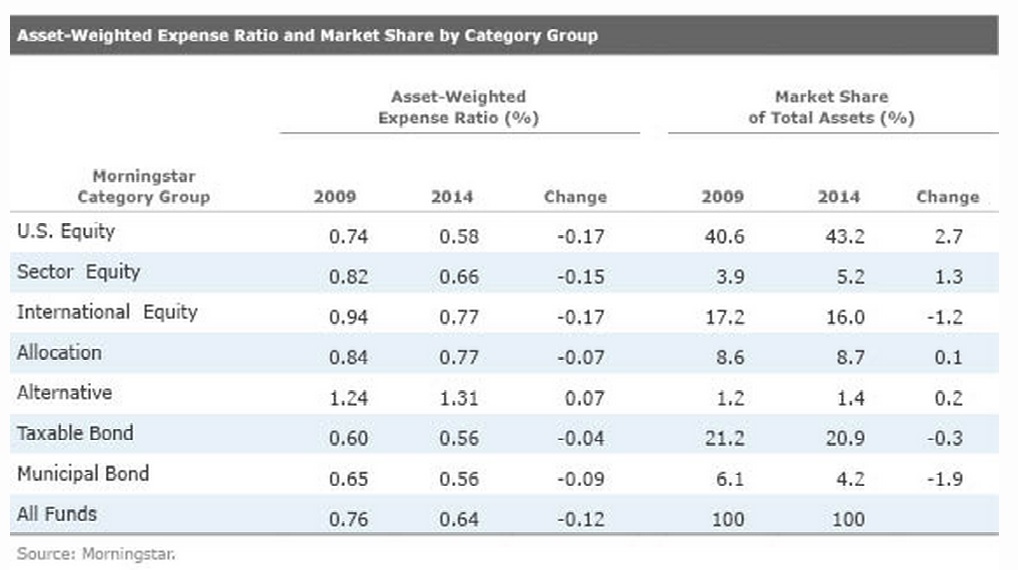
Most private managers are compensated with higher management fees, as mentioned above. Therefore, many private accounts usually do not incur separate administrative expenses. Some management firms charge custodial fees or similar account maintenance fees. Mutual funds incur a number of administrative expenses, including shareholder servicing, prospectuses, reporting, legal and auditing costs, and registration and custodial costs. Mutual funds report these expenses and management fees as an expense ratio—the ratio of expenses to the average net assets of the fund. Expense ratios also include distribution costs or 12b-1 charges.
Brokerage Commissions
Almost all buyers and sellers of securities incur brokerage commissions. Private “wealth managers” usually provide commission schedules to prospective physician-investors or current clients. Some private managers charge higher management fees and a discounted commission schedule, while others charge lower fees and higher commissions. These combinations of management and commission fees make comparison of prospective managers’ cost structures a difficult task. Most portfolio managers obtain research from brokerage firms, which can affect the commission relationship between broker and manager. Reduced commission schedules exchanged for information are known as “soft dollar costs.” Mutual funds may negotiate similar reduced commission schedules. In this regard, more-competitive brokerage firms can charge lower fees to investors. Commissions are not part of the expense ratio, because they are a part of the security cost basis. Firms with higher portfolio turnover are more likely to have higher commission costs than those with low turnover. Asset class impacts such costs as well. For example, small-cap stocks may be more expensive than large-cap stocks, or foreign bonds may be more expensive than domestic bonds.
Total Cost Approach
To arrive at a relevant comparison of fees among funds and managers, and to see what the total effect of fees on investment performance is, analyze the various charges on a net present value basis. Begin with a given investment amount (e.g., $10,000) and factor in fees over time to arrive at the present value of those fees. Present the comparisons in an easy-to-use table.
Sources of Fee Information
Consult the mutual fund prospectus for fee information. The prospectus has a fund expenses section that summarizes sales charges, expense ratios, and management fees; it does not cover commissions, however. Expense ratios usually are reported for the past 10 years. Commission or brokerage fees are more difficult to find. The statement of additional information and often the annual report disclose the annual amounts paid for commissions. When the total commission paid is divided by average asset values a sense of commission costs can be determined. Private wealth managers disclose fee structures in the ADV I filed with the SEC. Managers must disclose these fees to potential and current clients by providing either ADV Part II or equivalent form to the investor.
Reporting Services
Reporting services, such as Morningstar and Lipper, provide similar information from their own research of mutual funds. These services can be extremely beneficial, because fee information is summarized and often accounted for in the reports’ investment return calculations. This helps the investor and planner make good comparisons of funds. Information services that cover private managers provide information, primarily about management fees.
Assessment
To the extent that online trading, deep discount brokerages, lack of SEC and FINRA oversight, and the recent financial, insurance and banking meltdown has affected the above, it is left up to your discretion and personal situation. Generally, all fess are, and should be, negotiable.
Disclaimer: Both contributors are former licensed insurance agents and financial advisors.
Conclusion
Your thoughts and comments on this ME-P are appreciated. Feel free to review our top-left column, and top-right sidebar materials, links, URLs and related websites, too. Then, subscribe to the ME-P. It is fast, free and secure.
Link: http://feeds.feedburner.com/HealthcareFinancialsthePostForcxos
Speaker: If you need a moderator or speaker for an upcoming event, Dr. David E. Marcinko; MBA – Publisher-in-Chief of the Medical Executive-Post – is available for seminar or speaking engagements. Contact: MarcinkoAdvisors@msn.com
OUR OTHER PRINT BOOKS AND RELATED INFORMATION SOURCES:

***
Filed under: "Advisors Only", "Doctors Only", Ethics, Experts Invited, Financial Planning, Glossary Terms, Investing, Portfolio Management, Recommended Books, Research & Development | Tagged: 12b-1 fees, administrative fees, ADV I, ADV II, advisory fees, AIG, assets under management, back end fees, banking, banks, basis points, brokerage commissions, certified financial planner, certified medical planner, CFPs, CMPs, continuous charges, cost structures, CPAs, david marcinko, deferred sales charges, discount brokers, expense ratios, FAs, fee-only expenses, financial advisors, FINRA, front end fees, full services brokers, group fees, hard dollars, hope hetico, insurance, investing sales charges, investing sales expenses, investment returns, Lipper, loads, manaeg money AUMs, management advisory fees, MBAs, Morningstar, no loads, PhDs, Portfolio Management, redemption fees, RIA, sales loads, SEC, soft dollars, WRAP accounts | 8 Comments »







 Support our online development, and advance our onground research initiatives in free market economics, as we seek to showcase the brightest Next-Gen minds.
THE ME-P DISCLAIMER: Posts, comments and opinions do not necessarily represent iMBA, Inc., but become our property after submission. Copyright © 2006 to-date. iMBA, Inc allows colleges, universities, medical and financial professionals and related clinics, hospitals and non-profit healthcare organizations to distribute our proprietary essays, photos, videos, audios and other documents; etc. However, please review copyright and usage information for each individual asset before submission to us, and/or placement on your publication or web site. Attestation references, citations and/or back-links are required. All other assets are property of the individual copyright holder.
Support our online development, and advance our onground research initiatives in free market economics, as we seek to showcase the brightest Next-Gen minds.
THE ME-P DISCLAIMER: Posts, comments and opinions do not necessarily represent iMBA, Inc., but become our property after submission. Copyright © 2006 to-date. iMBA, Inc allows colleges, universities, medical and financial professionals and related clinics, hospitals and non-profit healthcare organizations to distribute our proprietary essays, photos, videos, audios and other documents; etc. However, please review copyright and usage information for each individual asset before submission to us, and/or placement on your publication or web site. Attestation references, citations and/or back-links are required. All other assets are property of the individual copyright holder.






 DR. DAVID EDWARD MARCINKO MBA MEd CMP™







 The Leading Business Education Network for Doctors, Financial Advisors and Health Industry Consultants