How the Federal Reserve Works

By Jason Dyken MD MBA
Tip: Checks. Due to the onslaught of electronic check collection, the Federal Reserve now processes paper checks at just one location nationwide, down from 45 locations in 2003.
Source: Board of Governors of the Federal Reserve System, 2016
QUESTION
Have you ever taken a close look at paper money? Each U.S. bill has the words “Federal Reserve Note” imprinted across the top.
But many individuals may not know why the bill is issued by the Federal Reserve and what role the Federal Reserve plays in the economy.
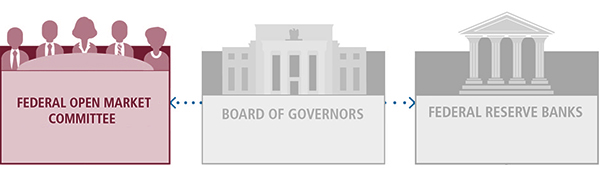
How the FOMC Really works?
Here’s an inside look
The Federal Reserve, often referred to as the Fed, is the country’s central bank. It was founded by Congress in 1913 to provide the nation with a safer, more flexible, and more stable monetary and financial system. Prior to its creation, the U.S. economy was plagued by frequent episodes of panic, bank failures, and limited credit.
The Fed has four main roles in the U.S. economy.
Economy Watch
In addition to its other duties, the Fed has been given three mandates with the economy: maintain maximum employment, maintain stable price levels, and maintain moderate long-term interest rates.
Fast Fact: Unwieldy Patchwork. In the early 1800s, the U.S. had no central bank and no common currency. The monetary system ran through a patchwork of state-chartered banks with no federal regulation. By 1860, there were nearly 8,000 of these banks, each issuing its own banknotes.
Source: Federal Reserve Bank of San Francisco, 2018
It’s important to remember that “the Fed” cannot directly control employment, inflation, or long-term interest rates. Rather, it uses a number of tools at its disposal to influence the availability and cost of money and credit. This, in turn, influences the willingness of consumers and businesses to spend money on goods and services.
For example, if the Fed maneuvers short-term interest rates lower, borrowing money becomes less expensive and people may be motivated to spend. Consumer spending may stimulate economic growth, which may cause companies to produce more product and potentially increase employment. When short-term rates are low, the Fed closely monitors economic activity to watch for signs of rising prices.
On the other hand, if the Fed pushes short-term rates higher, borrowing money becomes more expensive and people may be less motivated to spend. This may, in turn, slow economic growth and cause companies to decrease employment. When short-term rates are high, the Fed must watch for signs of a decline in overall price levels.

Supervise and Regulate
The Fed establishes and enforces the regulations banks, savings and loans, and credit unions must follow. It works with other federal and state agencies to ensure these financial institutions are financially sound and consumers are receiving fair and equitable treatment. When an organization is found to have problems, the Fed uses its authority to have the organization correct the problems.
Financial System
The Fed maintains the stability of the financial system by providing payment services. In times of financial strain, the Fed is authorized to step in as a lender of last resort, providing liquidity to an individual bank or the entire banking system.
For example, the Fed may step in and offer to buy the government bonds owned by a particular bank. By so doing, the Fed provides the bank with money that it can use for its own purposes.
Banker for Banks, U.S. Government
The Fed provides financial services to banks and other depository institutions and to the U.S. government. For banks, savings and loans, and credit unions, it maintains accounts and provides various payment services, including collecting checks, electronically transferring funds, distributing new money, and receiving and destroying old, worn-out money. For the federal government, the Fed pays Treasury checks; processes electronic payments; and issues, transfers, and redeems U.S. government securities.
Each day, the Fed is behind the scenes supporting the economy and providing services to the U.S. financial system. And while the Fed’s duties are many and varied, its focus is to maintain confidence in banking institutions.
***
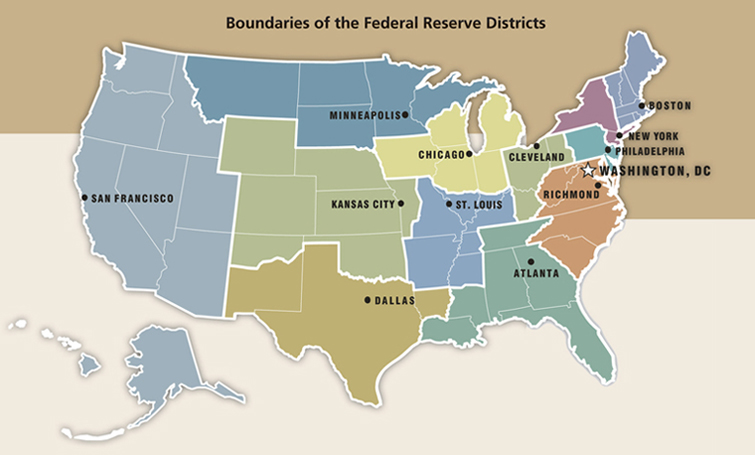
A De-Centralized Central Bank System
The Federal Reserve System consists of 12 independent banks that operate under the supervision of a federally appointed Board of Governors in Washington, D.C. Each of these banks works within a specific district, as shown.
Source: Federal Reserve Board of Governors, 2018
- U.S. Bureau of Engraving and Printing, 2018
- Federal Reserve Bank of San Francisco, 2018
- Board of Governors of the Federal Reserve System, 2016
Conclusion
Your thoughts and comments on this ME-P are appreciated. Feel free to review our top-left column, and top-right sidebar materials, links, URLs and related websites, too. Then, subscribe to the ME-P. It is fast, free and secure.
Speaker: If you need a moderator or speaker for an upcoming event, Dr. David E. Marcinko; MBA – Publisher-in-Chief of the Medical Executive-Post – is available for seminar or speaking engagements.
Book Marcinko: https://medicalexecutivepost.com/dr-david-marcinkos-bookings/
Subscribe: MEDICAL EXECUTIVE POST for curated news, essays, opinions and analysis from the public health, economics, finance, marketing, IT, business and policy management ecosystem.
DOCTORS:
“Insurance & Risk Management Strategies for Doctors” https://tinyurl.com/ydx9kd93
“Fiduciary Financial Planning for Physicians” https://tinyurl.com/y7f5pnox
“Business of Medical Practice 2.0” https://tinyurl.com/yb3x6wr8
HOSPITALS:
“Financial Management Strategies for Hospitals” https://tinyurl.com/yagu567d
“Operational Strategies for Clinics and Hospitals” https://tinyurl.com/y9avbrq5
***
 8
8
Filed under: Health Economics | Tagged: fed, Federal Open Market Committee, FOMC, Jason Dyken MD MBA | 2 Comments »







 Support our online development, and advance our onground research initiatives in free market economics, as we seek to showcase the brightest Next-Gen minds.
THE ME-P DISCLAIMER: Posts, comments and opinions do not necessarily represent iMBA, Inc., but become our property after submission. Copyright © 2006 to-date. iMBA, Inc allows colleges, universities, medical and financial professionals and related clinics, hospitals and non-profit healthcare organizations to distribute our proprietary essays, photos, videos, audios and other documents; etc. However, please review copyright and usage information for each individual asset before submission to us, and/or placement on your publication or web site. Attestation references, citations and/or back-links are required. All other assets are property of the individual copyright holder.
Support our online development, and advance our onground research initiatives in free market economics, as we seek to showcase the brightest Next-Gen minds.
THE ME-P DISCLAIMER: Posts, comments and opinions do not necessarily represent iMBA, Inc., but become our property after submission. Copyright © 2006 to-date. iMBA, Inc allows colleges, universities, medical and financial professionals and related clinics, hospitals and non-profit healthcare organizations to distribute our proprietary essays, photos, videos, audios and other documents; etc. However, please review copyright and usage information for each individual asset before submission to us, and/or placement on your publication or web site. Attestation references, citations and/or back-links are required. All other assets are property of the individual copyright holder.







 The Leading Business Education Network for Doctors, Financial Advisors and Health Industry Consultants