HUMAN TOUCH: Needed in Medicine

By Staff Reporters

***

***

According to Fierce Healthcare, 60% of patients say they are willing to switch doctors for a better communications experience, according to a survey. Patients want more of a “human touch” when texting their providers, like conversational message exchanges. 

COMMENTS APPRECIATED

Thank You

***

***

PODCAST: How Health Care Can Win by Adapting to Changes in Consumer Behavior

LESSONS FROM THE RETAIL SECTOR

See the source image

***

Discover how ProMedica uses customer feedback and a digital-first approach to consumers to achieve stellar results across more than 400 facilities in 28 states.

PODCAST: https://www.youtube.com/watch?v=861em_pJfVM&t=3070s

YOUR THOUGHTS AND COMMENTS ARE APPRECIATED.

***

Thank You

***

Doctor-Patient RELATIONSHIPS in the MODERN Health 2.0 ERA

Join Our Mailing List 

[Can We Talk? – A Collaborative Shift in Bedside Manner]

By Mario Moussa PhD MS

By David E. Marcinko MBBS MBA CMP

By Jennifer Tomasik PhD MS

Jennifer Tomasik

“The single biggest problem in communication is the illusion that it has taken place.”

George Bernard Shaw 

Star Trek fans have seen the future of medicine.

Leonard McCoy, also known as “Bones,” describes himself as a “simple country doctor,” although he plies his trade using 23rd. century medical technology. A deeply caring humanist, Bones often spars with the hyper-logical Spock—half human, half Vulcan. But as the Star Trek saga unfolds through The Next Generation, Deep Space Nine, and finally Voyager, Star Fleet physicians become increasingly rational and less recognizably human. The Voyager’s “Doctor” is no person at all. “He” is an infallible computer program designed to mimic compassion, self-assurance, and other soulful qualities.[i]

Health/Web 2.0

Today, when patients communicate through instant messaging, Twitter, Facebook, and other Health/Web 2.0 electronic mediums, they might feel that health providers are already more like the virtual “Doctor” than the all-too-human “Bones.” Before long, according to one technology expert, 20% – 50% of all doctor-patient communication will be virtual.[ii] But we suggest you pause before rocketing ahead into this brave new future that advocates call Health 2.0—the application of social media tools to the health care environment.

Electronic technology

Electronic technology in all of its forms has obviously had a profound impact on medicine. We focus here on just one of its most notable effects: the changing doctor-patient relationship. We believe Health 2.0 has the potential to deepen this relationship—or not. It depends on how you use it.

There are an almost overwhelming number of social media tools for managing the doctor-patient relationship. How do you choose the right ones? We offer some guidance in this essay by focusing on three issues:

The issues

  1. What matters most in the doctor-patient relationship?
  2. What counts as a good relationship?
  3. How should you use social media tools to build a relationship?

We have found that there is no one best way to use Health 2.0 technology. But there is just one rule. As the novelist E.M. Forster said, “Only connect.”

***

masks

***

Conclusion

Your thoughts and comments on this ME-P are appreciated. Feel free to review our top-left column, and top-right sidebar materials, links, URLs and related websites, too. Then, subscribe to the ME-P. It is fast, free and secure.

Speaker: If you need a moderator or speaker for an upcoming event, Dr. David E. Marcinko; MBA – Publisher-in-Chief of the Medical Executive-Post – is available for seminar or speaking engagements. Contact: MarcinkoAdvisors@msn.com

  • Petrany, Stephen M. “Star Trek and the Future of Family Medicine.” Family Medicine 40.2 (2008): 132 – 133.
  • Silverman, Jennifer. “Impact of Virtual Visits on Doctor-Patient Relationship Unclear: an end to ‘true medicine’?” Ob.Gyn. News 38.21 (2003): 29.

***

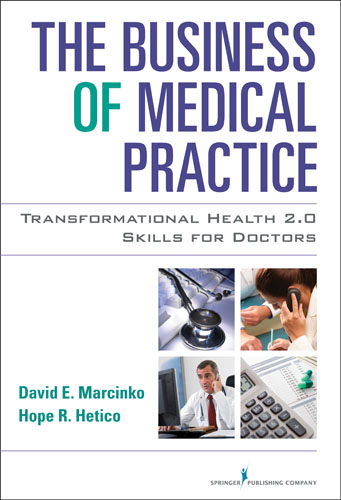
[PRIVATE MEDICAL PRACTICE BUSINESS MANAGEMENT TEXTBOOK – 3rd.  Edition]

Product DetailsProduct Details

  [Foreword Dr. Hashem MD PhD] *** [Foreword Dr. Silva MD MBA]

***

Developing New Medical Practice 2.0 “People” Skills

Join Our Mailing List 

The Times are Changing in …. 2015 and Beyond

[By Render S. Davis MHA CHE]

[By Dr. David Edward Marcinko MBA CMP™]

DEM white  shirtMedical practice today is vastly different from a generation ago, and physicians need new skills to be successful, and reduce liability risks while improving care delivery at lower costs.

In order to balance their obligations to both individual patients and to larger groups, physicians now must become more than competent clinicians.

Bedside Manner?

Traditionally, the physician was viewed as the “captain of the ship,” in charge of nearly all the medical decisions, but this changed with the dynamics of managed care and the health reform of the PP-ACA.

Today, the physician’s role may be more akin to the ship’s navigator, utilizing his or her clinical skills and knowledge of the health care environment to chart the patient’s course through a confusing morass of insurance requirements, care choices, and regulations to achieve the best attainable outcome.

Some of these new 2.0 “People” skills include:

  1. Negotiation – working to optimize the patient’s access to appropriate services and facilities;
  2. Being a team player – working in concert with other care givers, from generalist and specialist physicians, to nurses and therapists, to coordinate care delivery within a clinically appropriate and cost-effective framework;
  3. Working within the limits of professional competence – avoiding the pitfalls of payer arrangements that may restrict access to specialty physicians and facilities, by clearly acknowledging when the symptoms or manifestations of a patient’s illness require this higher degree of service; then working on behalf of the patient to seek access to them;
  4. Respecting different cultures and values – inherent in the support of the Principle of Autonomy is acceptance of values that may differ from one’s own. As the United States becomes a more culturally heterogeneous nation, health care providers are called upon to work within and respect the socio-cultural and/or spiritual framework of patients and their families;
  5. Seeking clarity on what constitutes marginal care – within a system of finite resources, physicians will be called upon to carefully and openly communicate with patients regarding access to marginal and/or futile treatments. Addressing the many needs of patients and families at the end of life will be an increasingly important challenge in both communications and delivery of appropriate, yet compassionate care;
  6. Supporting evidence-based practice – physicians should utilize outcomes data to reduce variation in treatments and achieve higher efficiencies and effectiveness of care delivery;
  7. Fostering transparency and openness in communications – physicians should be willing and prepared to discuss all aspects of care and treatment, especially when disclosing problems or issues that may arise;
  8. Exercising decision-making flexibility – treatment algorithms and clinical pathways are extremely useful tools when used within their scope, but physicians must follow the case managed patient closely and have the authority to adjust the plan if clinical circumstances warrant;
  9. Fostering “patient and family centered care – whenever possible, medical treatments should be undertaken in a way that respects the patient’s values and preferences, and recognizes the important role to be played by family in supporting the patient’s care and well-being. For details on engaging families in this process, visit the website for the Institute for Family-Centered Care at www.familycenteredcare.org.;
  10. Becoming skilled in the art of listening and interpreting — In her ground-breaking book, Narrative Ethics: Honoring the Stories of Illness, Rita Charon, MD Ph.D., a professor of Clinical Medicine at Columbia University’s College of Physicians and Surgeons, writes of the extraordinary value of utilizing the patient’s narrative, or personal story, in the care and treatment process. She notes that, “medicine practiced with narrative competence will more ably recognize patients and diseases, convey knowledge and regard, join humbly with colleagues, and accompany patients and their families through ordeals of illness.” In many ways, attention to narrative returns medicine full circle to the compassionate and caring foundations of the patient-physician relationship.

***

Masks

[The Masks of Change]

Courtesy SplitShire

*** 

Assessment

These represent only a handful of examples to illustrate the myriad of new skills that today’s savvy physicians must master in order to meet their timeless professional obligation of compassionate patient care; coupled with risk avoidance, assumption, transference and reduction mechanisms.

*NOTE: Health 2.0 is information exchange plus technology. It employs user-generated content, social networks and decision support tools to address the problems of inaccessible, fragmentary or unusable health care information. Healthcare 2.0 connects users to new kinds of information, fundamentally changing the consumer experience (e.g., buying insurance or deciding on/managing treatment), clinical decision-making (e.g., risk identification or use of best practices) and business processes (e.g., supply-chain management or business analytics.

About the Author

Render Davis was a Certified Healthcare Executive, now retired from Crawford Long Hospital at Emory University, in Atlanta, GA He served as Assistant Administrator for General Services, Policy Development, and Regulatory Affairs from 1977-95.  He is a founding board member of the Health Care Ethics Consortium of Georgia and served on the consortium’s Executive Committee, Advisory Board, Futility Task Force, Strategic Planning Committee, and chaired the Annual Conference Planning Committee, for many years.

MORE:

Channel Surfing the ME-P

Have you visited our other topic channels? Established to facilitate idea exchange and link our community together, the value of these topics is dependent upon your input. Please take a minute to visit. And, to prevent that annoying spam, we ask that you register. It is fast, free and secure.

Conclusion

Your thoughts and comments on this ME-P are appreciated. Feel free to review our top-left column, and top-right sidebar materials, links, URLs and related websites, too. Then, subscribe to the ME-P. It is fast, free and secure.

Speaker: If you need a moderator or speaker for an upcoming event, Dr. David E. Marcinko; MBA – Publisher-in-Chief of the Medical Executive-Post – is available for seminar or speaking engagements. Contact: MarcinkoAdvisors@msn.com

OUR OTHER PRINT BOOKS AND RELATED INFORMATION SOURCES:

Comprehensive Financial Planning Strategies for Doctors and Advisors: Best Practices from Leading Consultants and Certified Medical Planners(TM)* 8

A Guide to Patient Loyalty

Join Our Mailing List

A Multi-Factorial Visual Approach

Link: Chapter 15: I-Doctors I-Patients

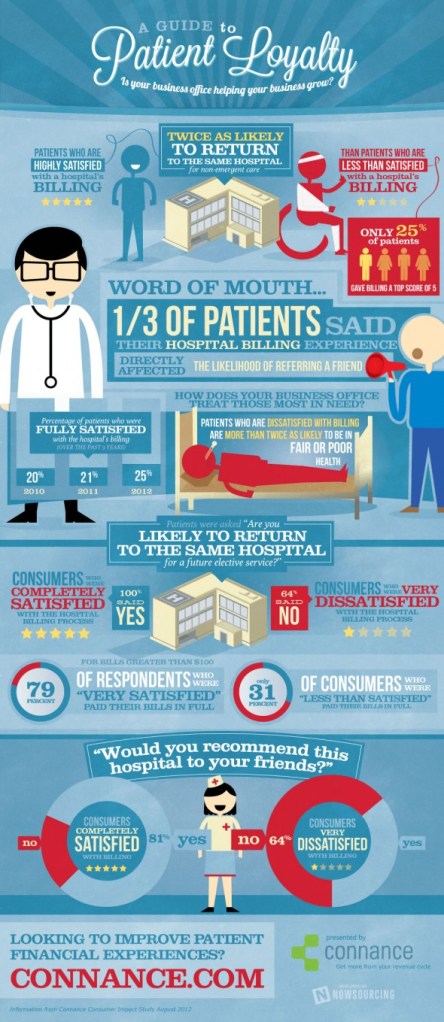
Many factors are involved when a patient has a good experience at a hospital, clinic or medical practice. One huge component in patient loyalty and satisfaction is the billing process.

This infographic colorfully shows what factors to consider in gaining and keeping loyal patients.

###

patient loyalty

Source:  www.connance.com and www.BusinessofMedicalPractice.com

Conclusion

Your thoughts and comments on this ME-P are appreciated. Feel free to review our top-left column, and top-right sidebar materials, links, URLs and related websites, too. Then, subscribe to the ME-P. It is fast, free and secure.

Link: http://feeds.feedburner.com/HealthcareFinancialsthePostForcxos

Speaker: If you need a moderator or speaker for an upcoming event, Dr. David E. Marcinko; MBA – Publisher-in-Chief of the Medical Executive-Post – is available for seminar or speaking engagements. Contact: MarcinkoAdvisors@msn.com

Our Other Print Books and Related Information Sources:

Health Dictionary Series: http://www.springerpub.com/Search/marcinko

Practice Management: http://www.springerpub.com/product/9780826105752

Physician Financial Planning: http://www.jbpub.com/catalog/0763745790

Medical Risk Management: http://www.jbpub.com/catalog/9780763733421

Hospitals: http://www.crcpress.com/product/isbn/9781439879900

Physician Advisors: www.CertifiedMedicalPlanner.org

Product Details

Understanding the Power of Consumer and Patient Sentiment

About New-Wave Social Media and Medical Marketing

By Staff Reporters

Join Our Mailing List

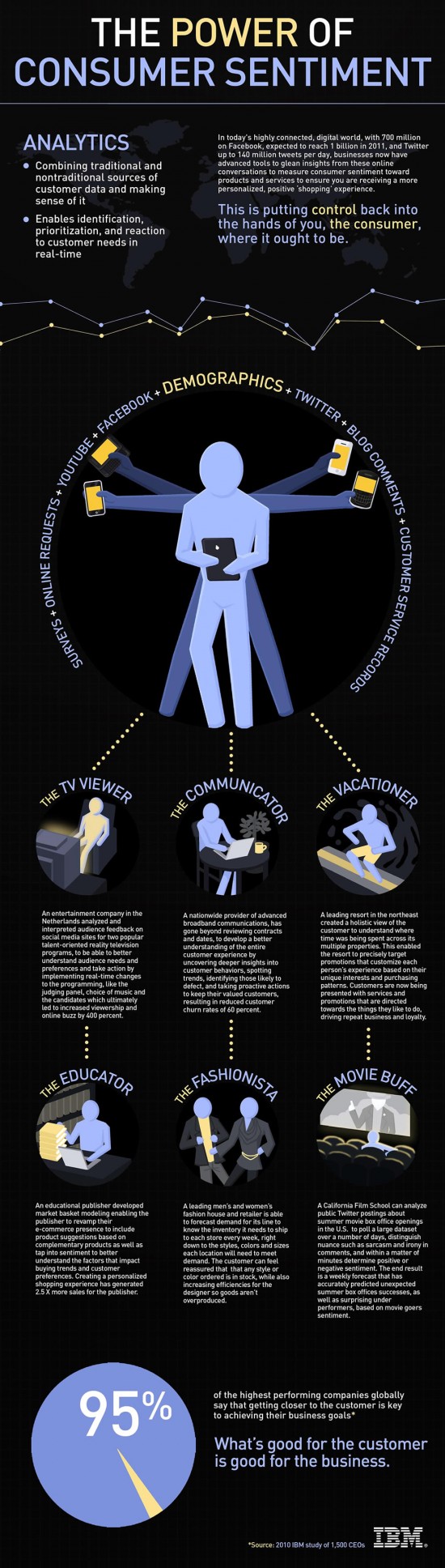
With social media and healthcare data becoming a focus for many healthcare businesses, hospitals and even medical practices, how are doctors taking advantage of consumer and new-wave patient sentiment?

Businesses like clinics and medical practices have more power than ever to start gleaning insights from online patient conversations to measure sentiment, and ultimately put power back into the hands of patient-consumers.

Source: IBM.com

Conclusion     

And so, your thoughts and comments on this ME-P are appreciated. Feel free to review our top-left column, and top-right sidebar materials, links, URLs and related websites, too. Then, subscribe to the ME-P. It is fast, free and secure.

Link: http://feeds.feedburner.com/HealthcareFinancialsthePostForcxos

Speaker: If you need a moderator or speaker for an upcoming event, Dr. David E. Marcinko; MBA – Publisher-in-Chief of the Medical Executive-Post – is available for seminar or speaking engagements. Contact: MarcinkoAdvisors@msn.com

Our Other Print Books and Related Information Sources:

Health Dictionary Series: http://www.springerpub.com/Search/marcinko

Practice Management: http://www.springerpub.com/product/9780826105752

Physician Financial Planning: http://www.jbpub.com/catalog/0763745790

Medical Risk Management: http://www.jbpub.com/catalog/9780763733421

Healthcare Organizations: www.HealthcareFinancials.com

Physician Advisors: www.CertifiedMedicalPlanner.com

Subscribe Now: Did you like this Medical Executive-Post, or find it helpful, interesting and informative? Want to get the latest ME-Ps delivered to your email box each morning? Just subscribe using the link below. You can unsubscribe at any time. Security is assured.

Link: http://feeds.feedburner.com/HealthcareFinancialsthePostForcxos

Sponsors Welcomed: And, credible sponsors and like-minded advertisers are always welcomed.

Link: https://healthcarefinancials.wordpress.com/2007/11/11/advertise

Product Details

A Survey to Understand the Modern Doctor-Patient Milieu

Doctors – Take Our Professional Contentment [“Happiness”] Survey

By Ann Miller RN MHA

[Executive-Director]

Join Our Mailing List 

www.BusinessofMedicalPractice.com

Today, when patients communicate through instant messaging, Twitter, Facebook, and other Web 2.0 electronic mediums, they might feel that health providers are already more like the virtual “Doctor” than the all-too-human “Bones.”

The Contemporary Practice Milieu

Before long, according to one technology expert, 20% – 50% of all doctor-patient communication will be virtual. But we suggest you pause before rocketing ahead into this brave new future that advocates call Health 2.0—the application of social media tools to the health care environment.

Electronic technology in all of its forms has obviously had a profound impact on medicine. We focus here on just one of its most notable effects: the changing doctor-patient relationship. We believe Health 2.0 has the potential to deepen this relationship—or not. It depends on how you use it.

Our Guidance

There are an almost overwhelming number of social media tools for managing the doctor-patient relationship. How do you choose the right ones? We offer some guidance in this essay by focusing on three issues:

  • What matters most in the doctor-patient relationship?
  • What counts as a good relationship?
  • How should you use social media tools to build a relationship?

We have found that there is no one best way to use Health 2.0 technology. But, there is just one rule. As the novelist E.M. Forster said, “Only connect.”

The Survey

And so, we ask you to opine:

  • Has your doctor-patient relationship changed in recent years with the rise of the Internet search engines like “Dr. Google and Dr. Oogle” [for dentists] and the push to empower patients to take a greater role in their own care via HD-HCPs, private or direct payment models, etc?
  • Are patients more demanding of your time and attention than in the past? Do they understand the economic pressures that affect your practice? Do they care, or should they even care?
  • How do you handle noncompliant or uncooperative patients? What strategies work best or least? Is this issue underappreciated by the people pushing to base a greater portion of reimbursement on quality measures and outcomes?
  • How much time each week do you spend on paperwork, phone calls to payers, insurance companies, and other administrative tasks? How much has this increased in the last few years? Have you reached your breaking point, yet?

Assessment

Please give us your thoughts and opinions in the text box below.

Conclusion

Your thoughts and comments on this ME-P are appreciated. Feel free to review our top-left column, and top-right sidebar materials, links, URLs and related websites, too. Then, subscribe to the ME-P. It is fast, free and secure.

Speaker: If you need a moderator or speaker for an upcoming event, Dr. David E. Marcinko; MBA – Publisher-in-Chief of the Medical Executive-Post – is available for seminar or speaking engagements. Contact: MarcinkoAdvisors@msn.com and http://www.springerpub.com/Search/marcinko

Our Other Print Books and Related Information Sources:

Health Dictionary Series: http://www.springerpub.com/Search/marcinko 

Practice Management: http://www.springerpub.com/product/9780826105752

Physician Financial Planning: http://www.jbpub.com/catalog/0763745790

Medical Risk Management: http://www.jbpub.com/catalog/9780763733421

Healthcare Organizations: www.HealthcareFinancials.com

Physician Advisors: www.CertifiedMedicalPlanner.com

Subscribe Now: Did you like this Medical Executive-Post, or find it helpful, interesting and informative? Want to get the latest ME-Ps delivered to your email box each morning? Just subscribe using the link below. You can unsubscribe at any time. Security is assured.

Link: http://feeds.feedburner.com/HealthcareFinancialsthePostForcxos

Sponsors Welcomed: And, credible sponsors and like-minded advertisers are always welcomed.

Link: https://healthcarefinancials.wordpress.com/2007/11/11/advertise

Product DetailsProduct DetailsProduct Details       

Product Details  Product Details

   Product Details 


Silverman, Jennifer. “Impact of Virtual Visits on Doctor-Patient Relationship Unclear: an end to ‘true medicine’?” Ob.Gyn. News 38.21 (2003): 29.

Understanding the Collaborative Shift in Bedside Manner

Join Our Mailing List

Doctor-Patient Relations in the Modern Era

[By Mario Moussa PhD]

[By Jennifer Tomasik MS]

[By Dr. David E. Marcinko MBA]

www.BusinessofMedicalPractice.com

When it comes to the doctor-patient relationship, Health 2.0 needs guidelines. Several leading health providers have begun to call for them. We think guidelines would, among other things, help define the right mix of virtual and live communication.

Our relationship strategies take a step in this direction. Such a framework can be used to start a productive dialogue among health providers about social media. A hospital committee or some other governing body could easily use Web 2.0 tools—a blog or a wiki—to start the discussion. Before long, there would be ample case material to flesh out general principles.

Health 2.0 Needs Guidelines

Guidelines would also address a big barrier to using Health 2.0: getting paid. Currently reimbursement policies do not cover electronic communication, so physicians have little financial incentive to use it. In a 2003 study, only 9% of physicians were willing to use e-mail to communicate with patients. This has something to do with old habits. But it has a lot to do with payment schedules, too. Guidelines should feature the research that shows the positive health outcomes of strong physician-patient relationships and how social media tools help build relationships. In today’s “pay for performance” market, these outcomes help build credibility for wired communication.

Training Support

We also think Health 2.0 guidelines need to be supported by training. Studies show that training in interviewing and interpersonal skills produces substantial differences in the quality of care. Training in Health 2.0 communication would likely have a similar impact.

Assessment

Paradoxically, as patients can access and control more data, they have a greater need for trusted physicians who communicate well using various mediums. As Ted Epperly, President of the American Academy of Family Physicians, has said, patients need “wise counsel” in sifting through the prodigious amounts of information available via Health 2.0. And physicians as well as patients need to learn how to navigate this environment. No longer the sole authoritative source of medical information, physicians need to adapt, becoming an experienced partner and guide for inquiring patients. Training can help doctors get comfortable in this new role.

Conclusion

And so, your thoughts and comments on this ME-P are appreciated. Feel free to review our top-left column, and top-right sidebar materials, links, URLs and related websites, too. Then, subscribe to the ME-P. It is fast, free and secure.

Speaker: If you need a moderator or speaker for an upcoming event, Dr. David E. Marcinko; MBA – Publisher-in-Chief of the Medical Executive-Post – is available for seminar or speaking engagements. Contact: MarcinkoAdvisors@msn.com and http://www.springerpub.com/Search/marcinko

Subscribe Now: Did you like this Medical Executive-Post, or find it helpful, interesting and informative? Want to get the latest ME-Ps delivered to your email box each morning? Just subscribe using the link below. You can unsubscribe at any time. Security is assured.

Link: http://feeds.feedburner.com/HealthcareFinancialsthePostForcxos

Sponsors Welcomed: And, credible sponsors and like-minded advertisers are always welcomed.

Link: https://healthcarefinancials.wordpress.com/2007/11/11/advertise


Anderson, James G., Eysenbach, Gunther, and Rainey, Michelle R. “The Impact of CyberHealthcare on the Physician–Patient Relationship.” Journal of Medical Systems. 27 (2003): 67 – 84.

Kaplan, Sherrie H., Greenfield, Sheldon, Gandek, Barbara, et al. “Characteristics of physicians with participatory decision-making styles.” Annals of Internal Medicine. 124.5 (1996): 497–504

Product DetailsProduct DetailsProduct Details

Product Details

Teaching Bedside Manners

Join Our Mailing List

Notes on Learning Ethics and Compassion

[By Staff Reporters]red-appple

According to a report cited by the New York Times, January 29th 2009, the journal Academic Medicine [AM] published its findings on medical ethics and professional compassion in the academic teaching environment.

Traditional [Last-Gen] Mindset

Unfortunately, it often seems a negative truism that good doctor bedside manner is something you are born with, rather than a learned behavior.  Think Gregory House; MD.

The Academic Medicine Report

However, a new study published in this month’s issue of Academic Medicine seems to prove that effort does matter, and that compassionate learning is possible. Even established physicians and clinicians can be re-inspired to adopt new humanistic skills, becoming better teachers and role models in the process.

Assessment

Will increased transparency in medicine and emerging collaborative health 2.0 initiatives change this traditional point-of-view?

Conclusion

Your thoughts and comments on this ME-P are appreciated. Feel free to review our top-left column, and top-right sidebar materials, links, URLs and related websites, too. Then, subscribe to the ME-P. It is fast, free and secure.

Speaker: If you need a moderator or speaker for an upcoming event, Dr. David E. Marcinko; MBA – Publisher-in-Chief of the Medical Executive-Post – is available for seminar or speaking engagements. Contact: MarcinkoAdvisors@msn.com

OUR OTHER PRINT BOOKS AND RELATED INFORMATION SOURCES:

Product DetailsProduct Details

Eroding Doctor-Patient Relationships

Join Our Mailing List

The “Bed-Side Manner” Deterioration Continues

[By Staff Reporters]

A growing chorus of discontent suggests that the once-revered doctor-patient relationship is on the rocks.

Results

About one in four patients feel that their physicians sometimes expose them to unnecessary risk, according to data from a Johns Hopkins University [JHU] study published in the journal, Medicine, while two recent studies show that whether patients trust a doctor strongly influences whether they take their medication, according to the New York Times, on July 29, 2008.

Tell-all-Books

In bookstores, there is now a new genre of “what your doctor won’t tell you” books promising previously withheld information on everything from weight loss to heart disease, while the Internet is bristling with frustrated comments, blogs, text-messages and wiki’s, etc., from patients.

Raison Detra’

Reasons for the frustration include declining reimbursements and higher costs that give doctors only minutes to spend with each patient, news reports about medical errors and drug industry influence fueling patients’ distrust, and the rise of direct-to-consumer drug advertising and medical Web sites that have taught patients to research their own medical issues and made them more skeptical and inquisitive.

Of course, related quality improvement initiatives seem to be loosing ground.

Assessment

One can only wonder if more extensive use of physician-extenders; like PAs, CRNAs, CNMWs, NPs and DNPs are part of the solution; as well as well-trained limited licensed providers like podiatrists, dentists, optometrists and psychologists; along with walk-in, on-site and retail medical clinics, etc?

Conclusion

Your thoughts and comments on this ME-P are appreciated. Feel free to review our top-left column, and top-right sidebar materials, links, URLs and related websites, too. Then, subscribe to the ME-P. It is fast, free and secure.

Speaker: If you need a moderator or speaker for an upcoming event, Dr. David E. Marcinko; MBA – Publisher-in-Chief of the Medical Executive-Post – is available for seminar or speaking engagements. Contact: MarcinkoAdvisors@msn.com

OUR OTHER PRINT BOOKS AND RELATED INFORMATION SOURCES:

Product DetailsProduct Details

***