







 Support our online development, and advance our onground research initiatives in free market economics, as we seek to showcase the brightest Next-Gen minds.
THE ME-P DISCLAIMER: Posts, comments and opinions do not necessarily represent iMBA, Inc., but become our property after submission. Copyright © 2006 to-date. iMBA, Inc allows colleges, universities, medical and financial professionals and related clinics, hospitals and non-profit healthcare organizations to distribute our proprietary essays, photos, videos, audios and other documents; etc. However, please review copyright and usage information for each individual asset before submission to us, and/or placement on your publication or web site. Attestation references, citations and/or back-links are required. All other assets are property of the individual copyright holder.
Support our online development, and advance our onground research initiatives in free market economics, as we seek to showcase the brightest Next-Gen minds.
THE ME-P DISCLAIMER: Posts, comments and opinions do not necessarily represent iMBA, Inc., but become our property after submission. Copyright © 2006 to-date. iMBA, Inc allows colleges, universities, medical and financial professionals and related clinics, hospitals and non-profit healthcare organizations to distribute our proprietary essays, photos, videos, audios and other documents; etc. However, please review copyright and usage information for each individual asset before submission to us, and/or placement on your publication or web site. Attestation references, citations and/or back-links are required. All other assets are property of the individual copyright holder.


By Staff Reporters
***
***
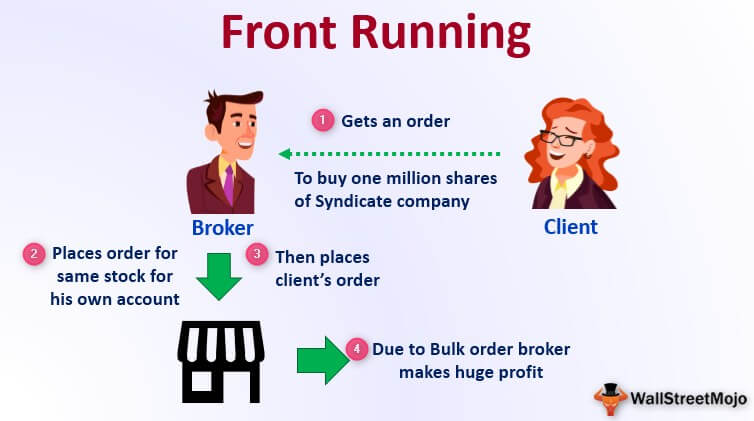
According to Wikipedia, front running, also known as tailgating, is the practice of entering into an equity (stock) trade, option, futures contract, derivative, or security-based swap to capitalize on advance, nonpublic knowledge of a large (“block”) pending transaction that will influence the price of the underlying security. In essence, it means the practice of engaging in a personal or proprietary securities transaction in advance of a transaction in the same security for a client’s account.
Front running is considered a form of market manipulation in many markets. Cases typically involve individual brokers or brokerage firms trading stock in and out of undisclosed, unmonitored accounts of relatives or confederates. Institutional and individual investors may also commit a front running violation when they are privy to inside information.
A front running firm either buys for its own account before filling customer buy orders that drive up the price, or sells for its own account before filling customer sell orders that drive down the price. Front running is prohibited since the front-runner profits come from nonpublic information, at the expense of its own customers, the block trade, or the public market.
CITE: https://www.r2library.com/Resource
***
High-profile short seller accused of fraud.
Citron Research founder Andrew Left is used to being the one calling out fraud, but federal prosecutors and the SEC claimed he’s the one pulling a financial fast one. The government alleges that Left committed securities fraud by using his appearances on television and his social media accounts to make misleading statements that manipulated the market—and reaped $16 million in profit for doing so.
Left declined to comment to news outlets, but his lawyer told the Wall Street Journal that the government’s cases were “based on a defective theory” and targeted Left for sharing his opinions.
COMMENTS APPRECIATED
Thank You
***
***
Share this:

Filed under: "Ask-an-Advisor", Accounting, Ethics, Financial Planning, Glossary Terms, Investing | Tagged: Andrew Left, Citron Research, SEC, stock fraud, Stock Market Front Running, tailgating | Leave a comment »
 ***
***





 The Leading Business Education Network for Doctors, Financial Advisors and Health Industry Consultants