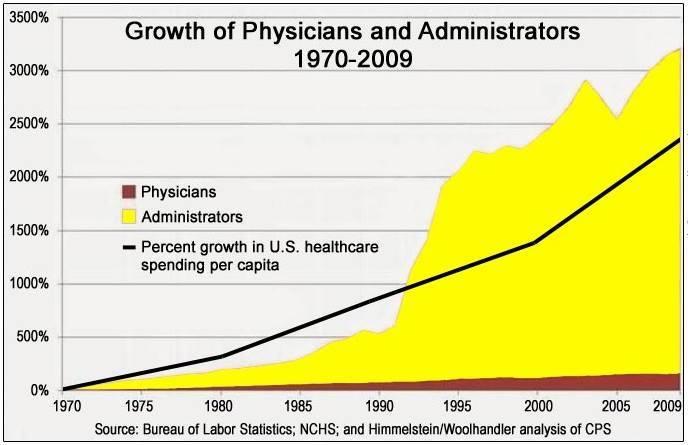
Growth of Physicians and Administrators [1970-2009]

And Waste – Need We Say More?

By http://www.MCOL.com

***

Problem #1

***

***

Conclusion

Your thoughts and comments on this ME-P are appreciated. Feel free to review our top-left column, and top-right sidebar materials, links, urls and related websites, too. Then, subscribe to the ME-P. It is fast, free and secure.

Speaker: If you need a moderator or speaker for an upcoming event, Dr. David E. Marcinko; MBA – Publisher-in-Chief of the Medical Executive-Post – is available for seminar or speaking engagements. Contact: MarcinkoAdvisors@msn.com

OUR OTHER PRINT BOOKS AND RELATED INFORMATION SOURCES:

Product DetailsProduct Details

***

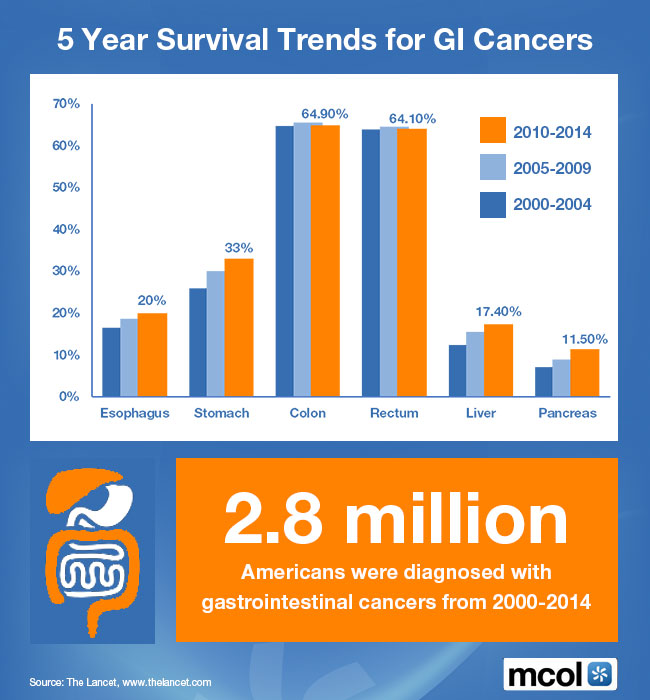
Survival Trends for GI Cancers

Five Years Trends

By http://www.MCOL.com

***

Conclusion

Your thoughts and comments on this ME-P are appreciated. Feel free to review our top-left column, and top-right sidebar materials, links, URLs and related websites, too. Then, subscribe to the ME-P. It is fast, free and secure.

Speaker: If you need a moderator or speaker for an upcoming event, Dr. David E. Marcinko; MBA – Publisher-in-Chief of the Medical Executive-Post – is available for seminar or speaking engagements. https://medicalexecutivepost.com/dr-david-marcinkos-bookings/

Contact: MarcinkoAdvisors@msn.com

***

Cost-of-Living USA

Goods and Services [1975 – 2015]

By BLS

***

***

Conclusion

Your thoughts and comments on this ME-P are appreciated. Feel free to review our top-left column, and top-right sidebar materials, links, URLs and related websites, too. Then, subscribe to the ME-P. It is fast, free and secure.

Speaker: If you need a moderator or speaker for an upcoming event, Dr. David E. Marcinko; MBA – Publisher-in-Chief of the Medical Executive-Post – is available for seminar or speaking engagements.

Book Marcinko: https://medicalexecutivepost.com/dr-david-marcinkos-bookings

Subscribe: MEDICAL EXECUTIVE POST for curated news, essays, opinions and analysis from the public health, economics, finance, marketing, IT, business and policy management ecosystem.

***

US Healthcare – Giving Doctors a Say

US Healthcare: Giving Doctors a Say

[A Bain infographic]

Doctors that are involved in the decision-making process are more willing to lead change.

***

***

http://www.bain.com/publications/articles/front-line-of-healthcare-2017-doctors-infographic.aspx

***

***

A Path to Faster Growth for Healthcare Companies

A Path to Faster Growth for Healthcare Companies

[A Bain Brief]

Many healthcare manufacturers view growth as a top priority, but the complexity that comes with growth creates a serious drag on performance.

Reducing all five types of complexity helps build a healthier, more resilient business.

***

http://www.bain.com/publications/articles/a-path-to-faster-growth-for-healthcare-companies.aspx

***

***

Insurers Can Break the Gordian Knot of Commoditization

How Insurers Can Break the Gordian Knot of Commoditization

[A Bain Infographic]

Insurance companies don’t have much contact with customers, making it hard to build loyalty.

But, this Bain research shows how insurers can build loyalty by focusing on ecosystem services.

***

***

http://www.bain.com/publications/articles/insurance-loyalty-2017-infographic.aspx

***

https://www.crcpress.com/Comprehensive-Financial-Planning-Strategies-for-Doctors-and-Advisors-Best/Marcinko-Hetico/p/book/9781482240283

Poverty in the USA

Fewer people in the US are living in poverty

By Rick Kahler CFP®

According to the October 2017 annual report of the Hamilton Project of the Brookings Institute, the number of Americans living in poverty declined by 13%, or 6 million people, in the two years from 2014 to 2016. That’s encouraging news.

Not so encouraging is that 40.6 million people still live under the government poverty level. This is about one out of every eight Americans. The department of Health and Human Services sets the poverty rate at $32,580 or less for a family of six and $16,020 or less for two people.

Who are those officially classified as poor?

According to IPUMS, an organization associated with the University of Minnesota which integrates worldwide census data, 33% are children under age 18 and 11% are seniors over age 65. So 56% of those living in poverty are of working age, ages 18-65.

Of those who are working age, 21% are disabled, 15% are caregivers, 13% are students, and 10% are early retirees or unclassified, which leaves 41% available to work full time. This is 24% of all people who are in poverty, or about 9.8 million people.

Of that 9.8 million, 65% work part time, 25% work full time, and 10% don’t work. This means just under one million of the 40.6 million people in poverty are actually able to work but unemployed.

Something I found interesting was that of the 65% who work part time, two-thirds (4.3 million) choose to do so and only one-third (2.1 million) would like to work full time. If we add the one million who are unemployed and the 2.1 million part time workers who want full time employment, we have 3.1 million people in poverty who would like to work full time, but can’t find work. This is just 7.4% of all people considered to be below the poverty level.

That leads me to wonder what might change if the 4.3 million choosing to work part time actually worked full time. Might a significant portion of them pull themselves and their families out of poverty? Is it possible that many of these people choose to live in poverty? Or might some of them choose to work part time because earning more would be countered by factors like higher child care costs or losses in government benefits? While I don’t have any statistics on this, I have a hunch it is both.

Keven Winder, a life coach who blogs at thriveinexile.com, has a post from June 2017 titled “The Poverty of the Poor.” He says, “The cause of poverty is not solely education, politics, or the need for jobs. It’s not mental illness, addiction, housing, or food programs,” which he contends are by-products of poverty. “Poverty is deeper. Poverty is disengagement from that which powers us.”

It seems to me that Winder is using “disengagement” to mean what might be described as emotional poverty. The type of emotional disengagement that helps keep people in poverty may be no different from that of a person who earns a comfortable income but chooses not to save for retirement. Or someone who loses a job but has too much false pride to take a lesser one even temporarily.

We know the cure for financial behaviors based in emotional disengagement is not more information. Those choosing to work part time and live in poverty don’t need budget figures on how earning more would increase their standard of living. The behavior goes much deeper and is emotionally entrenched.

Assessment

Certainly, financial therapy might make a difference. Unfortunately, it’s still unavailable for too many of those who need it the most.

Conclusion

Your thoughts and comments on this ME-P are appreciated. Feel free to review our top-left column, and top-right sidebar materials, links, URLs and related websites, too. Then, subscribe to the ME-P. It is fast, free and secure.

Speaker: If you need a moderator or speaker for an upcoming event, Dr. David E. Marcinko; MBA – Publisher-in-Chief of the Medical Executive-Post – is available for seminar or speaking engagements.

Book Marcinko: https://medicalexecutivepost.com/dr-david-marcinkos-bookings/

Subscribe: MEDICAL EXECUTIVE POST for curated news, essays, opinions and analysis from the public health, economics, finance, marketing, IT, business and policy management ecosystem.

https://www.crcpress.com/Comprehensive-Financial-Planning-Strategies-for-Doctors-and-Advisors-Best/Marcinko-Hetico/p/book/9781482240283

***

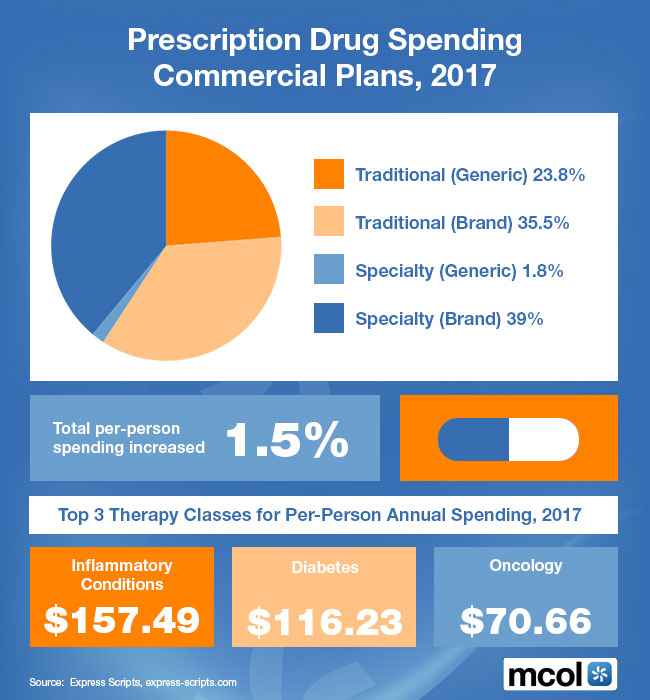
Prescription Drug Spending for Commercial Plans

FY 2017

By http://www.MCOL.com

***

***

Conclusion

Your thoughts and comments on this ME-P are appreciated. Feel free to review our top-left column, and top-right sidebar materials, links, URLs and related websites, too. Then, subscribe to the ME-P. It is fast, free and secure.

Speaker: If you need a moderator or speaker for an upcoming event, Dr. David E. Marcinko; MBA – Publisher-in-Chief of the Medical Executive-Post – is available for seminar or speaking engagements.

Book Marcinko: https://medicalexecutivepost.com/dr-david-marcinkos-bookings/
Subscribe: MEDICAL EXECUTIVE POST for curated news, essays, opinions and analysis from the public health, economics, finance, marketing, IT, business and policy management ecosystem.

***

COUPLES: “one is a spender and one is a saver”

On Couples and Money

By Rick Kahler CFP®

“With couples, usually one is a spender and one is a saver.”

I’ve heard this many times, and I’ve even said it myself. Money issues are one of the most common areas of stress between partners, and conflicting views over spending and saving is a major contributor.

However, a recent study done by Brigham Young University and Kansas State University led me to see marital money issues in a new way. The study, published last year in the Journal of Financial Planning under the title “Tightwads and Spenders: Predicting Financial Conflict in Couple Relationships,” found that partners’ perceptions of each other’s money behavior often does not match reality. The fact that you may see your partner as a spender has actually no correlation to whether they are. Yet there is a huge correlation between thinking your partner is a spender and experiencing financial conflict in the marriage.

Study

Ashley LeBaron, a BYU graduate student and co-author of the study, said this in a BYU News article published August 15, 2017: “The fact that partners’ perceptions of each other’s spending behaviors were so predictive of financial conflict suggests that when it comes to the impact of finances on relationships, perceptions may be just as important, if not more important, than reality.”

As it turns out, the highest contributors to financial conflict between partners weren’t disagreements over how much to fund children’s education, save toward retirement, or spend on a vacation or a car. It was whether one partner considered the other partner a spender or a tightwad—regardless of their actual spending patterns.

If you want to bring more harmony and objectivity around money to your couple-ship, you might consider taking the following steps:

1. Define “spender” in your own words. What does it mean to you if someone is a spender?
2. Define “tightwad” in your own words.
3. Think of your definition of “spender.” Write down all the one-word feelings that you can identify when you think of a spender.
4. Do the same with your definition of “tightwad.”
5. Write a list of all the evidence you can think of that your partner is a spender. Stick with the facts, not a projection. For example, a statement that “my partner spends too much money on coffee” is a projection. Instead, “Three days a week, my partner spends $2.50 on an Americano at Starbucks,” is an observation.
6. In the same way, list all the evidence that your partner is a tightwad.
7. Repeat steps 5 and 6, but about yourself.
8. Look back at the one-word feelings you listed in step 3. Which of those might your partner feel about your spending?
9. Consider which of the one-word feelings you listed in step 4 that your partner might feel about your saving.
10. Now, give this exercise to your partner to complete.

***

***

Finally, select a time to compare answers. Choose one of you to go first while the other listens with absolutely no interruptions, cross talk, or comment. This is hard, but crucial. When the first partner is done, then switch roles without any comments.

If your partner isn’t willing to participate, consider doing this exercise on your own. The insight you gain could be valuable.

Assessment

If the level of money conflict in your relationship is so high that you can’t even imagine doing this exercise together, you also might consider setting up an appointment with a financial therapist. Conflicts over money can be resolved, but it often takes both partners having the willingness do so. Even more, it often takes one or both partners having the courage to ask for help.

Conclusion

Your thoughts and comments on this ME-P are appreciated. Feel free to review our top-left column, and top-right sidebar materials, links, URLs and related websites, too. Then, subscribe to the ME-P. It is fast, free and secure.

Speaker: If you need a moderator or speaker for an upcoming event, Dr. David E. Marcinko; MBA – Publisher-in-Chief of the Medical Executive-Post – is available for seminar or speaking engagements.

Book Marcinko: https://medicalexecutivepost.com/dr-david-marcinkos-bookings/
Subscribe: MEDICAL EXECUTIVE POST for curated news, essays, opinions and analysis from the public health, economics, finance, marketing, IT, business and policy management ecosystem.

***

Dental EHRs are a Scam?

Electronic dental records are a scam. They have always been a scam.

By Darrell Pruitt DDS

“Microsoft & Google unable to detect new zero-day ransomware.” By Anthony Spadafora for ITProPortal, February 7, 2018
https://www.itproportal.com/news/microsoft-google-unable-to-detect-new-zero-day-ransomware/

Spadafora: “The ShurL0ckr ransomware was able to avoid detection by a majority of anti-virus engines and cloud applications. As organisations have adopted cloud services to increase their productivity and agility, so to have hackers who see cloud services as the next big target for distributing malware and stealing sensitive data from businesses and individuals.”

Over a decade ago, I warned the American Dental Association leadership about EHRs’ poor security. So did ADA leadership warn Congress? Oh hell no.

“Patient records will be adequately protected through organizational policies and technical security controls.”Dr. Robert H. Ahlstrom, representing the ADA in testimony before the National Committee on Vital and Health Statistics (NCVHS) on the benefits of EHRs in dentistry.

(See: “Testimony of the American Dental Association, National Committee on Vital and Health Statistics Subcommittee on Standards and Security July 31, 2007.”) http://www.ncvhs.hhs.gov/070731p08.pdf

Assessment

Conflict of interest caused unaccountable leaders to lie to us, Doc. How does that make you feel?

Conclusion:

Your thoughts and comments on this ME-P are appreciated. Feel free to review our top-left column, and top-right sidebar materials, links, urls and related websites, too. Then, subscribe to the ME-P. It is fast, free and secure.

Speaker: If you need a moderator or speaker for an upcoming event, Dr. David E. Marcinko; MBA – Publisher-in-Chief of the Medical Executive-Post – is available for seminar or speaking engagements. https://medicalexecutivepost.com/dr-david-marcinkos-bookings/

Contact: MarcinkoAdvisors@msn.com

Subscribe: MEDICAL EXECUTIVE POST for curated news, essays, opinions and analysis from the public health, economics, finance, marketing, I.T, business and policy management ecosystem.

CALIFORNIA LAUNCHES INVESTIGATION FOLLOWING STUNNING ADMISSION BY AETNA MEDICAL DIRECTOR

A CNN Exclusive

(CNN) California’s insurance commissioner has launched an investigation into Aetna after learning a former medical director for the insurer admitted under oath he never looked at patients’ records when deciding whether to approve or deny care.

California Insurance Commissioner Dave Jones expressed outrage after CNN showed him a transcript of the testimony and said his office is looking into how widespread the practice is within Aetna.

http://www.cnn.com/2018/02/11/health/aetna-california-investigation/index.html

Conclusion

Your thoughts and comments on this ME-P are appreciated. Feel free to review our top-left column, and top-right sidebar materials, links, URLs and related websites, too. Then, subscribe to the ME-P. It is fast, free and secure.

Speaker: If you need a moderator or speaker for an upcoming event, Dr. David E. Marcinko; MBA – Publisher-in-Chief of the Medical Executive-Post – is available for seminar or speaking engagements. https://medicalexecutivepost.com/dr-david-marcinkos-bookings/

Contact: MarcinkoAdvisors@msn.com

***

65% of Hospitals Have a Mobile Device Policy

FY 2017

[Staff reporters]

Zebra Technologies recently released survey results from nurse managers and IT executives on clinical mobility. Here are some key findings from the report:

• 65% of hospitals had a mobile device policy in 2017.
• By 2022, 98% of hospitals will expect to have a mobile device policy.
• Half of hospitals have had a predictive data analytics policy for 3+ years.
• 42% of hospitals have had a predictive data analytics policy for < 1 year.
• 3 in 4 IT executives say clinical mobility investments will increase by 2022.
• 97% expect workflow notifications to be sent to mobile devices by 2022.

Source: Zebra Technologies, January 2018

The entry point for medical app publishers into the healthcare market

Coaching Services

ralf

By Ralf-Gordon Jahns

Dear David,

Please find below Research2Guidance’s latest insights on “Coaching services: The entry point for medical app publishers into the healthcare market.”

Majority of mHealth app solutions are still operating outside the traditional healthcare market. App supported coaching services are more and more seen as the missing bridge between digital Health start-ups and healthcare incumbents. Coaching services are a win/win for both sides.

What are the six success factors of best in class digital enabled health coaching services?

Thank you for your time!Kind regards,
Research2Guidance

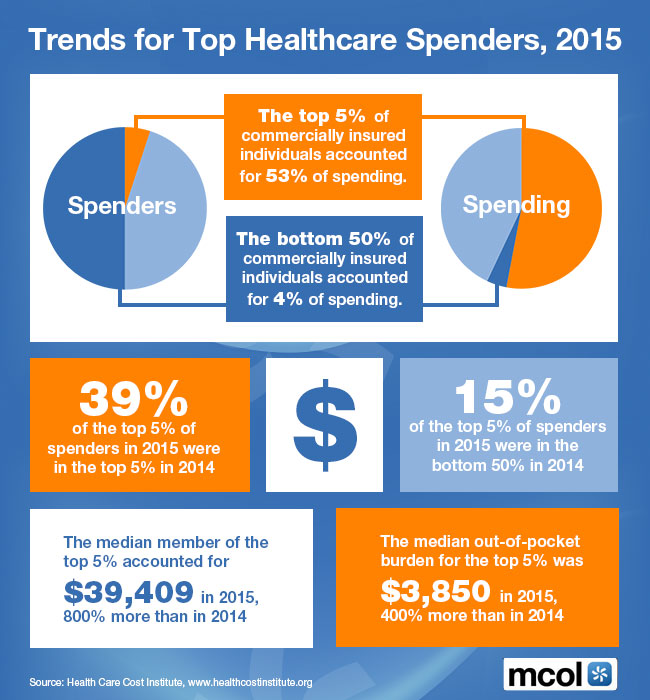
Top Healthcare Spender Trends

FY 2015

By http://www.MCOL.com

***

***

Conclusion

Your thoughts and comments on this ME-P are appreciated. Feel free to review our top-left column, and top-right sidebar materials, links, URLs and related websites, too. Then, subscribe to the ME-P. It is fast, free and secure.

Speaker: If you need a moderator or speaker for an upcoming event, Dr. David E. Marcinko; MBA – Publisher-in-Chief of the Medical Executive-Post – is available for seminar or speaking engagements.

Book Marcinko: https://medicalexecutivepost.com/dr-david-marcinkos-bookings/

Subscribe: MEDICAL EXECUTIVE POST for curated news, essays, opinions and analysis from the public health, economics, finance, marketing, IT, business and policy management ecosystem.

***

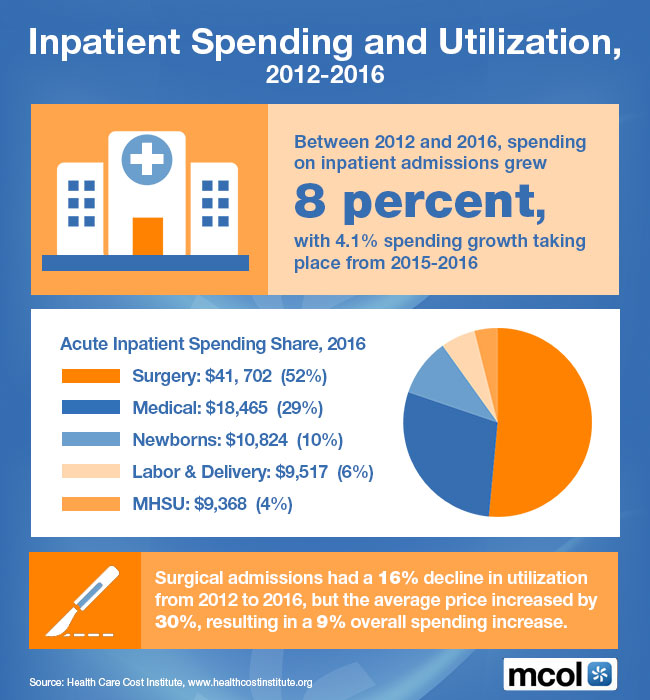
Hospital Inpatient Spending and Utilization

For 2012 – 2016

By http://www.MCOL. com

***

***

Conclusion

Your thoughts and comments on this ME-P are appreciated. Feel free to review our top-left column, and top-right sidebar materials, links, URLs and related websites, too. Then, subscribe to the ME-P. It is fast, free and secure.

Speaker: If you need a moderator or speaker for an upcoming event, Dr. David E. Marcinko; MBA – Publisher-in-Chief of the Medical Executive-Post – is available for seminar or speaking engagements.

Book Marcinko: https://medicalexecutivepost.com/dr-david-marcinkos-bookings/

Subscribe: MEDICAL EXECUTIVE POST for curated news, essays, opinions and analysis from the public health, economics, finance, marketing, IT, business and policy management ecosystem.

https://www.crcpress.com/Comprehensive-Financial-Planning-Strategies-for-Doctors-and-Advisors-Best/Marcinko-Hetico/p/book/9781482240283

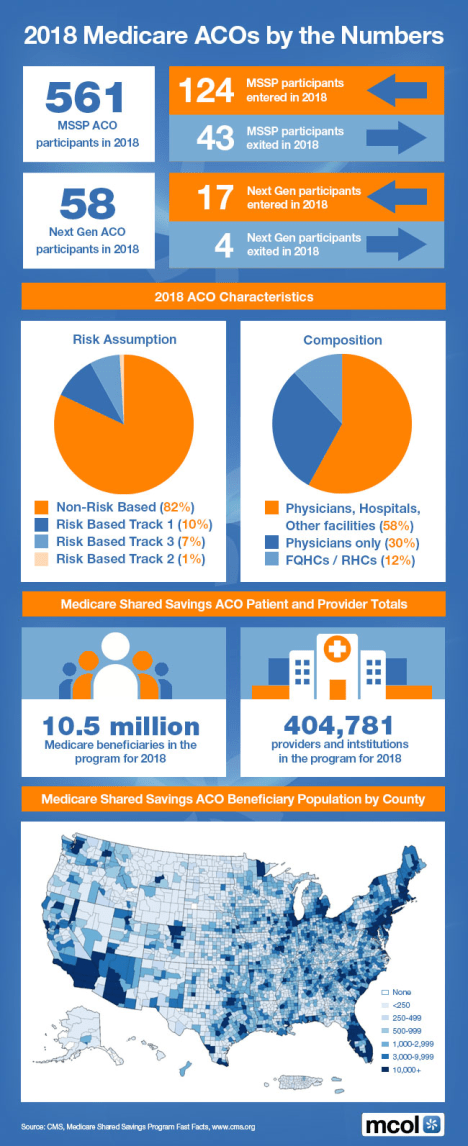
On Medicare ACOs

The Numbers for 2018

By http://www.MCOL.com

***

mcol

***

***
Conclusion

Your thoughts and comments on this ME-P are appreciated. Feel free to review our top-left column, and top-right sidebar materials, links, URLs and related websites, too. Then, subscribe to the ME-P. It is fast, free and secure.

Speaker: If you need a moderator or speaker for an upcoming event, Dr. David E. Marcinko; MBA – Publisher-in-Chief of the Medical Executive-Post – is available for seminar or speaking engagements.

Book Marcinko: https://medicalexecutivepost.com/dr-david-marcinkos-bookings

Subscribe: MEDICAL EXECUTIVE POST for curated news, essays, opinions and analysis from the public health, economics, finance, marketing, IT, business and policy management ecosystem.

https://www.crcpress.com/Comprehensive-Financial-Planning-Strategies-for-Doctors-and-Advisors-Best/Marcinko-Hetico/p/book/9781482240283