
Can Physician [Advisor] Body Language Assist Patient [Client] Adherence
[By Dr. David Edward Marcinko MBA CMP™]

Recently, I was at Drexel University which is a private research university in Philadelphia. It was founded in 1891 by Anthony J. Drexel, a noted financier and philanthropist. Drexel offers over 70 full-time undergraduate programs and accelerated degrees. At the graduate level, the university offers over 100 masters, doctoral, and professional programs, many available part-time.
Now, I know DU well because as a student from Temple University back in the day, I visited frequently. It was there that I first learned of the work of H. Ebbinghaus on the nature of emotions and the human memory.
Two [2] Examples
As doctors, we usually want to make a memorable impression on our patients and encourage them to remember our medical advice or instructions.
OR, as financial advisors, we want our clients to follow our informed advice. But how?
One suggestion is to take advantage of the Serial Position Effect.
Definition
The Serial Position Effect is a term coined by German psychologist Hermann Ebbinghaus PhD.
Hermann Ebbinghaus (January 24, 1850 — February 26, 1909)
According to Wikipedia, Dr. Ebbinghaus was a German psychologist who pioneered the experimental study of memory, and is known for his discovery of the forgetting curve and the spacing effect. He was also the first person to describe the learning curve. He was the father of the eminent neo-Kantian philosopher Julius Ebbinghaus.
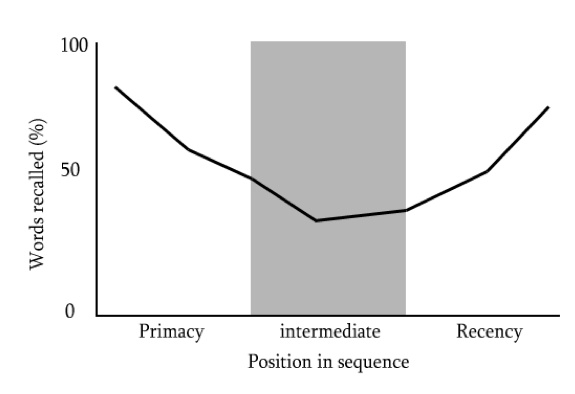
Through his studies, he found that people have a tendency to remember the first (primacy) and last (recency) things to occur, and scarcely the middle.
The graph below demonstrates the Serial Position Effect in recalling a list of words. However, this psychological effect can be applied to many things – from job interviews to television commercials to physician advice.
***
***
So, during your next patient interaction or client-advisor relationship, instruct your target either at the beginning or end of the event; or patient encounter. They are much more likely to remember you, and recall the topic, conversation, medical advice or instructions.
Assessment
If you want to be remembered, don’t be in the middle! And, this will make your next patient interaction; or client meeting, much easier.
Conclusion
Your thoughts and comments on this ME-P are appreciated. Feel free to review our top-left column, and top-right sidebar materials, links, URLs and related websites, too. Then, subscribe to the ME-P. It is fast, free and secure.
Link: http://feeds.feedburner.com/HealthcareFinancialsthePostForcxos
Speaker: If you need a moderator or speaker for an upcoming event, Dr. David E. Marcinko; MBA – Publisher-in-Chief of the Medical Executive-Post – is available for seminar or speaking engagements. Contact: MarcinkoAdvisors@msn.com
OUR OTHER PRINT BOOKS AND RELATED INFORMATION SOURCES:



Filed under: Ethics, Practice Management, Touring with Marcinko | Tagged: emotions, Hermann Ebbinghaus, memory | 1 Comment »





 Support our online development, and advance our onground research initiatives in free market economics, as we seek to showcase the brightest Next-Gen minds.
THE ME-P DISCLAIMER: Posts, comments and opinions do not necessarily represent iMBA, Inc., but become our property after submission. Copyright © 2006 to-date. iMBA, Inc allows colleges, universities, medical and financial professionals and related clinics, hospitals and non-profit healthcare organizations to distribute our proprietary essays, photos, videos, audios and other documents; etc. However, please review copyright and usage information for each individual asset before submission to us, and/or placement on your publication or web site. Attestation references, citations and/or back-links are required. All other assets are property of the individual copyright holder.
Support our online development, and advance our onground research initiatives in free market economics, as we seek to showcase the brightest Next-Gen minds.
THE ME-P DISCLAIMER: Posts, comments and opinions do not necessarily represent iMBA, Inc., but become our property after submission. Copyright © 2006 to-date. iMBA, Inc allows colleges, universities, medical and financial professionals and related clinics, hospitals and non-profit healthcare organizations to distribute our proprietary essays, photos, videos, audios and other documents; etc. However, please review copyright and usage information for each individual asset before submission to us, and/or placement on your publication or web site. Attestation references, citations and/or back-links are required. All other assets are property of the individual copyright holder.











 The Leading Business Education Network for Doctors, Financial Advisors and Health Industry Consultants