

To RIP Medical Debt
By Anonymous
***
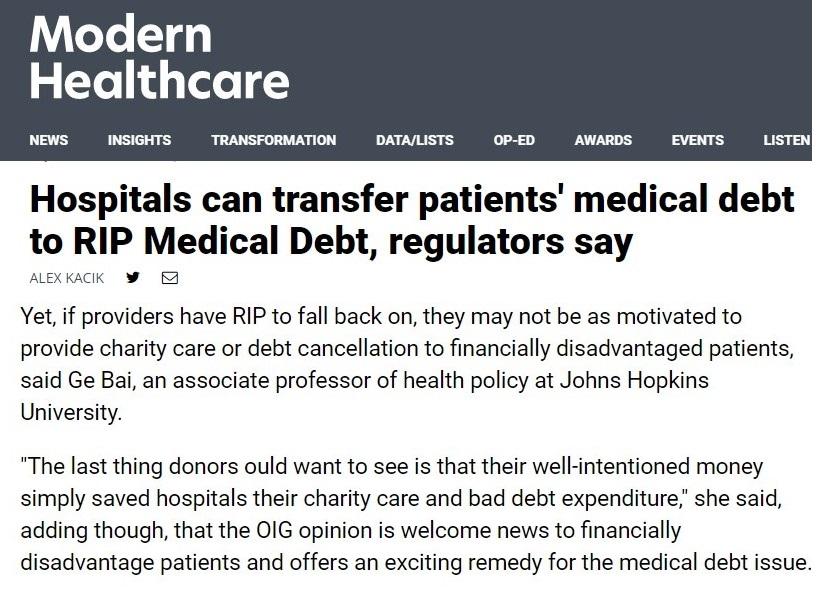 ***
******
Share this:

Filed under: Health Insurance, Health Law & Policy | Tagged: hospital debt, Patient debt, RIP Medical Debt | 1 Comment »
ME-P SYNDICATIONS:
WSJ.com,
CNN.com,
Forbes.com,
WashingtonPost.com,
BusinessWeek.com,
USNews.com, Reuters.com,
TimeWarnerCable.com,
e-How.com,
News Alloy.com,
and Congress.org


BOARD CERTIFICATION EXAM STUDY GUIDES
Lower Extremity Trauma
[Click on Image to Enlarge]
The “Medical Executive-Post” is about connecting doctors, health care executives and modern consulting advisors. It’s about free-enterprise, business, practice, policy, personal financial planning and wealth building capitalism. We have an attitude that’s independent, outspoken, intelligent and so Next-Gen; often edgy, usually controversial. And, our consultants “got fly”, just like U. Read it! Write it! Post it! “Medical Executive-Post”. Call or email us for your FREE advertising and sales consultation TODAY [678.779.8597] Email: MarcinkoAdvisors@outlook.com



 ePodiatryConsentForms.com
 “Providing Management, Financial and Business Solutions for Modernity”
 Support our online development, and advance our onground research initiatives in free market economics, as we seek to showcase the brightest Next-Gen minds.
THE ME-P DISCLAIMER: Posts, comments and opinions do not necessarily represent iMBA, Inc., but become our property after submission. Copyright © 2006 to-date. iMBA, Inc allows colleges, universities, medical and financial professionals and related clinics, hospitals and non-profit healthcare organizations to distribute our proprietary essays, photos, videos, audios and other documents; etc. However, please review copyright and usage information for each individual asset before submission to us, and/or placement on your publication or web site. Attestation references, citations and/or back-links are required. All other assets are property of the individual copyright holder.
Support our online development, and advance our onground research initiatives in free market economics, as we seek to showcase the brightest Next-Gen minds.
THE ME-P DISCLAIMER: Posts, comments and opinions do not necessarily represent iMBA, Inc., but become our property after submission. Copyright © 2006 to-date. iMBA, Inc allows colleges, universities, medical and financial professionals and related clinics, hospitals and non-profit healthcare organizations to distribute our proprietary essays, photos, videos, audios and other documents; etc. However, please review copyright and usage information for each individual asset before submission to us, and/or placement on your publication or web site. Attestation references, citations and/or back-links are required. All other assets are property of the individual copyright holder.


By Anonymous
***
***
Filed under: Health Insurance, Health Law & Policy | Tagged: hospital debt, Patient debt, RIP Medical Debt | 1 Comment »
By Noam N. Levey and Aneri Pattani

***
Robin Milcowitz, a Florida woman who found herself enrolled in an AccessOne loan at a Tampa hospital in 2018 after having a hysterectomy for ovarian cancer, said she was appalled by the financing arrangements.“Hospitals have found yet another way to monetize our illnesses and our need for medical help,” said Milcowitz, a graphic designer.
She was charged 11.5% interest — almost three times what she paid for a separate bank loan. “It’s immoral,” she said.
MORE: https://khn.org/news/article/medical-debt-hospitals-dallas-fort-worth/
***
COMMENTS APPRECIATED
Thank You
***

***

***
Filed under: "Doctors Only", Funding Basics, Glossary Terms, Health Economics, Health Insurance, Health Law & Policy, LifeStyle | Tagged: Aueri Pattani, hospital debt, KHN, medical debt, N. Levey and Aneri Pattani, patient bills, private equity cash, private equuity | Leave a comment »
Do Patients Come First or Creditors?
By Eric Bricker MD
***
***
Citation: https://www.r2library.com/Resource/Title/0826102549
YOUR THOUGHTS ARE APPRECIATED.
Thank You
***
Filed under: Experts Invited, Health Economics, Healthcare Finance, Investing, Videos | Tagged: AHA, bond ratings, Eric Bricker MD, Hospital Bonds, hospital capital finance, hospital debt, MOODY | Leave a comment »
By Eric Bricker MD
***
***
CITE: https://www.r2library.com/Resource/Title/082610254
COMMENTS APPRECIATED
Thank You
***

****
Filed under: "Ask-an-Advisor", Accounting, Experts Invited, Funding Basics, Glossary Terms, Investing, Op-Editorials, Research & Development, Taxation, Videos | Tagged: bonds, Eric Bricker MD, hospital debt, municipal bonds, PODCAST: Hospital Debt and Tax Exempt Bonds, tax exempt bonds | Leave a comment »
A STUDY OF the National Bureau of Economic Research
BY HEALTH CAPITAL CONSULTANTS, LLC
A recent study from the National Bureau of Economic Research (NBER) indicates that quality and patient outcomes suffer in hospitals that cannot maintain their relationships with banks and their lines of credit.
The NBER study measured quality and cost data in Medicare-certified hospitals from 2010 to 2016, during which banks were undergoing annual stress tests. Regulatory “stress tests” are annual assessments from the Federal Reserve, put in place after the Great Recession in 2008, to examine a bank’s ability to survive an impending economic crisis. (Read more…)
ASSESSMENT: Your thoughts are appreciated.
ORDER TEXTBOOK: https://www.amazon.com/Business-Medical-Practice-Transformational-Doctors/dp/0826105750/ref=sr_1_9?s=books&ie=UTF8&qid=1287563112&sr=1-9


THANK YOU
****
Filed under: Experts Invited, Funding Basics, Health Economics, Health Insurance, Health Law & Policy, Healthcare Finance | Tagged: Health Capital Consultants LLC, Hospital Credit, hospital debt, Negative Credit Shocks on Hospitals | Leave a comment »
Understanding the Capital Formation Process
By Calvin W. Wiese CPA MBA
Tax exempt debt has become an important means of external financing for hospitals, primarily because its cost is very attractive. Interest rates on tax-exempt financing are lower than interest rates on financing that is not tax-exempt because the interest income earned by the holders is exempt from federal income tax. In some states, it is also exempt from state income tax and in some cities; it is also exempt from city income tax. Accordingly, the holders of these debt instruments (usually bonds) are willing to accept lower rates of interest.
State and Local Governments Issue Hospital Debt
Hospitals themselves are not capable of issuing tax-exempt debt. Only state and local governments are. A state or local government issues tax-exempt debt for hospitals and then loans the proceeds to hospitals. This is called “conduit” financing: the state or local government acts as a conduit through which hospitals can access tax-exempt debt markets. State and local governments are authorized to loan proceeds of their bond issues to hospitals through state statutes, and each state statute is different. Some states authorize any state or local government to issue bonds to loan to hospitals. Other states restrict such power to special purpose governmental entities only. And some states restrict this power to a single governmental entity that is specially formed for the sole purpose of issuing tax-exempt bonds on behalf of hospitals.
[picapp align=”none” wrap=”false” link=”term=medical+clinic&iid=252095″ src=”http://view2.picapp.com/pictures.photo/image/252095/clinical-waiting-room/clinical-waiting-room.jpg?size=500&imageId=252095″ width=”324″ height=”480″ /]
The IRS and Tax Exempt Financing
The Internal Revenue Service (IRS) regulates the issuance of tax-exempt financing. While the IRS code nominally provides that debt instruments issued by state and local governments are exempt from federal income tax, it imposes special rules on conduit issues. Therefore, tax-exempt issues whose proceeds are loaned to hospitals must comply with special IRS rules. Although very complex, these rules primarily regulate the use of proceeds, restricting the use of tax-exempt proceeds to the acquisition of property, plant components and equipment. Given state statutes, IRS code and applicable security laws (both state and federal), issuing tax-exempt bonds is legally complex. Many lawyers get paid handsome fees every time tax-exempt debt is issued. The quarterback of the legal team is the bond counsel who represents the interests of the bondholders; the bond counsel issues the critical tax opinion that investors rely upon to claim tax-exemption on the interest from these instruments. Everything revolves around getting this opinion. Given its’ critical nature, only highly qualified lawyers are accepted by the market to provide this opinion. Underwriter’s counsel represents the interests of the investment bankers; their primary concern is compliance with security laws. Issuer’s counsel represents the interests of the state or local government, and hospital counsel represents the interests of the hospital; both have relatively minor roles. In the event credit enhancement is involved, credit enhancement counsel represents their interests and has significant influence on the process.
Bond Trustees
Another unique party to most tax-exempt bond issues is the bond trustee. The bond trustee is usually a bank who performs a fiduciary duty on behalf of the bond holders throughout the life of the bonds. The face of the faceless bond holders, they act on their behalf. And they, too, are represented by counsel in the bond issuance process. State or local government typically appoints bond counsel. In many cases, they work with only a single firm. Not unusually, these relationships are quite cozy, and often result in fees being paid that are well in excess of what otherwise would be paid.
The Indenture
An excess of documents is involved in most tax-exempt financings. The heart of the documents is the indenture, which is the agreement between the bond trustee (on behalf of the bond holders) and the state or local government issuer. It contains the promises made to the bond holders, and it describes the work of the bond trustee. The bond trustee will only perform actions on behalf of bond holders that are explicitly set forth in the bond indenture. The bond indenture is the security given to the bond holders, describing all their recourses.
Assessment
The bond indenture is typically supported by the loan agreement between the state or local government that issues the bonds and the hospital to which the proceeds are loaned. Its terms complement the terms of the bond indenture, which together, form the conduit.
Conclusion
And so, your thoughts and comments on this ME-P are appreciated. Feel free to review our top-left column, and top-right sidebar materials, links, URLs and related websites, too. Then, subscribe to the ME-P. It is fast, free and secure.
Speaker: If you need a moderator or speaker for an upcoming event, Dr. David E. Marcinko; MBA – Publisher-in-Chief of the Medical Executive-Post – is available for seminar or speaking engagements. Contact: MarcinkoAdvisors@msn.com
Get our Widget: Get this widget!
Our Other Print Books and Related Information Sources:
Practice Management: http://www.springerpub.com/prod.aspx?prod_id=23759
Physician Financial Planning: http://www.jbpub.com/catalog/0763745790
Medical Risk Management: http://www.jbpub.com/catalog/9780763733421
Healthcare Organizations: www.HealthcareFinancials.com
Health Administration Terms: www.HealthDictionarySeries.com
Physician Advisors: www.CertifiedMedicalPlanner.com
Subscribe Now: Did you like this Medical Executive-Post, or find it helpful, interesting and informative? Want to get the latest ME-Ps delivered to your email box each morning? Just subscribe using the link below. You can unsubscribe at any time. Security is assured.
Link: http://feeds.feedburner.com/HealthcareFinancialsthePostForcxos
Sponsors Welcomed: And, credible sponsors and like-minded advertisers are always welcomed.
Filed under: Health Economics, Healthcare Finance | Tagged: Bond Indenture, Calvin W. Wiese, hospital debt, tax-exempt bonds, tax-exempt financing, tax-exempt hospitals | 2 Comments »
Aggressive Debt Collectors Take to the Web
By Staff Reporters
Thousands of patients face crippling debt to hospitals and healthcare systems across the country; even though they may have qualified for free care.
Yale-New Haven Health System
Now, the Yale-New Haven Health System, Yale-New Haven Hospital and Bridgeport Hospitals are pursuing aggressive debt-collection practices—including liens, wage garnishments and foreclosures—even though they have millions of dollars set aside for free care for patients who can’t pay. Others have colossal endowments as well, and often pay their CEOs handsomely.
Assessment
But, according to their website, the Hospital Debt Justice Project is only fighting for fair treatment and accountability from our community hospitals.
Link: http://www.hospitaldebtjustice.org
Industry Indignation Index: 85
Conclusion
Your thoughts and comments on this Medical Executive-Post are appreciated. Isn’t it a charity hospital standard that not-for-profits typically charge the poor and indigent up to four times the UCR of insured patients? Your experiences are welcomed.
Speaker: If you need a moderator or speaker for an upcoming event, Dr. David E. Marcinko; MBA – Publisher-in-Chief of the Executive-Post – is available for seminar or speaking engagements. Contact: MarcinkoAdvisors@msn.com or Bio: www.stpub.com/pubs/authors/MARCINKO.htm
Get our Widget: Get this widget!
Our Other Print Books and Related Information Sources:
Practice Management: http://www.springerpub.com/prod.aspx?prod_id=23759
Physician Financial Planning: http://www.jbpub.com/catalog/0763745790
Medical Risk Management: http://www.jbpub.com/catalog/9780763733421
Healthcare Organizations: www.HealthcareFinancials.com
Physician Advisors: www.CertifiedMedicalPlanner.com
Subscribe Now: Did you like this Medical Executive-Post, or find it helpful, interesting and informative? Want to get the latest ME-Ps delivered to your email box each morning? Just subscribe using the link below. You can unsubscribe at any time. Security is assured.
Link: http://feeds.feedburner.com/HealthcareFinancialsthePostForcxos
Filed under: Health Insurance, Health Law & Policy, Healthcare Finance, Industry Indignation Index, Information Technology | Tagged: Bridgeport Hospital, charity care, debt collectors, Health Insurance, healthcare systems, hospital debt, hospital debt collectors, Hospital Debt Justice Project, hospitals, medical debt collectors, UCR, Yale-New Haven, Yale-New Haven Health System | 1 Comment »


 The Leading Business Education Network for Doctors, Financial Advisors and Health Industry Consultants
