Are you Being “Admitted” to the Hospital?

Join Our Mailing List

OR … just “Observed”?

Brian J. Knabe MD

By Brian J. Knabe, MD, CMP©, CFP®

Savant Capital Management
cmp-logo16

http://www.CertifiedMedicalPlanner.org

Much attention has been given in recent months to the unintended consequences of healthcare rules and laws.  Most of this has centered on the Affordable Care Act—employers discontinuing health plans for their employees, individuals being dropped from their privately purchased insurance, and other ill effects.  One subject that has not received much press, but which may affect many seniors, is changing rules for Medicare.

Medicare

Patients usually assume when they spend a night or more in a hospital that they have been “admitted.”  However, this is often not the case.  Medicare regulations and statutes require physicians and hospitals to predict at the time of initial hospitalization how long a patient will stay in the hospital.

A short stay—for a night or two– is classified as “observation,” while a longer stay can be classified as an “admission.”  While the difference between these may not be a primary concern for a sick patient wanting to receive necessary evaluation and treatment, it can make a significant difference for your pocketbook.

Observation status

Observation status is considered “outpatient” treatment, and as such can expose Medicare patients to unexpected expenses.  As outpatients, visits under observation status are not covered under Medicare Part A, which pays for hospital charges above a $1,184 deductible.  These outpatient services are billed under Medicare Part B, which requires patients to pay 20% of the cost and imposes no cap on their total out-of-pocket expenditures.

Moreover, observation patients must pay out of pocket for the medication they receive in the hospital.  Those with Medicare Part D prescription-drug plans can file claims for reimbursement, but they may receive little or no refund if their Part D plan doesn’t cover those specific medications.

SNF

Another unexpected consequence of hospital observation is subsequent nursing home coverage.  A stay in a Skilled Nursing Facility (SNF) is often covered by Medicare, as long as certain criteria are met.  One of those criteria is whether the SNF stay was preceded by a “qualifying hospital stay.”  An admission to a hospital might meet this criterion, but an observation stay will not, even if it extended for a number of days.  When a patient who meets Medicare’s admission requirement moves to a SNF, the program covers 100 percent of the first 20 days.  Patients are responsible for $152 daily co-pays for the next 80 days, if necessary.  On the other hand, patients leaving the hospital for a SNF after an observation stay pay the full cost out of pocket.

WSJ

According to a recent Wall Street Journal article, from 2004 to 2011 the number of observation services administered per Medicare beneficiary rose by almost 34%, while admissions per beneficiary declined 7.8%.  Why does this difference between admission and observation matter to hospitals?  It comes down to payment.  Hospitals are reimbursed less for outpatient services.  However, if it is determined after a hospitalization that a patient should have been kept under observation rather than admitted, Medicare will often deny payment to the hospital for the entire bill.  So hospitals are motivated to get it right, at least according to Medicare regulations.
hospital bills

What  to Do?

So, what can you do to protect yourself as a patient?  At the time of hospitalization, ask your physician whether you are being admitted or kept under observation.  Ask to speak to a case manager about the proper status of the hospital stay.  Ask your doctors if they suspect that rehabilitation services will be needed after the hospitalization, and if so, request their help in getting the decision to “observe” reversed prior to hospital discharge.

Assessment

For additional help, see the “Self Help Packet for Medicare Observation Status” at www.medicareadvocacy.org.

See more at: https://www.savantcapital.com/blog/are-you-being-admitted-to-the-hospital-or-just-observed/#sthash.EOOiPWOA.dpuf 

Conclusion

Your thoughts and comments on this ME-P are appreciated. Feel free to review our top-left column, and top-right sidebar materials, links, URLs and related websites, too. Then, subscribe to the ME-P. It is fast, free and secure.

Speaker: If you need a moderator or speaker for an upcoming event, Dr. David E. Marcinko; MBA – Publisher-in-Chief of the Medical Executive-Post – is available for seminar or speaking engagements. Contact: MarcinkoAdvisors@msn.com

OUR OTHER PRINT BOOKS AND RELATED INFORMATION SOURCES:

Product DetailsProduct Details

***


The Impact Of The U.S. Recession On Hospitals

Join Our Mailing List

By Objective Health via Laura Paden

Hospital Admissions

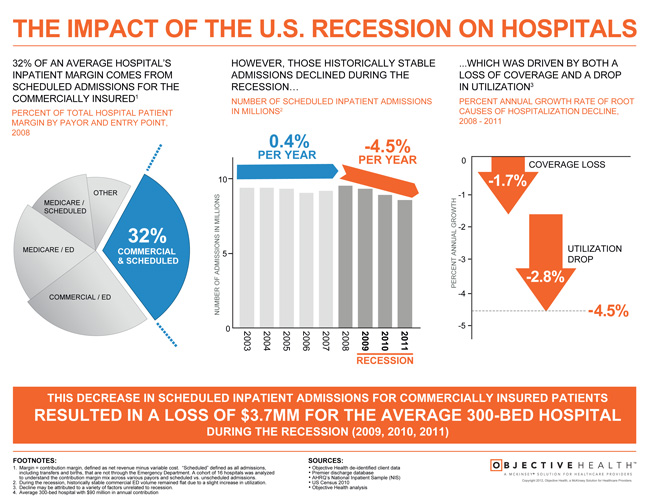
Commercially insured scheduled admissions are the largest contributor to inpatient margins for the average US hospital.

Recession Impact

During the US recession (2009-2011), volumes in this segment declined. There were two primary drivers of this decline.

  1. First, commercial insurance coverage decreased, stemming from unemployment and underemployment. This is expected to reverse and rebound as the economy recovers and as healthcare reform is implemented.
  2. Second, even among those who retained coverage, utilization of inpatient services decreased as patients delayed or forewent elective and preventative care. This was influenced by a range of economic factors, including reduced household incomes, higher co-pays, and a reduced ability to leave work for medical care, as well as factor unrelated to the recession, such as a shift to outpatient management of disease.

Assessment

It is unclear whether this second driver will diminish fully as the economy recovers. A slow recovery – or one that fails to see volumes to return to pre-recession levels – suggests that hospitals may need to refocus their strategies on service lines and segments that have historically been less attractive.

Conclusion

Your thoughts and comments on this ME-P are appreciated. Feel free to review our top-left column, and top-right sidebar materials, links, URLs and related websites, too. Then, subscribe to the ME-P. It is fast, free and secure.

Link: http://feeds.feedburner.com/HealthcareFinancialsthePostForcxos

Speaker: If you need a moderator or speaker for an upcoming event, Dr. David E. Marcinko; MBA – Publisher-in-Chief of the Medical Executive-Post – is available for seminar or speaking engagements. Contact: MarcinkoAdvisors@msn.com

Our Other Print Books and Related Information Sources:

Health Dictionary Series: http://www.springerpub.com/Search/marcinko

Practice Management: http://www.springerpub.com/product/9780826105752

Physician Financial Planning: http://www.jbpub.com/catalog/0763745790

Medical Risk Management: http://www.jbpub.com/catalog/9780763733421

Hospitals: http://www.crcpress.com/product/isbn/9781439879900

Physician Advisors: www.CertifiedMedicalPlanner.org

Our Newest Textbook Release

Buy from Amazon

Learn How to Profit and Thrive in the PP-ACA Era

BOOK FOREWORD / TESTIMONIAL

Access Management in the Hospital Check-In and Admissions Setting

The Role of Operational Activity Based Cost Management

By Dr. David Edward Marcinko; MBA, CMP™

[Editor-in-Chief]

www.HealthcareFinancials.com

In order to be paid and maintain cash flow, hospitals and clinics set up levels of specialization. The result is usually more handoffs, delays, eroding financial positions, and a frustrated set of patients and physicians. Much seems out of control. When you factor in the maze of Health Insurance Portability and Accountability Act (HIPAA) technologies, it becomes overwhelming. Now, consider these operational inefficiencies in light of Obama Care?

Access Management

At the hub of the patient hospital or clinic experience is admitting or registration. This department collects information for clinicians treating the patient, meets Joint Commission standards and other requirements, facilitates medical record documentation, patient flow, revenue capture, billing and collections, and ultimately begins to settle accounts. The access management area has numerous customers in addition to the doctor, patient, or family member sitting across from them.

Increasing HR Complexity

Without the benefit of relevant information, managers attempt to staff access management departments based on past history — namely, if patient and physician complaints are not too high, there is probably enough staff. However, staffing in access management has not kept up with the increased demands and complexity of the process, and other hospital areas often suffer. Clinicians and medical records personnel must often deal with incomplete or incorrect information, and take up the slack.

Beware Un-Happy Stakeholders

All of these deficits make for an unhappy set of customers (physicians and patients) as they continually live with the repercussions of inaccurate and incomplete information. This does not go unnoticed by patients and physicians, as these situations erode confidence in the hospital’s ability to get things done correctly.

Emotional Touch Points

Access Management is the clinic or hospital’s first chance to create an “emotional contract” with the customer. It is here that the tone is set for the patient on the issues with respect to his or her hospitalization. And it is here that the provider has the chance to begin working on the patient’s behalf so that clinical outcomes are appropriate. All of this must happen in an environment that minimizes the likelihood of an unfavorable occurrence, and outside the realm of the complex legal requirements established by state and federal officials.

Tips from the Manufacturing Sector

So why are there unresolved issues in the access management area? In a manufacturing environment, if there are problems on the front-end design, huge problems ripple downstream in terms of recalls, warranty-related expenses, lawsuits, and customers that abandon the company’s products. world -class manufacturers dealt with these issues with their ISO-9000, Total Quality Management (TQM), and Six Sigma programs during the ’80s and ’90s. Hospitals, however, have allowed issues in their access management process to fester and create huge and costly problems in the downstream process. 

Assessment

In an effort to help solve access management issues, every provider must take a proactive role in dealing with the trend. The first step in this journey is healthcare administrator and physician-executive assessment.

This assessment is not a management engineering set of time studies aimed at micro-costing every second of work. The critical path information needed for this plan is reasonable and collected in a few days by talking to the people performing the work. Estimates are gathered based on workers’ views about how they spend their time. This information is combined with available workload measures and general ledger cost information, and activity-based reports are produced.

Conclusion

Going forward, ABCM it is an exercise in operational planning. Activity-based information is used to look at areas where work can be restructured so errors and rework can be eliminated. New technologies that target problematic activities are selected and implemented. Outside companies that can perform complex activities more economically can be used (e.g., www.ICMS.net).

Join Our Mailing List

And so, your thoughts and comments on this ME-P are appreciated. Feel free to review our top-left column, and top-right sidebar materials, links, URLs and related websites, too. Then, be sure to subscribe to the ME-P. It is fast, free and secure.

Link: http://feeds.feedburner.com/HealthcareFinancialsthePostForcxos

Get our Widget: Get this widget!

Our Other Print Books and Related Information Sources:

Practice Management: http://www.springerpub.com/prod.aspx?prod_id=23759

Physician Financial Planning: http://www.jbpub.com/catalog/0763745790

Medical Risk Management: http://www.jbpub.com/catalog/9780763733421

Healthcare Organizations: www.HealthcareFinancials.com

Health Administration Terms: www.HealthDictionarySeries.com

Physician Advisors: www.CertifiedMedicalPlanner.com

Subscribe Now: Did you like this Medical Executive-Post, or find it helpful, interesting and informative? Want to get the latest ME-Ps delivered to your email box each morning? Just subscribe using the link below. You can unsubscribe at any time. Security is assured.

Link: http://feeds.feedburner.com/HealthcareFinancialsthePostForcxos

Sponsors Welcomed

And, credible sponsors and like-minded advertisers are always welcomed.

Link: https://healthcarefinancials.wordpress.com/2007/11/11/advertise

AHRQ Report on Uninsured Hospitalizations

Differs from Insured Hospitalizations

By Staff Reportershorizontal-nurses

According to Tracey Walker, Senior Editor of Healthcare Executive News on March 13, 2009, the number of uninsured hospitalizations increased by 34%, over the last 10-year period, and the number of Medicaid hospitalizations increased by 36%. However, a newt report from the Agency for Healthcare Research and Quality (AHRQ) suggests the number of privately insured hospitalizations remained about the same.

AHRQ Report

According to the report, hospital charges increased for the uninsured faster than for overall hospital charges (76% for compared with 69% for all hospital stays). The average hospital charge for an uninsured stay in 2006 was $19,400 compared to $11,000 in 1997 (after adjusting for inflation). The average length of stay for the uninsured remained the same at about 4 days per hospital visit. Other findings included: 

  • Compared to all hospital stays, uninsured hospitalizations begin in the emergency department much more frequently (60% for the uninsured compared to 44% for all hospital stays).
  • The number of uninsured hospitalizations for skin infections rose sharply over the 10-year period, increasing from about 28,000 stays in 1997 to about 75,000 stays in 2006. Early appropriate outpatient treatment for skin infections can usually prevent the need for hospitalization.
  • There was a 36% increase in hospitalizations billed to Medicaid during the 10-year period.

Assessment

According to AHRQ, on average the costs (not charges) to provide hospital care to the uninsured are about $1,500 less expensive ($6,800 vs. $8,400 per hospital stay) than costs for all other hospital stays.

Assessment

Lack of health insurance has serious consequences on individuals and societies. For example, the uninsured may be more likely to delay or forgo necessary medical care until eventual hospitalization makes care much more expensive. And philosophically,

“As spending on Medicaid increases; the number of uninsured hospitalizations ought to decrease proportionally—adjusted for population increases”

So says, Hope Hetico; RN, MHA, CMP™ of www.HealthcareFinancials.com.

“But, this was not the case, and determining exactly why will require more studies.”

Conclusion

And so, your thoughts and comments on this Medical Executive-Post are appreciated. Does a similar inverse relationship hold for public versus private education, housing and transportation?

Why or why not? Some pundits wonder if it is due to private entities having more “skin-in-the game?” Please opine?

Speaker: If you need a moderator or speaker for an upcoming event, Dr. David E. Marcinko; MBA – Publisher-in-Chief of the Executive-Post – is available for seminar or speaking engagements. Contact: MarcinkoAdvisors@msn.com  or Bio: www.stpub.com/pubs/authors/MARCINKO.htm

Get our Widget: Get this widget!

Our Other Print Books and Related Information Sources:

Practice Management: http://www.springerpub.com/prod.aspx?prod_id=23759

Physician Financial Planning: http://www.jbpub.com/catalog/0763745790

Medical Risk Management: http://www.jbpub.com/catalog/9780763733421

Healthcare Organizations: www.HealthcareFinancials.com

Health Administration Terms: www.HealthDictionarySeries.com

Physician Advisors: www.CertifiedMedicalPlanner.com

Subscribe Now: Did you like this Medical Executive-Post, or find it helpful, interesting and informative? Want to get the latest E-Ps delivered to your email box each morning? Just subscribe using the link below. You can unsubscribe at any time. Security is assured.

Link: http://feeds.feedburner.com/HealthcareFinancialsthePostForcxos