Earliest Guidelines in California Program
By Eugene Schmuckler; PhD MBA MEd CTS
By Dr. David E. Marcinko MBA MEd CMP
UPDATE
Assassination attempt on Donald J.Trump
At least 5 people are dead and multiple people are injured following a shooting at the Natalie Building at St. Francis Hospital in Tulsa, Oklahoma.
***
The impact of medical workplace violence became widely exposed on November 6, 2009 when 39 year old Army psychiatrist Maj. Nidal M. Hasan MD, a 1997 graduate of Virginia Tech University who received a medical doctorate in psychiatry from the Uniformed Services University of the Health Sciences in Bethesda, Maryland, and served as an intern, resident and fellow at the Walter Reed Army Medical Center in the District of Columbia, went on a savage 100 round shooting spree and rampage that killed 13 people and injured 32 others. In April 2010 he was transferred to Bell County Jail in Belton, Texas awaiting trial.
Federal Government Guidelines
The federal government and some states have developed guidelines to assist employers with workplace violence prevention. For instance, one of the earliest sets of guidelines for a comprehensive workplace violence prevention program was published in 1993 by California OSHA. This resulted from the murder of a state employee. In 1996, Guidelines for Preventing Workplace Violence for Healthcare and Social Service Workers was published by OSHA.
OSHA Guidelines
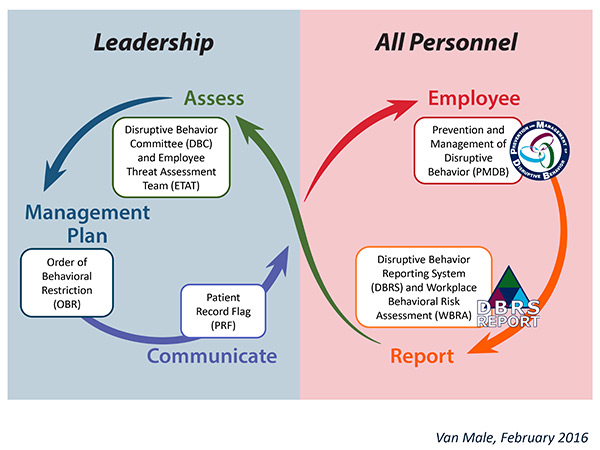
In its guidelines, OSHA sets forth the following essential elements for developing a violence prevention program:
- Management commitment — as seen by high-level management involvement and support for a written workplace violence prevention policy and its implementation.
- Meaningful employee involvement — in policy development, joint management-worker violence prevention committees, post-assault counseling and debriefing, and follow-up are all critical program components.
- Worksite analysis — includes regular walk-through surveys of all patient care areas and the collection and review of all reports of worker assault. A successful job hazard analysis must include strategies and policies for encouraging the reporting of all incidents of workplace violence, including verbal threats that do not result in physical injury.
- Hazard prevention and control — includes the installation and maintenance of alarm systems in high-risk areas. It may also include the training and posting of security personnel in emergency departments. Adequate staffing is an essential hazard prevention measure, as is adequate lighting and control of access to staff offices and secluded work areas.
- Pre-placement and periodic training and education — must include educationally appropriate information regarding the risk factors for violence in the healthcare environment and control measures available to prevent violent incidents. Training should include skills in aggressive behavior identification and management, especially for staff working in the mental health and emergency departments.

On May 17, 1999, Governor Gary Locke signed the New Workplace Violence Prevention Act for the state of Washington. This act mandates that each healthcare setting in the state implement a plan to reasonably prevent and protect employees from violence.
New Washington Workplace Violence Prevention Act
According to this act, prevention plans need to address security considerations related to:
- physical attributes of the healthcare setting;
- staffing, including security staffing;
- personnel policies;
- first aid and emergency procedures;
- reporting of violent acts; and
- employee education and training.
Prior to the development of an actual plan, a security and safety assessment needs to be conducted to identify existing or potential hazards. The training component of the plan must include the following topics:
- general safety procedures;
- personal safety procedures;
- the violence escalation cycle;
- violence-predicting factors;
- means of obtaining a patient history form from a patient with violent behavior;
- strategies to avoid physical harm;
- restraining techniques;
- appropriate use of medications as chemical restraints;
- documenting and reporting incidents;
- the process whereby employees affected by a violent act may debrief;
- any resources available to employee for coping with violence; and
- the healthcare setting’s workplace violence prevention plan.
Assessment
The act further mandates that any hospital operated and maintained by the State of Washington for the care of the mentally ill is required to provide violence prevention training to affected employees identified in the plan on a regular basis and prior.
Conclusion
Your thoughts and comments on this ME-P are appreciated. Feel free to review our top-left column, and top-right sidebar materials, links, URLs and related websites, too. Then, subscribe to the ME-P. It is fast, free and secure.
Speaker: If you need a moderator or speaker for an upcoming event, Dr. David E. Marcinko; MBA – Publisher-in-Chief of the Medical Executive-Post – is available for seminar or speaking engagements. Contact: MarcinkoAdvisors@msn.com
OUR OTHER PRINT BOOKS AND RELATED INFORMATION SOURCES:
PHYSICIANS: www.MedicalBusinessAdvisors.com
HOSPITALS: http://www.crcpress.com/product/isbn/9781466558731
CLINICS: http://www.crcpress.com/product/isbn/9781439879900
BLOG: www.MedicalExecutivePost.com
FINANCE: Financial Planning for Physicians and Advisors
INSURANCE: Risk Management and Insurance Strategies for Physicians and Advisors

Filed under: Book Reviews, Ethics, Experts Invited, Health Law & Policy, Practice Management | Tagged: Eugene Schmuckler, medical workplace violence, Nidal M. Hasan, OSHA, violence, Virginia Tech University, workplace violence | 21 Comments »





 Support our online development, and advance our onground research initiatives in free market economics, as we seek to showcase the brightest Next-Gen minds.
THE ME-P DISCLAIMER: Posts, comments and opinions do not necessarily represent iMBA, Inc., but become our property after submission. Copyright © 2006 to-date. iMBA, Inc allows colleges, universities, medical and financial professionals and related clinics, hospitals and non-profit healthcare organizations to distribute our proprietary essays, photos, videos, audios and other documents; etc. However, please review copyright and usage information for each individual asset before submission to us, and/or placement on your publication or web site. Attestation references, citations and/or back-links are required. All other assets are property of the individual copyright holder.
Support our online development, and advance our onground research initiatives in free market economics, as we seek to showcase the brightest Next-Gen minds.
THE ME-P DISCLAIMER: Posts, comments and opinions do not necessarily represent iMBA, Inc., but become our property after submission. Copyright © 2006 to-date. iMBA, Inc allows colleges, universities, medical and financial professionals and related clinics, hospitals and non-profit healthcare organizations to distribute our proprietary essays, photos, videos, audios and other documents; etc. However, please review copyright and usage information for each individual asset before submission to us, and/or placement on your publication or web site. Attestation references, citations and/or back-links are required. All other assets are property of the individual copyright holder.













 The Leading Business Education Network for Doctors, Financial Advisors and Health Industry Consultants