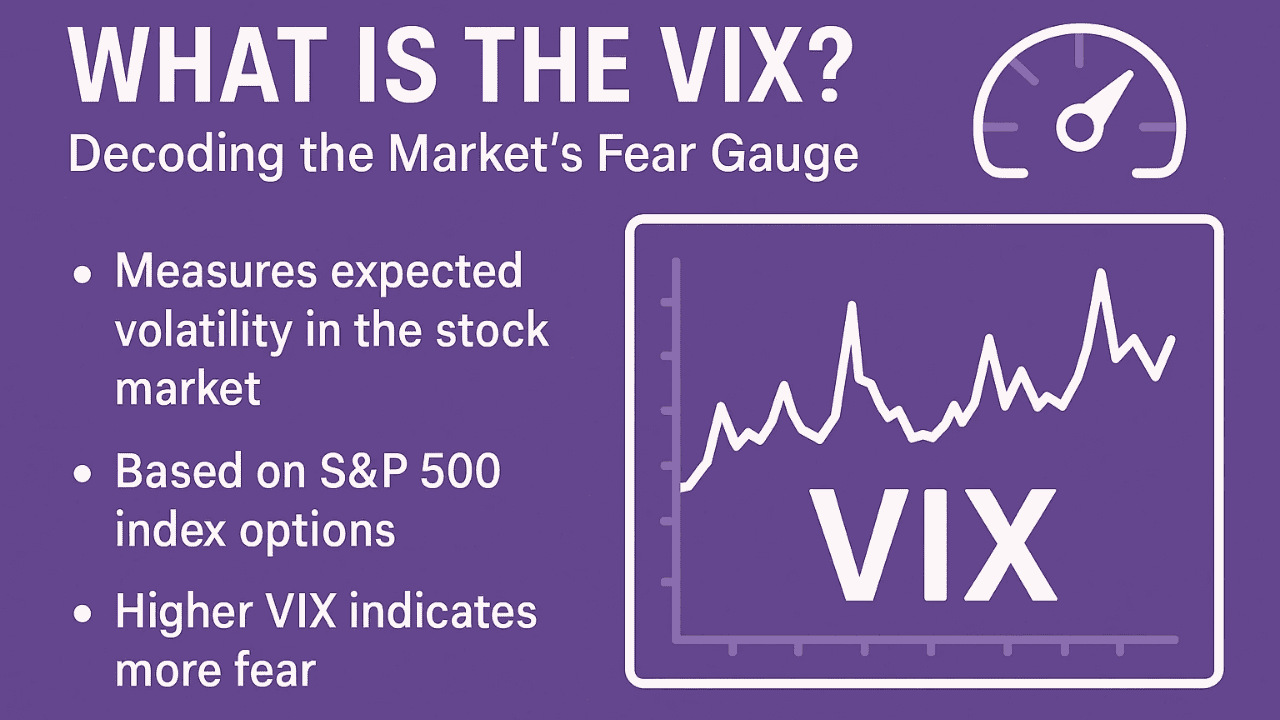
VIX: Stock Market Fear Gauge Update

VOLATILITY INDEX

By Staff Reporters

***

***

DEFINITION: https://medicalexecutivepost.com/2024/05/30/what-up-vix/

***

UPDATE

The VIX soared to 60.13 last Monday before plummeting all the way to 33.76 on Wednesday, the day after the president paused tariffs. But while the VIX has since settled down a bit, investor fear is still high. The VIX closed above 30 for 10 straight trading sessions and the last time that happened was during the bear market back in October 2022, according to MarketWatch—not exactly a comforting comparison.

Then again, just because fear skyrocketed last week doesn’t mean the markets will tank in turn. “Since 1997, there have been 11 times the VIX spiked above 45—and 10 out of 11 times, the S&P 500 was higher four months later by an average of +6.4%,” noted Austin Hankowitz in the latest edition of the Rich Habits newsletter.

Finally, the VIX closed above 30 Thursady as tariff talk and monetary policy pivots keep investors on their toes. But while worries might keep investors on the sidelines, some on Wall Street are taking this opportunity to be greedy while others are fearful.

COMMENTS APPRECIATED

Refer and Like

***

***

Appreciating Post Cyber Monday Stock Market Volatility

Join Our Mailing List

Living with Ambiguity [Is it Friend or Foe?]

By Robert Klosterman CFP® http://www.whiteoakswealth.com/

The stock market was down a bit last month and up last week, and then down today; back and forth, rising and falling and rising again the last few years, etc, etc.

Now: 23 557 DJIA

Whipsaw is the word I’ve heard to describe it lately. And, without a doubt, the question that gets asked the most is “How do you like this volatility?”

My reply, without exception, is “I LOVE volatility. I do prefer upside volatility to downside though”. The response is a smile or an outright laugh. Of course, few physicians or laymen I have ever met get worried about upside price movements in investing.

Third Quarter 2017

The third quarter of 2017 – post election results – clearly experienced both major up and downside volatility with the recent emphasis on the upside. Investors that fully invested in equities saw their portfolios rise in the positive and record-breaking direction.

Europe

The market pundits have a daily hero to pin the market movements on. Europe, Syria, Russia and Putin, Turkey, Greece, US Congress stalemates and other forces like the death of Fidel Castro are some of the most recent “good guys” that have given rise to Mr. Market’s positivity. Did we mention  Donald Trump?

How Long?

The bigger question is how long will these issues persist? Established societies, often described as western economies, have some significant headwinds facing them for the next few years: high debt, mounting costs of social insurance programs, and the likelihood of higher taxes to solve the problems.

There is nothing new or unique about that last sentence. There seems to be a wide consensus on those points and coupled with the record low interest rates, investors seem to have few traditional options to consider. It appears likely that it will take a few years to resolve these issues and provide a platform for above average growth.

Strategies

There are a number of strategies that can utilize volatility including Long-Short, Mean Reversion, Managed Futures and Market Neutral, etc [previously noted on this ME-P]. These provide returns in a secular bear market that may continue for a few more years.

Link: https://medicalexecutivepost.com/2007/11/28/what-is-a-market-neutral-fund/

It’s also important to recognize that while the US and Western Europe maybe having to face the headwinds there are economies in parts of the world that will likely experience above average growth rates for the next few years. For the most part, these emerging markets include Brazil, Russia, India and China (BRIC). A strong dollar not-withstanding.

BRIC Analogs to the USA

In the 1870‘s, the US was an emerging market the same way the BRIC economies are today’s emerging markets; developmentally analogous. Whereas the US and Western Europe face many headwinds, some of these emerging economies actually have wind in their backs. Trade surplus, demographics, low debt and low cost of Government are some of the key advantages. These countries’ standard of living is changing to the positive, and they have a large percentage of their population that can move up and be a purchaser of goods and services where previously they could not.

Income Generation

Another important focus will be on income generation. For many years the income portion of an investment in equities was half or more of its return. Only in recent years has the largest portion come from capital gains. We are likely “back to the old days” in order to achieve returns that will offset inflation and meet longer-term investment goals

Opportunities exist in a variety of areas, including real estate, Mortgage Backed Securities, Private Equity and others to have more focus on income as a dominant portion of the total return.

Assessment

Volatility is going to be with us and it would be wonderful to have the confidence needed to say the emphasis would be on upside volatility, but that is not the case right now. The optimum strategies are to align portfolios with the world we live in today.

IOW: Doctors, medical professionals and all investors must learn to “live with ambiguity.”

About the Author

Robert J. Klosterman® has been listed as one of the Top 250 Financial Advisors in the United States by Worth Magazine. He has also been recognized as one of the top 150 Financial Advisors by Mutual Fund Magazine, Medical Economics and Bloomberg’s Wealth Manager Magazine. Bob’s published quotes appear frequently in dozen’s of local and national publications, including USA Today, the New York Times, Minneapolis Star Tribune, CFP Today, Barron’s and Fortune.

Channel Surfing the ME-P

Have you visited our other topic channels? Established to facilitate idea exchange and link our community together, the value of these topics is dependent upon your input. Please take a minute to visit. And, to prevent that annoying spam, we ask that you register. It is fast, free and secure.

Conclusion

Your thoughts and comments on this ME-P are appreciated. Feel free to review our top-left column, and top-right sidebar materials, links, URLs and related websites, too. Then, subscribe to the ME-P. It is fast, free and secure.

Speaker: If you need a moderator or speaker for an upcoming event, Dr. David E. Marcinko; MBA – Publisher-in-Chief of the Medical Executive-Post – is available for seminar or speaking engagements. Contact: MarcinkoAdvisors@msn.com

OUR OTHER PRINT BOOKS AND RELATED INFORMATION SOURCES:

Product Details  Product Details

***

Comprehensive Financial Planning Strategies for Doctors and Advisors: Best Practices from Leading Consultants and Certified Medical Planners(TM)

***

Do You Have a “Stomach of Steel” in this Stock Market Environment?

Join Our Mailing List 

The Wall Street Journal Called

Rick Kahler MS CFP

By Rick Kahler CFP® CLU MS http://www.KahlerFinancial.com

[FOMC Holds Steady Today]

A few weeks ago, when the US markets started dropping dramatically, a reporter for The Wall Street Journal called. He asked me if I had received any calls from worried clients. I told him I had heard from 5% of my clients. “What changes in their portfolios are you making?” he asked.

“I’m not making any changes to my investment strategy.”

He expressed amazement that I was not “doing something.” Most investors and their advisors he was speaking with were making “adjustments” to their portfolios. He told me I must have a “stomach of steel.”

Hardly. My gut is certainly not immune to those fearful sinking feelings that go along with market plunges. What I do have is enough experience to trust my long-term investment strategy.

The time most investors and advisors decide an investment strategy doesn’t work is when their portfolios lose value, usually due to a decline in US stocks. This confuses me.

Here’s why:

First, I’m confused that so many investors believe it’s possible to move in and out of markets in such a way that their portfolios will rarely, if ever, suffer a negative return.

This is magical or delusional thinking. The only investor I’m aware of who consistently produced positive returns, year after year, was a fellow by the name of Bernie Madoff. If you have never heard of this investment wizard, he’s the one who is now serving a life sentence in a federal prison for propagating a Ponzi scheme that robbed billions of dollars from investors.

Short-term or moderate-term losses are inevitable in any portfolio that seeks to earn returns above those offered by a bank Certificate of Deposit. Usually, in the long run, markets recover and so does your portfolio.

Sadly, too many investors turn short-term losses into long-term losses by abandoning their investment strategy when the US markets turn down. This locks in their losses, never to be recovered.

If your portfolio is widely diversified among many markets—like bonds, emerging markets, commodities, real estate, TIPs, and various investment strategies—you will almost always have an asset class losing money. You will also almost always have an asset class making money. If not, you probably don’t have a diversified portfolio.

Here’s the second reason I’m confused.

Most investment strategies assume that the US market will decline, and they have a strategy in place for dealing with those declines. For a buy-and-hold investor, the strategy is to do absolutely nothing. For a strategic asset allocator like myself, it’s to rebalance frequently by selling appreciating asset classes and buying into those in decline. By not making changes to clients’ portfolios during a market decline, I am not “doing nothing;” I am simply continuing to follow an investment strategy.

Because most of my clients have learned over time to trust this strategy, relatively few of them make panicky calls to my office during downturns. Yet I have noticed a direct correlation between US stock market declines and my daily phone call volume. Many of the calls are from reporters wanting to know what I am doing and am telling clients. My response—that I’m not doing anything different—is the same thing I told them when the markets last declined in 2011 and before that in 2009, 2008, 2002, 2001, 2000, 1997, etc.

***

untitled

***

Assessment

This isn’t the response an anxious client or a concerned reporter wants to hear. When the emotional center of the brain is overcome with panic and fear, taking action helps relieve anxiety. If that short-term action is selling into volatile stock markets, however, it often turns out to be a long-term mistake.

Conclusion

Your thoughts and comments on this ME-P are appreciated. Feel free to review our top-left column, and top-right sidebar materials, links, URLs and related websites, too. Then, subscribe to the ME-P. It is fast, free and secure.

Speaker: If you need a moderator or speaker for an upcoming event, Dr. David E. Marcinko; MBA – Publisher-in-Chief of the Medical Executive-Post – is available for seminar or speaking engagements. Contact: MarcinkoAdvisors@msn.com

OUR OTHER PRINT BOOKS AND RELATED INFORMATION SOURCES:

Comprehensive Financial Planning Strategies for Doctors and Advisors: Best Practices from Leading Consultants and Certified Medical Planners(TM)

Front Matter with Foreword by Jason Dyken MD MBA

logos

“BY DOCTORS – FOR DOCTORS – PEER REVIEWED – FIDUCIARY FOCUSED”

***

Tools for Navigating the Market Pullback

Join Our Mailing List

On Stock market uncertainty?

By Lon Jefferies CFP MBA lon@networthadvice.com | http://www.networthadvice.com 

Lon JefferiesOn August 24th 2015, the Dow Jones Industrial Average opened the day decreasing in value by more than 1,000 points, equating to a -6.42% decline. One of the most volatile days in memory continued, with the DOW fighting back to nearly even by mid-day, down only 98 points or about -0.60%.

Unfortunately, the bounce couldn’t be maintained through the market close with the DOW ending the day down 588 points, off about -3.6%.

How are investors to deal with this level of uncertainty?

First and foremost, remember that this is what diversification is for. It is easy to look at a major market index like the DOW or the S&P 500 and equate the performance of those assets to the performance of your portfolio. However, the first thing investors should remind themselves is that they don’t have a portfolio consisting of only large cap stocks, which is what is measured by both the DOW and S&P 500 index.

In fact, most investors don’t have a portfolio consisting of just stocks. Many investors who are nearing or enjoying retirement may have a portfolio that is closer to only 50% or 60% stocks. If an investor only has 50% of his portfolio invested in stocks, only 50% of the portfolio is invested in the asset that declined in value by -3.6% on August 24th, meaning the individual’s portfolio likely only decreased by about -1.80%. While a -1.80% decline is not pleasant, it is hardly catastrophic.

The next step is to remind ourselves that temporary sharp market declines are common. Morgan Housel, one of my favorite financial writers, noticed that the correction the market is currently experiencing is still not nearly as bad as the correction that took place in the summer of 2011 when the DOW lost 2,000 points in 14 days (a loss of about -15.5%). Mr. Housel points out that no one now remembers or cares about that short-term correction. These market pullbacks will always come and go, and the world will continue to turn.

Additionally, it is useful to acknowledge that while we tend to remember dramatic and shocking market decreases, stocks tends to be an efficient investment over time. Another one of my favorite financial journalists, Ben Carlson, pointed out in his blog that when investors think of the ‘80s the first thing that comes to mind is usually the Crash of ’87 when the Dow lost -22% in one day (Black Monday). However, U.S. stocks were up over 400% during the decade. Similarly, even though stocks are up 200% since March of 2009, many investors have spent the last five years trying to anticipate the next 10% – 20% correction. In retrospect, an investor would have clearly been better off riding the equities rollercoaster during both the good and bad times and ending with a 200% gain rather than being out of the market in an attempt to avoid a small temporary decline. Given a long enough investment time frame, this has always been true and I believe this will continue to be the case.

Finally, as I pointed out in a previous article, it is useful to recall that market corrections are actually a good thing for long-term investors. Fear among investors is what creates the equity risk premium that enables stocks to produce superior investment results when compared to investments with no risk such as CDs and money markets, which essentially experience no growth after accounting for inflation. When investors forget that equities can go both up and down in value, everyone wants to invest their money in stocks. This excess demand inflates asset purchase prices to the point that owning equities is no longer profitable. Market declines reintroduce risk to the investing public, and it is the presence of risk that makes stocks an appreciating asset. Thus, for those who don’t intend to sell their investments for 10+ years, short periods of volatility are a positive because they recreate the equity risk premium which raises rates of return over time.

***

Bear + A Falling Stock Chart

***

Logical steps

These are all logical steps for mentally dealing with market corrections. For those who need it, Josh Brown from CBNC proposes a less logical step for tricking your mind into embracing the market pullback. During scary market environments, Mr. Brown proposes that you identify a couple of stocks you’ve always felt you missed out on. Have you always wished you got in earlier on Apple, Google, Netflix, Chipotle, etc? A market correction like we are experiencing might be the perfect opportunity to become an owner of a great stock at an attractive price. Why not set a number for each of these stocks – say, if they drop in value by 20% – and if those targets are met you commit to buying some shares?

This strategy truly enables you to use lemons to make lemonade. It provides an opportunity to buy shares of companies that you have always wanted without overpaying for them. This mental trick can actually cause you to hope that the market correction continues because you are now hoping for a chance to buy. Rooting for a further correction can certainly make volatile market periods more tolerable.

As I mentioned, this mentality isn’t completely logical because the rest of your portfolio will likely need to decline in value in order to afford you the opportunity to purchase those coveted stocks. However, implementing this strategy is a bit of a mental hedge that enables you to get something good out of whichever direction the market turns. Think of promising yourself a fancy dinner if your favorite sports team loses – of course you don’t want your team to lose, but even if they do you still get something positive out of it.

Assessment

I’m confident that most of my clients already know that selling in the middle of a market correction is not a good idea. Still, I acknowledge that doing nothing as the market seems to be collapsing around you can be nerve-racking – even though it has historically been an appropriate response. Hopefully these mental strategies and tricks enable you to stick to your long-term buy-and-hold investment strategy which has always proved to be profitable given a long enough time frame.

NOTE:

–On a side note, I had zero clients call or email expressing a desire to sell positions yesterday. This enabled everyone to participate in today’s market bounce. Smart clients rule. 

Conclusion

Your thoughts and comments on this ME-P are appreciated. Feel free to review our top-left column, and top-right sidebar materials, links, URLs and related websites, too. Then, subscribe to the ME-P. It is fast, free and secure.

Speaker: If you need a moderator or speaker for an upcoming event, Dr. David E. Marcinko; MBA – Publisher-in-Chief of the Medical Executive-Post – is available for seminar or speaking engagements. Contact: MarcinkoAdvisors@msn.com

OUR OTHER PRINT BOOKS AND RELATED INFORMATION SOURCES:

Sponsors Welcomed: Credible sponsors and like-minded advertisers are always welcomed.

Comprehensive Financial Planning Strategies for Doctors and Advisors: Best Practices from Leading Consultants and Certified Medical Planners(TM)

Front Matter with Foreword by Jason Dyken MD MBA

logos

“BY DOCTORS – FOR DOCTORS – PEER REVIEWED – FIDUCIARY FOCUSED”

Medical Endowment Fund Contingency Planning

Understanding Stock Market Volatility?

Source: www.HealthcareFinancials.com

Join Our Mailing List 

According to Wayne Firebaugh CPA, CFP®, CMP™ the many quantitative methods of stock, bond, derivatives, alternative assets and mutual fund investing would have suggested that the October 1987 crash was impossible; yet the flash-crash of 2008 still occurred.

The Improbable Happens

For example, Mark Rubenstein, a professor at University of California at Berkeley, noted that if annualized stock market volatility was assumed to be approximately 20% “(the historical average since 1928), the probability that the stock market could fall 29% in a single day is 10–160. So improbable is such an event that it would not be anticipated to occur even if the stock market were to last for 20 billion years. Indeed, such an event should not occur even if the stock market were to enjoy a rebirth for 20 billion years in each of 20 billion big bangs.”

Statistically Impossible

Although it was statistically impossible for it to happen, it did happen in 1987 and again 2008. The nature of crises is such that many will be unanticipated events with unexpected precipitators. As such, a medical endowment or physician’s portfolio contingency plan cannot address every conceivable event. What a contingency plan should address is the process for confronting these events. Most importantly, the plan should assign responsibility for actions and contain provisions to limit the ability of panic to impair long-term decisions.

Donor Trust is Core

Healthcare and all endowments have at their core donor trust. As such, it is important for an endowment’s contingency plan to include provisions for communicating promptly and forthrightly with the public. One only has to look at the Red Cross’ performance during the aftermath of the 9/11 tragedy to receive a lesson on an inappropriate approach. After donating more than $550 million to the Liberty Fund, donors learned that less than $175 million had been spent on direct aid for victims and that the Red Cross was allocating a large portion of the funds to other programs. After public outcry and congressional hearings, the Red Cross announced that all donations would be spent on direct victim relief.

Unfortunately, Dr. Bernadine Healy, the president of the Red Cross, resigned at least in part because of this controversy. These alleged violations of public confidence can have long-term impacts on an endowment’s donor base. Consider also the United Way whose national leader, William V. Aramony, was accused of fraud, embezzlement, and other charges in 1992. Even a decade later, inflation-adjusted contributions are lower than they were before the scandal even though charitable giving in general has doubled.

Assessment

The very nature of crises is such that pre-determined contingency plans generally allow more rapid and appropriate reaction. For an endowment, a well-considered contingency plan will include both an action (or standstill) plan and a public relations plan.

Note: Red Cross defends handling of September 11 donations on November 6, 2001: see: www.cnn.com

Conclusion

And so, your thoughts and comments on this ME-P are appreciated. Feel free to review our top-left column, and top-right sidebar materials, links, URLs and related websites, too. Then, subscribe to the ME-P. It is fast, free and secure.

Speaker: If you need a moderator or speaker for an upcoming event, Dr. David E. Marcinko; MBA – Publisher-in-Chief of the Medical Executive-Post – is available for seminar or speaking engagements. Contact: MarcinkoAdvisors@msn.com

Get our Widget: Get this widget!

Our Other Print Books and Related Information Sources:

Practice Management: http://www.springerpub.com/prod.aspx?prod_id=23759

Physician Financial Planning: http://www.jbpub.com/catalog/0763745790

Medical Risk Management: http://www.jbpub.com/catalog/9780763733421

Healthcare Organizations: www.HealthcareFinancials.com

Health Administration Terms: www.HealthDictionarySeries.com

Physician Advisors: www.CertifiedMedicalPlanner.com

Subscribe Now: Did you like this Medical Executive-Post, or find it helpful, interesting and informative? Want to get the latest ME-Ps delivered to your email box each morning? Just subscribe using the link below. You can unsubscribe at any time. Security is assured.

Link: http://feeds.feedburner.com/HealthcareFinancialsthePostForcxos

Sponsors Welcomed: And, credible sponsors and like-minded advertisers are always welcomed.

Link: https://healthcarefinancials.wordpress.com/2007/11/11/advertise