PODCAST: Nurse Practitioners VS. Physician Associates

NPs versus PAs

By Eric Bricker MD

***

COMMENTS APPRECIATED

Thank You

***

***

PHYSICIANS: “Aging Out”

By Staff Reporters

***

***

According to HealthcareBrew, thousands of doctors are expected to reach retirement age in the next three years, and their replacements won’t be physicians. Instead, physician assistants (PAs) and nurse practitioners (NPs) will increasingly provide primary care services, according to a report from consulting firm Mercer.

By 2026, 21% of family medicine, pediatric, and obstetrics and gynecology physicians—or about 32,000 doctors—will be 65 or older, and Mercer anticipates about 23,000 physicians will leave the profession permanently. At the same time, demand for primary care physicians is expected to grow 4%, the report found.

PAs and NPs—also called advanced practice providers (APPs) or physician extenders—are highly trained medical professionals. To become a PA, you have to have both a bachelor’s and a master’s, some clinical work experience, pass the Physician Assistant National Certifying Exam, and then apply to get licensed in your state (you know, easy peasy). It takes seven to nine years to go through that process, compared to 11+ years to become an MD.

CITE: https://www.r2library.com/Resource/Title/0826102549

To become an NP, you must have both a bachelor’s and a master’s in nursing, become a registered nurse, and pass a national NP board certification exam. It takes between six to eight years to become an NP.

Compared to physicians, PAs and NPs are “considerably younger professions with less than half the retirement risk,” the Mercer report stated. Roughly 40,000 PAs and NPs join the workforce annually.

“We’re certainly going to see increasing demand for APPs,” David Mitchell, a partner in Mercer’s career consulting business and a specialist in the healthcare industry, told Healthcare Brew.

While most state licensing boards require a physician to oversee APPs, both PAs and NPs have the authority to do many services primary care physicians do, like seeing and diagnosing patients, ordering lab tests, and writing prescriptions, said Mitchell.

READ HERE: https://www.healthcare-brew.com/stories/2023/03/16/non-mds-will-provide-primary-care?cid=30859907.17846&mid=349b552221c994e2540a304649746d7c&utm_campaign=hcb&utm_medium=newsletter&utm_source=morning_brew

MORE: https://www.aamc.org/data-reports/data/2022-physician-specialty-data-report-executive-summary

***
COMMENTS APPRECIATED

Thank You

***

ORDER: https://www.routledge.com/Risk-Management-Liability-Insurance-and-Asset-Protection-Strategies-for/Marcinko-Hetico/p/book/9781498725989

***

ADVISORY OPINION: Allows Nurse Practitioner Support in Hospitals

NURSE PRACTITIONERS [NPs]

By Health Capital Consultants, LLC

***

***

Advisory Opinion Allows Nurse Practitioner Support in Hospitals

On December 19, 2022, the Department of Health and Human Services (HHS) Office of Inspector General (OIG) published Advisory Opinion (AO) No. 22-20, analyzing the utilization of nurse practitioners (NPs) in lieu of attending physicians within medical units. The OIG concluded that the arrangement utilizing NPs in certain medical units, subject to several safeguards, presented a low risk for fraud or abuse.

CITE: https://www.r2library.com/Resource/Title/0826102549

As noted by legal experts, this AO deviates from OIG’s typical approach to limiting arrangements involving potential remuneration from a hospital to its referring physicians. (Read more…)

***

ORDER: https://www.amazon.com/Business-Medical-Practice-Transformational-Doctors/dp/0826105750/ref=sr_1_9?ie=UTF8&qid=1448163039&sr=8-9&keywords=david+marcinko

***

COMMENTS APPRECIATED

Thank You

***

Today is “Physician Assistant” Day 2014

Join Our Mailing List 

Celebrating PA Day

[By Dr. David Edward Marcinko MBA CMP]

Dr. DEMPhysician Assistant Day, or PA Day, is a celebration of those who assist doctors in their work.

This important event, begun by the American Academy of Physicians’ Assistants, aims to raise awareness of the PA profession, and inform people about healthy living.

A Work Horse – Not a Show Horse

Physician assistants are less high-profile and glamorous than doctors themselves, but the work that they do is essential for the smooth running of hospitals and performing of healthcare.

Many medical establishments are in need of more people to enter the profession, and one of the main aims of PA Day is to get this message across, encouraging people to consider assistance as a career.

***

Unknown-1

***

Assessment

The main celebration takes place on Rockefeller Plaza in New York. You can join in by being there on the day, arranging an event to raise awareness at your local hospital or social hub.

Link: http://www.cute-calendar.com/event/physician-assistant-day/16354.html

More:

Conclusion

Your thoughts and comments on this ME-P are appreciated. Feel free to review our top-left column, and top-right sidebar materials, links, URLs and related websites, too. Then, subscribe to the ME-P. It is fast, free and secure.

Speaker: If you need a moderator or speaker for an upcoming event, Dr. David E. Marcinko; MBA – Publisher-in-Chief of the Medical Executive-Post – is available for seminar or speaking engagements. Contact: MarcinkoAdvisors@msn.com

OUR OTHER PRINT BOOKS AND RELATED INFORMATION SOURCES:

Product DetailsProduct Details

Fighting Mid-Level Medical Providers

Join Our Mailing List

Scope of practice’ stories vary according to state laws

One of the interesting stories to watch in the coming months in the states is the fight over “scope of practice.” That means: who gets to do what, and under whose supervision. It basically pits doctors against other health care providers — nurses, nurse practitioners, physician assistants, etc. They are sometimes called “extenders” or “non-physician providers.” (There are also big fights within dentistry.)

Dental Therapists [Emerging New Providers?]

The PP-ACA

These fights would heat up even without the Affordable Care Act — you’ve heard about the shortage of primary care physicians and you know there is an aging population that is going to need access to primary care. Throw in the health care law — millions of newly insured people entering the system — as well as delivery system reforms and care innovations that encourage more primary care, care coordination and team-based medicine that invites a larger role from those “extenders.”

Role of Retail Medical Clinics

Association of Health Care Journalists

Joanne Kenen, AHCJ’s health reform topic leader, writes about the questions and issues to be addressed and offers some resources to help reporters follow the story in their own communities. In a blog post tomorrow, she will point to two articles that have been done about the role nurses, physician assistants or other providers can have in providing primary care in underserved areas.

Next Generation Physician Recruitment

Conclusion

Your thoughts and comments on this ME-P are appreciated. Feel free to review our top-left column, and top-right sidebar materials, links, URLs and related websites, too. Then, subscribe to the ME-P. It is fast, free and secure.

Speaker: If you need a moderator or speaker for an upcoming event, Dr. David E. Marcinko; MBA – Publisher-in-Chief of the Medical Executive-Post – is available for seminar or speaking engagements. Contact: MarcinkoAdvisors@msn.com

OUR OTHER PRINT BOOKS AND RELATED INFORMATION SOURCES:

Product Details

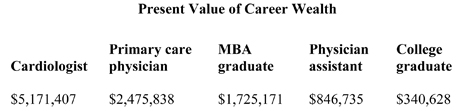
Doctor Salary v. Others [Present Value of Career Wealth]

Specialists v. GPs v. MBAs v. PAs v. College Graduates

Join Our Mailing List

Researchers at Duke University modeled the earning potential of cardiologists and primary care physicians between the ages of 22 and 65, taking into account medical school debt, earning potential and the age at which doctors begin earning an income.

According to John Goodman, they then conducted similar analyses for the average b-school, physician assistant and college graduate.

Assessment

Conclusion

Your thoughts and comments on this ME-P are appreciated. Feel free to review our top-left column, and top-right sidebar materials, links, URLs and related websites, too. Then, subscribe to the ME-P. It is fast, free and secure.

Link: http://feeds.feedburner.com/HealthcareFinancialsthePostForcxos

Speaker: If you need a moderator or speaker for an upcoming event, Dr. David E. Marcinko; MBA – Publisher-in-Chief of the Medical Executive-Post – is available for seminar or speaking engagements. Contact: MarcinkoAdvisors@msn.com

OUR OTHER PRINT BOOKS AND RELATED INFORMATION SOURCES:

Product DetailsProduct DetailsProduct Details

About the Convenient Care Association

Developing Best Medical Practices and Retail Operating Standards

By Staff Reporters

horizontal-nurses2The Convenient Care Association [CCA] is comprised of companies, medical providers and healthcare systems that provide patients and consumers with accessible, affordable and quality healthcare in retail-based locations. The CCA works primarily to enhance and sustain the growth of the convenient care industry through sharing of best practices and common standards of operation. It was founded in October 2006.

About CCA

According to their website, the first Convenient Care Clinics [CCCs] opened in 2000, and the industry grew quickly since then. Today there are approximately 1,060 clinics in operation, and CCA member clinics represent more than 95% of the industry. To date, CCCs have served more than 3.5 million patients with its nurse practitioners [NPs] and physician assistants [PAs].

Link: http://www.ccaclinics.org/index.php?option=com_content&view=article&id=4&Itemid=11

Growth and Expansion

With this rapid expansion, and projected continued growth, it quickly became clear that the shared concerns and needs of both providers and patients could best be served through an association that allowed for: 

  • Sharing best practices, common standards of operation, experiences and ideas.
  • Developing common standards of operation to ensure the highest quality of care.
  • A united voice to advance the needs of CCCs and their customers
  • A unified effort to promote the concept of CCCs, and to respond to questions about this evolving industry.
  • Reaching out to the existing medical community and creating new partnerships.
  • Building synergies with traditional medical service providers.

Assessment

The Public Health Management Corporation [PHMC], a nonprofit public health institute, provides executive management and administrative support for the Convenient Care Association. For more information, contact Tine Hansen-Turton at (215) 731-7140.

Conclusion

And so, your thoughts and comments on this Medical Executive-Post are appreciated. Have you ever used a retail medical clinic and what was your experience? Will this business model save primary care medicine?

Speaker: If you need a moderator or speaker for an upcoming event, Dr. David E. Marcinko; MBA – Publisher-in-Chief of the Executive-Post – is available for seminar or speaking engagements. Contact: MarcinkoAdvisors@msn.com  or Bio: www.stpub.com/pubs/authors/MARCINKO.htm

Get our Widget: Get this widget!

Our Other Print Books and Related Information Sources:

Practice Management: http://www.springerpub.com/prod.aspx?prod_id=23759

Physician Financial Planning: http://www.jbpub.com/catalog/0763745790

Medical Risk Management: http://www.jbpub.com/catalog/9780763733421

Healthcare Organizations: www.HealthcareFinancials.com

Health Administration Terms: www.HealthDictionarySeries.com

Physician Advisors: www.CertifiedMedicalPlanner.com

Subscribe Now: Did you like this Medical Executive-Post, or find it helpful, interesting and informative? Want to get the latest E-Ps delivered to your email box each morning? Just subscribe using the link below. You can unsubscribe at any time. Security is assured.

Link: http://feeds.feedburner.com/HealthcareFinancialsthePostForcxos

About Clinician 1.com

Physician Assistants Establish Online Presence

Staff Reporters

As face-time with doctors is increasingly limited, the role of physician and nurse practitioners has become integral in the healthcare system. However, it hasn’t exactly become easier for PAs and NPs to obtain information about drugs and treatments. That’s about to change according to George Koroneous, the Online Content and News Editor for Pharmaceutical Executive.com on October 8, 2008.

Just Launched

Launched last week, www.Clinician1.com  is a Facebook-style social networking site targeted to the 200,000 physician and nurse practitioners that prescribe drugs in all 50 states. It features personal information pages, medical education, and areas to facilitate two-way conversations between like-minded clinicians.

Website Proposition

According to its’ website, Clinician 1 was created by leading Nurse Practitioners [NPs] and Physician Assistants [Pas]. Clinician 1 is the first Internet community where NPs and PAs across all specialties can connect, consult and converse.

Assessment

More info: http://pharmexec.findpharma.com/pharmexec/Marketing/Physician-Assistants-Establish-Online-Presence/ArticleStandard/Article/detail/556966?contextCategoryId=39717

Conclusion

Your comments on this new professional network are appreciated.

Speaker: If you need a moderator or speaker for an upcoming event, Dr. David E. Marcinko; MBA – Publisher-in-Chief of the Executive-Post – is available for seminar or speaking engagements. Contact: MarcinkoAdvisors@msn.com  or Bio: www.stpub.com/pubs/authors/MARCINKO.htm

Subscribe Now: Did you like this Executive-Post, or find it helpful, interesting and informative? Want to get the latest E-Ps delivered to your email box each morning? Just subscribe using the link below. You can unsubscribe at any time. Security is assured.

Link: http://feeds.feedburner.com/HealthcareFinancialsthePostForcxos