Understanding Financial Broker and Advisor Licenses

Image result for sec

Series #65 VS Series #7

By Dr. David Edward Marcinko MBA

When I am approached by a prospective client, the question they always ask without fail is “Are you properly licensed?” This is actually the wrong question to ask. The right question should be, “Which license do you have?”

The Types of Licenses

Generally, there are two types of licenses for people who call themselves a “financial advisor.” People who passed the series #65 test and people who passed the series #7 test. The nature of these two licenses is as far apart as heaven and earth.

The Securities License

Series #7 is a securities license. People who have passed this test can legally be a stock-broker. They are actually prohibited by law to give financial advice, except incidental to the financial products they are selling.

A financial advisor with a series #7 license can receive third party payments like kickbacks, commissions etc in conjunction with the products they sell you. They are not required to put your interest first as they are not your fiduciary. Legally they abide by a much lenient “suitability standard.” That is, if they think the product is suitable for you, irrespective of the cost, they are legally off the hook.

All of Morgan Stanley, Merrill Lynch and other Wall Street firms’ financial advisors are required to pass the series 7# license.

The Advisor License

Series #65 is an advisor license. People who have passed this test are legally called registered investment advisors or RIA representative. An RIA representative’s compensation is in the form of fees paid directly by the client. He or She is prohibited to receive any third party payment unless disclosed to and approved by the client first.

###

Wall Street

###

Assessment

When searching for a financial advisor, it’s crucial to find out what licensure he or she has. Do not use a stock-broker as your financial advisor – unless you’re in the habit of letting you friendly neighborhood used car salesman hand pick your vehicle purchases.

More:

Conclusion

Your thoughts and comments on this ME-P are appreciated. Feel free to review our top-left column, and top-right sidebar materials, links, URLs and related websites, too. Then, subscribe to the ME-P. It is fast, free and secure.

Speaker: If you need a moderator or speaker for an upcoming event, Dr. David E. Marcinko; MBA – Publisher-in-Chief of the Medical Executive-Post – is available for seminar or speaking engagements. Contact: MarcinkoAdvisors@msn.com

OUR OTHER PRINT BOOKS AND RELATED INFORMATION SOURCES:

Comprehensive Financial Planning Strategies for Doctors and Advisors: Best Practices from Leading Consultants and Certified Medical Planners(TM)

The Massacre of Hedge Fund Business

Join Our Mailing List

By Michael Zhuang

Michael Zhuang

The Massacre of Hedge Fund Business

 ***
I took the sensationalist title from a CNBC article I read recently. The articles talks about,  and I quote,
” … hedge funds, as a category, is experiencing the worst quarter of outflows since the bottom of the financial crisis … there were an avalanche of stories about the industry’s nearly systematic underperforming.”
Readers of my newsletter and blog, The Investment Scientist,  can thank me later for warning them years ago.
Examples
On April 28, 2011, I published “A Balanced Portfolio to Avoid (II): Hedge Funds Don’t Deliver Outstanding Returns.” Let me quote my former self:
“Hedge funds are often peddled as an unique asset class that are uncorrelated with the market. In reality, hedge funds are as much an asset class as Las Vegas is.”
The unspoken message is: you should expect to lose money.
On August 15, 2012, I published “Why You should Avoid Hedge Funds.
” I wrote that article after I read the book by former hedge fund industry insider Simon Lack, “The Hedge Fund Mirage.”  I summarized the book in one sentence for my readers: “Between 1998 and 2010, hedge fund fees totaled $440 billion vs. $9 billion profits for investors.”
Note: Hedge fund performance reporting is voluntary – unprofitable hedge funds need not report – so even the $9 billion profit figure should be taken with a grain of salt.
On June 13, 2013, I was aghast at SEC Chairwoman Mary Jo White’s proposal to allow hedge funds to market to the public. That day, I wrote a sarcastic piece “Why Allowing Hedge Funds to Market to The Public is Such A Good Idea.”
In the concluding paragraph I wrote:
“What’s unfair about the existing hedge fund rule is that only the top 1% get that bragging right. The rest of us don’t even know such a wonderful opportunity exists to transfer our puny wealth to the hedge fund managers who are really the top 0.1%.”
***
dollar-1029742_640
***
Assessment
I hope somewhere out there a reader or two did not buy into the hedge fund hype because of my writings. That would make all the midnight oil I have burned worth it!

Conclusion

Your thoughts and comments on this ME-P are appreciated. Feel free to review our top-left column, and top-right sidebar materials, links, URLs and related websites, too. Then, subscribe to the ME-P. It is fast, free and secure.

Speaker: If you need a moderator or speaker for an upcoming event, Dr. David E. Marcinko; MBA – Publisher-in-Chief of the Medical Executive-Post – is available for seminar or speaking engagements. Contact: MarcinkoAdvisors@msn.com

OUR OTHER PRINT BOOKS AND RELATED INFORMATION SOURCES:

Risk Management, Liability Insurance, and Asset Protection Strategies for Doctors and Advisors: Best Practices from Leading Consultants and Certified Medical Planners™8Comprehensive Financial Planning Strategies for Doctors and Advisors: Best Practices from Leading Consultants and Certified Medical Planners™

***

On The Unpredictability of The Market

Join Our Mailing List

On Brexit

Michael Zhuang

By Michael Zhuang,

[Principal of MZ Capital Management]

At the end of June this year, UK citizens voted in a referendum for the nation to withdraw from the European Union. The result, which defied the expectations of many, led to market volatility as participants weighed possible consequences.

Journalists

Journalists responded by using the results to craft dramatic headlines and stories. The Washington Post said the vote had “escalated the risk of global recession, plunged financial markets into free fall, and tested the strength of safeguards since the last downturn seven years ago.” The Financial Times said “Brexit” had the makings of a global crisis. “[This] represents a wider threat to the global economy and the broader international political system,” the paper said. “The consequences will be felt across the world.”

What about those self-proclaimed financial gurus? Motley Fool wrote: “Sell Everything! How Brexit Can Shatter Share Market” and Jim Cramer wrote: “Don’t Buy! Why the Mass Brexit Sell Off is Worth Riding Out.”

It turned out there was no “mass brexit sell off”

It’s true UK got a new Prime Minister, and the Pound Sterling fell to 35 years low. But within a few weeks of the UK vote, Britain’s top share index, the FTSE 100, hit 11-month highs. By mid-July, the US S&P 500 and Dow Jones Industrial Average had risen to record highs. Shares in Europe and Asia also strengthened after dipping initially following the vote.

***

thumb

***

Assessment

Before Brexit faded away in our memory, what can we learn from this experience? I don’t know about you, here is what I learn. We don’t know what gonna happen in the future, and we don’t know how the market gonna react. And those pundits on TV and newsletter don’t know either. Prudent investing aka wealth preservation should never be based on their (or our) speculation.

Conclusion

Your thoughts and comments on this ME-P are appreciated. Feel free to review our top-left column, and top-right sidebar materials, links, URLs and related websites, too. Then, subscribe to the ME-P. It is fast, free and secure.

Speaker: If you need a moderator or speaker for an upcoming event, Dr. David E. Marcinko; MBA – Publisher-in-Chief of the Medical Executive-Post – is available for seminar or speaking engagements. Contact: MarcinkoAdvisors@msn.com

OUR OTHER PRINT BOOKS AND RELATED INFORMATION SOURCES:

Risk Management, Liability Insurance, and Asset Protection Strategies for Doctors and Advisors: Best Practices from Leading Consultants and Certified Medical Planners™8Comprehensive Financial Planning Strategies for Doctors and Advisors: Best Practices from Leading Consultants and Certified Medical Planners™

***

Brexit: What to Do About It?

Join Our Mailing List

The BRITISH-EXIT 2016?

Michael Zhuang                              

By Michael Zhuang

Shortly, there will be a referendum in Great Britain to determine if the UK should stay in EU or should leave for good. A mere month ago, the stay vote still won by a comfortable margin. Just showing how political wind can shift, the odds are now 50/50 that the leave vote might win.

Here are some consequences I believe a leave vote would entail:

1. Copycat referendums in other EU states, and within a few years, EU might not exist.

2. London’s reputation as world financial capital on par with New York may be diminished.

3. Disruptions to trades and investments, since UK’s relationship with Europe and the rest of the world, will have to be renegotiated.

4. Pound Sterling, London stocks, and property prices might go south. Potential capital flights from the UK.

5. More volatility in global stock markets.

As an investor, what should you do about it?

Well, all of the above can be called informed speculations. They are not actionable intelligence. In other words, when it comes to investment, we should never base our decisions on speculation about future events.

There is a mountain of academic evidence that the more investors react to events, the less the returns they get from stock markets. If you don’t believe me, go read “Trading is Hazardous to Your Wealth”, by Berkeley professor Terry Odean, published in Journal of Finance in April 2000.

I know it’s the reverse of a popular belief, but I will follow this mantra “Don’t just do something, sit there!”

If it should come to pass that the market drops significantly following the Brexit vote, then we rebalance and pick up shares cheap! Who doesn’t like a big discount?

***

british_pound_sign_black

***

PS: As I was finishing up this article, news broke that a pro-stay MP was shot and killed by a pro-leave fanatic. The murder has the potential of shifting the political wind again!

Conclusion

Your thoughts and comments on this ME-P are appreciated. Feel free to review our top-left column, and top-right sidebar materials, links, URLs and related websites, too. Then, subscribe to the ME-P. It is fast, free and secure.

Speaker: If you need a moderator or speaker for an upcoming event, Dr. David E. Marcinko; MBA – Publisher-in-Chief of the Medical Executive-Post – is available for seminar or speaking engagements. Contact: MarcinkoAdvisors@msn.com

OUR OTHER PRINT BOOKS AND RELATED INFORMATION SOURCES:

Risk Management, Liability Insurance, and Asset Protection Strategies for Doctors and Advisors: Best Practices from Leading Consultants and Certified Medical Planners™8Comprehensive Financial Planning Strategies for Doctors and Advisors: Best Practices from Leading Consultants and Certified Medical Planners™

***

DOL’s Fiduciary Rule Brings Good News

The DOL and Your Retirement Account

 
Join Our Mailing List 

By Michael Zhuang,

[Principal of MZ Capital Management]
Contributor to Morningstar and Physicians Practice
Michael Zhuang
 
Recently the Department of Labor issued a fiduciary rule that requires financial advisors who manage retirement accounts to act in clients’ best interests.
***
Here is the quote from a Wall Street Journal report … 

About $14 trillion in retirement savings could be affected by the rule, which requires stockbrokers providing retirement advice to act as “fiduciaries” who will serve their clients’ “best interest.” That is stricter than the current standard, which only says they need to offer “suitable” recommendations, a standard that critics say has encouraged some advisers to charge excessive fees or favor investments that offer hidden commissions.

Still, reflecting intense lobbying from the financial industry, which has fought the regulation since it was first proposed six years ago, the final version includes a number of modifications. 

This might come as a surprise to many physician-executives and people that financial advisors do not need to act in clients’ best interests up until this day.  

Alas, as I explained in this article, there are really two types of financial advisors: those who have a broker license (series 7) and those who have a registered investment advisor license (series 65).

Here is the kicker:

93% of all financial advisors are licensed brokers. These are advisors from major Wall Street brokerages like Merrill Lynch, Morgan Stanley and etc., as well as many independent broker-dealers. By law, they do NOT need to act in clients’ best interests. 

Those who have a registered investment advisor license have always been required by law to act in clients’ best interests, but they account for only 7% of all financial advisors. 

The financial industry benefits tremendously from not needing to act in clients’ best interests, for instance, by selling clients high hidden cost financial products. That’s why they fight the fiduciary rule tooth and nail, and with the help of many Senators and Congressmen.

It’s better late than never. I am glad that seven years after the financial crisis that nearly brought the country to its knees, something is finally done to address the rampant conflict of interests in the financial industry. 

There is a caveat though. The fiduciary rule only applies to retirement accounts. So if you have a brokerage account and an IRA account with Merrill Lynch. Your Merrill Lynch broker needs to act in your best interests with your IRA account, but needs NOT with your brokerage account! 

Assessment 

The best way to check whether your financial advisor is a broker is to ask “Do you have a series 7 license?” If the answer is “Yes.” You need a second opinion review. Chances are good that it will find many hidden costs and bad investments.

More: The DOL’s Final Fiduciary Rule: What’s in it and what does it mean for advisors?

Conclusion

Your thoughts and comments on this ME-P are appreciated. Feel free to review our top-left column, and top-right sidebar materials, links, URLs and related websites, too. Then, subscribe to the ME-P. It is fast, free and secure.

Speaker: If you need a moderator or speaker for an upcoming event, Dr. David E. Marcinko; MBA – Publisher-in-Chief of the Medical Executive-Post – is available for seminar or speaking engagements. Contact: MarcinkoAdvisors@msn.com

OUR OTHER PRINT BOOKS AND RELATED INFORMATION SOURCES:

Risk Management, Liability Insurance, and Asset Protection Strategies for Doctors and Advisors: Best Practices from Leading Consultants and Certified Medical Planners™8Comprehensive Financial Planning Strategies for Doctors and Advisors: Best Practices from Leading Consultants and Certified Medical Planners™

****

Why A Global Diversified Portfolio?

Join Our Mailing List 

Investing at Home or Away?

Michael ZhuangBy Michael Zhuang

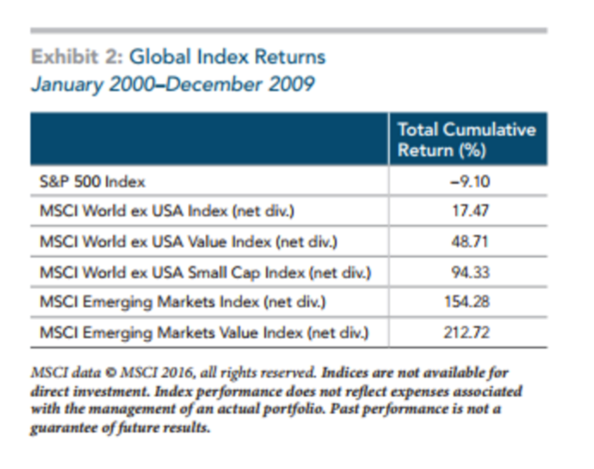
Recently a client asked me why we bother with investing in international markets.  After all, the S&P 500 has done quite well in the last year. Indeed, it has outperformed foreign markets three years in a row, and by a huge margin to boot.

Take 2014 for example-the S&P 500 was up 13%, while the international markets on aggregate were down 5%. So; why then?

Table

Well, let’s look at this table

***

untitled

***

The Lost Decade

The decade between 2000 and 2009 is what investors call “The Lost Decade,” but only if you invested solely in the S&P 500. If you had owned a globally diversified portfolio, the decade would not have been lost. In fact, after The Lost Decade, some of my clients asked me “Why bother with investing in US stocks at all?”

Assessment

My answers then and now are the same: because we don’t know what the future will bring and we don’t know which market will do best or worst, so we need a globally diversified portfolio to limit our risk of falling victim to another lost decade.

Conclusion

Your thoughts and comments on this ME-P are appreciated. Feel free to review our top-left column, and top-right sidebar materials, links, URLs and related websites, too. Then, subscribe to the ME-P. It is fast, free and secure.

Speaker: If you need a moderator or speaker for an upcoming event, Dr. David E. Marcinko; MBA – Publisher-in-Chief of the Medical Executive-Post – is available for seminar or speaking engagements. Contact: MarcinkoAdvisors@msn.com

OUR OTHER PRINT BOOKS AND RELATED INFORMATION SOURCES:

Comprehensive Financial Planning Strategies for Doctors and Advisors: Best Practices from Leading Consultants and Certified Medical Planners™

***

Stock Market Mayhem from 1950 to 2015

 Join Our Mailing List 

Stock Market Mayhem from 1950 to 2015

The Investment Scientist

ImageProxy

Michael Zhuang

[Principal of MZ Capital]

  • Stocks Decline 14% (June 1950 to July 1950) North Korean troops attack along the South Korean border. The U.N. Security Council condemns North Korea. The U.S. gets involved.
  • Stocks Decline 20.7%, (July 1957 to October 1957) The Suez Canal crisis manifests itself, the Soviets launch Sputnik and the U.S. slips into recession.
  • Stocks Decline 26.4% (January 1962 to June 1962) Stocks plunge after a decade of solid economic growth and market boom, the first “bubble” environment since 1929.

***

SHJ

***

Read more of this post

Conclusion

Your thoughts and comments on this ME-P are appreciated. Feel free to review our top-left column, and top-right sidebar materials, links, URLs and related websites, too. Then, subscribe to the ME-P. It is fast, free and secure. 

Speaker: If you need a moderator or speaker for an upcoming event, Dr. David E. Marcinko; MBA – Publisher-in-Chief of the Medical Executive-Post – is available for seminar or speaking engagements. Contact: MarcinkoAdvisors@msn.com

OUR OTHER PRINT BOOKS AND RELATED INFORMATION SOURCES:

***

Comprehensive Financial Planning Strategies for Doctors and Advisors: Best Practices from Leading Consultants and Certified Medical Planners™

***

What If the Stock Market Falls 30%?

Join Our Mailing List

Are YOU ready, Doctor?

By Michael Zhuang,

[Principal of MZ Capital Management – Contributor to Morningstar and Physicians Practice]

Ever since it touched bottom on March 9th, 2009, the market has been going up and up and up with barely any hiccup. That’s dangerous! Because our minds could get complacent. That’s why I want to do a mental exercise with all of you: What would you do if the market falls 30%?

First of all, recognize these two important facts:

1.    Market fall of 30% and above happened every ten years or so.

If we use history as a guide, we should expect a 10% odds of that happening over the next 12 months. (So don’t be surprised.)

2.    All market tumbles of that magnitude were recovered within 18 months in the US. (So don’t despair.)

So instead of seeing a 30% fall a bad thing: a horrible hit to your wealth, how about seeing that as a good thing: a deep discount of productive assets on sale that happens only once every decade.

Here is what you should do before, during and after a 30% fall of the market.

1.    Start with having an appropriate asset allocation. Depending on your age and risk tolerance, maybe it’s a 70/30 portfolio, or a 60/40 one, or a 50/50 one.

2.    Stick to it through good market and bad.

3.    Rebalance periodically or opportunistically

Let’s take a 50/50 portfolio for example. After the (stock) market tumble of 30%, the portfolio becomes 35/65. To rebalance back to 50/50, you must sell appreciated bonds and buy discounted stocks.

When you do the above over and over, you create a system of buying low and selling high.

An additional note on rebalance, to keep it simple, you can rebalance every year. The optimal rebalance however, is opportunistic not periodic. The research on that was published in Journal of Financial Analyst and it suggests a rebalance when an asset class has deviated from its target allocation by 20%. When this is done right, you can add about 40 basis points in excess return.

***

stock market

***

Channel Surfing

Have you visited our other topic channels? Established to facilitate idea exchange and link our community together, the value of these topics is dependent upon your input. Please take a minute to visit. And, to prevent that annoying spam, we ask that you register.

Link: http://feeds.feedburner.com/HealthcareFinancialsthePostForcxos

Conclusion

Your thoughts and comments on this ME-P are appreciated. Feel free to review our top-left column, and top-right sidebar materials, links, URLs and related websites, too. Then, subscribe to the ME-P. It is fast, free and secure.

Speaker: If you need a moderator or speaker for an upcoming event, Dr. David E. Marcinko; MBA – Publisher-in-Chief of the Medical Executive-Post – is available for seminar or speaking engagements. Contact: MarcinkoAdvisors@msn.com

OUR OTHER PRINT BOOKS AND RELATED INFORMATION SOURCES:

Risk Management, Liability Insurance, and Asset Protection Strategies for Doctors and Advisors: Best Practices from Leading Consultants and Certified Medical Planners™8Comprehensive Financial Planning Strategies for Doctors and Advisors: Best Practices from Leading Consultants and Certified Medical Planners™

Video on Six Costly Investment Behaviors

Join Our Mailing List

Pathetic results compared to the markets

[Principal of MZ Capital Management]

[Contributor to Morningstar and Physicians Practice]

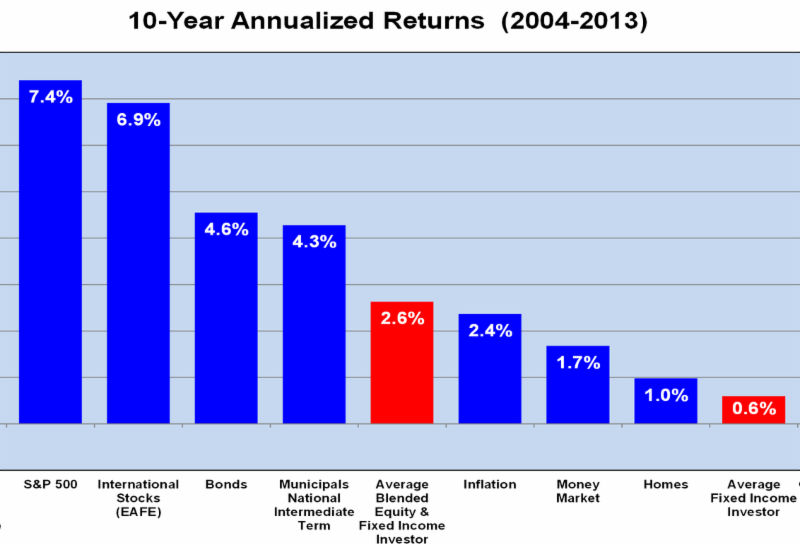
Most investors are very good at hurting themselves financially. According to latest release of Dalbar’s Quantitative Analysis of Investor Behavior (QAIB), the average investor has a return of only 2.6% over the last ten years. That’s pathetic compared to what the markets gave. See the chart below, over the same period, the S&P 500 gave an annualized return of 7.4% and the bond market gave 4.6%.

***

ImageProxy

[Click to Enlarge]

***

Investor behaviors are such a big drag on investment returns that Nobel Prize winner Daniel Kahneman, an Israeli American, advised Israel’s Pension Authority to send out statements once a quarter instead of once a month. Since when Israel’s pensioners don’t get their statements, they don’t do stupid things to their accounts.

So what are those behaviors that are so costly to investment returns? Please watch this five minute long video produced by Independence Advisors.

In a nutshell, the emotional reactions (such as herding) that had helped our hunter-gatherer forebears survive so well and thus are hard-wired into our brains are literally hazardous to successful investing. In a way, the value of an advisor like myself is to separate your emotions from your money.

Assessment

So, how does this relate to physicians and other medical professionals; better or worse?

Conclusion

Your thoughts and comments on this ME-P are appreciated. Feel free to review our top-left column, and top-right sidebar materials, links, URLs and related websites, too. Then, subscribe to the ME-P. It is fast, free and secure.

Speaker: If you need a moderator or speaker for an upcoming event, Dr. David E. Marcinko; MBA – Publisher-in-Chief of the Medical Executive-Post – is available for seminar or speaking engagements. Contact: MarcinkoAdvisors@msn.com

OUR OTHER PRINT BOOKS AND RELATED INFORMATION SOURCES:

Comprehensive Financial Planning Strategies for Doctors and Advisors: Best Practices from Leading Consultants and Certified Medical Planners(TM)

Do You Have These Horrible Investments in Your Portfolio?

Join Our Mailing List 

Beware Structured Products and Annuities

By Michael Zhuang

Principal of MZ Capital Management

[Contributor to Morningstar and Physicians Practice]

Recently, I had a new client. As part of the on-boarding process, I examined her old portfolio and found some things I didn’t recognize.

***

Cusip Symbol Description Return
25190A104 N/A Deutsche Bk AG London BRH Ret Opt Secs Lkd Ishare MSCI Mexico Capped -21.15%
25190A203 N/A Deutsche Bk AG London BRH Ret Opt Secs Lkd Ishare Euro STOXX 50 Idx -26.60%
90273L815 N/A USB AG London BRH Notes Five 15 -22.30%

***

Structured Products

What these products have in common is they don’t have a ticker symbol, meaning they are not publicly traded securities. They also have weird descriptions and they all lost a lot of money.

I called Fidelity (my custodian firm) to find out what they were and how I could get rid of them. I was told that they are structured products created by the bank(s) to shove into their clients’ accounts (The managing “advisor” works for UBS).

That rang a bell! My very first job was a financial engineer for a French bank – Societe Generale. My job was to create structured products that had appealing features and made the bank a lot of profits. Now, that I finally see them in action from, the client side of the equation; I am not proud.

Annuities

But, these structured products are not nearly as bad as an Allianz annuity that a client bought from an insurance agent “friend” a while back. He bought the annuity eleven years ago for $150-k, and over the years, saw it steadily increases in value to $189-k.

Then, there came a time when he needed the money. So, he called to cash out and was shocked to discover there was a $62-k surrender charge. In other words, he was able to get $127-k back. I subsequently called Allianz on his behalf to find out when the surrender charge would end and was told there was no end! In other words, there would always be a huge surrender charge.

***

insurance

***

What the Heck!

So, what in the heck does that value of $189-k really mean, when every time you want to take out the “value”, you have to pay a hefty ⅓ surrender charge?

Alas, Allianz explained the client can annuitize and take the amount out over ten years (or twenty years,) during which no interest will be accrued.  So, they will take your principal -or- they will take your interest, either way they screw you.

More:

Assessment 

Do you have structured products or annuities in your portfolio? Don’t know – Find out, now!

Conclusion

Your thoughts and comments on this ME-P are appreciated. Feel free to review our top-left column, and top-right sidebar materials, links, URLs and related websites, too. Then, subscribe to the ME-P. It is fast, free and secure.

Speaker: If you need a moderator or speaker for an upcoming event, Dr. David E. Marcinko; MBA – Publisher-in-Chief of the Medical Executive-Post – is available for seminar or speaking engagements. Contact: MarcinkoAdvisors@msn.com

OUR OTHER PRINT BOOKS AND RELATED INFORMATION SOURCES:

Comprehensive Financial Planning Strategies for Doctors and Advisors: Best Practices from Leading Consultants and Certified Medical Planners(TM)

What Physician-Investors Need to Know about the Shiller PE Ratio

Join Our Mailing List 

What it is – How it works

By Michael Zhuang MS www.MZCap.com

This Shiller PE index is a stock market metric invented by Yale University Professor Robert Shiller, PhD.

Basically, it is the average PE ratio of all S&P 500 stocks for the last ten years. The Shiller PE is also called PE10. Professor Shiller found it to be a reasonably good measure of valuation of the whole market.

IOW: The higher the Shiller PE, the more expensive the market. So, with Shiller PE at 24, we can call this market relatively expensive.

Assessment

Here is what I know currently.

  1. The  higher the Shiller PE – the lower the one-year and three-year return propensity.
  2. Return variability is so high as to render the Shiller PE’s predictive power very weak.
  3. Only when Shiller PE is over 35 are the three-year forward returns overwhelmingly negative.

So, the market may or may not be headed for a fall immediately, but we do need to temper our expectation of future returns.

About the Author

Michael Zhuang is founder and principal of MZ Capital, a fee-only registered investment advisor firm located in the Greater Washington D.C. metropolitan area.

Conclusion

Your thoughts and comments on this ME-P are appreciated. Feel free to review our top-left column, and top-right sidebar materials, links, URLs and related websites, too. Then, subscribe to the ME-P. It is fast, free and secure.

Link: http://feeds.feedburner.com/HealthcareFinancialsthePostForcxos

Speaker: If you need a moderator or speaker for an upcoming event, Dr. David E. Marcinko; MBA – Publisher-in-Chief of the Medical Executive-Post – is available for seminar or speaking engagements. Contact: MarcinkoAdvisors@msn.com

OUR OTHER PRINT BOOKS AND RELATED INFORMATION SOURCES:

Physician Advisors: www.CertifiedMedicalPlanner.org

Product Details  Product Details

Top Ten Wealth Management Posts for Doctors

Join Our Mailing List

By Michael Zhuang

Conclusion

Your thoughts and comments on this ME-P are appreciated. Feel free to review our top-left column, and top-right sidebar materials, links, URLs and related websites, too. Then, subscribe to the ME-P. It is fast, free and secure.

Speaker: If you need a moderator or speaker for an upcoming event, Dr. David E. Marcinko; MBA – Publisher-in-Chief of the Medical Executive-Post – is available for seminar or speaking engagements. Contact: MarcinkoAdvisors@msn.com

OUR OTHER PRINT BOOKS AND RELATED INFORMATION SOURCES:

Product Details  Product Details