







 Support our online development, and advance our onground research initiatives in free market economics, as we seek to showcase the brightest Next-Gen minds.
THE ME-P DISCLAIMER: Posts, comments and opinions do not necessarily represent iMBA, Inc., but become our property after submission. Copyright © 2006 to-date. iMBA, Inc allows colleges, universities, medical and financial professionals and related clinics, hospitals and non-profit healthcare organizations to distribute our proprietary essays, photos, videos, audios and other documents; etc. However, please review copyright and usage information for each individual asset before submission to us, and/or placement on your publication or web site. Attestation references, citations and/or back-links are required. All other assets are property of the individual copyright holder.
Support our online development, and advance our onground research initiatives in free market economics, as we seek to showcase the brightest Next-Gen minds.
THE ME-P DISCLAIMER: Posts, comments and opinions do not necessarily represent iMBA, Inc., but become our property after submission. Copyright © 2006 to-date. iMBA, Inc allows colleges, universities, medical and financial professionals and related clinics, hospitals and non-profit healthcare organizations to distribute our proprietary essays, photos, videos, audios and other documents; etc. However, please review copyright and usage information for each individual asset before submission to us, and/or placement on your publication or web site. Attestation references, citations and/or back-links are required. All other assets are property of the individual copyright holder.


A Dimensionless Number
By Staff Reporters
SPONSOR: http://www.MarcinkoAssociates.com
***
***
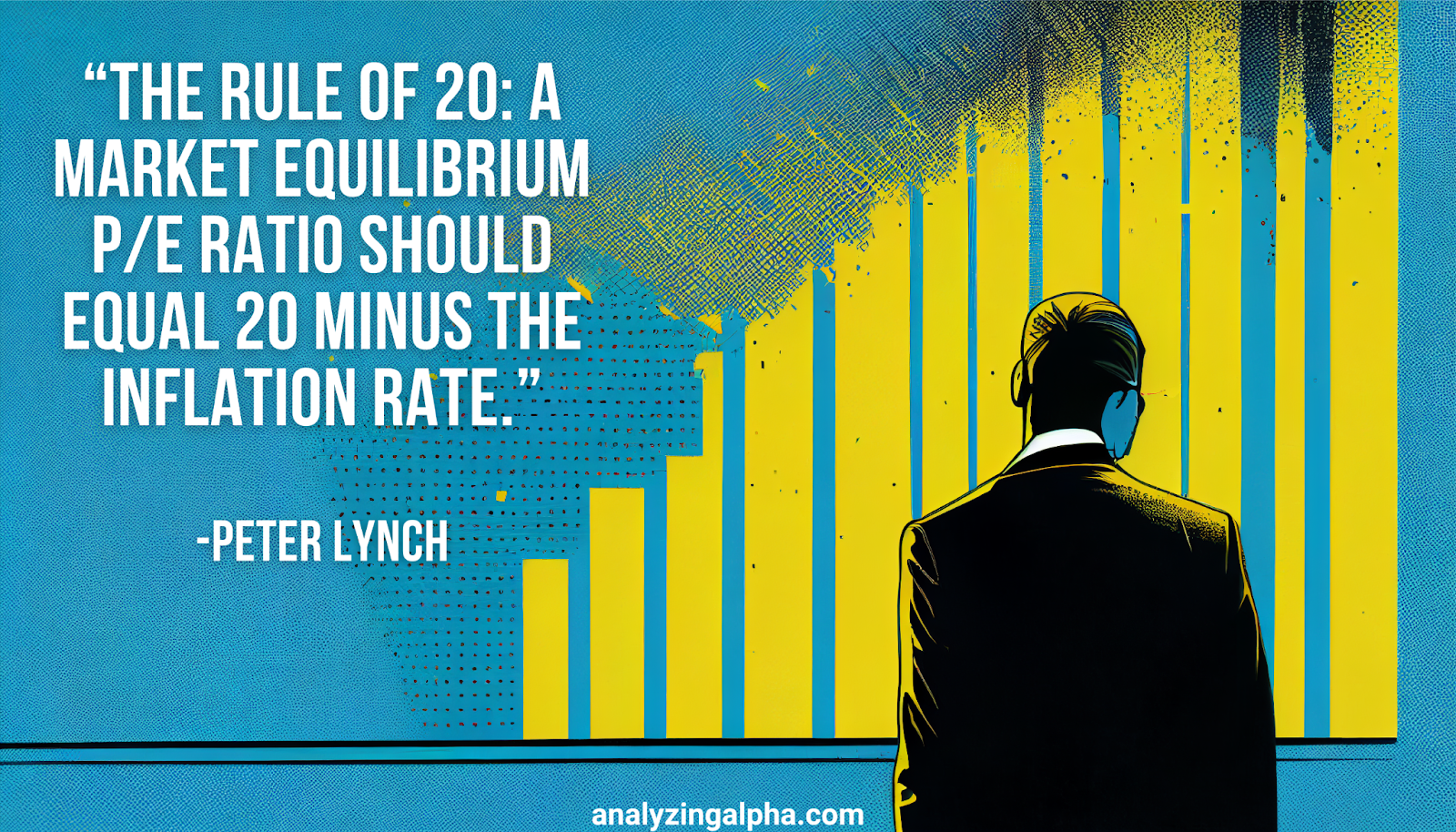
What is the Rule of 20?
The Rule of 20 is a dimensionless number that adds the current 12-month trailing Price to Earnings Ratio to the annual change in an index of the annual consumer inflation rate. A reading below 20, while a market is trending lower, means that we could be near a bottom.
In the United States, the most common index used is the broad-based S&P 500, and CPI-U is used as a proxy for inflation.
The Rule of 20 is purportedly a rule from Peter Lynch. In chapter 39 of Graham and Dodd’s seminal Security Analysis, they mention: “We would suggest that about 20 times average earnings is as high a price as can be paid in an investment purchase of a common stock” … with no mention of inflation.
Lynch’s formulation attempts to factor the ‘gravity’ of interest rates into the fair value of a stock. And, as you can see, the measure has fluctuated quite a bit. However, it has returned to roughly the 20 level repeatedly.
MORE: https://dqydj.com/sp-500-rule-of-20-calculator/
COMMENTS APPRECIATED
Subscribe and Like!
***
***
Share this:

Filed under: "Ask-an-Advisor", Experts Invited, Financial Planning, Funding Basics, Glossary Terms, iMBA, Inc., Investing, Touring with Marcinko | Tagged: CPI, CPI-U, economics, economy, fair value, finance, Graham and Dodd, inflation, inflation rate, Marcinko, PE ratio, Peter Lynch, rule 20, S&P 500 | Leave a comment »
 The Leading Business Education Network for Doctors, Financial Advisors and Health Industry Consultants