BOARD CERTIFICATION EXAM STUDY GUIDES Lower Extremity Trauma
[Click on Image to Enlarge]
ME-P Free Advertising Consultation
The “Medical Executive-Post” is about connecting doctors, health care executives and modern consulting advisors. It’s about free-enterprise, business, practice, policy, personal financial planning and wealth building capitalism. We have an attitude that’s independent, outspoken, intelligent and so Next-Gen; often edgy, usually controversial. And, our consultants “got fly”, just like U. Read it! Write it! Post it! “Medical Executive-Post”. Call or email us for your FREE advertising and sales consultation TODAY [678.779.8597] Email: MarcinkoAdvisors@outlook.com
Medical & Surgical e-Consent Forms
ePodiatryConsentForms.com
iMBA Inc., OFFICES
Suite #5901 Wilbanks Drive, Norcross, Georgia, 30092 USA [1.678.779.8597]. Our location is real and we are now virtually enabled to assist new long distance clients and out-of-town colleagues.
ME-P Publishing
SEEKING INDUSTRY INFO PARTNERS?
If you want the opportunity to work with leading health care industry insiders, innovators and watchers, the “ME-P” may be right for you? We are unbiased and operate at the nexus of theoretical and applied R&D. Collaborate with us and you’ll put your brand in front of a smart & tightly focused demographic; one at the forefront of our emerging healthcare free marketplace of informed and professional “movers and shakers.” Our Ad Rate Card is available upon request [678-779-8597].
Tax-loss harvesting is a strategy to lower investment taxes that involves selling securities at a loss to offset capital gains. BofA said investors in the past week also pulled out $10 billion from bonds.
Amazon.com Inc. has erased more shareholder wealth than any other publicly traded company in 2022. In total, investors in Amazon have lost $804.6 billion this year. The stock is down 48% in 2022.
Apple Inc. and Microsoft Corp. have also suffered larger market-cap declines than Tesla, by virtue of their sheer size.
I enjoy writing about taxes as much as I enjoy going to the dentist. But I feel what I am about to say is important. We – including yours truly – have been mindlessly conditioned to do tax selling at the end of every year to reduce our tax bills. On the surface it makes sense. There are realized gains – why don’t we create some tax losses to offset them?
Here is the problem. With a few exceptions, which I’ll address at the end, tax-loss selling makes no logical sense. Let me give you an example.
Let’s say there is a stock, XYZ. We bought it for $50; we think it is worth $100. Fourteen months later we got lucky and it declined to $25. Assuming our estimate of its fair value hasn’t changed, we get to buy $1 of XYZ now for 25 cents instead of 50 cents.
But as of this moment we also have a $25 paper loss. The tax-loss selling thinking goes like this: Sell it today, realize the $25 loss, and then buy it in 31 days. (This is tax law; if we buy it back sooner the tax loss will be disqualified.) This $25 loss offsets the gains we took for the year. Everybody but Uncle Sam is happy.
Since I am writing about this and I’ve mentioned above I’d rather be having a root canal, you already suspect that my retort to the above thinking is a great big NO!
In the first place, we are taking the risk that XYZ’s price may go up during our 31-day wait. We really have no idea and rarely have insights as to what stocks will do in the short term. Maybe we’ll get lucky again and the price will fall further. But we’re selling something that is down, so risk in the long run is tilted against us. Also, other investors are doing tax selling at the same time we are, which puts additional pressure on the stock.
Secondly – and this is the most important point – all we are doing is pushing our taxes from this year to future years. Let’s say that six months from now the stock goes up to $100. We sell it, and… now we originate a $75, not a $50, gain. Our cost basis was reduced by the sale and consequent purchase to $25 from $50. This is what tax loss selling is – shifting the tax burden from this year to next year. Unless you have an insight into what capital gains taxes are going to be in the future, all you are doing is shifting your current tax burden into the future.
Thirdly, in our first example we owned the stock for 14 months and thus took a long-term capital loss. We sold it, waited 31 days, and bought it back. Let’s say the market comes back to its senses and the price goes up to $100 three months after we buy it back. If we sell it now, that $75 gain is a short-term gain. Short-term gains are taxed at your ordinary income tax bracket, which for most clients is higher than their capital gain tax rate. You may argue that we should wait nine months till this gain goes from short-term to long-term. We can do that, but there are costs: First, we don’t know where the stock price will be in nine months. And second, there is an opportunity cost – we cannot sell a fully priced $1 to buy another $1 that is on fire sale.
Final point. Suppose we bought a stock, the price of which has declined in concert with a decrease of its fair value; in other words, the loss is not temporary but permanent. In this case, yes, we should sell the stock and realize the loss.
We are focused on the long-term compounding of your wealth. Thus our strategy has a relatively low portfolio turnover. However, we always keep tax considerations in mind when making investment decisions, and try to generate long-term gains (which are more tax efficient) than short term gains.
We understand that each client has their unique tax circumstances. For instance, your income may decline in future years and thus your tax rate, too. Or higher capital gains may put you in a different income bracket and thus disqualify you from some government healthcare program.
We are here to serve you, and we’ll do as much or as little tax-loss selling as you instruct us to do. We just want you to be aware that with few exceptions tax-loss selling does more harm than good.
Posted on November 6, 2022 by Dr. David Edward Marcinko MBA MEd CMP™
By Staff Reporters
***
***
What Is Tax-Loss Harvesting?
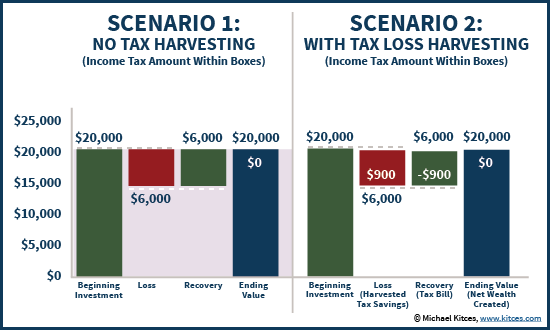
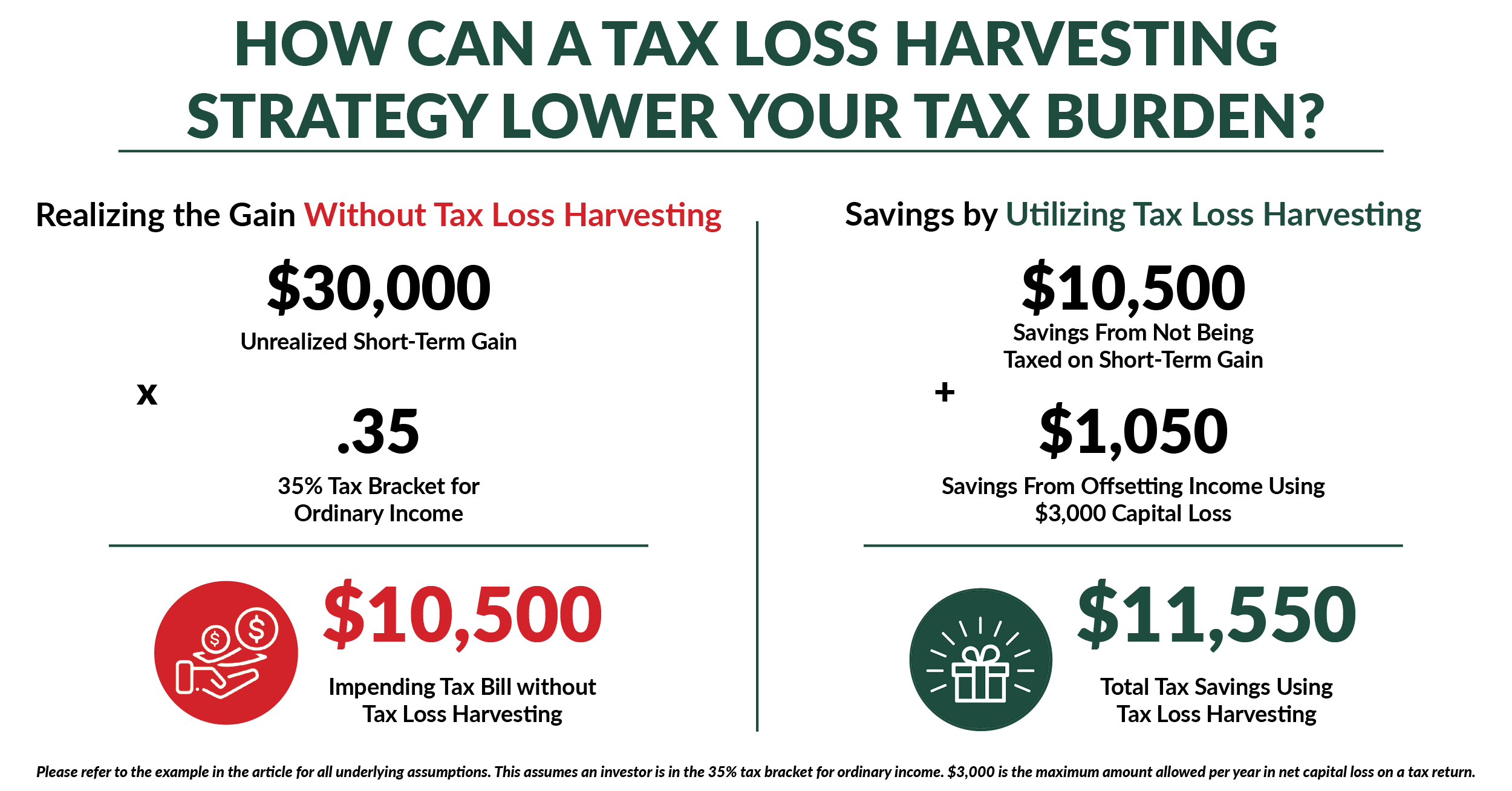
Tax-loss harvesting is the timely selling of securities at a loss in order to offset the amount of capital gains tax due on the sale of other securities at a profit.
This strategy is most often used to limit the amount of taxes due on short-term capital gains, which are generally taxed at a higher rate than long-term capital gains. However, the method may also offset long-term capital gains. This strategy can help preserve the value of the investor’s portfolio while reducing the cost of capital gains taxes.
There is a $3,000 limit on the amount of capital gains losses that a federal taxpayer can deduct in a single tax year. However, Internal Revenue Service (IRS) rules allow additional losses to be carried forward into the following tax years.
4 Key Points
Tax-loss harvesting is a strategy investors can use to reduce the total amount of capital gains taxes due from the sale of profitable investments.
The strategy involves selling an asset or security at a net loss.
The investor can then use the proceeds to purchase a similar asset or security, maintaining the portfolio’s overall balance.
The investor must be careful not to violate the IRS rule against buying a “substantially identical” investment within 30 days.







 Support our online development, and advance our onground research initiatives in free market economics, as we seek to showcase the brightest Next-Gen minds.
THE ME-P DISCLAIMER: Posts, comments and opinions do not necessarily represent iMBA, Inc., but become our property after submission. Copyright © 2006 to-date. iMBA, Inc allows colleges, universities, medical and financial professionals and related clinics, hospitals and non-profit healthcare organizations to distribute our proprietary essays, photos, videos, audios and other documents; etc. However, please review copyright and usage information for each individual asset before submission to us, and/or placement on your publication or web site. Attestation references, citations and/or back-links are required. All other assets are property of the individual copyright holder.
Support our online development, and advance our onground research initiatives in free market economics, as we seek to showcase the brightest Next-Gen minds.
THE ME-P DISCLAIMER: Posts, comments and opinions do not necessarily represent iMBA, Inc., but become our property after submission. Copyright © 2006 to-date. iMBA, Inc allows colleges, universities, medical and financial professionals and related clinics, hospitals and non-profit healthcare organizations to distribute our proprietary essays, photos, videos, audios and other documents; etc. However, please review copyright and usage information for each individual asset before submission to us, and/or placement on your publication or web site. Attestation references, citations and/or back-links are required. All other assets are property of the individual copyright holder.







 The Leading Business Education Network for Doctors, Financial Advisors and Health Industry Consultants