USA HEALTHCARE QUALITY: Confidence Down

Confidence in the caliber of the American health system has never been lower

A GALLUP POLL

***

***

ANNUAL GALLUP HEALTHCARE QUALITY REPORT

More than one in five adults (21%) living in the US now rate the country’s healthcare as “poor” quality—a record high, according to Gallup’s annual health and healthcare poll.

Less than half of all respondents (48%) surveyed in 2022 said they’d rank the quality of healthcare in the US as “excellent/good”—a new low since Gallup began tracking the issue in 2001. (That’s down from 50% in 2021 and a record high of 62% in 2010 and 2012.) About a third (31%), meanwhile, said they’d rate the quality of US healthcare as “only fair,” a slight drop from 35% in 2021.

Gallup partially attributed the drop in perceived quality to politics, noting that “Republicans’ positive ratings have been subdued since President Donald Trump left office.” Other likely factors, the organization offered, could be “changes to healthcare that have taken place amid the Covid-19 pandemic or curtailed access to abortion since the Supreme Court’s Dobbs decision.”

Survey Reports:

  • Respondents reported a rosier take on the care they personally receive. Over 70% rated it as “excellent/good” compared to 6% who rated it as “poor.” But that high “excellent/good” mark is still down from 76% in 2021 and 82% in 2020.
  • Costs remained a point of contention in 2022. Less than a quarter (24%) of respondents said they were “satisfied” with the total cost of healthcare in the US, and this proportion is on par with rates from the past two decades. But only 56% of those surveyed reported being satisfied with the total cost they pay for care—the lowest level since 2016.
  • One in five respondents think the US healthcare system is in a “state of crisis” (20%) or has “major problems” (48%).

EDITOR’S NOTE: As a former CPHQ [Certified Physician in Healthcare Quality], I find this report alarming and confusing – David EdwardMarcinko MBA CMP

CMP Program: http://www.CertifiedMedicalPlanner.org

***

Product Details

***

ORDER: https://www.amazon.com/Financial-Management-Strategies-Healthcare-Organizations/dp/1466558733/ref=sr_1_3?ie=UTF8&qid=1380743521&sr=8-3&keywords=david+marcinko

ORDER: https://www.amazon.com/Hospitals-Healthcare-Organizations-Management-Operational/dp/1439879907/ref=sr_1_4?s=books&ie=UTF8&qid=1334193619&sr=1-4

COMMENTS APPRECIATED

Thank You

***

PODCAST: “Un-Accountable” Healthcare Quality

BOOK REVIEW

By Dr. Eric Bricker MD

***

***

YOUR COMMENTS ARE APPRECIATED.

MEDICAL ETHICS: https://medicalexecutivepost.com/2021/05/28/medical-ethics-managing-risk-is-a-component-of-caring/

Thank You

***

***

Why Healthcare Variations are Expensive

The Cost of Medical Quality

By Daniel L. Gee; MD MBA

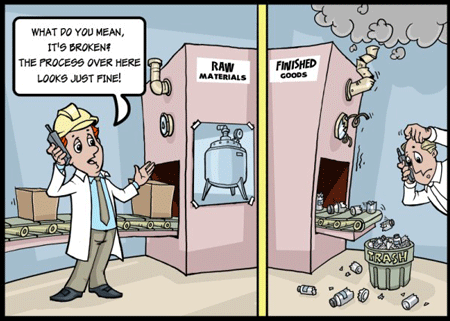
The cost of medical quality actually goes up when the variation and error rate of a process goes up. For example, the costs of pharmaceutical errors alone, in terms of lives and money, are huge. Consider the legal implications of incorrect procedures to an institution. Coding errors that lead to variability in reimbursements costs physicians and other providers, lost revenue.

Think also of the cost of additional safeguards, such as inspectors, that must be put into place to oversee defective processes. When a process is improved, the cost of quality goes down. There are fewer costs due to redundancy, lost time and lost labor.

A Variations Analogue

The concept of looking at medical variations in a process is analogous to the process of teaching a child to ride a bicycle for the first time. The child will be wobbly when he or she gets on the bicycle, at first and, may even fall, several times. As long as you are watching closely, to help the child back on the bicycle, help steer a little and provide encouragement, the child soon learns to ride smoothly and it appears all so natural. The child soon learns to balance from the feedback gained from you and the internal feedback from the brain. After studying the learning process closer, you may find the child to be more successful learning on a set of training wheels or on a bicycle a little smaller in size.

Regardless, the closed loop feedback, analysis, and monitoring by a teacher or process “champion,” keeps the child from wobbling too much and to stay on a straight and narrow course.

A Closed Feedback Loop

Businesses and medical practices wobble too in their processes and, in Six Sigma terminology, this wobbling is the variation that needs continual feedback to help correct and stabilize. Unlike riding a bike, where when once learned it becomes natural and smooth, businesses continue to wobble in their processes and may fall without ever being able to get back up. The institution of Six Sigma methodology is a closed feedback loop to prevent instability in processes.

More: http://businessofmedicalpractice.com/bonus-e-material/

Assessment

Virtual perfection may not be as easily attainable in an industry – like medicine – as computer chips coming off an assembly line; and the healthcare industry certainly has its share of “wobbliness;”

It is, nonetheless, the desire to constantly improve operations, perfect the way healthcare business is done – and tune in to what the patient needs – that separates the Six Sigma Sx improvement method from those QI techniques that have come before.

Moreover, the benefits of setting high performance goals, is a strategic decision to accelerate improvement, promote continual learning and sustaining efforts to succeed. It is a cultural change in medical mind-set to attain quality at its highest level.

Join Our Mailing List

Conclusion

And so, your thoughts and comments on this ME-P are appreciated. What is your SS experience with medical variations? How should we define cost; in economic or human terms? Feel free to review our top-left column, and top-right sidebar materials, links, URLs and related websites, too. Then, be sure to subscribe. It is fast, free and secure.

Speaker: If you need a moderator or speaker for an upcoming event, Dr. David E. Marcinko; MBA – Publisher-in-Chief of the Medical Executive-Post – is available for seminar or speaking engagements. Contact: MarcinkoAdvisors@msn.com

Our Other Print Books and Related Information Sources:

Practice Management: http://www.springerpub.com/prod.aspx?prod_id=23759

Physician Financial Planning: http://www.jbpub.com/catalog/0763745790

Subscribe Now: Did you like this Medical Executive-Post, or find it helpful, interesting and informative? Want to get the latest ME-Ps delivered to your email box each morning? Just subscribe using the link below. You can unsubscribe at any time. Security is assured.

Link: http://feeds.feedburner.com/HealthcareFinancialsthePostForcxos

Sponsors Welcomed

And, credible sponsors and like-minded advertisers are always welcomed.

Link: https://healthcarefinancials.wordpress.com/2007/11/11/advertise

Product DetailsProduct DetailsProduct Details

Product Details  Product Details

Product Details

Certified Physician in Healthcare Quality

Join Our Mailing List

About CPHQ

[By Dr. David Edward Marcinko; MBA, CPHQ, CMP™]dr-david-marcinko2

Mission

The mission of the National Association for Healthcare Quality (NAHQ) is to improve healthcare by advancing the theory and practice of quality management in healthcare organizations and by supporting the professional growth and development of Healthcare quality management professionals. The association has about 15,000 members and was established in 1976 www.CPHQ.org

Several Specialties

There are specialties in infection control, medical and staff records, nursing, risk management, utilization review and CQI/TQM. Annual educational conferences are available, along with integrated educational courses, the quarterly newsletter NAHQ News and the bimonthly publication, Journal for Healthcare Quality. The NAHQ certification program, confers the designation Certified Professional in Healthcare Quality to members, and is accredited by the National Organization for Competency and National Commission for Health Certifying Agencies. It has certified more than 8,000 individuals.

Assessment

The NAHQ has liaison relationships with allied organizations, such as the American Hospital Association, JCAHO, National Health Council and the National Association of Medical Staff Services. It has working relationships with the American Health Information Management Association, Healthcare Financial Management Association and the US Department of Health and Human Services. Corporate headquarters are at 5700 Old Orchard Road, first floor, Skokie, Illinois, 60077 (708) 966-9392

Conclusion

Your thoughts and comments on this ME-P are appreciated. Feel free to review our top-left column, and top-right sidebar materials, links, URLs and related websites, too. Then, subscribe to the ME-P. It is fast, free and secure.

Speaker: If you need a moderator or speaker for an upcoming event, Dr. David E. Marcinko; MBA – Publisher-in-Chief of the Medical Executive-Post – is available for seminar or speaking engagements. Contact: MarcinkoAdvisors@msn.com

OUR OTHER PRINT BOOKS AND RELATED INFORMATION SOURCES:

Product DetailsProduct Details