







 Support our online development, and advance our onground research initiatives in free market economics, as we seek to showcase the brightest Next-Gen minds.
THE ME-P DISCLAIMER: Posts, comments and opinions do not necessarily represent iMBA, Inc., but become our property after submission. Copyright © 2006 to-date. iMBA, Inc allows colleges, universities, medical and financial professionals and related clinics, hospitals and non-profit healthcare organizations to distribute our proprietary essays, photos, videos, audios and other documents; etc. However, please review copyright and usage information for each individual asset before submission to us, and/or placement on your publication or web site. Attestation references, citations and/or back-links are required. All other assets are property of the individual copyright holder.
Support our online development, and advance our onground research initiatives in free market economics, as we seek to showcase the brightest Next-Gen minds.
THE ME-P DISCLAIMER: Posts, comments and opinions do not necessarily represent iMBA, Inc., but become our property after submission. Copyright © 2006 to-date. iMBA, Inc allows colleges, universities, medical and financial professionals and related clinics, hospitals and non-profit healthcare organizations to distribute our proprietary essays, photos, videos, audios and other documents; etc. However, please review copyright and usage information for each individual asset before submission to us, and/or placement on your publication or web site. Attestation references, citations and/or back-links are required. All other assets are property of the individual copyright holder.


Physicians Returning to Zero?
[By Somnath Basu PhD, MBA]
How have your investments done over the last three years? If you were to ask doctors, or the myriads of people who are or even pose as professional financial advisors, they would generally say that it would depend on how well your portfolio was diversified. By this jargon, they would mean how your money (in what proportions) was invested among various asset classes such as stocks, bonds, commodities, cash etc. The more it was spread out around various asset classes, the safer they would have been.
To see how safe (or how risky) your portfolio was over the last few years, it’s useful to view how these asset classes themselves fared over this time period. That is what is shown in the next chart where the following asset class performances over the last few years are shown. The chart shows the performances of stocks (S&P 500 shown by the symbol ^GPSC, in red), bonds (symbol IEI, Barclay’s 3-7 Year Treasury Bond index etf, in light green), Commodities (DBC, Powershares etf, in dark green), Long dollar (UUP, Powershares long dollar etf, in orange; this fund allows speculating on the dollar going up against a basket of important currencies; whenever the world financial markets are in turmoil, this index generally goes up as investors around the world seek the “safe haven” status of the dollar.
Alternately, note that this index value will also typically rise when the domestic economy is in a sound condition and both domestic and international investors favor the U.S. financial markets) and the short dollar (UDN, the Powershares inverse of UUP). Note that the “Cash” asset class has been left out and returns on cash (or money market funds) have been close to zero the whole time.
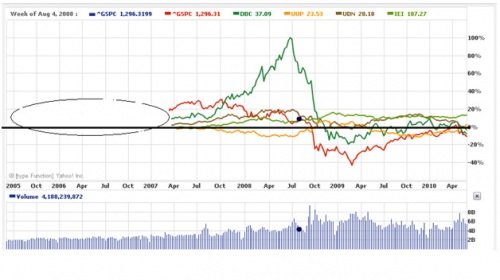
There are a few startling observations from this period. The first part that arrests the eye is how commodities performed over this time period. If your portfolio was heavy in this sector, you had a heck of a ride these last three years. If you had a lot of stocks as well, heck, your ride just got wilder. As can also be seen from the picture, healthy doses of bonds and currencies would have made your ride that much smoother.
On the other hand, what is additionally startling to observe is that we all started this period close to zero returns in the beginning of 2007 (around March 2007) and in June 2010, we are all converging back to zero returns. No matter how you were diversified, you either took a smooth ride (well diversified portfolio) from a zero return environment to a zero return environment or a wilder ride. That is why diversification is so important. Another way to gauge your diversification benefit is to use a two-pronged system.
The first is what I refer to as the “monthly statement effect”. When your monthly financial statements come in, you first observe the current month’s ending balance, then the previous month’s ending balance and then have a great day, a lousy day or an uneventful day. Depending on how good or bad (how volatile the ride) the monthly effect is, it may last for much more than just a day, maybe days. The second piece is your age.
Life Cycle Investment Hypothesis
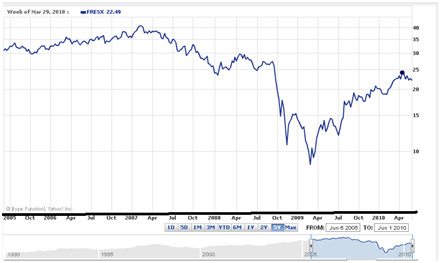
As you grow older, you ask yourself how wild a ride can you tolerate at this point in your life? Hopefully, as you age, this tolerance level should show significant declines. If it does, you are then joining a rational investment group practicing a “lifecycle-investment hypothesis” style. Finally, did anything do well during this time? Yes, and surprisingly from an asset class whose underlying asset is shaped too like a zero – mother earth and real estate. Having some real estate in your investment basket (another important diversification asset) would not only have smoothed your ride but would have made your financial life so much more pleasurable. Just take a look at this picture below (FRESX, an old Fidelity’s real estate index fund) which says it all.
Assessment
Even in the darkest days of falling real estate markets of 2008, this fund produced a positive return. Of course many other real estate indexes lost their bottoms; thus finding these stable indexes in all asset classes are well worth their salt. That is, if it is time for you to diversify.
Conclusion
Your thoughts and comments on this ME-P are appreciated. Feel free to review our top-left column, and top-right sidebar materials, links, URLs and related websites, too. Then, subscribe to the ME-P. It is fast, free and secure.
Speaker: If you need a moderator or speaker for an upcoming event, Dr. David E. Marcinko; MBA – Publisher-in-Chief of the Medical Executive-Post – is available for seminar or speaking engagements. Contact: MarcinkoAdvisors@msn.com
OUR OTHER PRINT BOOKS AND RELATED INFORMATION SOURCES:
- PRACTICES: www.BusinessofMedicalPractice.com
- HOSPITALS: http://www.crcpress.com/product/isbn/9781466558731
- CLINICS: http://www.crcpress.com/product/isbn/9781439879900
- ADVISORS: www.CertifiedMedicalPlanner.org
- FINANCE: Financial Planning for Physicians and Advisors
- INSURANCE: Risk Management and Insurance Strategies for Physicians and Advisors
- Dictionary of Health Economics and Finance
- Dictionary of Health Information Technology and Security
- Dictionary of Health Insurance and Managed Care


Share this:

Filed under: Financial Planning, Investing, Portfolio Management, Research & Development | Tagged: bonds, CASH, commodities, FRESX, Life Cycle Investment Hypothesis, real-estate, Somnath Basu, stocks, UDN, UUP |


Dr. Basu, you made an important observation – that most asset classes are close to where they were 3 years ago. Diversification indeed helps, but when you add disciplined rebalancing to the mix, you benefit even more.
Consider this: if you started this period of time diversified in a number of different asset classes, then rebalanced regularly over the past 3 years, the asset classes may be near where they started, but your total return for the period could be higher than the average return for the individual asset class!
Brian J. Knabe MD CFP CMP™
LikeLike
In striking shift, small investors flee stock markets
Is it different this time?
http://www.msnbc.msn.com/id/38803088/ns/world_news-the_new_york_times
Talk about “life cycles.”
Blaine
LikeLike
On Holistic Life Planning
There is another way of living with money, a way of both acknowledging money’s useful roles, and also finding a way to connect with our most profound aspirations around money, our deepest ideals, our most difficult emotions, our darkest places, as well as our joys, putting it altogether and understanding what all of our humanness has to do with our relationship to money.
George D. Kinder, CFP©
[Kinder Institute of Life Planning]
LikeLike
Future Healthcare Costs?
Dr. Basu’s points for diversification of the investment portfolio based on a physician’s life cycle in retirement is helpful in reducing risk. The lifecycle model also takes into consideration the uncertainties of lifespan, income needs, and old age health shocks in determining expenses in retirement. The standard use of replacement rates by financial planners in calculating a pre-retirees income needs in retirement is flawed.
The big problem here for us financial planners is also properly calculating future expenses. By using data provided by the Health and Retirement Study (HRS) conducted by the University of Michigan in Ann Arbor, Scholz, Seshadri and Khitatrakun point out that older Americans are, by in large, preparing reasonably for retirement when using lifecycle modeling, while younger Americans are probably not on target for proper retirement expenses [.Scholz, John Karl, Ananth Seshadri, and Surachai Khitatrakun. 2006. “Are Americans Saving ‘Optimally’ for Retirement?” Journal of Political Economy. August, 607-643. Web. 17 Aug. 2012.]
Households may have variations in future variables which can include rate of return, life expectancy, future bequests intentions and future reductions in the social security system which the HRS data does not fully comprehend. The ability of households to comfortably weather large out of pocket future medical costs however is something the authors admit the lifecycle model is not able to accurately forecast or predict.
Do we straight-line health costs increasing at 6% a year? 8%? Any suggestions with ACA in the wings?
David K. Luke MIM
CMP candidate
http://www.CertifiedMedicalPlanner.org
LikeLike
OUR NEW BOOK
Comprehensive Financial Planning Strategies for Doctors and Advisors: Best Practices from Leading Consultants and Certified Medical Planners
SECTION TWO: FOR NEW PRACTITIONERS
New medical practitioners are typically in their late-twenties or early thirties and it may be a decade, or more, before they independently lead a case. Often, they are in debt and with a new spouse and children. And, it is not unusual for them to desire nice homes, automobiles, clothes and take vacations as a reward for their years of hard work. After all; they’ve earned it. In retrospect, they step back, look at their peers from college who are farther along in their careers, and wonder if it was all worth it? It is about this same time that so-called “financial advisors” seek them out for gain. But, is it for their benefit; or advisor self-benefit?
Of course, the IRS is vicious and young doctors need an account, says the CPA. And, you must protect your business, career, life, kids and possessions with insurance, says the insurance agent. Ditto for an investing plan and stock portfolio, says the financial advisor; as they all recommend their products or hawk their services of choice. Insiders are aware that there is a truism in the financial services sector which suggests that most every problem can be solved with a insurance product or financial plan. So it’s no surprise that goaded physicians might prefer “investing” vehicles like the guaranteed minimum death benefit of variable annuities, or the assurance that comes with disability or long term care insurance, or traditional cash value life insurance policies, despite their decidedly higher costs and commissions. Salesmen all – as uber bloger Michael Kitecs MSFS, MTAX, CFP®, CLU, ChFC, RHU, REBC, CASL opines – “all financial planning is about sales, sales and sales” [personal communication, Kitces.com, Reston, VA].
Yet, for true physician-focused financial advisors, this is an exciting time to be practicing because there is much research and creative enlightenment occurring in the academic and practitioner communities. But, one must be willing to abandon ancient thoughts and remain open to new ideas that identify and provide solutions to the contemporaneous problems of healthcare professionals. As an example of this epiphany, the economist Christian Gollier revisited the raison detra’ of insurance, by asking: should one even buy insurance since the industry itself is so skilled at exploiting human foibles? Although this emerging work is descriptive, it is not yet time tested since some of it aspires to be normative, as developing modern models of savings and consumption hint that insurance may deserve a smaller role in personal risk management than previously believed.
So, in Section Two, we review insurance plans, risk management topics, tax and asset protection fundamentals and strategies, and then introduce the various investment vehicles and platforms used in professional and self portfolio construction.
Ann Miller RN MHA
[Executive Director]
LikeLike