Broadening the Strategic Value of Integrated Medical Provider Management‏

How Health Plans Can Create Scalable and Competitive Products that Enable Affordable and High-Quality Care

Join Our Mailing List 

By Sam Muppalla – Vice President, McKesson Health Solutions Network Performance Management

[Part 6 in a 6 part series]

Over the past few weeks, I’ve covered a lot of ground in this ME-P series of six essays. We looked at the pressures on health plans and the ways in which those pressures are forcing a new dynamic in how the plans create new, scalable competitive products that enable affordable, high-quality care. We talked about some of the innovations that leading health plans are bringing to the areas of product, network, care model and reimbursement designs.

The pilot initiatives in these areas continue to show positive results. The next level of scaling requires an integrated and automated approach to enable health plans to deploy, manage and maintain these innovations in a much more rapid fashion. This all has to be done without increasing health plan costs while delivering new value to a health plan’s customers, providers and members.

Affordable Care Can be Achieved

It is our position at NPM that achieving this alignment will deliver affordable care. Additionally, through this alignment, health plans will gain a competitive and cost savings leadership position. Through collaborative and independent research with our health plan partners, we have identified three main areas of competitive and cost savings leadership. The potential cost savings of achieving alignment are impressive. For example, working with a regional Blues plan with three million members, the potential cost savings due to achieving an integrated approach to network design were projected to be:

Administrative Cost Savings [Total Potential Annual Savings = $13 million to $25 million]

  • Provider data administration cost reductions: $5 million to $10 million
  • Provider outreach cost reductions: $0.75 million to $1.25 million
  • Contract management cost reductions: $1 million to $3 million
  • Administrative reimbursement cost reductions: $3 million to $5 million
  • Provider service cost reductions: $1.5 million to $2.5 million
  • Credentialing cost reductions: $1.5 million to $3 million

Medical Cost Savings [Total Potential Annual Savings = $45 million to $100 million]

  • Streamlined member health advocacy: $5 million to $10 million
  • Pay for Performance: $15 million to $40 million
  • Network design and performance improvements: $25 million to $50 million

Provider IT Cost Savings [Total Potential Annual Savings = $.5 million to $2.5 million]

  • Redundant system consolidations: $0.25 million to $2 million
  • IT change management cost reductions: $0.25 million to $0.5 million

The total aggregated annual potential for savings is between $59 million and $127 million.

Some Final Thoughts

In 2009, the National Health Expenditure (NHE) rose to $2.5 trillion or 17.6 percent of the Gross Domestic Product (GDP) with private health insurance accounting for 32 percent of the NHE. Yet all of this spending is not translating into any measure of higher quality care as the World Health Organization (WHO) also ranks the U.S. as 72nd in overall level of health in the world. To affect high-quality, affordable care, health plans must be able to harness innovative product, network, care model and reimbursement designs. Network design is the critical element that will orchestrate the operational scaling of innovation. Therefore, automation of network design and efficient implementation of it through end-to-end integration will be crucial to success of health plans in the post reform world.

Assessment

Thanks for taking the time to follow me, and the ME-P, on this journey. If you’ve joined us late in the discussion, fear not. We’ve collected all the related threads in the Unlocking Affordable Care by Aligning Products white paper, which you can download by visiting our website at http://ow.ly/7MFKb.

MORE: Strategic Management Improvement

Conclusion

And so, your thoughts and comments on this ME-P are appreciated. Please review our top-left column, and top-right sidebar materials, links, URLs and related websites, too. Then, subscribe to the ME-P. It is fast, free and secure.

Link: http://feeds.feedburner.com/HealthcareFinancialsthePostForcxos

Speaker: If you need a moderator or speaker for an upcoming event, Dr. David E. Marcinko; MBA – Publisher-in-Chief of the Medical Executive-Post – is available for seminar or speaking engagements. Contact: MarcinkoAdvisors@msn.com

Our Other Print Books and Related Information Sources:

Health Dictionary Series: http://www.springerpub.com/Search/marcinko

Practice Management: http://www.springerpub.com/product/9780826105752

Physician Financial Planning: http://www.jbpub.com/catalog/0763745790

Medical Risk Management: http://www.jbpub.com/catalog/9780763733421

Healthcare Organizations: www.HealthcareFinancials.com

Physician Advisors: www.CertifiedMedicalPlanner.com

Subscribe Now: Did you like this Medical Executive-Post, or find it helpful, interesting and informative? Want to get the latest ME-Ps delivered to your email box each morning? Just subscribe using the link below. You can unsubscribe at any time. Security is assured.

Link: http://feeds.feedburner.com/HealthcareFinancialsthePostForcxos

Sponsors Welcomed: And, credible sponsors and like-minded advertisers are always welcomed.

Link: https://healthcarefinancials.wordpress.com/2007/11/11/advertise

 

An Integrated Approach to Healthcare Network Alignment and Scalable Innovation‏

More on Healthcare Network Design and Automation

Join Our Mailing List

[Part 5 in a 6 part series]

By Sam Muppalla – Vice President, McKesson Health Solutions Network Performance Management

Previously, on this ME-P, I wrote about the barriers to alignment across product, network, care and reimbursement innovations. And, yes, I teased you with the three-word preview of what was to come this week: Integrated Building Blocks. The idea of building blocks lies at the heart of an approach to achieving alignment and scaling innovation, so let’s dive in.

Unlocking potential administrative, IT and medical savings — while also creating sustainable alignment of the innovation engines — requires various building blocks be in place as a sound foundation for network design and implementation. These building blocks deliver the required functionality in the most efficient manner. When these building blocks are utilized in an integrated fashion, the current barriers are removed and innovation alignment is achieved.

Four Essential Building Blocks

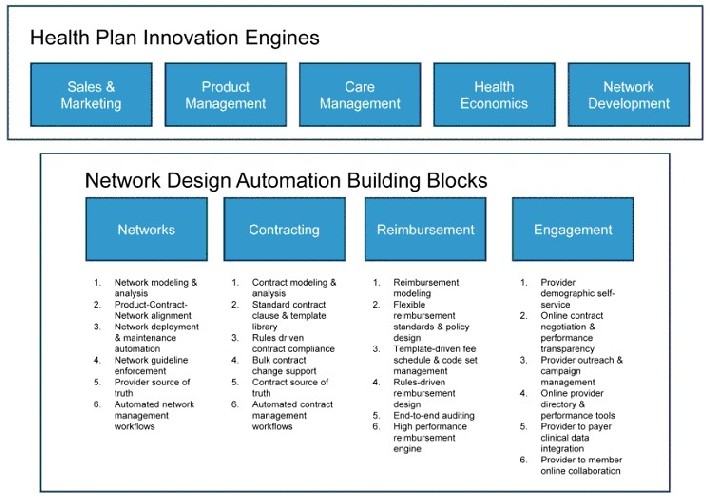
There are four essential network design automation building blocks that comprise the foundation for innovation: networks, contracting, reimbursement and engagement.

Each of these building blocks enables capabilities by delivering necessary functionality within and across the spectrum of network design. Reaching levels of maturity with this capability unlocks additional value and alignment.

Networks

The network building block enables health plans to differentiate and compete. The purpose is to differentiate their value for each customer segment by aligning the product and care model designs with the underlying network designs. It ensures network performance by facilitating the selection of appropriate providers into networks and the alignment of provider reimbursement with network design objectives. It enables networks to be mapped to member-facing and provider-facing products. The provider-facing products can be used for contracting and provider rate differentiation. The member-facing products can be aligned with benefits and serve as steerage targets for benefit designers.

These constructs, in conjunction with each other, enable productization of care model and payment innovation. For example, a health plan could define a “Medical Home Network” that consists of medical homes and supporting providers in a given geography. It could then enable PCMH-specific reimbursement (e.g., PMPM capitation + Fee For Services (FFS) for preventive services + P4P for EBM) by defining a provider-facing product and associating specific reimbursement policies with that provider product. Additionally, it could also define a member-facing product (e.g., PPO Value) which combines the medical home network with the general market PPO network. This in turn will allow the health plan to define a benefit extension which gives a 10 percent premium reduction to members who use Medical Home Network providers for their primary care. In short, a health plan is now able to monetize its care innovation (PCMH), align benefit design to network design for steerage, and align its provider payment with member incentives (around preventive services), while incenting higher quality care (P4P).

The network building block also achieves administrative cost leadership through comprehensive provider data governance and automation of core provider processes.

Contracting

The contracting building block is designed to enable health plans to reduce contract administrative costs while increasing provider payment accuracy. It optimizes the management of the provider contracting lifecycle through the automation of contract authoring, offering negotiating and acceptance while ensuring the standardization of terms and policies. This building block achieves reduced medical expenditure driven by contract standards adherence, reduced claims mis-payments, and increased speed to market for new payment innovations. It also can support rules-based enforcement of network level reimbursement guidelines to ensure consistent network performance.

Reimbursement

The reimbursement building block enables health plans to maximize the effectiveness of their medical expenditures by paying for value versus volume and by incenting team-based performance. It is the single source of truth for all forms of reimbursement including traditional claims pricing, episodes of care, shared savings, capitation and P4P. This building block enables the mixing and matching of reimbursement methodologies to incent optimal provider performance. It supports a modeling engine to analyze the financial impact of reimbursement and contract changes. It incorporates network-aware provider/contract selection for claims pricing intake. This is a rules driven, high performance service that leverages provider relationship information to select the right provider, the right governing contract and the right reimbursement model for each incoming claim. Additionally, it includes provider transparency services that enable health plan provider portals to support online pricing lookups and reimbursement status/detail inquiries for providers. These services can be extended to support provider performance scorecards and benchmarks.

Engagement

The engagement building block is designed to increase collaboration and participation. It enables meaningful engagement among health plans, providers and members in order to improve health outcomes and reduce costs. This building block achieves reduced administrative and service costs, increased member participation and adherence, increased provider satisfaction and adoption of care/payment initiatives, and the enablement of collaborative/integrated care delivery models such as PCMH and ACO.

Utilizing flexible, automated and integrated building block capabilities is the key to sustainable success that not only unlocks the promise of affordable care to customer segments but also delivers on reduced administrative, medical and IT costs. Incorporating information technologies that can facilitate, if not altogether replace, the manual interactions will be an important part of every organization’s evolution.

Assessment

Next week, in our final part 6 of this series, we’ll wrap up this discussion with a look at some of the potential savings health plans could achieve through alignment and an integrated approach to network design. The potential savings are not slight, so stay tuned. As always, if you just don’t want to wait for next week, visit our website and download the entire Unlocking Affordable Care by Aligning Products white paper; it’s available now.

Conclusion

Your thoughts and comments on this ME-P are appreciated. Feel free to review our top-left column, and top-right sidebar materials, links, URLs and related websites, too. Then, subscribe to the ME-P. It is fast, free and secure.

Speaker: If you need a moderator or speaker for an upcoming event, Dr. David E. Marcinko; MBA – Publisher-in-Chief of the Medical Executive-Post – is available for seminar or speaking engagements. Contact: MarcinkoAdvisors@msn.com

OUR OTHER PRINT BOOKS AND RELATED INFORMATION SOURCES:


Product Details

On Performance Based Health Networks and Medical Cost Savings‏

Achieving Proper Healthcare Alignment

[Number 3 in a Series of 6]

By Sam Muppalla – Vice President, McKesson Health Solutions, Network Performance Management (NPM)

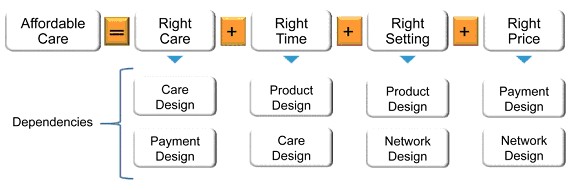
Last week, on this ME-P, I wrote about Health Plans and the Three Levers of Innovation for Affordable Care. We looked at a number of innovations taking place in the areas of products, care models, reimbursement, and network designs. It’s vitally important to be able to innovate in each of these areas, but even more important to be able to align these network elements properly. The key to affordable care is enabling every member to get the right care, at the right time, from the right provider, and for the right price. But, when you look at what it takes to deliver such care, the interdependencies of design of care models, payment, products and networks become apparent, as you can see in Figure 1 below:

 Figure 1: Affordable care requires alignment of product, network, care model, and payment design.

Steering the member to the right provider at the right setting is influenced by the member incentives built into the product design and the provider choice component of the network design. The right care is dependent on the care model design and the provider reimbursement design. Overall affordability of care is obviously tied to payment design. Not so obvious are the dependencies between product design and payment design. The member behavior targeted by product incentives should be reinforced by the provider engagement influenced by reimbursement design. All these interdependencies necessitate alignment between product, care model, reimbursement and network design. Alignment is fundamental to scaling innovation.

Network Design Drives Alignment

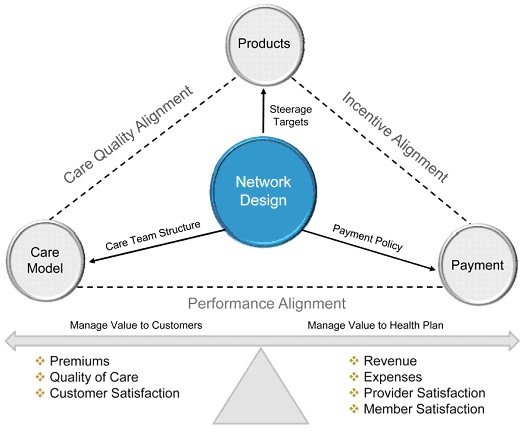
As shown in Figure 2, network design drives alignment between product, care model, and payment approaches. As an illustration, it facilitates the alignment of products and care models by enabling steerage of members to the appropriate care teams or sub-segments of the network. This steerage can only occur if member benefits and incentives (which are embodied in the product design) and the structure of care teams (which are described in the network design) are systematically matched. This systematic matching has to be governed by network-level guidelines for provider performance management.

Figure 2: Network design drives the alignment that delivers affordable, high-quality care.

Focusing on the alignment between products and payment, network design enables this by ensuring that the goals of member incentives are supported by the provider behavior driven by payment design. This enablement is achieved through network-level reimbursement guidelines being automatically enforced during provider contracting.

Finally, network design incorporates network-level reimbursement guidelines to drive alignment between care model and payment design by ensuring that provider behavior envisioned in the care model design is incented by payment design.

As health plans productize new care models and payment innovations, the complexity and the frequency of the abovementioned alignment efforts will mushroom. Customer segmentation and the need for tailored products to serve these customer segments will further amplify the alignment challenge.

The approach of using network design automation to efficiently operationalize alignment is a critical core competency for health plans. By innovating with this approach, it will be possible for health plans to strike the optimal balance between the value to their customers (competitive premiums, high-quality care) and the value to themselves (revenue enablement, reduced medical and administrative cost).

Assessment 

Are there barriers to operationalizing alignment? Of course! But stay tuned: Next week, I’ll be writing about the barriers to alignment — and after that, I’ll go into more detail about why it takes an integrated approach to remove these barriers. As before, if you don’t want to wait to read more, you can read the entire Unlocking Affordable Care by Aligning Products white paper now; it’s available on our website.

Conclusion

Your thoughts and comments on this ME-P are appreciated. Feel free to review our top-left column, and top-right sidebar materials, links, URLs and related websites, too. Then, subscribe to the ME-P. It is fast, free and secure.

Link: http://feeds.feedburner.com/HealthcareFinancialsthePostForcxos

Speaker: If you need a moderator or speaker for an upcoming event, Dr. David E. Marcinko; MBA – Publisher-in-Chief of the Medical Executive-Post – is available for seminar or speaking engagements. Contact: MarcinkoAdvisors@msn.com

OUR OTHER PRINT BOOKS AND RELATED INFORMATION SOURCES:

DICTIONARIES: http://www.springerpub.com/Search/marcinko
PHYSICIANS: www.MedicalBusinessAdvisors.com
PRACTICES: www.BusinessofMedicalPractice.com
HOSPITALS: http://www.crcpress.com/product/isbn/9781466558731
CLINICS: http://www.crcpress.com/product/isbn/9781439879900
BLOG: www.MedicalExecutivePost.com
FINANCE: Financial Planning for Physicians and Advisors
INSURANCE: Risk Management and Insurance Strategies for Physicians and Advisors

Product DetailsProduct DetailsProduct Details

Product Details  Product Details

   Product Details

Health Plans and the Three Levers of Innovation for Affordable Care

Unlocking Affordable Care

Number 2 in a Series of 6

By Sam Muppalla – Vice President, McKesson Health Solutions, Network Performance Management (NPM)

Last week, for the ME-P, I wrote about the increasing Pressure to Deliver Affordable, High-Quality Care.

In the face of those pressures, many health plans have begun to explore innovative approaches to product, care model, and reimbursement designs. What are they doing?

In this second installment of our series about unlocking affordable care, I’d like to take look at how some of the pilots in these areas show promise.

Product Innovation

One path health plans are using to achieve affordable care is through the deployment of value-based insurance designs (VBID). At the heart of this approach is the utilization of member incentives to reduce barriers to high value Rx and services. Conversely, it also incorporates disincentives for low value services or Rx. Typical member incentives include premium reduction, co-pay/coinsurance waiver/reduction, and health reimbursement accounts (HRA). Co-pay increase or cost sharing are typical disincentives. Member steerage to high value providers is another typical goal of VBID. The design of the supporting networks is critical to the success of VBID products. The network design has to ensure that the composition, the quality and the value of the participating providers can fulfill the benefit design and match steerage goals of the member incentives. Furthermore, the network level provider reimbursement guidelines should be complimentary to the member incentives.

For example, member incentive for a preventive exam during a Primary Care Physician (PCP) office visit could be matched by a Pay for Performance (P4P) provider incentive (on top of regular capitation) to perform the examination. Without the incentive, the Per Member Per Month (PMPM) capitation might be a disincentive for the PCP to perform the preventative exam.

describe the image

Figure 1: Network steerage is a critical component of product innovation.

Care Model Innovation

Innovative care models provide another approach to the delivery of affordable, high-quality health services. Population management-based care model designs, such as Patient Centered Medical Home (PCMH) and Accountable Care Organization (ACO) designs, are an important advancement towards affordable care. These designs deploy a care team-based approach rather than a traditional siloed services approach to ensure a continuity of care.

The PCMH care model results in continuity of care via a physician who leads the medical team that coordinates all aspects of preventive, acute and chronic needs of patients using the best available evidence and appropriate technology. The emphasis for PCMH is about collaboration to manage a population’s health.

Another example of a care model with a team-based approach is the ACO care model. In this care model, the emphasis is on accountability for providing the required healthcare services for a defined population. Health plans are rolling out ACO pilots across the nation.

For example, the Pension System (of the California Public Employees’ Retirement System) formed a partnership with the Blue Shield of California Health Maintenance Organization, Catholic Healthcare West, and Hill Physicians Medical Group with the goal of improving quality of care while reducing costs. Some of the early findings are showing positive results:

  • 17 percent reduction in patient re-admissions since the pilot began
  • Length of stay reduced by one half day
  • Almost a 14 percent drop in the total days patients spend in a facility
  • 50 percent reduction in the number of patients who stay in a hospital 20 or more days

These results show that it is possible to utilize care models to improve the quality of outcomes while reducing the cost of healthcare.

It is worth noting that health plans are not limited to adopting one care design innovation over another. Greater benefits can accrue to both consumer and provider by combining approaches—leveraging both collaborative and accountable care designs.

Adoption of population management is forcing a change from paying for individual providers’ services to paying for health management of a population across a team of providers. Supporting this requires the reimbursement systems to understand the structure of the care team, role of the various providers within the care team and the relationships between the providers in the care team.

In other words, it will need to understand the provider network structure to calculate the reimbursement. Another complexity is that providers participating in PCMH or ACO care models may also be directly contracted with the health plan. Selecting which payment arrangement to use in these scenarios will require an understanding of providers’ relationships with the plan.

Reimbursement Innovation

Along with innovations in product and care model designs, health plans are also innovating in the area of provider reimbursement. These innovation efforts primarily focus on enabling incentives for quality and performance, while controlling the rate of medical cost growth. These objectives reflect the need to move away from a healthcare system that bases provider reimbursement on volume to one that bases provider reimbursement on the value of the outcome. Within this approach, a variety of different models are evolving (see Figure 2). 

describe the image

Figure 2: Mixing and matching payment models.

Evolving in parallel with individual models is an understanding that the ability to mix and match different reimbursement designs will deliver greater value than the utilization of just one design. Health plans are mixing and matching different reimbursement methodologies to optimize provider performance. This implies that a provider is likely to have multiple valid payment arrangements at any given time. Picking the appropriate payment arrangement will require the reimbursement engine to understand the role of the provider in the network and the full context of all of the provider’s relationships.

Assessment

Next week, I’ll be discussing why the alignment between products, care models, provider reimbursement, and network design is so important when it comes to scaling these innovative approaches.

If you can’t wait that long for that discussion, you can read the entire Unlocking Affordable Care by Aligning Products white paper now; it’s available on our website.

Conclusion

And so, your thoughts and comments on this ME-P are appreciated. Feel free to review our top-left column, and top-right sidebar materials, links, URLs and related websites, too. Then, subscribe to the ME-P. It is fast, free and secure.

Link: http://feeds.feedburner.com/HealthcareFinancialsthePostForcxos

Speaker: If you need a moderator or speaker for an upcoming event, Dr. David E. Marcinko; MBA – Publisher-in-Chief of the Medical Executive-Post – is available for seminar or speaking engagements. Contact: MarcinkoAdvisors@msn.com

Our Other Print Books and Related Information Sources:

Health Dictionary Series: http://www.springerpub.com/Search/marcinko

Practice Management: http://www.springerpub.com/product/9780826105752

Physician Financial Planning: http://www.jbpub.com/catalog/0763745790

Medical Risk Management: http://www.jbpub.com/catalog/9780763733421

Healthcare Organizations: www.HealthcareFinancials.com

Physician Advisors: www.CertifiedMedicalPlanner.com

Subscribe Now: Did you like this Medical Executive-Post, or find it helpful, interesting and informative? Want to get the latest ME-Ps delivered to your email box each morning? Just subscribe using the link below. You can unsubscribe at any time. Security is assured.

Link: http://feeds.feedburner.com/HealthcareFinancialsthePostForcxos

Sponsors Welcomed: And, credible sponsors and like-minded advertisers are always welcomed. Link: https://healthcarefinancials.wordpress.com/2007/11/11/advertise

   Product Details

Health Plans Under Pressure to Deliver Affordable and High Quality Care

Join Our Mailing List

US Healthcare Expenditures Reaching Unsustainable Levels

[By Sam Muppalla]

Vice President: McKesson Health Solutions, Network Performance Management (NPM)

Expenditures on healthcare in the United States continue to increase and are rapidly reaching unsustainable levels. Pressures by businesses, households and the government to address these escalating costs and ensure high-quality healthcare are multiplying.

This is the first in a series of six essays that examine the challenges facing health plans and the ways that network design can unlock affordable care by aligning products, care models, and reimbursement.

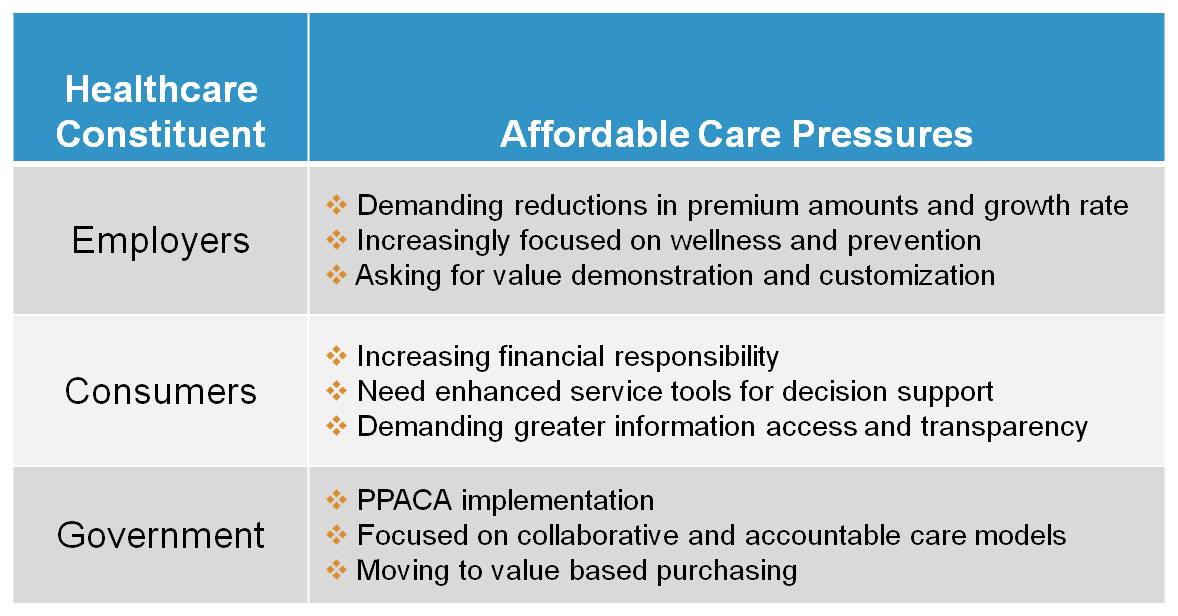
Health insurance companies are faced with addressing a rapidly changing healthcare environment on multiple fronts. These changes are being driven by the goal of achieving a more affordable, higher quality healthcare system. Shifting market needs, increased regulatory initiatives, and a demand for administrative efficiency are requiring innovative approaches to unlocking affordable care. These pressures are originating from key healthcare stakeholders—employers, members and the government (Figure 1).

Employer Pressure

As the competition for the group insurance market increases, health plans need to respond to employer demands for products that deliver greater value. Delivering high value requires products which are tailored to the health of the employer’s specific population and emphasize wellness and prevention. An employer that can offer benefits and programs tailored to meet their employee needs can both improve their workforce productivity and optimize their healthcare spend. The employer’s insistence for reduction in premiums and decrease in the rate of premium growth is challenging health plans to develop more innovative strategies.

Consumer/Member Pressure

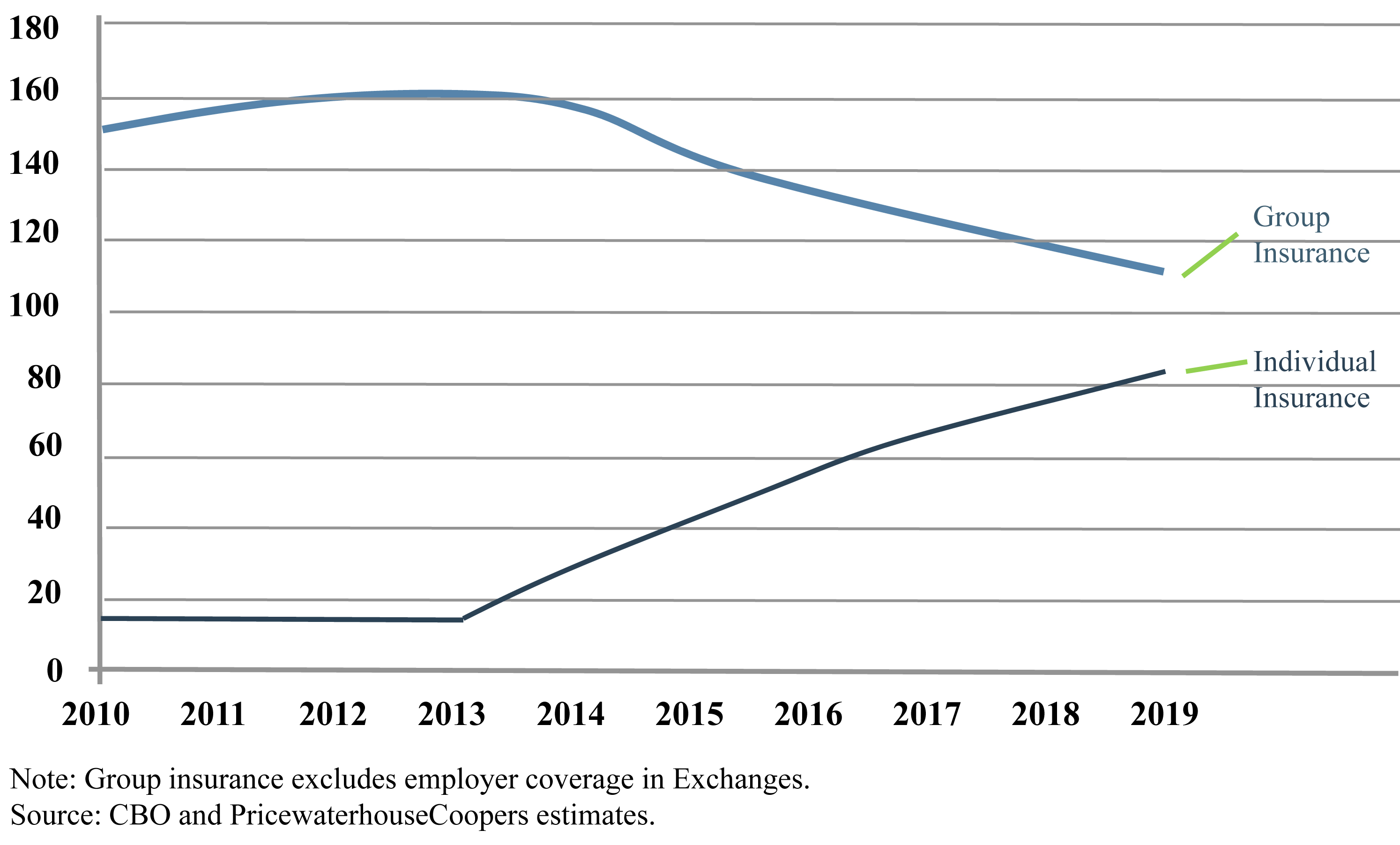
With the passage of the Patient Protection and Affordable Care Act of 2010 (PPACA), the Congressional Budget Office (CBO) estimates (Figure 2) that approximately 32 million more individuals will require access to healthcare services. This represents a significant increase in the number of new healthcare consumers at a time when health insurance companies are required to guarantee issue and re-newability of coverage. Steering this influx of new members to the right care teams will be a very critical core competency for health plans to develop. It is one of the few risk management tools left in the plan’s arsenal in a guaranteed access world. The growth of the individual market is also being accompanied by an increase in member financial responsibility. Members are increasingly demanding greater transparency into their provider quality, performance and cost information.

Government/Regulatory Pressure

Evolving healthcare regulation puts still more pressure on health plans. New regulations within the PPACA Section 9016, stipulate an 80% MLR cap for small groups (fewer than 100 lives) and an 85% Medical Loss Ratio (MLR) cap for large groups (more than 100 lives). These regulations also cap the percentage of revenues that can be earmarked for operational and administrative expenses at 15-20%. This poses a unique challenge for health plans; it requires plans to innovate in the areas of products, care models, and reimbursement designs without increasing the administrative and operational overhead.

There are roughly eighteen additional PPACA provisions that put further pressure on health plans by promoting increased collaboration (sections: 6301, 4201, 3027, 3011, 3021, 10333, 3022, 3024) and accountability (sections: 2705, 3006 & 10301, 3001, 3025, 2706, 2704, 3023, 3004, 3008 and 3002). The Bureau of National Affairs best summarized these provisions by stating,

“The comprehensive provisions in the act regarding payment and delivery reform reflect both the payment system continuum—from fee-for-service to bonus incentives for quality to bundled payments to partial and full global payments as well as the delivery system continuum—from independent clinicians and hospitals to small group practices to multi-provider networks to partially or virtually integrated organizations to fully integrated systems with common ownership and employment.”

These demands mean that health plans need to offer new high-value products that incorporate outcome-based reimbursement to drive quality outcomes and not pay for potentially avoidable costs.

According to studies by the Robert Wood Johnson Foundation and Prometheus Payment (2009), “Up to 40 cents of every dollar spent on chronic conditions and 15 to 20 cents of every dollar spent on acute hospitalization and procedures are attributable to potentially avoidable complications (PACs).”

With evidence like this health plans are taking a new, hard look at when and how care is delivered.

Assessment

Next time, we’ll be looking at how health plans are responding to these challenges with innovations in products, care models, and reimbursement structures. Visit the blog next week for “The Three Levers of Innovation for Care Affordability.”

If you can’t wait, you can read the entire Unlocking Affordable Care by Aligning Products white paper now; it’s available on our website.

A Webinar 

On December 8th, we’ll be hosting a webinar on Lean Provider Lessons for Post Reform Success. Plan to attend this free webinar for more insights into designing for affordable high-quality care.

Channel Surfing the ME-P

Have you visited our other topic channels? Established to facilitate idea exchange and link our community together, the value of these topics is dependent upon your input. Please take a minute to visit. And, to prevent that annoying spam, we ask that you register. It is fast, free and secure.

Conclusion

Your thoughts and comments on this ME-P are appreciated. Feel free to review our top-left column, and top-right sidebar materials, links, URLs and related websites, too. Then, subscribe to the ME-P. It is fast, free and secure.

Speaker: If you need a moderator or speaker for an upcoming event, Dr. David E. Marcinko; MBA – Publisher-in-Chief of the Medical Executive-Post – is available for seminar or speaking engagements. Contact: MarcinkoAdvisors@msn.com

OUR OTHER PRINT BOOKS AND RELATED INFORMATION SOURCES:

Product DetailsProduct DetailsProduct Details

Product Details  Product Details

   Product Details