







 Support our online development, and advance our onground research initiatives in free market economics, as we seek to showcase the brightest Next-Gen minds.
THE ME-P DISCLAIMER: Posts, comments and opinions do not necessarily represent iMBA, Inc., but become our property after submission. Copyright © 2006 to-date. iMBA, Inc allows colleges, universities, medical and financial professionals and related clinics, hospitals and non-profit healthcare organizations to distribute our proprietary essays, photos, videos, audios and other documents; etc. However, please review copyright and usage information for each individual asset before submission to us, and/or placement on your publication or web site. Attestation references, citations and/or back-links are required. All other assets are property of the individual copyright holder.
Support our online development, and advance our onground research initiatives in free market economics, as we seek to showcase the brightest Next-Gen minds.
THE ME-P DISCLAIMER: Posts, comments and opinions do not necessarily represent iMBA, Inc., but become our property after submission. Copyright © 2006 to-date. iMBA, Inc allows colleges, universities, medical and financial professionals and related clinics, hospitals and non-profit healthcare organizations to distribute our proprietary essays, photos, videos, audios and other documents; etc. However, please review copyright and usage information for each individual asset before submission to us, and/or placement on your publication or web site. Attestation references, citations and/or back-links are required. All other assets are property of the individual copyright holder.


Below Zero

By Dan Timotic CFA
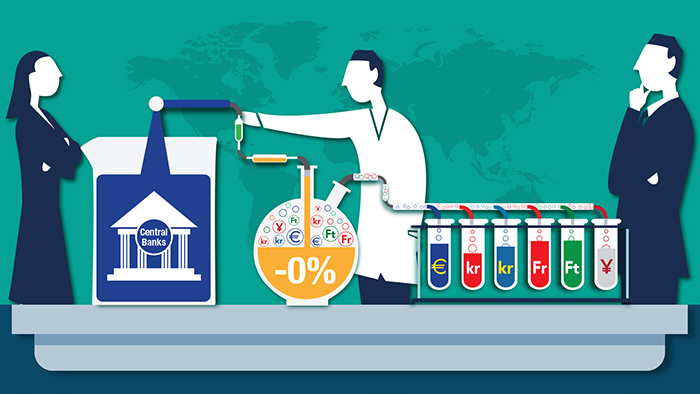
As of late April 2016, six central banks in Europe and Asia have adopted negative interest rates in an effort to stimulate their national economies. The experiment began in Denmark in 2012, but the big step came in June 2014 when the European Central Bank (ECB) dropped its benchmark rate below zero. Sweden and Switzerland soon followed, and Japan and Hungary went negative in early 2016. Taken together, these economies represent about one-fourth of global economic output.1–2
Although the Federal Reserve remains committed to raising the federal funds target rate, the Fed is watching the efforts of foreign central banks with an eye toward expanding its tools in the event of an economic downturn. On a more immediate level, the overseas experiment is affecting the dollar and helping to suppress interest rates in the United States.3–4
Reverse Economics
Central banks lower interest rates for two fundamental reasons: (1) to encourage business investing and consumer spending by making it cheaper to borrow and less lucrative to hold onto cash; and (2) to lower the value of the national currency in order to make exports more appealing and create an expectation of future inflation, which may further stimulate current spending.
The push into negative territory reflects the same goals, but it reverses traditional economic concepts by turning borrowers into creditors and creditors into borrowers. Although specifics vary, the central banks are pulling rates downward by assessing a negative interest rate on certain short-term deposits from commercial banks. These banks actually lose money on their deposits, which in theory should stimulate the banks to lend money to other banks, businesses, and consumers.
The greatest fear regarding negative rates is a mass exodus from the banking system. The experiments in Europe and Japan are still new and the rates relatively moderate, but so far banks and their customers seem to be weathering the transition, albeit with lower margins and additional fees.5 Deposits in eurozone banks grew by $327 billion from June 2014 (when negative rates were implemented) through October 2015.6 Some banks assess negative rates on large commercial customers, but they have been hesitant to do so with retail customers. One small Swiss bank instituted a charge of 0.125% on savings accounts and gained more customers than it lost.7
These early responses suggest that businesses and consumers may be willing to pay a premium to deposit cash assets safely in a bank. Keeping large amounts of cash outside of a bank can be expensive, requiring guards, safes, and other security measures. Average consumers might keep cash under a mattress, but it is difficult to pay bills — or buy merchandise over the Internet — with cash. This cost-benefit balance may change if rates continue to decline.
Bonds and Mortgage Rates
By April 2016, more than $8 trillion of government bonds in Europe and Japan were trading at negative interest rates.8 As with banking, this suggests that some investors are willing to accept a loss in return for the security of government bonds. However, negative or very low yields may put pressure on pension plans and insurance companies, which depend on low-risk, fixed-rate investments.9
Low rates have driven housing prices up in Denmark and Sweden, creating fears of a “bubble.” Some Danish homeowners have even seen the monthly interest on their adjustable-rate mortgages turn into monthly credits due to negative rates.10
***
***
Currency Competition
After the ECB instituted negative rates, the euro dropped sharply against the U.S. dollar and was still down about 17% in April 2016.11 A strong dollar stimulates European exports at the expense of U.S. exports and makes it more difficult to raise U.S. interest rates, which would only make the dollar more appealing for foreign investors.
Denmark, Sweden, Switzerland, and Hungary all dropped rates in large part to keep their currencies competitive with the euro.12 Denmark’s experience, the longest-running experiment, suggests that negative rates may be effective when the primary goal is to control currency but less effective as a stimulus to growth.13 On the other hand, Japan’s initial efforts have seen the yen rise unexpectedly against the dollar, unsettling markets.14
How Low Can They Go?
Early eurozone results are tepid but encouraging. Annual GDP growth improved to 1.5% in 2015 versus 0.9% in 2014, and lending by eurozone banks (which had been decreasing) increased slightly by 0.6% in 2015.15 It’s unclear how much worse the European situation might be without negative rates.
Assessment
After a tentative beginning, central banks have become more aggressive. In March 2016, the ECB dropped its deposit rate to –0.40%, and the Swiss National Bank rate was –0.75%.16 It remains to be seen how banks and consumers will respond to even lower rates, and whether reverse economics will strengthen the global economy or create new challenges.
All investments are subject to market fluctuation, risk, and loss of principal. Investments, when sold, may be worth more or less than their original cost. Investing internationally carries additional risks, such as differences in financial reporting and currency exchange risk as well as economic and political risk unique to a specific country. This may result in greater investment price volatility.
References
1, 5, 9, 16) International Monetary Fund, 2016 2, 12) Reuters, April 10, 2016 3) The New York Times, March 5, 2016 4, 11) European Central Bank, 2016 6) The New York Times, December 3, 2015 7–8, 10, 14) The Wall Street Journal, April 14, 2016 13) Bloomberg, February 15, 2016 15) The Wall Street Journal, February 28, 2016
Conclusion
Your thoughts and comments on this ME-P are appreciated. Feel free to review our top-left column, and top-right sidebar materials, links, URLs and related websites, too. Then, subscribe to the ME-P. It is fast, free and secure.
Speaker: If you need a moderator or speaker for an upcoming event, Dr. David E. Marcinko; MBA – Publisher-in-Chief of the Medical Executive-Post – is available for seminar or speaking engagements. Contact: MarcinkoAdvisors@msn.com
OUR OTHER PRINT BOOKS AND RELATED INFORMATION SOURCES:
- PRACTICES: www.BusinessofMedicalPractice.com
- HOSPITALS: http://www.crcpress.com/product/isbn/9781466558731
- CLINICS: http://www.crcpress.com/product/isbn/9781439879900
- ADVISORS: www.CertifiedMedicalPlanner.org
- FINANCE: Financial Planning for Physicians and Advisors
- INSURANCE: Risk Management and Insurance Strategies for Physicians and Advisors
- Dictionary of Health Economics and Finance
- Dictionary of Health Information Technology and Security
- Dictionary of Health Insurance and Managed Care
[PHYSICIAN FOCUSED FINANCIAL PLANNING AND RISK MANAGEMENT COMPANION TEXTBOOK SET]

***
Share this:

Filed under: Financial Planning, Investing | Tagged: "Negative" Interest Rates, Dan Timotic CFA | 6 Comments »




 The Leading Business Education Network for Doctors, Financial Advisors and Health Industry Consultants