Trends Suggest Specialty Liability Insurers Growing

Join Our Mailing List

Physician Owned Malpractice Risk Retention Groups [RRGs]

By Dr. David Edward Marcinko; FACFAS, MBA, CMP™

[Editor-in-Chief]

dr-david-marcinko1 One new(er) method used to keep medical malpractice liability premiums low(er) may be specialty specific carriers, using Risk Retention Groups [RRGs].

In this business model, member physicians perform underwriting tasks, rate setting, and strategic operations. They also provide additional services, such as providing attorneys, medical risk and practice management experts; and are less likely to settle lawsuits, too.

History of RRGs

First prominent in the 1970’s, controlling more than 60% of medical malpractice market share and $ 6.1 billion in net premiums, RRG muscle dwindled in the 1990’s. RRGs however, seem to be making a comeback in 2008; according to proprietary iMBA Inc research studies www.MedicalBusinessAdvisors.com 

But there is a downside to physician owned liability insurers like RRGs. These include limited experience, reserve requirements, financial backing and a sparse but improving track record.

Current State of the Industry

Nevertheless, there are more than 51 specific sub-markets, and 40 so-called “bed-pan” mutuals, now serve orthopedic surgeons in Pennsylvania (Positive Mutual Risk Retention Group, Inc.), ophthalmologists in San Francisco (Ophthalmic Mutual Insurance Company), podiatrists in Tennessee (Podiatry Insurance Company of America), general practitioners in Illinois (Illinois State Medical Inter-Insurance Exchange), internists in New Jersey (MIIX Advantage Insurance Corporation), optometrists (Optometric Insurance of America) and chiropractors (Nationwide Chiropractors) across the country.

The Physician Insurers Association America, in Rockville MD, represents many of these RRGs and reports a membership combined-ratio which is a measurement of company viability of 141 – compared to an industry average of 154.

Actuaries suggest the figure should be closer to 125.*

The top five physician-owned medical malpractice mutual companies include: MLMIC Group, Doctors Company Insurance Group, Pro Assurance Group, Healthcare Indemnity, Inc., and the NORCAL Group. Laggards included neurosurgeons and OB/GYNs.

Assessment

A related new innovation for RRGs may be in the form of a tracking company, or system of medical providers to monitor and follow unhappy patients who are considered the most likely to sue.

Remember, liability underwriters and actuaries are risk-adverse by education and training. They react slowly, cautiously and incrementally to shifting risk factors; especially toward positive trends that might suggest reduced underwriter income and liability premiums.

Conclusion

Physicians, healthcare executives and medical group administrators must therefore develop their own strategies for evaluating liability risk factors, and lead the trend to reduced operational expenses through managed liability costs.

Perhaps this may be accomplished by RRGs in some cases?

And so, what experience do you have with this hybrid medical liability insurance machination?

Speaker: If you need a moderator or a speaker for an upcoming event, Dr. David Edward Marcinko; MBA is available for speaking engagements. Contact him at: MarcinkoAdvisors@msn.com

*Source: AM Best  

Product Details

The Malpractice Insurance Capitation-Liability Theory

Join Our Mailing List

A New Litigation-Equation Philosophy of Liability

[One Healthcare-Executive’s Experiential Opinion] 

[By Dr. David Edward Marcinko; MBA, CMP™]insurance-book

Developed by iMBA Inc, the factors that comprise the so-called “litigation-equation” include: (1) patient communication factors, (2) provider healthcare delivery systems and reimbursement factors, (3) payer factors and, (4) revised liability legislation and patient encounter data factors. All are briefly reviewed below:

Communication Factors

Patient communication factors for the CLT include; reduced economic and financial fear, consideration of cultural barriers, improved medical awareness through continuing education, concern for geographic access, focused primary and specialty care availability, management information systems, and the frequency and duration of utilization.

Reimbursement Factors

Provider reimbursement factors and healthcare delivery systems include both soft and hard varieties.

Soft CLT provider factors include increased patient availability to services, accessibility to timely appointments, office and quality care satisfaction surveys, communication assessments, known fixed costs and technical information interchanges.

Hard CLT factors include managed operational procedures, illness severity, defined treatment options, clinical variations, outcomes measurements and quality monitoring, performance quotas, aligned financial incentives, and predictable reimbursements.

Payer Factors

Payer factors of the CLT include practitioner screening and shifting, quality assessment, behavioral modification and team care, provider discipline, complaint management, cost and call economic considerations, and adequate capitalization rates.

Liability Factors

Finally, liability factors of the CLT include allegation frequency and severity, standards of care, defensibility, risk management, premium pricing, loss adjustment, legislation, settlement losses, and administrative costs.

WHITE-PAPER: ACOs VBC Capitation SAMPLE DEM

Assessment

To fully understand the CLT, all four parts of the litigation-equation must be recognized. These factors, when integrated with underwriter data and experience, may help determine the level of liability risk and the ultimate cost of malpractice coverage.

For example, if capitated medical care is deemed to involve less risk than in the traditional indemnity environment, then the cost of liability coverage should gradually decrease as the percent of capitated managed care increases, in any particular office setting.

In actual terms, the CLT suggests that capitated insurance and patient care risk are inversely, but not necessarily proportionally, related since experiential data will determine the percentages.

Conclusion

Your thoughts and comments on this ME-P are appreciated. Feel free to review our top-left column, and top-right sidebar materials, links, URLs and related websites, too. Then, subscribe to the ME-P. It is fast, free and secure.

Speaker: If you need a moderator or speaker for an upcoming event, Dr. David E. Marcinko; MBA – Publisher-in-Chief of the Medical Executive-Post – is available for seminar or speaking engagements. Contact: MarcinkoAdvisors@msn.com

OUR OTHER PRINT BOOKS AND RELATED INFORMATION SOURCES:

Product Details  Product Details

Product Details


New Negligent Medical Care Policy Proposal

In with Contract Law – Out with Tort Law and Litigation

Staff Writers 


The National Center for Policy Analysis [NCPA} recently reported that more than 98 percent of people injured by negligent medical care never files a lawsuit. Moreover, among the lawsuits that are filed, one in three doesn’t involve medical errors and only 46 percent of the payouts in malpractice cases go to patients. 

Of course, the threat of malpractice litigation causes great distress for doctors. One in four is sued in any given year, while more than half are sued at least once during a career. 

Therefore, the NCPA proposed using voluntary medical care legal contracts to:

· Pre-determine economic damages in the event of unexpected death or disability.

· Allow the economic payouts to be risk-adjusted.

· Require doctors to disclose quality information.

· Mandate patient accountability with medical orders.  

The center said that a legal contract system might compensate patients harmed by medical errors, reduce the cost of determining fault and compensation, and encourage health care providers and patients to reduce the frequency of errors.  

What do you think about this new health law vision of medical negligence as contract law? 

Kindred Hospital Liability Policy

Join Our Mailing List

The Medical Waiver Issue

[By Staff Writers] 

Recently, Kindred Hospital of Wyoming Valley, PA has come under fire from two attorneys who fear patients may be signing away their rights to seek a jury trial if they are injured through malpractice.  

Introduction 

Kindred Hospital, a long term acute care facility, is asking patients to sign a waiver that would mandate any claim for injuries go through mediation or binding arbitration. These are alternative legal processes utilized in lieu of filing a lawsuit.

According to the hospital, such voluntary waivers benefit the patient by allowing for faster resolution of malpractice claims. 

Not so Fast! 

But, lawyers who reviewed the document say they are concerned that it is being presented to patients who, because they are under duress due to their illness, might not understand its implications. 

Enter the Guidance Counselors 

Upon investigation, Kindred said that admissions counselors review documents to ensure patients understand it, and do not attempt to pressure them in any way. Patients also have the right to revoke the document within five days of signing it, according to the Times Leader; in February 2007.  

Assessment

Kindred Healthcare operates various types of health care facilities nationwide where the form is used. Is anyone familiar with these folks who can make an informed opinion on this tactic?

Hospital with paper MRs

Channel Surfing the ME-P

Have you visited our other topic channels? Established to facilitate idea exchange and link our community together, the value of these topics is dependent upon your input. Please take a minute to visit. And, to prevent that annoying spam, we ask that you register. It is fast, free and secure.

Conclusion

Your thoughts and comments on this ME-P are appreciated. Feel free to review our top-left column, and top-right sidebar materials, links, URLs and related websites, too. Then, subscribe to the ME-P. It is fast, free and secure.

Speaker: If you need a moderator or speaker for an upcoming event, Dr. David E. Marcinko; MBA – Publisher-in-Chief of the Medical Executive-Post – is available for seminar or speaking engagements. Contact: MarcinkoAdvisors@msn.com

OUR OTHER PRINT BOOKS AND RELATED INFORMATION SOURCES:

Product DetailsProduct Details


Malpractice Crisis – What Crisis?

Join Our Mailing List

State Tort Reform Improves Liability Climates

[By Staff Writers]

The American Medical Association (AMA) recently reduced the number of states in liability “crisis” to 17 by the end of 2007, down from 21 in 2006, while upgrading Arkansas, Georgia, Mississippi and West Virginia to a more “moderate” liability environment.  

Before passing various tort reforms of the past few years, those states had been listed as being in “crisis” because unaffordable insurance premiums were forcing physicians to retire early, give up high-risk procedures or leave the state. 

Still, pundits caution that some legislative changes have yet to take hold, and other states face legal threats, preventing significant decreases in premiums. 

What do you think – is the malpractice liability crisis over?

Conclusion

Your thoughts and comments on this ME-P are appreciated. Feel free to review our top-left column, and top-right sidebar materials, links, URLs and related websites, too. Then, subscribe to the ME-P. It is fast, free and secure.

Speaker: If you need a moderator or speaker for an upcoming event, Dr. David E. Marcinko; MBA – Publisher-in-Chief of the Medical Executive-Post – is available for seminar or speaking engagements. Contact: MarcinkoAdvisors@msn.com

OUR OTHER PRINT BOOKS AND RELATED INFORMATION SOURCES:

Product Details  Product Details


Risk Retention Groups

Join Our Mailing List

RRGs and Medical Malpractice Insurance Companies

[By Dr. David Edward Marcinko; FACFAS, MBA, CMP™]

dr-david-marcinko1

Definition

Risk Retention Groups are owner-controlled insurance companies authorized by the Federal Risk Retention Act of 1986.  An RRG provides liability Insurance to members who engage in similar or related business or activities for all or any portion of the exposures of group members, excluding first party coverage’s, such as property, workers’ compensation and personal lines.  Authorization under the federal statute allows a group to be chartered in one state, but able to engage in the business of insurance in all states, subject to certain specific and limited restrictions.  The Federal Act preempts state law in many significant ways.

RRG Advantages:

Medical RRGs

  • Avoidance of multiple state filing and licensing requirements;
  • Member control over risk and litigation management issues;
  • Establishment of stable market for coverage and rates;
  • Elimination of market residuals;
  • Exemption from countersignature laws for agents and brokers;
  • No expense for fronting fees;
  • Unbundling of services.

Of 130 new medical malpractice liability insurance companies that entered the market between 2002 and 2006, 65 percent were risk-retention groups, according to a study conducted for the National Risk Retention Association by the actuarial consulting company Milliman Inc.

Statistics from the Risk Retention Reporter, a journal that tracks the industry, showed that through September, 43 percent of the 23 risk-retention groups formed this year across various sectors are doctor-owned, while in 2001, no new physician risk-retention groups joined the market.

RRG Disadvantages

Some doctors and industry experts warn about drawbacks of risk-retention groups and question whether the physician-run companies – most of them relatively young – can survive future claims payouts and tough market cycles, while doctors do not have access to state guaranty funds to back up their coverage if a risk-retention group struggles financially or goes out of business. The Risk Retention Reporter noted that, anecdotally, physician self-insurance companies have failed at no greater rate than traditional carriers in recent years. 

Conclusion

Your thoughts and comments on this ME-P are appreciated. Feel free to review our top-left column, and top-right sidebar materials, links, URLs and related websites, too. Then, subscribe to the ME-P. It is fast, free and secure.

Speaker: If you need a moderator or speaker for an upcoming event, Dr. David E. Marcinko; MBA – Publisher-in-Chief of the Medical Executive-Post – is available for seminar or speaking engagements. Contact: MarcinkoAdvisors@msn.com

OUR OTHER PRINT BOOKS AND RELATED INFORMATION SOURCES:

Product Details  Product Details

Medical Malpractice – Hope Springs?

Join Our Mailing List

The Medical Malpractice Insurance Crisis 

By Dr. David Edward Marcinko; MBA, CMP™

[Publisher-in-Chief, FA and Health Insurance Agent]

DEM @ WhartonHas the Corner Been Turned?

In the fall of 2003, the American Medical Association announced that six more states had reached a medical malpractice crisis, with patients losing access to care due to physician attrition. The AMA’s list of crisis states then totaled 18.

The new states were: Arkansas, Connecticut, Illinois, Kentucky, Missouri and North Carolina. The 12 states previously identified are: Florida, Georgia, Mississippi, Nevada, New Jersey, New York, Ohio, Oregon, Pennsylvania, Texas, Washington and West Virginia.

More recently, the Medical Group Management Association (MGMA) reported that medical malpractice premiums for its members increased by more than 53% between 2003 and 2004. Today, about 25% of those physicians planned to retire, relocate or restrict their services over the next few years. Massachusetts was especially hard hit in 2003-06, as the practice environment worsened for the twelfth consecutive year, driven primarily by rising premiums for medical malpractice coverage. 

Yet, in 2007, the rate of medical malpractice claims fell for the fourth straight year in Pennsylvania, with half the payout of 2003. That suggests that claims are getting smaller, as observer’s credit a 2002 law which banned attorneys from moving cases to counties they felt would have more favorable juries. Now, the state’s physicians would like to see the state enact caps on non-economic damages. 

So, how is this crisis affecting you; if at all?

Spring 2011 - NIH

MARCINKO’s New Risk Management and Asset Protection Textbook for MDs and Financial Advisors

Join Our Mailing List

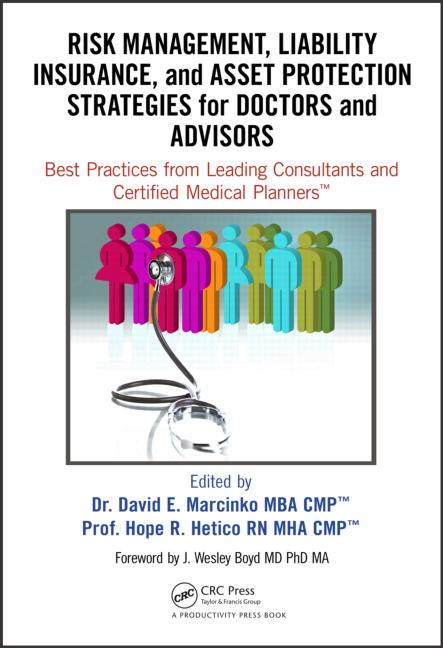
Risk Management, Liability Insurance, and Asset Protection Strategies for Doctors and Advisors [Best Practices from Leading Consultants and Certified Medical Planners]

***

 Our New Text – “Take a Peek Inside 

Available – ORDER NOW!

***

Risk Management, Liability Insurance, and Asset Protection Strategies for Doctors and Advisors: Best Practices from Leading Consultants and Certified Medical Planners™8Risk Management, Liability Insurance, and Asset Protection Strategies for Doctors and Advisors: Best Practices from Leading Consultants and Certified Medical Planners™

***

Foreword by J. WESLEY BOYD MD PhD MA

logos

“BY DOCTORS – FOR DOCTORS – PEER REVIEWED – FIDUCIARY FOCUSED”

***

Book Reviews

“Physicians who don’t understand modern risk management, insurance, business and asset protection principles are sitting ducks waiting to be taken advantage of by unscrupulous insurance agents and financial advisors; and even their own prospective employers or partners. This comprehensive volume from Dr. David Marcinko, and his co-authors, will go a long way toward educating physicians on these critical subjects that were never taught in medical school or residency training.”
—Dr. James M. Dahle, MD, FACEP, Editor of The White Coat Investor, Salt Lake City, Utah, USA

“With time at a premium, and so much vital information packed into one well organized resource, this comprehensive textbook should be on the desk of everyone serving in the healthcare ecosystem. The time you spend reading this frank and compelling book will be richly rewarded.”
—Dr. J. Wesley Boyd, MD, PhD, MA, Harvard Medical School, Boston, Massachusetts, USA

“Physicians have more complex liability challenges to overcome in their lifetime, and less time to do it, than other professionals. Combined with a focus on practicing their discipline, many sadly fail to plan for their own future. They need trustworthy advice on how to effectively protect themselves, families and practice, from the many overt and covert risks that could potentially disrupt years of hard work.
Fortunately, this advice is contained within ‘Risk Management, Liability Insurance, And Asset Protection Strategies For Doctors And Advisors: Best Practices From Leading Consultants And Certified Medical Planners™’. Written by Dr. David Edward Marcinko, Nurse Hope Rachel Hetico and their team of risk managers, accountants, insurance agents, attorneys and physicians, it is uniquely positioned as an integration of applied, academic and peer-reviewed strategies and research, with case studies, from top consultants and Certified Medical Planners™. It contains the latest principles of risk management and asset protection strategies for the specific challenges of modern physicians. My belief is that any doctor who reads and applies even just a portion of this collective wisdom will be fiscally rewarded. The Institute of Medical Business Advisors has produced another outstanding reference for physicians that provide peace of mind in this unique marketplace! In my opinion, it is a mandatory read for all medical professionals.”
—David K. Luke, MS-PFP, MIM, CMP™, Net Worth Advisory Group, Inc., Sandy, Utah, USA

“This book is a well-constructed, comprehensive and experiential view of risk management throughout the entire medical practice life-cycle. It is organized in an accessible, high-yield style that is familiar to doctors. Each chapter has case models, examples and insider tips and useful pearls. I was pleased to see multi-degreed physicians sharing their professional experiences in a textbook on something other than clinical medicine. I can’t decide if this book is right on – over the top – or just plain prescient. Now, after a re-read, I conclude it is all of the above; and much more.”
—Dr. Peter P. Sidoriak, Pottsville, Pennsylvania, USA

“When a practicing physician thinks about their risk exposure resulting from providing patient care, medical malpractice risk immediately comes to mind. But; malpractice and liability risk is barely the tip of the iceberg, and likely not even the biggest risk in the daily practice of medicine. There are risks from having medical records to keep private, risks related to proper billing and collections, risks from patients tripping on your office steps, risks from medical board actions, risk arising from divorce, and the list goes on and on. These liabilities put a doctor’s hard earned assets and career in a very vulnerable position. This new book from Dr. David Marcinko and Prof. Hope Hetico shows doctors the multiple types of risk they face and provides examples of steps to take to minimize them. It is written clearly and to the point, and is a valuable reference for any well-managed practice. Every doctor who wants to take preventive action against the risks coming at them from all sides needs to read this book.”
—Richard Berning, MD, FACC, New Haven, Connecticut, USA

“This is an excellent companion book to Dr. Marcinko’s Comprehensive Financial Planning Strategies For Doctors And Advisors: Best Practices from Leading Consultants and Certified Medical Planners™. It is all inclusive yet easy to read with current citations, references and much frightening information. I highly recommend this text. It is a fine educational and risk management tool for all doctors and medical professionals.”
—Dr. David B. Lumsden, MD, MS, MA, Orthopedic Surgeon, Baltimore, Maryland, USA

“This comprehensive text book provides an in-depth presentation of the cyber security and real risk management, asset protection and insurance issues facing all medical profession today. It is far beyond the mere medical malpractice concerns I faced when originally entering practice decades ago.”
—Dr. Barbara s. Schlefman, DPM, MS, Family Foot Care, PA, Tucker, Georgia, USA

“Am I over-insured and thus wasting money? Am I under-insured and thus at risk for a liability or other disaster? I never really had the means of answering these questions; until now.”
—Dr. Lloyd M. Krieger, MD, MBA, Rodeo Drive Plastic Surgery, Beverly Hills, California, USA

“I read and use this book, and several others, from Dr. David Edward Marcinko and his team of advisors.”
—Dr. John Kelley, DO, Orthopedic Surgeon, Tucker, Georgia, USA

“An important step in the risk management, insurance planning and asset protection process is the assessment of needs. One can create a strong foundation for success only after all needs have been analyzed so that a plan can be constructed and then implemented. This book does an excellent job of recognizing those needs and addressing strategies to reduce them.
—Shikha Mittra, MBA, CFP®, CRPS®, CMFC®, AIF®, President – Retire Smart Consulting LLC, Princeton, New Jersey, USA

“The Certified Medical Planner™ professional designation and education program was created by the Institute of Medical Business Advisors Inc., and Dr. David Edward Marcinko and his team (who wrote this book). It is intended for financial advisors who aim specifically to serve physicians and the medical community. Content focuses not only on the insurance and professional liability issues relevant to physicians, but also provides an understanding of the risky business of medical practice so advisors can help work more successfully with their doctor-clients.”
—Michael E. Kitces, MSFS, MTAX, CFP®, CLU, ChFC, RHU, REBC, CASL, http://www.Kitecs.com, Reston, Virginia, USA

“I have read this text and used consulting services from the Institute of Medical Business of Advisors, Inc. on several occasions.”
—Dr. Marsha Lee, DO, Radiologists, Norcross, Georgia, USA

“The medical education system is grueling and designed to produce excellence in medical knowledge and patient care. What it doesn’t prepare us for is the slings and arrows that come our way once we actually start practicing medicine. Successfully avoiding these land mines can make all the difference in the world when it comes to having a fulfilling practice. Given the importance of risk management and mitigation, you would think these subjects would be front and center in both medical school and residency – ‘they aren’t.’ Thankfully, the brain trust over at iMBA Inc., has compiled this comprehensive guide designed to help you navigate these mine fields so that you can focus on what really matters – patient care.”
—Dennis Bethel, MD, Emergency Medicine Physician

MORE: FRONT MATTER Risk Management
***

business-valuation1

***

Invite Dr. Marcinko

***