Senate Finance Committee to Limit Specialty Hospitals

Ban Due to Medicare Participation Prohibitions

Staff Reporters

 ho-journal9A new report outlining violations of health and safety standards at some physician-owned specialty hospitals has some lawmakers renewing efforts to ban the facilities. 

www.HealthcareFinancials.com

The American Medical News [AMN] recently reported that Department of Health and Human Services [HHS], Office of Inspector General [OIG], investigated 109 of the country’s orthopedic, cardiac and surgical hospitals and found that more than one-third of them may be in violation of Medicare’s conditions of participation. 

The OIG concluded that the administration should work to require all hospitals – not just specialty facilities – to meet Medicare’s hospital staffing rules. These include having the capability for evaluation and initial treatment of emergency patients, and to include necessary information in their written policies regarding how to manage medical emergencies.  

The Centers for Medicare and Medicaid Services [CMS] concurred with the findings, and for those who oppose them, the report is more evidence that legislation is required to address potential problems. 

Conclusion: And so, what is your considered opinion of specialty hospitals?

Department of Labor Curtails Healthy Habits

New DOL Regulatory Guidelines Seem Paradoxical

Staff writers 

New regulatory guidelines from the Department of Labor [DOL] may curtail the ability of employers to motivate workers and employees to kick unhealthy habits.  

According to a report in the Wall Street Journal, the guidelines close a legal loophole that could have allowed employers to make health insurance more expensive for unhealthy workers than for their colleagues. 

High Deductible – HCPs 

Some employers have incorporated a form of supplemental insurance into their wellness programs under which workers enroll in an employer sponsored high-deductible health care plan [HD-HCP] and can offset the deductible by earning “wellness credits” for meeting certain health benchmarks – such as weight control or cholesterol levels – issued under a separate supplemental policy.  

Legal Opinions and Risk Management Concerns

But lawyers, benefits managers and risk management consultants have voiced concerns that such programs could hurt employees with health problems, as unhealthy employees could face insurance deductibles more than $1,000 higher than healthier co-workers. 

Conclusion 

And so, is this fair or not – and – does it promote the public good?

The US Supreme Court

Denies GA Hospital Peer-Review Case

Staff Writers

According to Gregg Blesch of Modern Healthcare, the US Supreme Court just declined to review a case that hospitals hoped would clarify whether federal courts must defer to state laws protecting the confidentiality of peer review. 

The 11th U.S. Circuit Court of Appeals ruled in June that peer-review records should be fair game for a urologist attempting to prove he was the target of racial discrimination at 186-bed Houston Medical Center [HMC] in Warner Robins, GA.

HMC appealed to the Supreme Court. No federal law provides a privilege for hospital peer-review, yet all states have laws that protect the confidentiality hospitals say they need in order to foster the participation and candor crucial to identifying and addressing mistakes. 

And so, have you ever been on a hospital peer-review panel, and what are your thoughts on this case regarding privilege and confidentiality?

Related information: http://www.jbpub.com/catalog/9780763733421

Healthcare Entities and the US PARIOT Act?

Applicability to Hospitals and Medical Organizations

By Gregory O. Ginn; PhD, CPA, MBA, CMP™ (Hon)

By Hope Rachel Hetico; RN, MHA, CMP™

HO-JFMS-CD-ROM

After the September 11, 2001 terrorist attacks against the United States, the US Congress passed Public Law 107-56 whose short title is “Uniting and Strengthening America by Providing Appropriate Tools Required to Intercept and Obstruct Terrorism (USA PATRIOT Act) Act of 2001.”

At first blush, the Act seems to have very little to do with hospitals, healthcare organizations or the medical industrial complex; however, upon closer inspection, several sections appear to be relevant to the industry. 

The Prevention and Detection of Money Laundering 

Title III of the USA PATRIOT Act is entitled the “International Money Laundering Abatement and Anti-Terrorist Financing Act of 2001.” The purposes of the Act are “to prevent, detect, and prosecute money laundering and the financing of terrorism.” Healthcare responsibilities in a money laundering program may include:

· Developing internal policies, procedures, and controls;

· Designation a chief compliance officer;

· Ongoing employee training programs; and

· Executing an independent audit program to test compliance 

Preparedness for Biological and Chemical Attacks 

Title X of the USA PATRIOT Act contains several calls for strengthening the public health system. Section 1013(a)(4) calls for “enhanced resources for public health officials to respond to potential bioterrorism attacks.”

Hospitals can take several steps to mitigate even in the absence of significant funding: 

· First, hospitals can establish links with ‘first responders’ such as local law enforcement, fire departments, state and local government, other hospitals, emergency medical services, and local public health departments.

· Second, hospitals can establish training programs to educate hospital staff on how to deal with chemical and biological threats.

· Third, hospitals can make changes in their information technology to facilitate disease surveillance that might give warning that an attack has occurred. Information technology may be useful in identifying the occurrence syndromes such as headache or fevers that might not be noticed individually but in the aggregate would signal that a biological or chemical agent had been released.

· Fourth, hospitals may be able to acquire access to staff and equipment to respond to biological and chemical attack through resource sharing arrangements in lieu of outright purchases. 

Protection of Critical Infrastructures 

Title X of the USA PATRIOT Act also contains section 1016, entitled “The Critical Infrastructures Protection Act of 2001.” It acknowledges that the defense of the United States is based upon the functioning of many networks and that these networks must be defended against attacks of both a physical and virtual nature.

Section 1016 also specifies that actions necessary to carry out policies designed to protect the infrastructure will be based upon public and private partnerships between the government and corporate and non-governmental agencies. 

Toward this end, the Act establishes a National Infrastructure Simulation and Analysis Center (NISAC) to support counter-terrorism, threat assessment, and risk mitigation. NISAC will acquire data from governments and the private sector to model, simulate, and analyze critical infrastructures including cyber, telecommunications, and physical infrastructures.

Health Insurance Implications 

With the recent popularity and growth of High Deductible Health Care Plans [HDHCPs], compliance with the USA PATRIOT Act has becomes an important issue for these new, hybrid health insurance products that place financial services organizations into relationships with shared information institutions like hospitals, healthcare organizations, medical clinics and patient clients.

This happens because many HDHCPs are opened by mail or online, as patients use the internet to search for policies. Appropriately, banks, healthcare entities and hospitals are working with insurance companies, trust companies and broker-dealers to offer identity-compliant and integrated HDHCPs. Verifications that these clients are who they say they are, is as paramount as monitoring their activity?

Healthcare organizations may meet these requirements by implementing a Customer Identification Program [CIP] and/or Anti-Money laundering requirements. Section 314(b) of the Act permits financial institutions, upon providing notice to the United States Department of the Treasury, to share information with one another in order to identify and report to the federal government activities that may involve money laundering or terrorist activity. 

Assessment 

Almost five years after passage of the USA PATRIOT Act, little is known about how it is being used to track terrorists, healthcare organization activity, or innocent Americans.

Unfortunately, the Muslim doctor terrorist incident of July, 2007 in North Staffordshire Hospital near Glasgow, implicated eight medical-workers of a clandestine Al-Qaeda sleeper cell in an attempted attack in Great Britain.  

Although successfully thwarted, the fact that all were tied to the British National Healthcare System [NHS] indicates the international nature of such threats and growing domestic reliance on foreign-trained physicians which must be carefully screened. 

Conclusion

The USA PATRIOT Act provides little indication in its title to affect the management of hospitals. Nevertheless, it is intended to safeguard the nation and its economy.

Since the healthcare industry is such a large part of the economy, it follows that legislation designed to protect our nation and economy will invariably have an effect on hospitals. 

And so, has your hospital or healthcare organization analyzed its activities to comply, prevent and/or mitigate losses and very possibly improve its financial performance by adhering to the US PARIOT Act?

Product DetailsProduct DetailsProduct Details

***

An Emerging Never-Events Policy

Leapfrog Hospital Quality and Safety Survey

Staff WritersHospital Access Management

According to a September 2007 report, just over half of responding hospitals have adopted the new Leapfrog Group Never-Events Policy, which is a list of actions to take whenever a “never-event” – a rare medical error – occurs. By agreeing to this policy, hospitals pledge to:

  • Apologize to the patient and/or family affected by the never-event.
  • Report the event to at least one of the following agencies: The Joint Commission, a state reporting program for medical errors, a Patient Safety Organization.
  • Perform a root cause analysis, consistent with instructions from the chosen reporting agency.
  • Waive all costs directly related to the serious reportable adverse event.

The Leapfrog Group follows the National Quality Forum’s (NQF) definition of “never-events”; which includes errors such as surgery performed on the wrong body part or on the wrong patient, leaving a foreign object inside a patient after surgery, and discharging an infant to the wrong person, etc. 

Is this policy reasonable or unreasonable, in your estimation?

Product DetailsProduct DetailsProduct Details       

Product Details  Product Details

   Product Details 

Tax and Estate Planning Attorneys

Join Our Mailing List

Legal Re-Tooling in the Era of Healthcare Reform

[By Staff Writers]

As a tax, estate planning or bankruptcy lawyer, you already know that almost every legal magazine around has articles or advertisements proposing that you become a financial planning professional or business consultant to your physician clients. 

Moreover, lawyers of all stripes are being pushed toward interdisciplinary alliances by encroachment on their turf by the Big Four accounting firms. With audits of publicly held companies now a commodity, the giant accounting firms are getting more of their revenues from consulting, and that puts them into direct competition with attorneys, MBAs, actuaries and other management and financial service professionals. 

Of all careers, you know how absolutely onerous it is to practice medicine today, and are finally thankful that you did not take that career route many years ago. So, like your neighbor the accountant, you begin to explore that potential of developing a service line extension to your legal practice, in order to assist your medical colleagues who have been hit on hard economic times.  

2010 Estate Tax Reform Letter

The Epiphany 

In fact, you soon realize that more than 90,000 trust, probate and estate planning attorneys like yourself are interested in pursuing financial planning in the next decade. And, you reckon, advising physicians has got to be easier than law, or less stressful than the corporate lifestyle of your MBA trained brother-in-law, right? 

So, you set out to stretch your legal horizons and explore the basic legal nuances of those topics not available in law school when you were a student. Things like medical fraud and abuse standards; managed care compliance audits and Medicare recoupments, CPT® codes, OSHA, EMTALA, HIPAA, capitation and EPA standards; anti-trust issues; and managed care contract dilemmas or de-selection appeals; etc. 

***

210_1

***

The New World 

What a brave new world the legal profession has become! Even the American Bar Association’s commission on multi-disciplinary practice has recommended that lawyers be permitted to share fees and become partners with financial planners, money managers and other similar professionals. 

As a real life example, the venerated Baltimore brokerage firm of Legg Mason teamed up with the Boston law firm of Bingham Danna, LLC, to create one of the first marriages between a law and securities firm. 

Assessment 

If you want in on the challenge and bucks, you’d better acquire at least a working knowledge of healthcare administration, or perhaps help craft some new case law, or assist your doctor-clients in some fashion; otherwise, you will remain a legal document producer.

Conclusion

Your thoughts and comments on this ME-P are appreciated. Feel free to review our top-left column, and top-right sidebar materials, links, URLs and related websites, too. Then, subscribe to the ME-P. It is fast, free and secure.

Speaker: If you need a moderator or speaker for an upcoming event, Dr. David E. Marcinko; MBA – Publisher-in-Chief of the Medical Executive-Post – is available for seminar or speaking engagements. Contact: MarcinkoAdvisors@msn.com

OUR OTHER PRINT BOOKS AND RELATED INFORMATION SOURCES:

Comprehensive Financial Planning Strategies for Doctors and Advisors: Best Practices from Leading Consultants and Certified Medical Planners(TM)

***

Kindred Hospital Liability Policy

Join Our Mailing List

The Medical Waiver Issue

[By Staff Writers] 

Recently, Kindred Hospital of Wyoming Valley, PA has come under fire from two attorneys who fear patients may be signing away their rights to seek a jury trial if they are injured through malpractice.  

Introduction 

Kindred Hospital, a long term acute care facility, is asking patients to sign a waiver that would mandate any claim for injuries go through mediation or binding arbitration. These are alternative legal processes utilized in lieu of filing a lawsuit.

According to the hospital, such voluntary waivers benefit the patient by allowing for faster resolution of malpractice claims. 

Not so Fast! 

But, lawyers who reviewed the document say they are concerned that it is being presented to patients who, because they are under duress due to their illness, might not understand its implications. 

Enter the Guidance Counselors 

Upon investigation, Kindred said that admissions counselors review documents to ensure patients understand it, and do not attempt to pressure them in any way. Patients also have the right to revoke the document within five days of signing it, according to the Times Leader; in February 2007.  

Assessment

Kindred Healthcare operates various types of health care facilities nationwide where the form is used. Is anyone familiar with these folks who can make an informed opinion on this tactic?

Hospital with paper MRs

Channel Surfing the ME-P

Have you visited our other topic channels? Established to facilitate idea exchange and link our community together, the value of these topics is dependent upon your input. Please take a minute to visit. And, to prevent that annoying spam, we ask that you register. It is fast, free and secure.

Conclusion

Your thoughts and comments on this ME-P are appreciated. Feel free to review our top-left column, and top-right sidebar materials, links, URLs and related websites, too. Then, subscribe to the ME-P. It is fast, free and secure.

Speaker: If you need a moderator or speaker for an upcoming event, Dr. David E. Marcinko; MBA – Publisher-in-Chief of the Medical Executive-Post – is available for seminar or speaking engagements. Contact: MarcinkoAdvisors@msn.com

OUR OTHER PRINT BOOKS AND RELATED INFORMATION SOURCES:

Product DetailsProduct Details


Reducing Medicare Payment Denials and Reductions

Start with Diagnosis Coding Documentation Guidelines

By Patricia A Trites; MPA, CHBC, CPC, CHCC, CHCO, CMP™(Hon) 

[CEO: Healthcare Compliance Resources, Inc]

A 2003 audit of Medicare claims by the Office of the Inspector General (OIG) found that Medicare fee-for-service payments that did not comply with all of the Medicare laws and regulation was $13.3 billion in fiscal years 2001 and 2002. 

Improper payments in 2002 occurred mostly in three areas: medically unnecessary services (57.1 percent), documentation deficiencies (28.6 percent) and miscoding (14.3 percent).

And so, how do you prevent or reduce denials or reduction of payment when claims are adjudicated as “not medically necessary”?  

Begin by following the diagnosis coding documentation guidelines, which are: 

  • Code to the ultimate specificity. There is a significant difference between 716.90, Arthritis, Type and Site Not Otherwise Specified, and 716.39, Menopausal Arthritis, Multiple Sites-Joints.
  • Use Additional Codes and Underlying Disease Codes. Many conditions require, by medical-record coding rules, that you use two ICD-9 codes and that these codes are put in the appropriate order. For example, 533.30 Peptic Ulcer-Acute and Without Obstruction, and 041.86, Due to Helicobacter Pylori Infection.
  • Use multiple codes to fully describe the encounter. This includes coding any additional co-morbidities and/or signs and symptoms that affect the patient’s current encounter.
  • Choose the appropriate principals diagnosis and properly sequence secondary codes. List first the ICD-9-CM code for the diagnosis, condition, problem, or other reason for encounter/visit shown in the medical record to be chiefly responsible for the services provided. Then list additional codes that describe any co-existing conditions or symptoms.
  • Avoid using .8 and .9 “catch-all” codes. In the ICD-9 system, descriptions and digits are provided for times when a physician lack information about a patient’s exact condition or diagnosis. The codes commonly end in .8 or .9 and are commonly referred to as catch-all codes. Under Medicare coding guidelines, these codes should be used only when the specific information required to code correctly is unknown or unattainable. 

Do you use a professional coder in your healthcare entity; or do you do-it-yourself?

Get our Widget: Get this widget!

Our Other Print Books and Related Information Sources:

Practice Management: http://www.springerpub.com/prod.aspx?prod_id=23759

Physician Financial Planning: http://www.jbpub.com/catalog/0763745790

Medical Risk Management: http://www.jbpub.com/catalog/9780763733421

Healthcare Organizations: www.HealthcareFinancials.com

Health Administration Terms: www.HealthDictionarySeries.com

Physician Advisors: www.CertifiedMedicalPlanner.com

Subscribe Now: Did you like this Medical Executive-Post, or find it helpful, interesting and informative? Want to get the latest ME-Ps delivered to your email box each morning? Just subscribe using the link below. You can unsubscribe at any time. Security is assured.

Link: http://feeds.feedburner.com/HealthcareFinancialsthePostForcxos

For more information: http://www.mgma.com/store.aspx?i=519&kc=ECN

Product Details

This HIPAA Mess

Join Our Mailing List

Medical R&D Efforts to Slow?

[By Staff Writers]Prescription Bottle

An Institute of Medicine sponsored survey from 1,527 epidemiology practitioners published in a November 2007 issue of the Journal of the American Medical Association [JAMA], reported that variability in HIPAA interpretation has slowed scientific research by making it more costly and time consuming to the point that some academic institutional  review boards are closing down R&D efforts. 

Assessment

Have you experienced this happening at your medical institution, and what is being done about this HIPAA mess?

Conclusion

Your thoughts and comments on this ME-P are appreciated. Feel free to review our top-left column, and top-right sidebar materials, links, URLs and related websites, too. Then, subscribe to the ME-P. It is fast, free and secure.

Link: http://feeds.feedburner.com/HealthcareFinancialsthePostForcxos

Speaker: If you need a moderator or speaker for an upcoming event, Dr. David E. Marcinko; MBA – Publisher-in-Chief of the Medical Executive-Post – is available for seminar or speaking engagements. Contact: MarcinkoAdvisors@msn.com

OUR OTHER PRINT BOOKS AND RELATED INFORMATION SOURCES:

DICTIONARIES: http://www.springerpub.com/Search/marcinko
PHYSICIANS: www.MedicalBusinessAdvisors.com
PRACTICES: www.BusinessofMedicalPractice.com
HOSPITALS: http://www.crcpress.com/product/isbn/9781466558731
CLINICS: http://www.crcpress.com/product/isbn/9781439879900
BLOG: www.MedicalExecutivePost.com
FINANCE: Financial Planning for Physicians and Advisors
INSURANCE: Risk Management and Insurance Strategies for Physicians and Advisors

Product DetailsProduct DetailsProduct Details

MARCINKO’s New Risk Management and Asset Protection Textbook for MDs and Financial Advisors

Join Our Mailing List

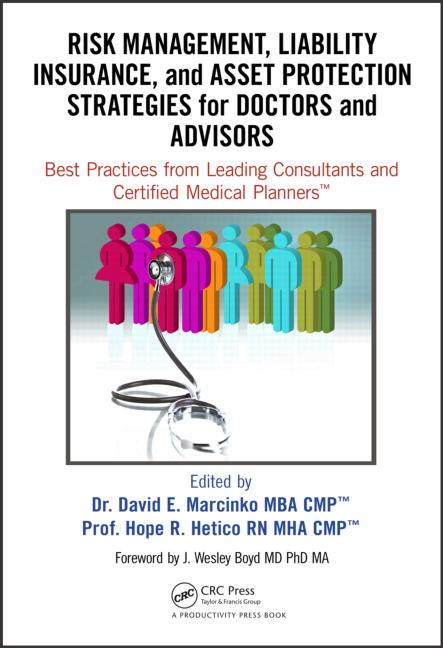
Risk Management, Liability Insurance, and Asset Protection Strategies for Doctors and Advisors [Best Practices from Leading Consultants and Certified Medical Planners]

***

 Our New Text – “Take a Peek Inside 

Available – ORDER NOW!

***

Risk Management, Liability Insurance, and Asset Protection Strategies for Doctors and Advisors: Best Practices from Leading Consultants and Certified Medical Planners™8Risk Management, Liability Insurance, and Asset Protection Strategies for Doctors and Advisors: Best Practices from Leading Consultants and Certified Medical Planners™

***

Foreword by J. WESLEY BOYD MD PhD MA

logos

“BY DOCTORS – FOR DOCTORS – PEER REVIEWED – FIDUCIARY FOCUSED”

***

Book Reviews

“Physicians who don’t understand modern risk management, insurance, business and asset protection principles are sitting ducks waiting to be taken advantage of by unscrupulous insurance agents and financial advisors; and even their own prospective employers or partners. This comprehensive volume from Dr. David Marcinko, and his co-authors, will go a long way toward educating physicians on these critical subjects that were never taught in medical school or residency training.”
—Dr. James M. Dahle, MD, FACEP, Editor of The White Coat Investor, Salt Lake City, Utah, USA

“With time at a premium, and so much vital information packed into one well organized resource, this comprehensive textbook should be on the desk of everyone serving in the healthcare ecosystem. The time you spend reading this frank and compelling book will be richly rewarded.”
—Dr. J. Wesley Boyd, MD, PhD, MA, Harvard Medical School, Boston, Massachusetts, USA

“Physicians have more complex liability challenges to overcome in their lifetime, and less time to do it, than other professionals. Combined with a focus on practicing their discipline, many sadly fail to plan for their own future. They need trustworthy advice on how to effectively protect themselves, families and practice, from the many overt and covert risks that could potentially disrupt years of hard work.
Fortunately, this advice is contained within ‘Risk Management, Liability Insurance, And Asset Protection Strategies For Doctors And Advisors: Best Practices From Leading Consultants And Certified Medical Planners™’. Written by Dr. David Edward Marcinko, Nurse Hope Rachel Hetico and their team of risk managers, accountants, insurance agents, attorneys and physicians, it is uniquely positioned as an integration of applied, academic and peer-reviewed strategies and research, with case studies, from top consultants and Certified Medical Planners™. It contains the latest principles of risk management and asset protection strategies for the specific challenges of modern physicians. My belief is that any doctor who reads and applies even just a portion of this collective wisdom will be fiscally rewarded. The Institute of Medical Business Advisors has produced another outstanding reference for physicians that provide peace of mind in this unique marketplace! In my opinion, it is a mandatory read for all medical professionals.”
—David K. Luke, MS-PFP, MIM, CMP™, Net Worth Advisory Group, Inc., Sandy, Utah, USA

“This book is a well-constructed, comprehensive and experiential view of risk management throughout the entire medical practice life-cycle. It is organized in an accessible, high-yield style that is familiar to doctors. Each chapter has case models, examples and insider tips and useful pearls. I was pleased to see multi-degreed physicians sharing their professional experiences in a textbook on something other than clinical medicine. I can’t decide if this book is right on – over the top – or just plain prescient. Now, after a re-read, I conclude it is all of the above; and much more.”
—Dr. Peter P. Sidoriak, Pottsville, Pennsylvania, USA

“When a practicing physician thinks about their risk exposure resulting from providing patient care, medical malpractice risk immediately comes to mind. But; malpractice and liability risk is barely the tip of the iceberg, and likely not even the biggest risk in the daily practice of medicine. There are risks from having medical records to keep private, risks related to proper billing and collections, risks from patients tripping on your office steps, risks from medical board actions, risk arising from divorce, and the list goes on and on. These liabilities put a doctor’s hard earned assets and career in a very vulnerable position. This new book from Dr. David Marcinko and Prof. Hope Hetico shows doctors the multiple types of risk they face and provides examples of steps to take to minimize them. It is written clearly and to the point, and is a valuable reference for any well-managed practice. Every doctor who wants to take preventive action against the risks coming at them from all sides needs to read this book.”
—Richard Berning, MD, FACC, New Haven, Connecticut, USA

“This is an excellent companion book to Dr. Marcinko’s Comprehensive Financial Planning Strategies For Doctors And Advisors: Best Practices from Leading Consultants and Certified Medical Planners™. It is all inclusive yet easy to read with current citations, references and much frightening information. I highly recommend this text. It is a fine educational and risk management tool for all doctors and medical professionals.”
—Dr. David B. Lumsden, MD, MS, MA, Orthopedic Surgeon, Baltimore, Maryland, USA

“This comprehensive text book provides an in-depth presentation of the cyber security and real risk management, asset protection and insurance issues facing all medical profession today. It is far beyond the mere medical malpractice concerns I faced when originally entering practice decades ago.”
—Dr. Barbara s. Schlefman, DPM, MS, Family Foot Care, PA, Tucker, Georgia, USA

“Am I over-insured and thus wasting money? Am I under-insured and thus at risk for a liability or other disaster? I never really had the means of answering these questions; until now.”
—Dr. Lloyd M. Krieger, MD, MBA, Rodeo Drive Plastic Surgery, Beverly Hills, California, USA

“I read and use this book, and several others, from Dr. David Edward Marcinko and his team of advisors.”
—Dr. John Kelley, DO, Orthopedic Surgeon, Tucker, Georgia, USA

“An important step in the risk management, insurance planning and asset protection process is the assessment of needs. One can create a strong foundation for success only after all needs have been analyzed so that a plan can be constructed and then implemented. This book does an excellent job of recognizing those needs and addressing strategies to reduce them.
—Shikha Mittra, MBA, CFP®, CRPS®, CMFC®, AIF®, President – Retire Smart Consulting LLC, Princeton, New Jersey, USA

“The Certified Medical Planner™ professional designation and education program was created by the Institute of Medical Business Advisors Inc., and Dr. David Edward Marcinko and his team (who wrote this book). It is intended for financial advisors who aim specifically to serve physicians and the medical community. Content focuses not only on the insurance and professional liability issues relevant to physicians, but also provides an understanding of the risky business of medical practice so advisors can help work more successfully with their doctor-clients.”
—Michael E. Kitces, MSFS, MTAX, CFP®, CLU, ChFC, RHU, REBC, CASL, http://www.Kitecs.com, Reston, Virginia, USA

“I have read this text and used consulting services from the Institute of Medical Business of Advisors, Inc. on several occasions.”
—Dr. Marsha Lee, DO, Radiologists, Norcross, Georgia, USA

“The medical education system is grueling and designed to produce excellence in medical knowledge and patient care. What it doesn’t prepare us for is the slings and arrows that come our way once we actually start practicing medicine. Successfully avoiding these land mines can make all the difference in the world when it comes to having a fulfilling practice. Given the importance of risk management and mitigation, you would think these subjects would be front and center in both medical school and residency – ‘they aren’t.’ Thankfully, the brain trust over at iMBA Inc., has compiled this comprehensive guide designed to help you navigate these mine fields so that you can focus on what really matters – patient care.”
—Dennis Bethel, MD, Emergency Medicine Physician

MORE: FRONT MATTER Risk Management
***

business-valuation1

***

Invite Dr. Marcinko

***