







 Support our online development, and advance our onground research initiatives in free market economics, as we seek to showcase the brightest Next-Gen minds.
THE ME-P DISCLAIMER: Posts, comments and opinions do not necessarily represent iMBA, Inc., but become our property after submission. Copyright © 2006 to-date. iMBA, Inc allows colleges, universities, medical and financial professionals and related clinics, hospitals and non-profit healthcare organizations to distribute our proprietary essays, photos, videos, audios and other documents; etc. However, please review copyright and usage information for each individual asset before submission to us, and/or placement on your publication or web site. Attestation references, citations and/or back-links are required. All other assets are property of the individual copyright holder.
Support our online development, and advance our onground research initiatives in free market economics, as we seek to showcase the brightest Next-Gen minds.
THE ME-P DISCLAIMER: Posts, comments and opinions do not necessarily represent iMBA, Inc., but become our property after submission. Copyright © 2006 to-date. iMBA, Inc allows colleges, universities, medical and financial professionals and related clinics, hospitals and non-profit healthcare organizations to distribute our proprietary essays, photos, videos, audios and other documents; etc. However, please review copyright and usage information for each individual asset before submission to us, and/or placement on your publication or web site. Attestation references, citations and/or back-links are required. All other assets are property of the individual copyright holder.


EMRs – Providers Need to Prepare for Virulent Ransomware in 2018
[By staff reporters]
Ransomware emerged as a significant threat on the worldwide stage in 2017, but new variants will challenge healthcare providers well into 2018, with some versions of new malware not even needing a network to distribute themselves throughout an organization. Previous variants of ransomware, particularly the WannaCry attack in May, showed the ability to self-propagate and spread across a network and onto other networks via the Internet.
Educating a healthcare’s organization workforce on cyberattacks is necessary, but it’s not enough to bring them up to speed on phishing and other threats. Practices need to harden their own email systems; for example, Matt Sherman, a malware outbreak specialist at Symantec, advises using secure email systems as a best practice along with two-factor authentication software. Email systems should scan links contained in incoming messages, and they should enable automatic image loading in messages.
Source: Joseph Goedert, adapted from Health Data Management [12/28/17]
***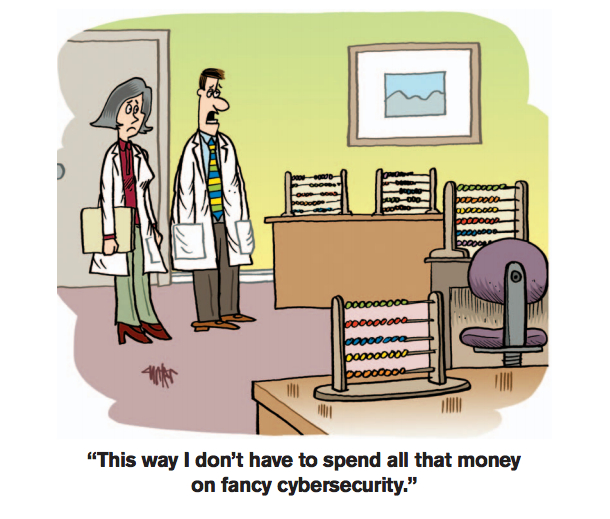 Courtesy: FunnyBones
Conclusion
Your thoughts and comments on this ME-P are appreciated. Feel free to review our top-left column, and top-right sidebar materials, links, URLs and related websites, too. Then, subscribe to the ME-P. It is fast, free and secure.
Speaker: If you need a moderator or speaker for an upcoming event, Dr. David E. Marcinko; MBA – Publisher-in-Chief of the Medical Executive-Post – is available for seminar or speaking engagements.
Book Marcinko: https://medicalexecutivepost.com/dr-david-marcinkos-bookings/
Subscribe: MEDICAL EXECUTIVE POST for curated news, essays, opinions and analysis from the public health, economics, finance, marketing, IT, business and policy management ecosystem.
***
Share this:

Filed under: Information Technology, Jokes and Puns | Tagged: EHRs, EMRs, MEDICAL CYBER SECURITY RISKS |
 The Leading Business Education Network for Doctors, Financial Advisors and Health Industry Consultants
So True,
We need more of this “comic relief.”
Thanks.
Carla
LikeLike
Allscripts Hit by Ransomware, Knocking Some Services Offline
A limited number of Allscripts services went down Thursday after a ransomware incident, according to an emailed statement from company spokeswoman Concetta Rasiarmos. The EHR giant is investigating the incident to provide further details.
“We are working diligently to restore these systems, and most importantly, to ensure our clients’ data is protected,” wrote Rasiarmos. “We regret any inconvenience caused by this temporary outage.” Users took to Twitter to express frustration with the outage. One specifically referred to downed cloud services, being unable to access patient data all day. Allscripts directed users to its support team for more information.
Source: Jessica Davis, HealthcareIT News [1/19/18]
LikeLike
Why EHR data interoperability is such a mess in 3 charts
Hospitals have a complex web of electronic health record vendors but once data sharing broadens it will open the door to innovation.
https://www.healthcareitnews.com/news/why-ehr-data-interoperability-such-mess-3-charts?mkt_tok=eyJpIjoiTnpobVpUSmpZak0yWVdGbSIsInQiOiJPOU5NQVlMdDhkWXJTSU9rNjJGTHFzZlFZNlo3RXdiWUtUSHhETWtBR1VVMVQzVlhUVnJ5QVJtRkU2eXRHWGtZb0o4RlwvQ1wvSURQQ3hVTGVQVlM3YlU3cHFRandXbDUxMElCMXRFWTlyeFVNbU81Q0RxS2dFdGoyWG5OT0xhTEpIIn0%3D
Dr. David E. Marcinko MBA
LikeLike
DATA “SHARING”?
Roche/Flatiron owns the rights of first refusal on the personal health information of millions of cancer patients medical charts and records.
Pfizer owns the rights of first refusal on the personal health information in millions of Oschner Clinic patient charts
Now Google owns the rights of first refusal on the content of millions of patients medical records cared for at Mass General Hospital.
Question; would Roche, Pfizer or Google publish any negative data if it didn’t support their business plan, pipeline or aided a competitor?
Norman
LikeLike