







 Support our online development, and advance our onground research initiatives in free market economics, as we seek to showcase the brightest Next-Gen minds.
THE ME-P DISCLAIMER: Posts, comments and opinions do not necessarily represent iMBA, Inc., but become our property after submission. Copyright © 2006 to-date. iMBA, Inc allows colleges, universities, medical and financial professionals and related clinics, hospitals and non-profit healthcare organizations to distribute our proprietary essays, photos, videos, audios and other documents; etc. However, please review copyright and usage information for each individual asset before submission to us, and/or placement on your publication or web site. Attestation references, citations and/or back-links are required. All other assets are property of the individual copyright holder.
Support our online development, and advance our onground research initiatives in free market economics, as we seek to showcase the brightest Next-Gen minds.
THE ME-P DISCLAIMER: Posts, comments and opinions do not necessarily represent iMBA, Inc., but become our property after submission. Copyright © 2006 to-date. iMBA, Inc allows colleges, universities, medical and financial professionals and related clinics, hospitals and non-profit healthcare organizations to distribute our proprietary essays, photos, videos, audios and other documents; etc. However, please review copyright and usage information for each individual asset before submission to us, and/or placement on your publication or web site. Attestation references, citations and/or back-links are required. All other assets are property of the individual copyright holder.


We don’t plan to fail – We fail to plan
[By Dr. David Edward Marcinko MBA CMP™]
http://www.CertifiedMedicalPlanner.org

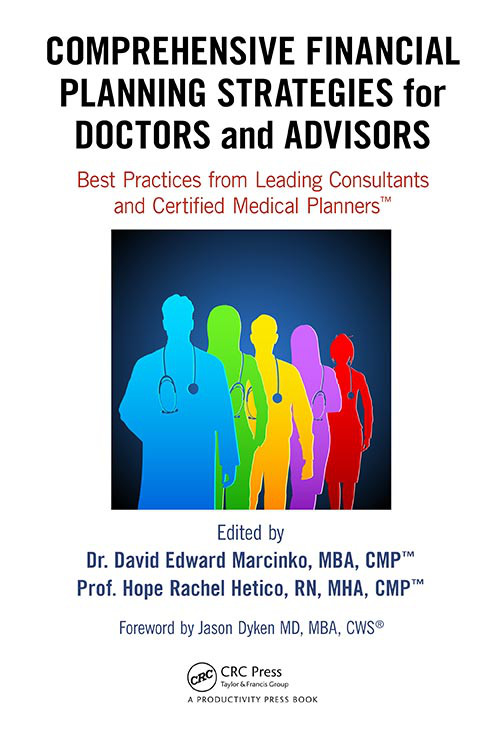
Our newest textbook COMPREHENSIVE FINANCIAL PLANNING STRATEGIES FOR DOCTORS AND ADVISORS [Best Practices from Leading Consultants and Certified Medical Planners™] will shape the physician-focused financial planning landscape for the next-generation of Health 2.0 medical professionals and their financial advisors.
Why Now?
We created this innovative textbook because the healthcare industry is rapidly changing and the financial planning ecosystem has not kept pace. Traditional insurance-commission and sales-driven generic advice is yielding to a new breed of deeply informed fiduciary advisor, and educated consultant, or Certified Medical Planner (CMP™). Internet and social media of the last decade demonstrates that medical providers are becoming accustomed to the need for knowledgeable advice. And so, financial planning is set to be transformed by “market disruptors” that will soon make an impact on the $2.8 trillion healthcare marketplace for those financial advisers serving this sector.
We are at the leading edge of this positive disruption — also known as niche based Financial Planning 2.0 — that over time will see today’s command-controlled financial services industry becomes a wide open academic marketplace. And, a growing cadre of specialty entrants is poised to shake up the industry drawing billions of dollars in revenue from traditional broker-dealer organizations while building lucrative new markets.
For example, an iMBA Inc survey points to the growing need for financial advisors to serve current and future medical professionals thanks to their eagerness to seek premium financial planning solutions from non-traditional sources and providers; like the online Certified Medical Planner™ charter designation program. The industry is ripe for a shakeup and physician focused financial planning will soon have its own new brands. We aim to be among the first-movers and top tier names in the industry.

How We Are Different?
COMPREHENSIVE FINANCIAL PLANNING STRATEGIES FOR DOCTORS AND ADVISORS [Best Practices from Leading Consultants and Certified Medical Planners™] will change this niche industry sector by following eight important principles.
1. First, we have assembled a world-class editorial advisory board and independent team of contributors and reviewers and asked them to draw on their experiences in contemporaneous healthcare focused financial planning. Like many of their physician and nurse clients, each struggles mightily with the decreasing revenues, increasing costs, automation, SEC scrutiny and higher physician-client expectations in today’s competitive financial advisory and technological landscape. Yet, their practical experience and physician focused education, knowledge and vision is a source of objective information, informed opinion and crucial information to all consultants working with doctors and medical professionals in the financial services field.
2. Second, our writing style allows us to condense a great deal of information into one volume. We integrate bullet points and tables; pithy language, prose and specialty perspectives with real world examples and case models. The result is an oeuvre of integrated financial planning principles vital to all modern physicians and allied healthcare professionals.
3. Third, to the best of our knowledge, this is the first peer-reviewed book of its type, as we seek to follow traditional medical research and journal publishing guidelines for best practices. We present differing viewpoints, divergent and opposing stake-holder perspectives, and informed personal and professional opinions. Each chapter has been reviewed by one to three outside independent reviewers and critical thinkers. We include references and citations, and although we cannot rule out all biases, we do strive to make them transparent to the extent possible.
4. Fourth, our perspective is decidedly from the physician-client side of the equation. More specifically, as consultants to medical professionals, we champion the physician-investor over the financial advisor. And, to the extent that both sides ethically succeed; we hope all concerned “do well – by doing good”. This is unique in the fee and commission driven financial services industry. Much like the emerging patient-centered care initiative in medicine, we call it client-centered advice.
5. Fifth, it is important to note that deep specificity and niche knowledge is needed when advising physicians and healthcare providers. And so, we present information directly from that space, and not by indirect example from other industries, as is the unfortunate norm. Medical case models, healthcare industry examples, and anecdotal insights from the Over Heard in the Doctor’s Lounge, and Over Heard in the Advisor’s Lounge features, are also included. Finally, personalized financial planning for all medical professionals is our core, and only focus.
6. Sixth, this textbook represents an academic template for about 25 percent [125/500 credit hours] of the Certified Medical Planner™ chartered professional online certification program curriculum. It is useful for those studying, auditing, or considering matriculation for this prestigious designation mark.
7. Seventh, we include a glossary-of-terms specific to the text, a list of comprehensive advice sources, and three illustrative physician-specific financial plan examples additionally available by separate order.
8. Finally, as editor, we prefer engaged readers who demand compelling content. According to conventional wisdom, printed texts like this one should be a relic of the past; from an era before instant messaging and high-speed connectivity. Our experience shows just the opposite. Applied physician focused personal financial planning literature, from informed fiduciary sources, is woefully sparse; just as a plethora of generalized internet information makes that material less valuable to doctor clients.
***
***
A Seminal Work
And so, rest assured that COMPREHENSIVE FINANCIAL PLANNING STRATEGIES FOR DOCTORS AND ADVISORS [Best Practices from Leading Consultants and Certified Medical Planners™] will become a seminal book for the advancement of personal financial planning and related personal micro-economic principles in this niche ecosystem.
In the years ahead, we trust these principles will enhance utility and add value to your book. Most importantly, we hope to increase your return on investment by some small increment.
If you have any comments or would like to contribute material or suggest topics for future editions please contact me.
More:
- Comprehensive Financial Planning Strategies for Doctors and Advisors: Best Practices from Leading Consultants
- Medical Practice Worth
- Enter the CMPs
- More on Doctors and Personal Net Worth
- MD Salary versus Net-Worth Conundrum [.ppt slide-show presentation]
Conclusion
Your thoughts and comments on this ME-P are appreciated. Feel free to review our top-left column, and top-right sidebar materials, links, URLs and related websites, too. Then, subscribe to the ME-P. It is fast, free and secure.
Speaker: If you need a moderator or speaker for an upcoming event, Dr. David E. Marcinko; MBA – Publisher-in-Chief of the Medical Executive-Post – is available for seminar or speaking engagements. Contact: MarcinkoAdvisors@msn.com
OUR OTHER PRINT BOOKS AND RELATED INFORMATION SOURCES:
- DICTIONARIES: http://www.springerpub.com/Search/marcinko
- PHYSICIANS: www.MedicalBusinessAdvisors.com
- PRACTICES: www.BusinessofMedicalPractice.com
- HOSPITALS: http://www.crcpress.com/product/isbn/9781466558731
- CLINICS: http://www.crcpress.com/product/isbn/9781439879900
- ADVISORS: www.CertifiedMedicalPlanner.org
- BLOG: www.MedicalExecutivePost.com
- FINANCE: Financial Planning for Physicians and Advisors
- INSURANCE: Risk Management and Insurance Strategies for Physicians and Advisors
Share this:

Filed under: Book Reviews, CMP Program, Financial Planning, iMBA, Inc., Touring with Marcinko | Tagged: certified medical planner, CMP™ Course, david marcinko, Financial Planning |
 The Leading Business Education Network for Doctors, Financial Advisors and Health Industry Consultants
How to invest when the world is in chaos
As geopolitical tensions threaten to spin out of control, investors are wondering how best to position their portfolios for the global turmoil.
http://money.msn.com/top-stocks/post–how-to-invest-when-the-world-is-in-chaos
Norman
LikeLike
WHO KNOWS WHAT THE STOCK MARKET IS DOING?
Dr. Marcinko and ME-P Readers,
There are two questions I’d like you to consider.
First, would you say you have thought about your investment portfolio more, less, or the same amount as usual during the last five months?
Second, do you know how much the stock market has either increased or decreased in value over the last five months?
Of course, there will always be certain investors who take pride in following the market meticulously or simply just enjoy doing so. But I’d contend that a high percentage of investors have thought less about their portfolio during the last five months than they normally would. Further, I’d argue that more investors than usual are unaware of whether the market has gone up or down during the last five months and by how much.
Why is this? Have our work or retirement schedules kept us busier than normal over the last five months? Not likely. We’ve certainly been concerned about ISIS, hurricanes, what Scotland would do, and wars in Israel, Iraq and Ukraine, but is it the additional anxiety from those events that has prevented us from following the stock market? Probably not. So why are fewer of us than normal aware of what the market has done lately?
A common adage is that negative events happening over a short period of time capture the headlines, while progress happening over an extended period of time commonly goes unnoticed. How many headline-worthy days of large market movements have occurred during the last five months?
Amazingly, between April 17 and Sept. 23 (110 trading days), the S&P 500 has either increased or decreased in value by more than 1% during only four trading days:
Date S&P 500 Return
7/17/14 +1.19%
7/18/14 -1.03%
7/31/14 -2.02%
8/08/14 +1.11%
That’s a period of more than five months during which the market experienced a significant movement (defined as 1% or more either up or down) only four times, or only 3.6% of the time! A period of such low volatility is especially rare in today’s market environment. By comparison, since 1950, the S&P 500 has moved more than 1% by the end of 20% of all trading days. Moreover, all four significant movements during the last five months occurred within an approximately three-week time frame, between July 17 and Aug. 8. If we exclude that three-week period, we would have four and a half months during which the market had no trading days resulting in significant movements.
It’s interesting to recognize that although the market hasn’t experienced many significant daily movements over the last five months, it has changed in value considerably over the time period as a whole. In fact, from April 17 through Sept. 22, the S&P 500 has actually increased in value by 7.28%. Simply, a low volatility environment where the market consistently obtains small daily positive returns has been quite advantageous for investors, despite having few days of large gains.
So what investing lessons can be taken from this pleasant five-month period? First, I’d encourage investors to not get too comfortable. Remember that the last five months have been a period of unusual stability in the investment markets and such low levels of volatility cannot continue in perpetuity.
Of course, this is not necessarily a bad thing—we expect a level of risk when investing in stocks, and it is ultimately the presence of risk that enables appealing returns in the long run. Consequently, the return of volatility should not frighten investors and certainly should not be interpreted as a signal to alter your long-term investment strategy.
Finally, allow me to pose one last question: Regarding financial and investing matters, have you been more, less, or equally happy compared to the norm during the last five months?
Studies indicate that if you have been thinking less about your portfolio, you have likely enjoyed reduced levels of stress and increased levels of happiness. Why not learn from this experience and attempt to think less about your investment portfolio when a normal amount of volatility returns to the market?
Remember that your portfolio was constructed with a focus on the long-term and that short-term volatility is ultimately inconsequential. Consequently, regardless of day-to-day market movements, you should worry less about your portfolio and focus on the things that make you happy.
Lon Jefferies MBA CFP®
http://www.NetWorthAdvice.com
LikeLike